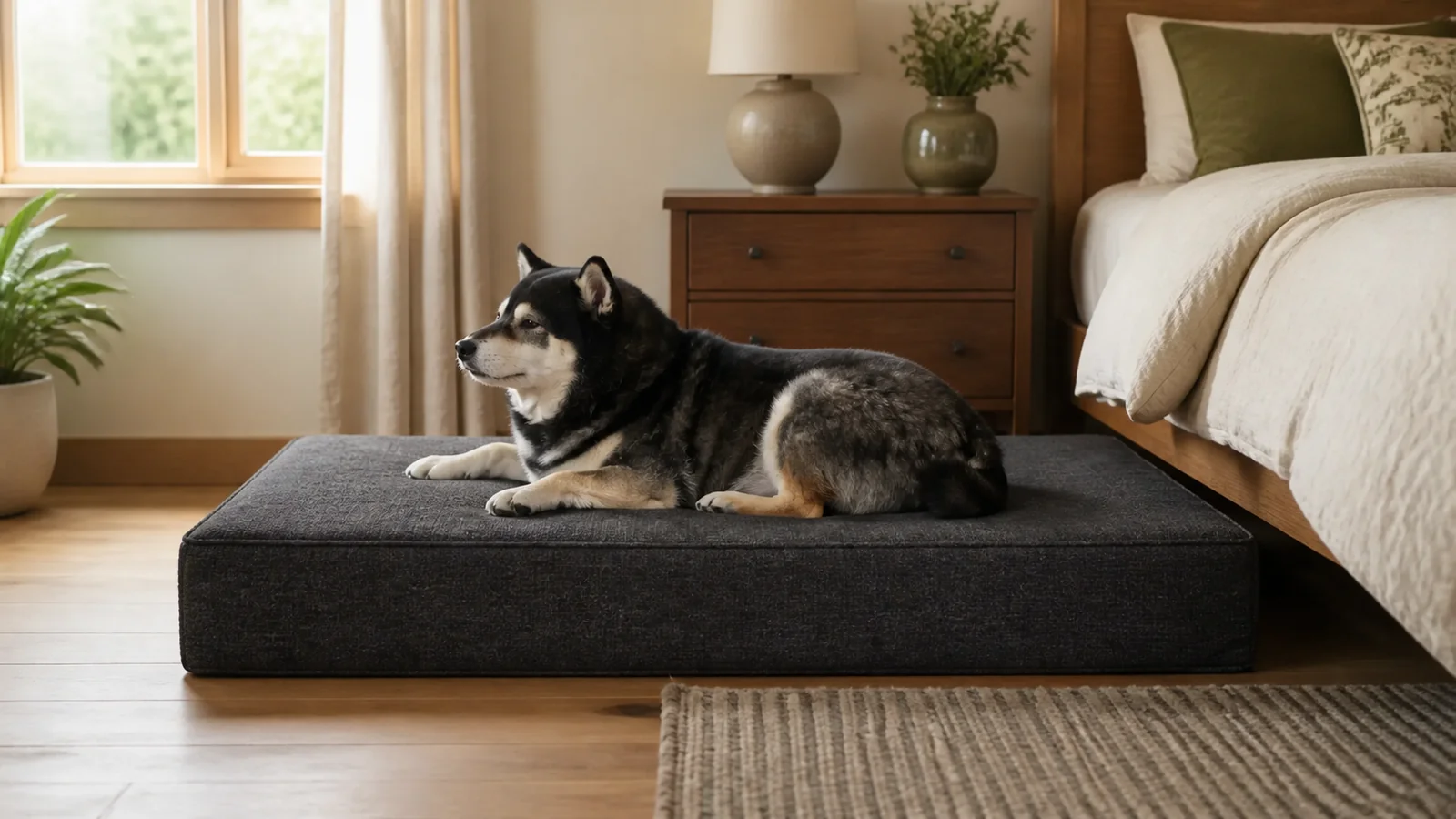
Large dogs need more than a bed that technically matches a weight range. Surface area, foam compression, entry height, cover strength, and room placement all matter because a bed that works for a small dog may flatten, shift, or feel cramped under a heavier body.
Start with the Dog Beds pillar for the full buying framework. Use this guide when your main question is how to choose a bed that gives a large dog enough support and usable space without becoming impossible to clean. After choosing a washable-cover bed, use the Dog Bed Cleaning Schedule to plan cover washes, liner checks, and drying notes. If the bed will take up a lot of floor space, use the Dog Bed Placement Guide before buying.
Quick read
TL;DR
- Best starting point: a wide flat orthopedic foam bed with a removable washable cover.
- Measure the sleep position, not just your dog's weight or breed.
- Foam should not collapse flat under the dog's body during normal rest.
- Low entry matters for senior, stiff, or short-legged large dogs.
- Bolsters can help leaners, but they reduce usable sleep area.
- Cleaning is critical because large covers, foam, and liners are harder to manage.
- Product claims need checking against current dimensions, foam details, warranty language, and return policy.
Quick answer
For many large dogs, choose a rectangular orthopedic foam bed that is long and wide enough for their normal resting position. A flat bed gives sprawlers the most usable surface area and is easier to size than a deep bolster bed.
Choose a bolster only when your dog clearly likes leaning or curling. Choose a washable-cover bed when shedding, outdoor dirt, drool, or odor are routine. If your dog has limping, stiffness, sudden mobility changes, or trouble getting up, ask a vet before treating a bed as the solution.
Share & embed
Large dog sprawls
Flat orthopedic foam bed
- Look for
Wide sleep area, stable support, removable cover
- Avoid
Small bolsters and thin pillow beds
Large dog curls or leans
Orthopedic bolster bed
- Look for
Supportive base, raised edge, low front entry
- Avoid
Tiny inner sleep area
Messy large dog
Washable-cover bed with liner
- Look for
Removable cover, protected foam, sturdy zipper
- Avoid
Unprotected foam and vague washable claims
Senior large dog
Low-entry supportive bed
- Look for
Easy step-on height, flat surface, room to shift
- Avoid
Tall sides and slippery covers
Large-dog support checklist
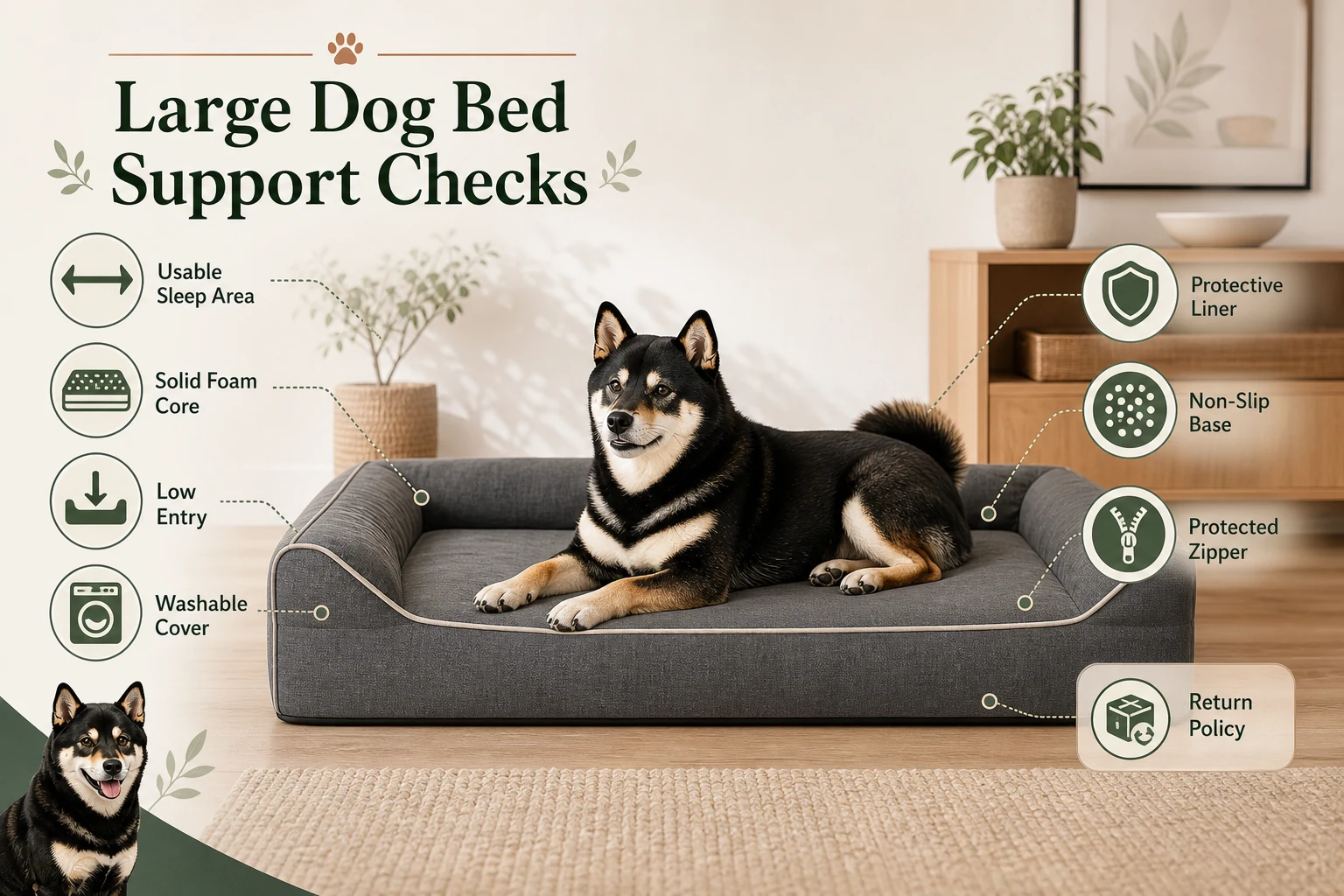
For large breeds and heavier dogs, support starts with the whole structure of the bed, not a single word in the listing. Compare the usable sleep surface, foam core, cover system, entry height, bottom grip, and return policy together.
Share & embed
Look for these listing details:
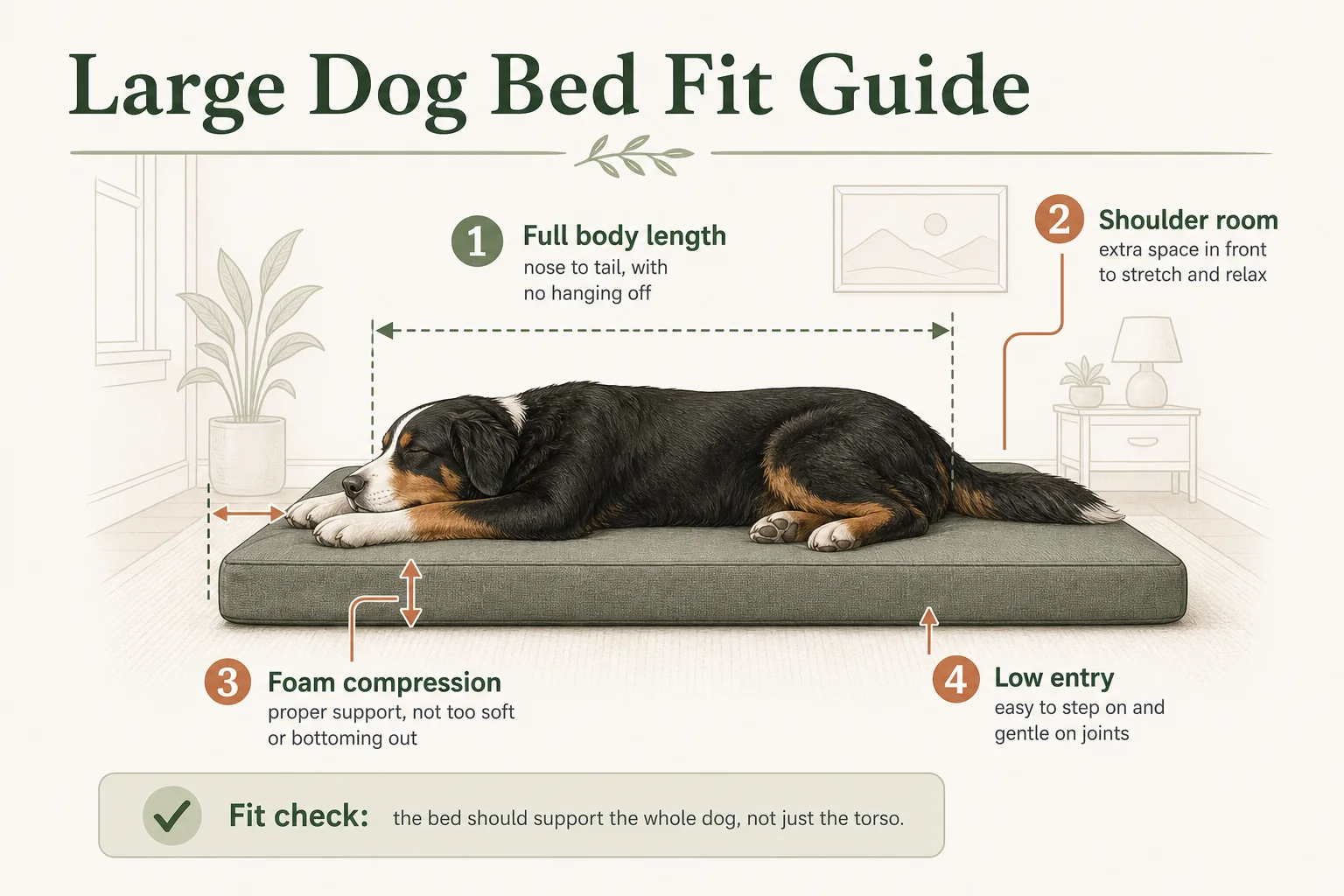
- Usable sleep area: the flat part your dog can actually lie on, not the outside footprint.
- Solid foam core: a slab or layered foam system usually gives a clearer support signal than loose stuffing.
- Foam thickness and compression feedback: owner reviews about sagging, flattening, or bottoming out matter more than plush photos.
- Low entry: important for older, stiff, short-legged, or tired large dogs.
- Removable washable cover: the cover should come off without wrestling the whole bed.
- Protective liner: helpful when drool, damp paws, senior accidents, or odor are realistic issues.
- Protected zipper and seams: recessed zippers, zipper garages, and simple rectangular shapes can reduce snag points.
- Non-slip base: useful on wood, tile, laminate, and smooth floors.
- Return policy: large beds are expensive to ship and awkward to store if the fit is wrong.
What large dogs need from a bed
Large dogs put more pressure on foam and seams. A thin cushion can look comfortable in photos but compress quickly once a heavy dog rests on it. The bed should keep the dog off the hard floor, give them room to change positions, and hold its shape after regular use.
Support and size work together. A supportive bed that is too small will still be uncomfortable. A large bed with weak fill may look roomy but provide little support. Use Orthopedic vs Memory Foam Dog Bed before treating memory foam as a complete support answer, and use the Dog Bed Materials Guide before choosing between foam, loose fill, liners, plush tops, and woven covers.
Support and foam compression
Orthopedic foam is a useful category to compare, but the label is not a guarantee. Look for foam depth, a flat sleep surface, and owner feedback about long-term compression. Memory foam can be comfortable, but it may retain heat. Egg-crate foam can improve airflow, but thin layers may not be enough for heavier dogs.
Simple pressure check after delivery
This is not a clinical test, but it is a useful owner check before the return window closes. Press your hand or forearm into the main sleep area, then check whether you can easily feel the floor or hard surface beneath the foam. If the bed collapses quickly under light pressure, a large dog may compress it further during normal rest.
After your dog uses the bed for a few days, look for a permanent body dip, shifting fill, sagging edges, or fabric pulling at the seams. Recheck the fit after washing the cover, because some large covers become harder to reinstall or change shape after drying.
Match the bed to the dog profile
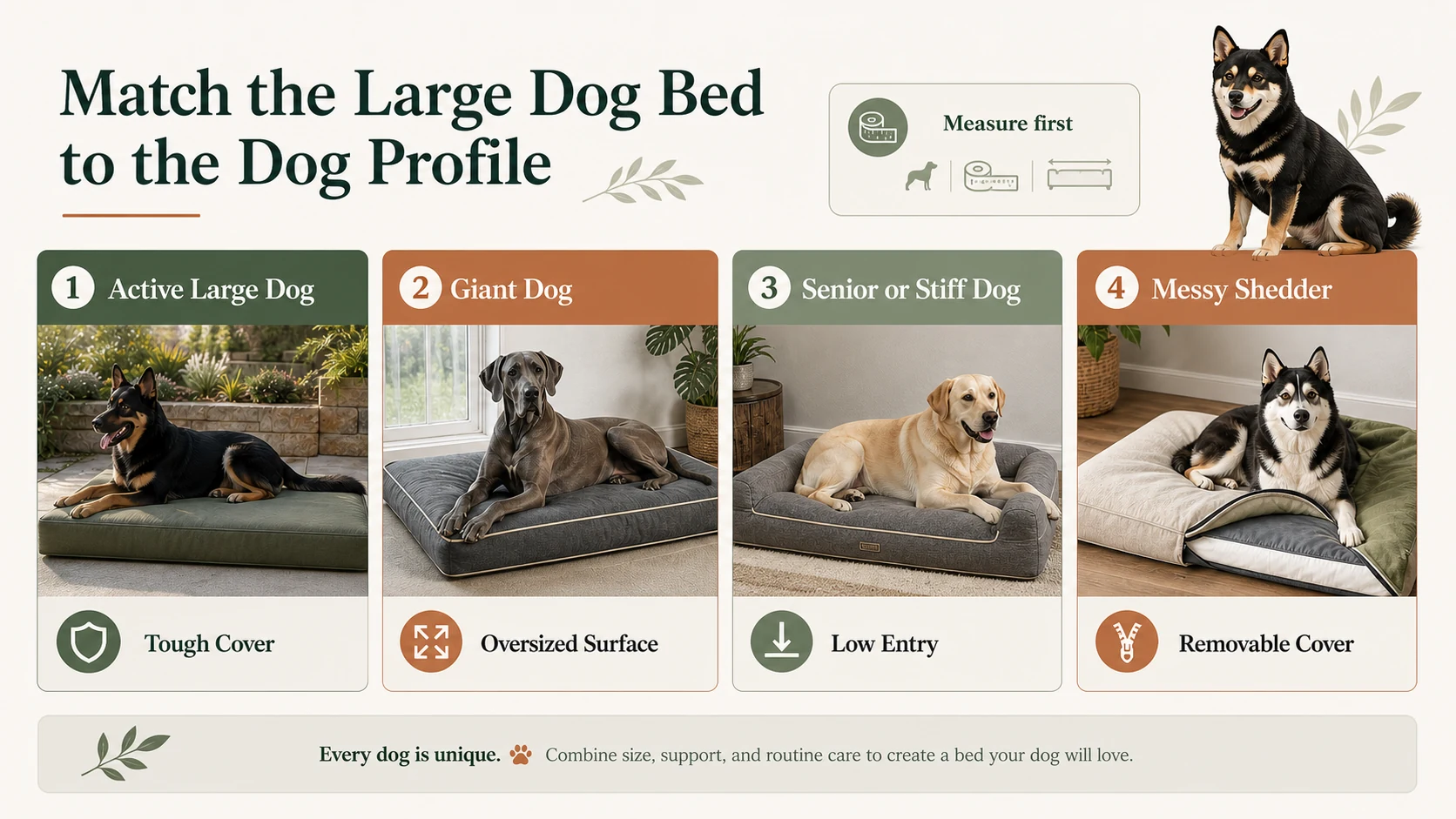
Large dogs are not one buying group. A young active Lab, a giant breed, a senior dog, and a messy shedder can all need different tradeoffs.
Share & embed
| Option | Best for | Key features | Caveat | Merchant |
|---|---|---|---|---|
Active large dog | Dogs that stretch, roll, and come in from outdoor routines | Wide flat surface, tougher cover, easy cleaning | Avoid tiny bolsters and delicate plush covers | See direct product examples below |
Giant dog | Great Danes, Mastiffs, and very long dogs | Oversized rectangle, strong foam, clear edge space | Breed labels can still be too small | See direct product examples below |
Senior or stiff dog | Older dogs or dogs that prefer easy step-on access | Low entry, stable surface, non-slip base | Tall nest beds may be harder to use | See direct product examples below |
Messy shedder | Dogs that drool, shed, track mud, or have occasional accidents | Removable cover, liner, sturdy zipper | Unprotected foam can hold odor | See direct product examples below |
Size, entry height, and room fit
Measure your dog lying down in their normal sleep position. Add room for movement and choose the usable sleep area, not just the outside dimensions. For bolsters, the raised sides can take away several inches of interior space.
Entry height matters for large dogs that are older, stiff, or tired after exercise. A very thick bed can be supportive, but it should still be easy to step onto. Low-entry shapes are often better than deep nest-style beds.
Cleaning and durability
Large dog beds are harder to wash because covers are bigger and foam cores are heavier. A removable cover is the minimum practical feature for many homes. A liner helps protect foam from drool, accidents, and damp paws.
Check zipper placement and cover reviews. A large cover that is hard to remove will not get washed as often as it should.
Materials, certifications, and brand signals
For large dog beds, material details can help you avoid vague product pages. Use Dog Bed Materials Guide when you want a deeper breakdown of foam, fill, liners, cover fabrics, and hair release.
CertiPUR-US and OEKO-TEX can be useful signals when a current listing clearly says which part of the bed is covered by the standard. Treat them as comparison signals, not proof that a bed will fit your dog or hold up under large-dog use.
Brand reputation can also help, but it should not replace measurement. Large-dog specialist brands, structured sofa-style beds, and tougher-cover beds can all be worth comparing if the current listing gives clear dimensions, foam details, cover information, and return terms.
Direct product CTAs
These are direct Amazon product CTAs for premium comparison. They are not fixed universal winners. Check the current Amazon listing, size chart, foam details, cover system, warranty language, and return policy before buying.
Category searches if the direct picks do not fit
Use category searches when a direct pick is the wrong size, wrong shape, unavailable, or too expensive.
| Option | Best for | Key features | Caveat | Merchant |
|---|---|---|---|---|
Flat orthopedic bed | Large sprawlers and seniors | Wide surface, stable support, easy entry | Can be heavy and warm | See direct product examples below |
Bolster orthopedic bed | Large dogs that lean or curl | Raised edge plus support base | Interior area may be smaller | See direct product examples below |
Washable-cover large bed | Shedding, drool, muddy paws | Removable cover, easier odor control | Zipper quality matters | See direct product examples below |
Low-profile foam bed | Senior or stiff large dogs | Easy step-on height, flat surface | Less nest-like than bolsters | See direct product examples below |
What Dogs Like may earn from qualifying purchases. Affiliate links do not change the checks in this guide.
Common mistakes
✓ Better buying habits
- Measure your dog's real sleep position.
- Check usable sleep area on large and bolster beds.
- Prioritize stable foam over fluffy height.
- Choose removable covers and foam protection.
- Compare owner feedback for sagging and compression.
- Inspect the bed again before the return window closes.
× Mistakes to avoid
- Buying only by breed or weight range.
- Choosing a bed that looks large but has a small inner area.
- Ignoring entry height for senior large dogs.
- Assuming every orthopedic label means strong support.
- Forgetting that large covers need drying space.
- Treating a dog bed as a medical or behavior fix.
Related guides
For support details, read Best Orthopedic Dog Beds for Support and Orthopedic vs Memory Foam Dog Bed. For material choices, use the Dog Bed Materials Guide. For measuring, use the Dog Bed Size Guide or the Dog Bed Size Calculator. For room flow and large-bed placement, use the Dog Bed Placement Guide. For cleanup, read Washable Dog Beds for Easier Cleanup and print the Dog Bed Cleaning Schedule. If your large dog also rests in a crate, compare low-profile bedding in the Dog Crate Mats Guide. Return to the Dog Beds pillar for the full framework.
Frequently asked questions
What type of bed is best for large dogs?
A flat orthopedic foam bed is a strong starting point because it gives large dogs support and room to change positions.
How big should a large dog bed be?
Measure your dog lying down and add room for movement. Use the bed's usable sleep area, not only outside dimensions.
Are bolsters good for large dogs?
They can be good for dogs that curl or lean, but they reduce usable surface area. Check inner dimensions carefully.
Do large dogs need orthopedic beds?
Not always, but orthopedic foam is worth considering for heavy dogs, seniors, and dogs that rest for long periods.
How do I know if a large dog bed has enough support?
Check the foam thickness, usable sleep area, owner feedback about sagging, and whether the bed keeps its shape after normal use. If it flattens quickly or your dog avoids it, compare a stronger foam structure.
Are premium large dog beds worth it?
They can be worth comparing when your dog needs more surface area, stronger cover construction, or a clearer return policy. They are not automatically right for every home, so measure first.
What should I check for cleaning?
Look for a removable washable cover, sturdy zipper, clear drying instructions, and foam protection.