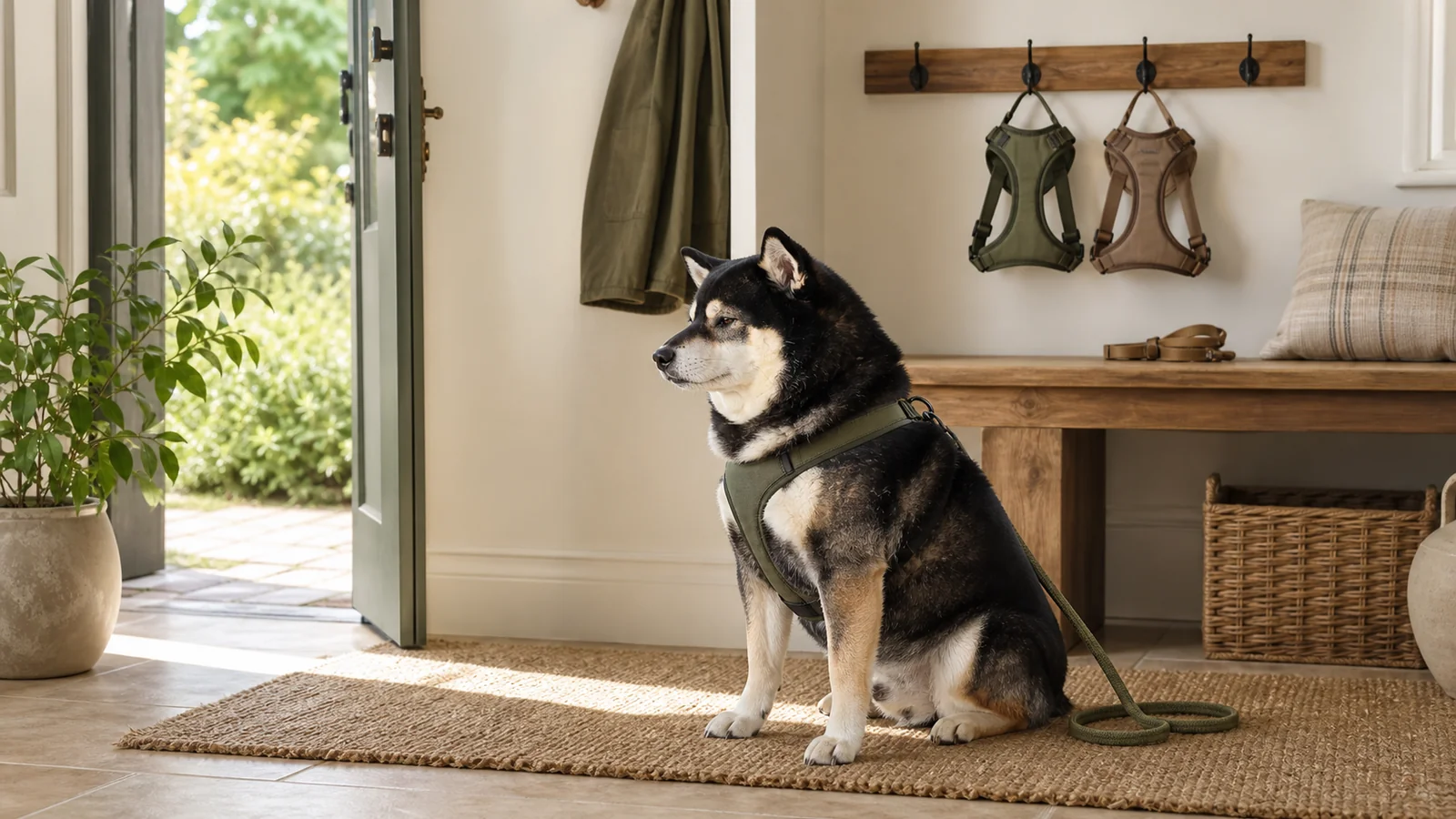
An everyday dog harness should be secure, comfortable, and easy to put on without rubbing or blocking movement. The best category depends on your dog's body shape, walking behavior, and how much control you need.
Start with the curated Dog Harnesses hub or the broader Harnesses, Collars & Leashes pillar. Use the Dog Harness Fit Guide and the Harness Fit Checklist before choosing a final size. If pulling management is the main need, read the No-Pull Dog Harness Guide without treating equipment as a training result. For a growing puppy, read Dog Collar vs Harness for Puppy and Puppy Harness Size Guide before deciding whether the first walking setup needs a collar, harness, or both.
Quick read
TL;DR
- Best starting point: an adjustable Y-front harness for shoulder freedom and everyday fit.
- Back-clip harnesses work well for relaxed walkers.
- Front-clip harnesses may help handling but do not train loose-leash walking by themselves.
- Step-in harnesses can help some small dogs but must still fit securely.
- Padding is useful only if fit is right.
- Measure chest girth and check movement before keeping any harness.
Quick answer
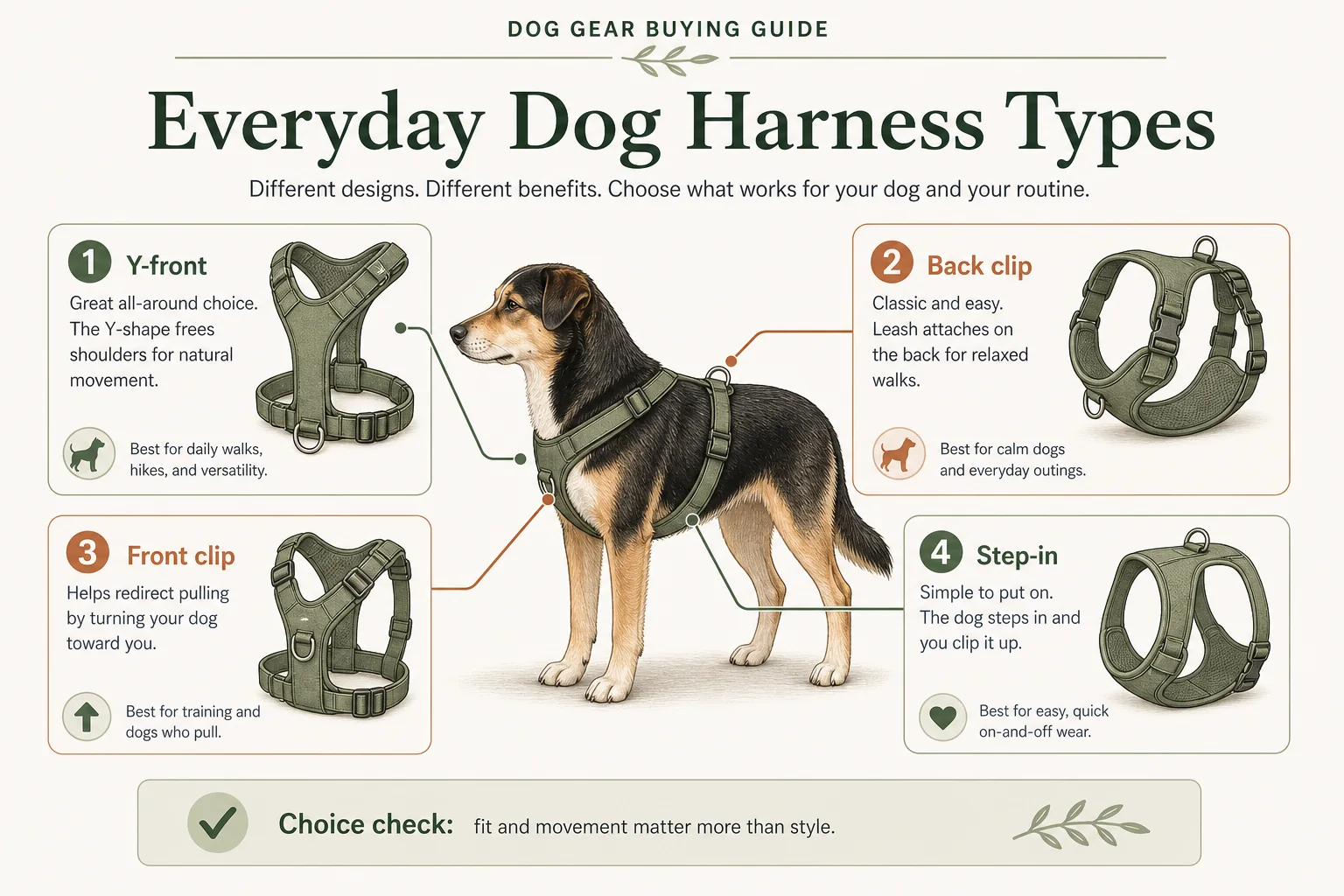
For many dogs, compare adjustable Y-front harnesses first. They often offer better shoulder freedom than bulky straight-front designs and usually include multiple adjustment points.
Choose a back-clip harness for relaxed walkers, a front-clip or dual-clip harness for some pulling management, and a lightweight step-in harness for small dogs that dislike over-head gear.
Share & embed
Most everyday walks
Adjustable Y-front harness
- Look for
Shoulder freedom, chest fit, multiple adjustment points
- Avoid
Buying by weight alone
Relaxed walker
Back-clip harness
- Look for
Simple leash attachment, easy handling
- Avoid
Expecting it to reduce pulling
Pulling management
Front-clip or dual-clip harness
- Look for
Changes leash angle, extra handling option
- Avoid
Skipping training and fit checks
Small dog
Lightweight step-in harness
- Look for
Less over-head handling, lighter hardware
- Avoid
Loose fit or bulky clips
Everyday harness types
Y-front harnesses form a Y shape across the chest and can allow natural shoulder movement when fitted well. Back-clip harnesses are simple and easy to use. Front-clip harnesses attach at the chest and can help some handlers manage pulling. Step-in harnesses may be easier for dogs that dislike gear going over the head.
No type works if the size is wrong. A harness that rubs, twists, or presses into the neck is not a good everyday choice.
Fit and movement
Measure chest girth around the widest part of the rib cage. Compare the number with the brand's chart. After fitting, watch your dog walk from the side. The harness should not slide into the armpits or restrict the front legs.
Padding, hardware, and visibility
Padding can improve comfort, but it can also hold moisture and heat. Hardware should match the dog: large dogs need strong clips and rings; small dogs need lighter hardware that does not drag or bounce.
Reflective details help for early morning or evening walks, but they are not a substitute for a secure fit and reliable leash handling.
| Option | Best for | Key features | Caveat | Merchant |
|---|---|---|---|---|
Y-front harness | Most everyday walks | Shoulder freedom, adjustable fit, body-based control | Fit varies by brand | See direct product examples below |
Back-clip harness | Relaxed walkers | Simple attachment, easy daily use | May give pullers more leverage | See direct product examples below |
Front-clip harness | Some pulling management | Changes leash angle, extra control option | Not a training replacement | See direct product examples below |
Step-in harness | Small dogs and over-head-sensitive dogs | Easy to put on for some dogs | Can slip if poorly fitted | See direct product examples below |
Category picks
These are category-level recommendations, not fixed single-product winners.
What Dogs Like may earn from qualifying purchases. Affiliate links do not change the fit, movement, control, or safety checks used in this guide.
Common mistakes
✓ Better buying habits
- Measure chest girth before choosing size.
- Watch shoulder movement during a real walk.
- Match clip style to walking behavior.
- Choose hardware weight that fits the dog.
- Recheck straps after a few walks.
× Mistakes to avoid
- Buying the harness with the most features.
- Assuming padding fixes poor fit.
- Treating front clips as a training shortcut.
- Ignoring armpit rubbing.
- Leaving wet or muddy harnesses on after walks.
Related guides
Read Dog Harness vs Collar if you are deciding whether the harness is the leash attachment point or the collar is only for ID. Read Dog Collar vs Harness for Puppy and Puppy Harness Size Guide when puppy growth, neck-pressure caution, and first-walk gear shape the decision. Read the Dog Harness Fit Guide before final sizing and print the Harness Fit Checklist for the first short walk. Use Front Clip vs Back Clip Harnesses if clip style is the main decision. Use the Dog Leash Length Guide if leash length is also changing, and the Dog Leash Materials Guide if grip, wet-weather cleaning, leash burn risk, or clip hardware affects handling. Return to the Harnesses, Collars & Leashes pillar for the full gear framework.
Frequently asked questions
What type of harness is best for everyday walks?
An adjustable Y-front harness is a strong starting point for many dogs because it can allow shoulder movement and secure body fit.
Is a front-clip harness better?
It can help handling for some dogs, but it is not automatically better and does not replace training.
Are padded harnesses more comfortable?
Only if they fit well. Padding can help, but poor strap placement still rubs.
Can small dogs use step-in harnesses?
Yes, if the harness fits securely and does not slip or use hardware that is too heavy.
Should dogs wear harnesses all day?
Most walking harnesses should be removed after walks unless the design is intended for longer wear.