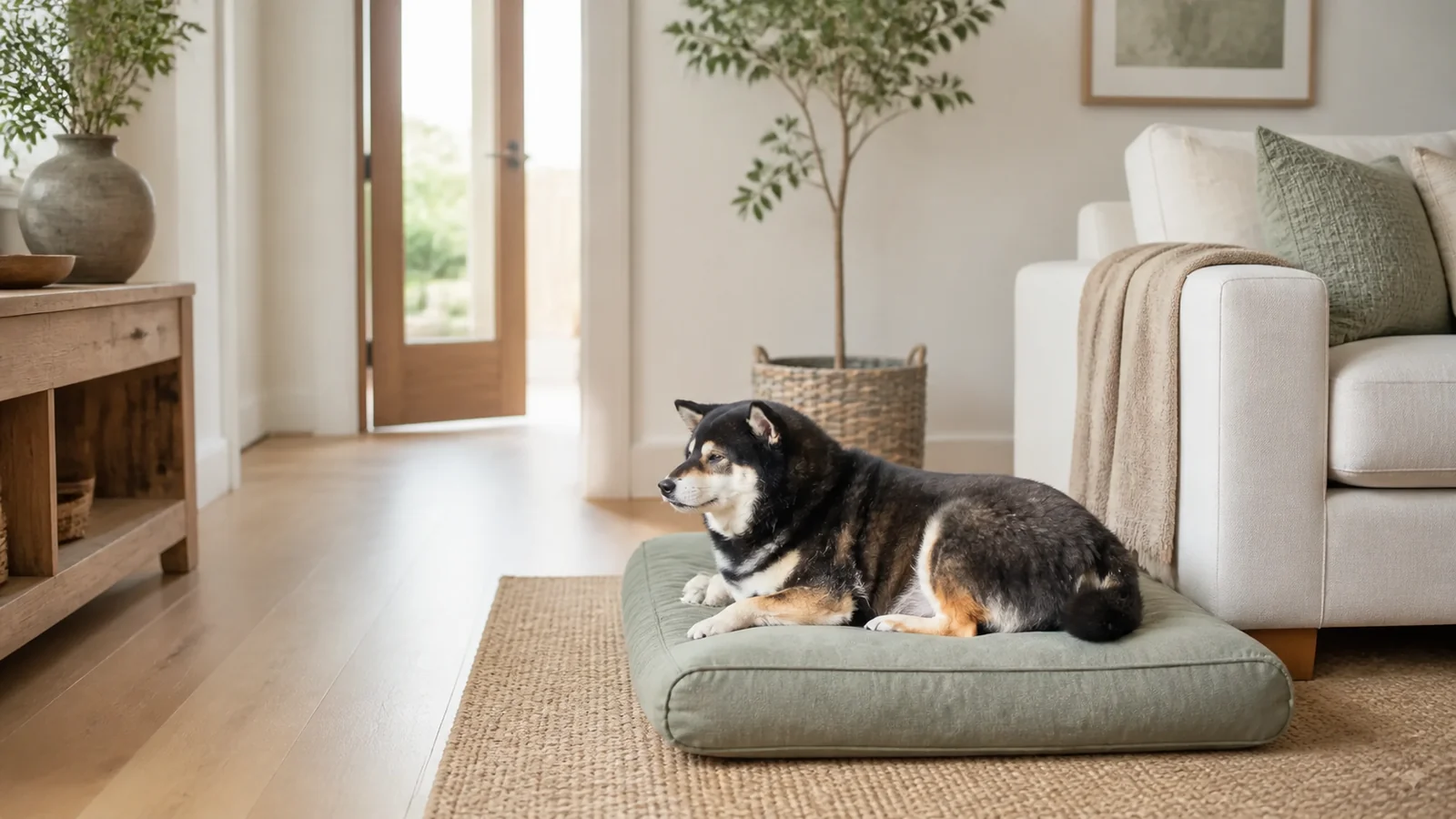
Dog bed placement is part comfort, part room setup, and part sensory management. A bed that is technically the right size can still fail if it blocks a walkway, sits in a draft, traps heat, faces a busy window, or ends up far from the places your dog naturally relaxes.
Use the Dog Beds pillar for the full buying framework. This guide focuses on where the bed should live after you have compared size, shape, support, and cleaning needs.
Quick read
TL;DR
- Place beds where your dog already relaxes, not in an unused corner chosen only for room decor.
- Keep the bed near normal household life so your dog can rest without being isolated.
- Avoid drafts, heat vents, direct sun, door swings, busy windows, loud appliances, and tight walkways.
- Use a quiet wall or corner as visual backing so the bed feels connected without turning into a guard post.
- Check cleaning access before buying a large bed with a removable cover.
- Senior or stiff dogs need easy routes, low entry, and stable flooring around the bed.
- In larger homes, two simpler beds can work better than one perfect bed in the wrong room.
Quick answer
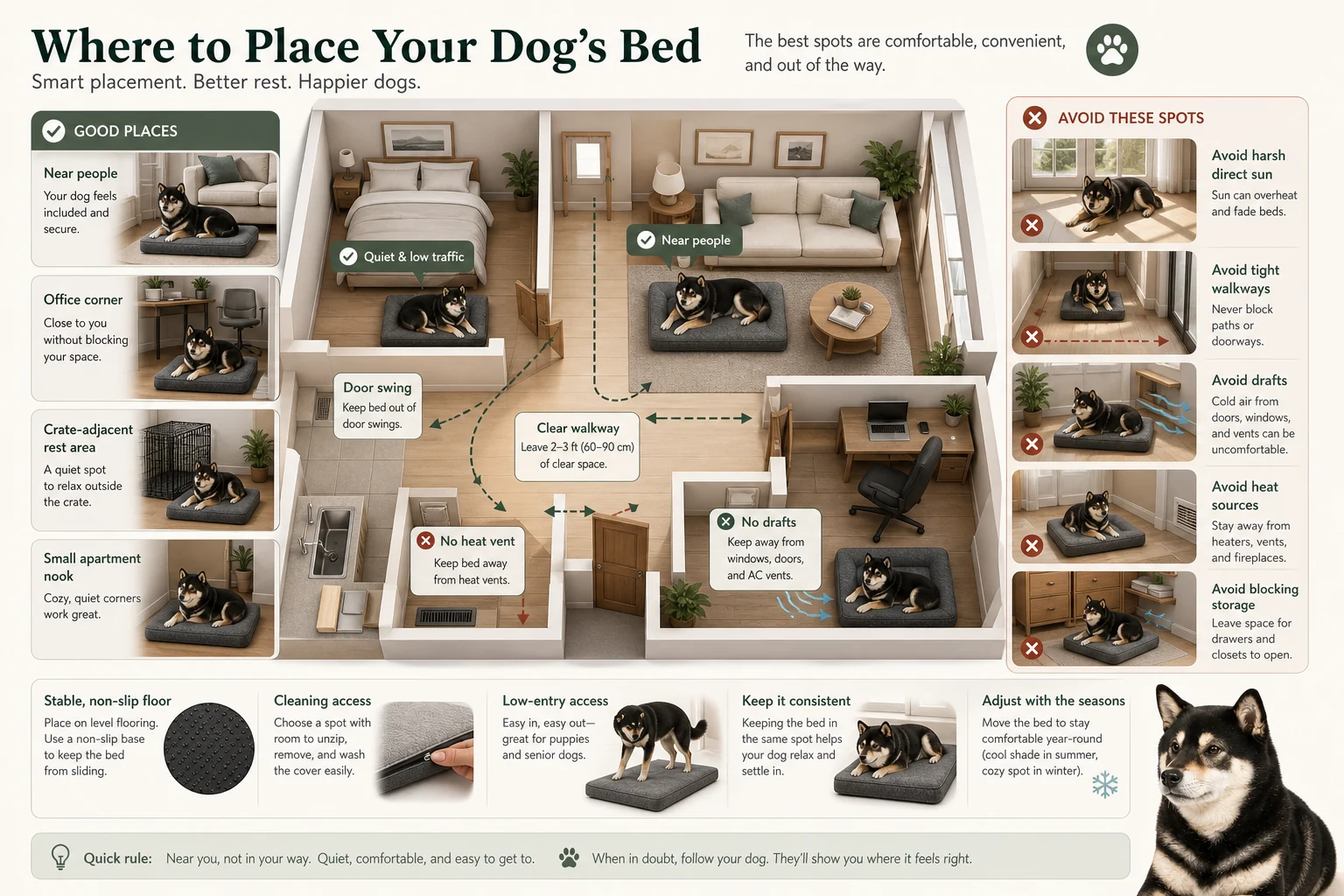
Place a dog bed where your dog already chooses to relax, close enough to normal household activity that they do not feel separated, but away from drafts, heat vents, harsh direct sun, door swings, drawers, busy windows, loud appliance vibration, and traffic bottlenecks.
The right spot should let your dog step on and off easily, stretch without blocking the room, and stay comfortable through normal daily noise, cleaning, and temperature changes. Think in layers: social closeness, clear approach path, low foot traffic, stable temperature, and enough visual calm for real rest.
Share & embed
Bedroom
Quiet washable bed
- Look for
Near the sleep routine, away from door swings, low nighttime traffic
- Avoid
Drafty corners, blocked drawers, beds too tall for stiff dogs
Living room
Everyday comfort bed
- Look for
Near people, clear walking path, fabric that handles hair
- Avoid
Direct sun, sofa pinch points, cluttered corners
Office or work area
Low-profile mat or flat bed
- Look for
Close to the owner, chair clearance, easy vacuuming
- Avoid
Rolling chair paths, cords, cramped desk corners
Crate-adjacent rest area
Flat mat or low bed outside the crate
- Look for
Separate daytime rest spot, crate door stays clear
- Avoid
Thick beds blocking crate access or confusing the entry
Small apartment
Rectangular bed or low mat
- Look for
Wall placement, compact footprint, removable cover access
- Avoid
Oversized bolsters blocking doors or common paths
Senior or stiff dog
Low-entry supportive bed
- Look for
Stable floor, easy step-on height, clear route from room to room
- Avoid
Slippery floors, tall bolsters, stairs or obstacles
What this guide can and cannot claim
This is a researched home-setup guide, not veterinary advice or behavior treatment. Changing a bed location cannot be assumed to resolve anxiety, guarding, barking, or sleep problems. Bed placement can reduce obvious household friction, but it is only one part of a dog's routine.
If your dog shows panic when alone, defensive reactions around beds, sleep startle, resource guarding, sudden mobility changes, pain, limping, or major restlessness, ask a veterinarian or qualified behavior professional. Use this guide to improve the environment, not to replace professional support.
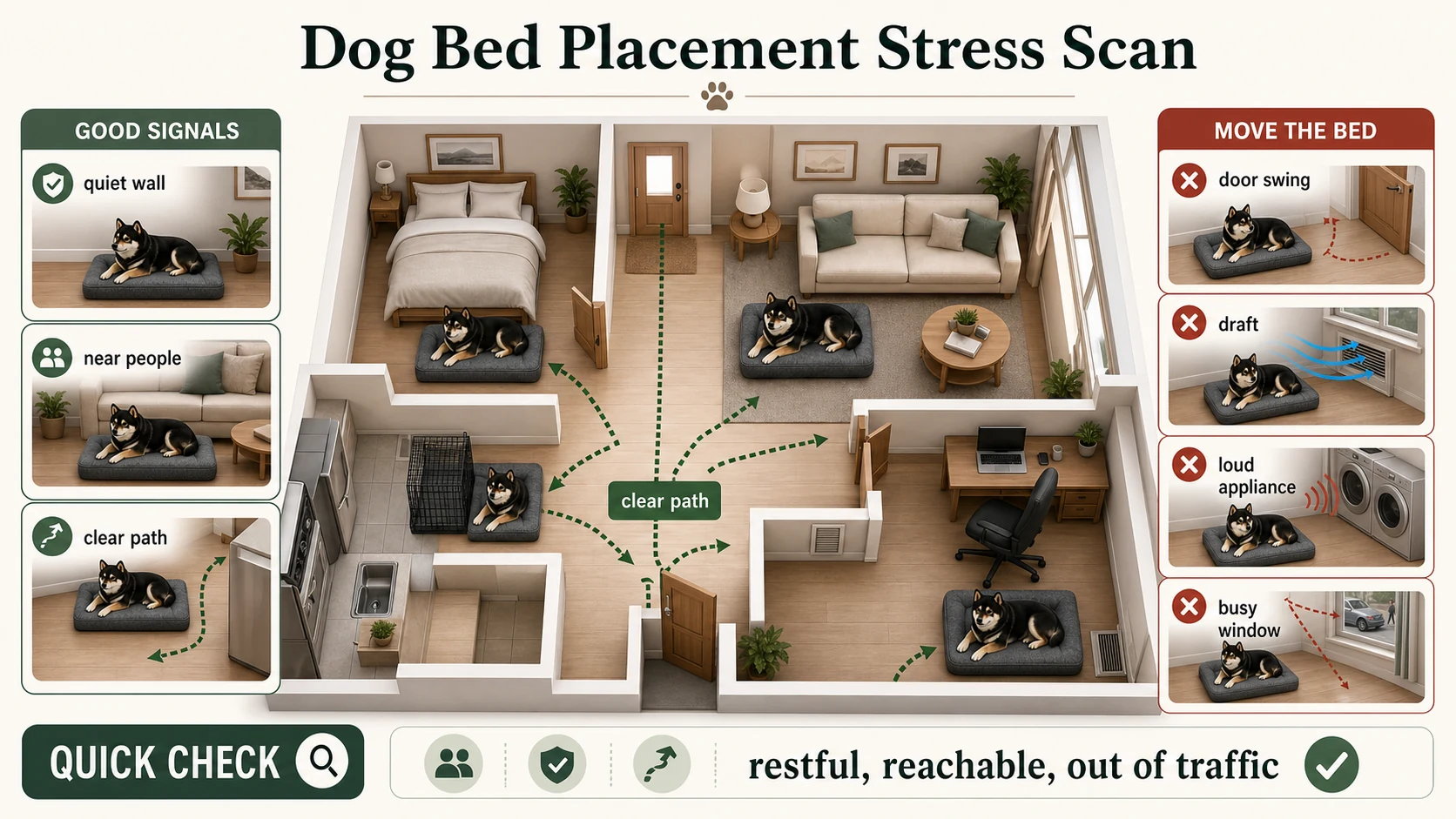
Placement stress scan
Share & embed
Bedroom vs living room
A bedroom bed works well when your dog sleeps near you, settles at night, or needs a quieter place away from daytime activity. It should not block closet doors, bathroom paths, nightstands, or the side of the bed where people step down in the dark.
A living room bed works better for dogs that want to stay near family activity. Place it where your dog can see the room without lying in the main traffic lane. The best living room spot is usually beside a sofa, along a wall, or near a quiet corner that still feels connected.
If your dog uses both rooms, one full-size bed plus one simple mat can be more useful than moving a single bed all day.
Placement by dog and household pattern
Use this matrix to choose the first placement test. It is not a diagnosis; it is a practical way to match room layout to how your dog already rests.
| Option | Best for | Key features | Caveat | Merchant |
|---|---|---|---|---|
Dog that follows people room to room | Bedroom, living room, or office edge | Near people but not underfoot; side wall, desk edge, or sofa-adjacent spot | Do not put the bed where the dog blocks chairs, doors, or exits | |
Dog that watches doors or windows | Living room corner away from the front door view | Quiet wall, fewer direct sightlines, no street-facing window pressure | Moving the bed may help setup, but it is not behavior treatment | |
Shy or easily startled dog | Alcove, crate-adjacent rest area, or low-traffic bedroom corner | Backed by a wall, predictable approach path, no people stepping over the dog | Avoid dark walkways where sleep startle becomes more likely | |
Multi-dog home | Separated rest spots in open rooms | Multiple exits, no narrow choke point, enough distance between beds | Avoid placing one bed where another dog can block access | |
Senior or stiff dog | Main-floor room with stable floor traction | Low-entry bed, clear path, no stairs needed for daily rest | Ask a veterinarian about pain, stiffness, or sudden mobility changes |
Near people, not isolated corners
Many dogs rest best when they can be near people without being stepped over. A bed tucked behind furniture, in a laundry room, or in a spare corner may look tidy, but it may not match your dog's social routine.
Watch where your dog already lies: beside the sofa, near a desk, outside a bedroom door, or near a crate. That pattern tells you more than a floor plan does. A smaller bed in the right social spot can get more use than a large bed placed where the dog never chooses to rest.
Dogs often prefer a location that feels socially connected but not exposed. A wall, sofa side, crate side, or furniture edge can give the bed a clearer boundary. This loosely matches the denning instinct without requiring a closed or isolated space.
Doorways, walkways, drawers, and tripping risks
Before buying or moving a bed, check the path around it. Open nearby doors, drawers, closets, baby gates, and crate doors. Walk through the room the way you do when carrying laundry, food, or a leash.
Avoid spots where the bed:
- Blocks a doorway, hallway, or crate entrance.
- Sits where people step down from a bed or sofa.
- Makes drawers, closets, or cabinets hard to open.
- Forces people to step over the dog.
- Creates a tight turn around furniture.
This matters more for large beds, thick bolsters, and senior dogs that may get up slowly.
Sun, drafts, heat vents, noise, and slippery floors
Comfort can change through the day. A sunny spot may feel pleasant in the morning and too hot in the afternoon. A floor vent may make a bed warm in winter but uncomfortable in summer. A draft near an exterior door can make a cozy bed less useful.
If your dog seeks cooler rest, compare water-core mats and elevated cots in Best Cooling Dog Beds while keeping shade and airflow primary.
If the rest spot is a deck, shaded patio, or campsite rather than an indoor room, use Best Outdoor Dog Beds to check ground moisture, frame stability, moving shade, and storage after rain.
Noise matters too. Some dogs relax near household activity, while others avoid spots near appliances, speakers, entry doors, or busy windows. If your dog keeps leaving the bed, check sound and temperature before blaming the bed itself.
Floor traction is part of placement. On hardwood, tile, or laminate, use a bed with a non-slip bottom or place it where the bed does not slide when the dog steps on it.
Microclimate and sensory scan
Before treating a bed as uncomfortable, test the spot at different times of day. Stand or sit where the dog bed sits and check:
- Air movement: exterior-door drafts, window leaks, floor vents, AC flow, and heat registers.
- Heat and light: harsh afternoon sun, fireplace heat, radiator edges, and bright streetlight at night.
- Sound and vibration: washer, dryer, refrigerator hum, subwoofer bass, garage doors, and busy entry doors.
- Sightlines: front windows, glass doors, stairways, and hallways that encourage constant scanning.
- Scent and mess: trash cans, litter boxes, strong cleaners, plug-in fragrances, or kitchen spill zones.
If the dog repeatedly leaves the bed during appliance cycles, sunny hours, or busy door times, the location may be the problem even when the bed itself is fine.
Front doors, busy windows, and guard pressure
Entryways and street-facing windows are tempting because they keep the dog near the action. They can also turn a resting spot into a lookout post. Some dogs settle fine there; others stay alert, bark more, or wake at every passing sound.
For a calmer first test, place the bed along a side wall with one or two visual boundaries. The goal is not isolation. It is a spot where the dog can rest without feeling responsible for every movement in the home.
Multi-dog homes and resource guarding risk
In multi-dog homes, bed placement is also about access. Avoid narrow hallways, kitchen entrances, door thresholds, and crate openings where one dog can block another. Beds should not force dogs to pass nose-to-nose in a tight space.
If one dog guards beds, growls when approached, stiffens around resting spots, or blocks another dog's path, change the layout and get qualified help. Place beds with open approach routes, distance between resting zones, and no single high-value bed in a choke point.
Senior dogs and low-entry placement
For senior dogs, stiff dogs, short-legged dogs, and dogs that hesitate after rest, placement and entry height matter together. A supportive bed is less useful if the route to it is slippery, narrow, or blocked.
Choose a spot that lets the dog approach from more than one angle. Avoid tall bolsters, cramped corners, or locations that require stairs unless the dog already handles that route comfortably.
Multiple beds in larger homes
In a larger home, one bed may not cover the whole routine. A dog may need a primary sleeping bed in the bedroom and a simpler daytime rest mat in the living room or office.
Multiple beds do not need to be identical. Use the highest-support bed where your dog rests longest, then use a washable mat, low-profile pad, or crate-adjacent bed for shorter daytime rest.
Cleaning access and cover removal
Placement affects cleaning. A removable cover is only useful if you can unzip it, pull it off, shake it out, and carry it to the washer without dragging the whole bed through tight furniture.
Leave enough room to lift the bed, vacuum around it, and remove the cover. If the bed sits under a desk, inside a tight furniture gap, or behind a heavy chair, it may get cleaned less often.
For a practical maintenance routine, use the Dog Bed Cleaning Schedule after choosing the bed location.
Small-space placement
In apartments and smaller rooms, avoid buying the thickest or most decorative shape first. Rectangular beds, flat orthopedic beds, and low-profile mats are often easier to place against walls, beside sofas, or near a crate area.
Measure the actual footprint with painter's tape before buying a large bed. Then open doors and walk around the taped area. If the room feels blocked before the bed arrives, choose a smaller footprint or a lower-profile shape.
Direct product examples to inspect
These are direct Amazon product examples, not final rankings. Product details, sizes, prices, cover materials, and availability can change, so check the current listing before buying.
Category options to compare
These are category-level starting points, not fixed product rankings. Compare current listings by usable size, cover design, entry height, return policy, and recent owner feedback.
Affiliate shopping checks
Compare bed options after choosing the spot
What Dogs Like may earn from qualifying purchases. Affiliate links do not change the placement checks in this guide.
Related guides
Use the Dog Bed Size Guide before choosing dimensions, then check the result with the Dog Bed Size Calculator.
For cleanup and odor control, read Washable Dog Beds for Easier Cleanup and print the Dog Bed Cleaning Schedule. For fabric, foam, fill, liner, and warmth decisions, use the Dog Bed Materials Guide.
For support decisions, compare Best Orthopedic Dog Beds for Support, Orthopedic vs Memory Foam Dog Bed, and Best Dog Beds for Large Dogs. For shape tradeoffs, read Bolster vs Flat Dog Beds. Return to the Dog Beds pillar for the full bed framework.
Frequently asked questions
Where should I put a dog bed in the house?
Start where your dog already relaxes, then check traffic flow, temperature, noise, cleaning access, and entry height. Most dogs do better near normal household life than in an isolated unused corner.
Should a dog bed go in the bedroom or living room?
Use the bedroom if your dog settles near your sleep routine. Use the living room if they rest near daytime family activity. Some homes work better with one primary bed and one simple mat.
Where should I put a dog bed for an anxious dog?
Start with a calm, predictable spot near normal household life but away from the front door, busy windows, appliance noise, and tight traffic paths. Bed placement can support a calmer routine, but separation anxiety, panic, or destructive distress needs qualified professional support.
Can bed placement affect resource guarding?
It can make household movement easier or harder. Avoid placing beds in narrow doorways, kitchen entrances, crate openings, or hallway choke points where a dog can block another dog or guard the space. If guarding appears, change the setup and ask for qualified help.
What is sleep startle, and why does placement matter?
Some dogs startle when woken suddenly, especially if people step over them or approach in the dark. Place beds away from walkways, bedroom step-down zones, and tight corners so people can pass without surprising the dog.
Is it bad to put a dog bed near a vent or sunny window?
It depends on temperature and your dog. Avoid spots that become too hot, too cold, drafty, or uncomfortable at certain times of day.
Should a dog bed face the front door?
Only if your dog truly rests there calmly. If the dog watches, barks, startles, or stays alert near the entry, move the bed to a side wall where they can remain near the family without monitoring the door.
What is the best placement for a senior dog bed?
Choose a stable, low-traffic spot with easy step-on access, clear routes, and good floor traction. Avoid slippery approaches, tall bolsters, and tight corners.
Can a dog bed be too close to a crate?
It can sit near a crate if the crate door stays clear and the dog has a separate rest option. Do not place a thick bed where it blocks crate access or makes the area harder to use safely.