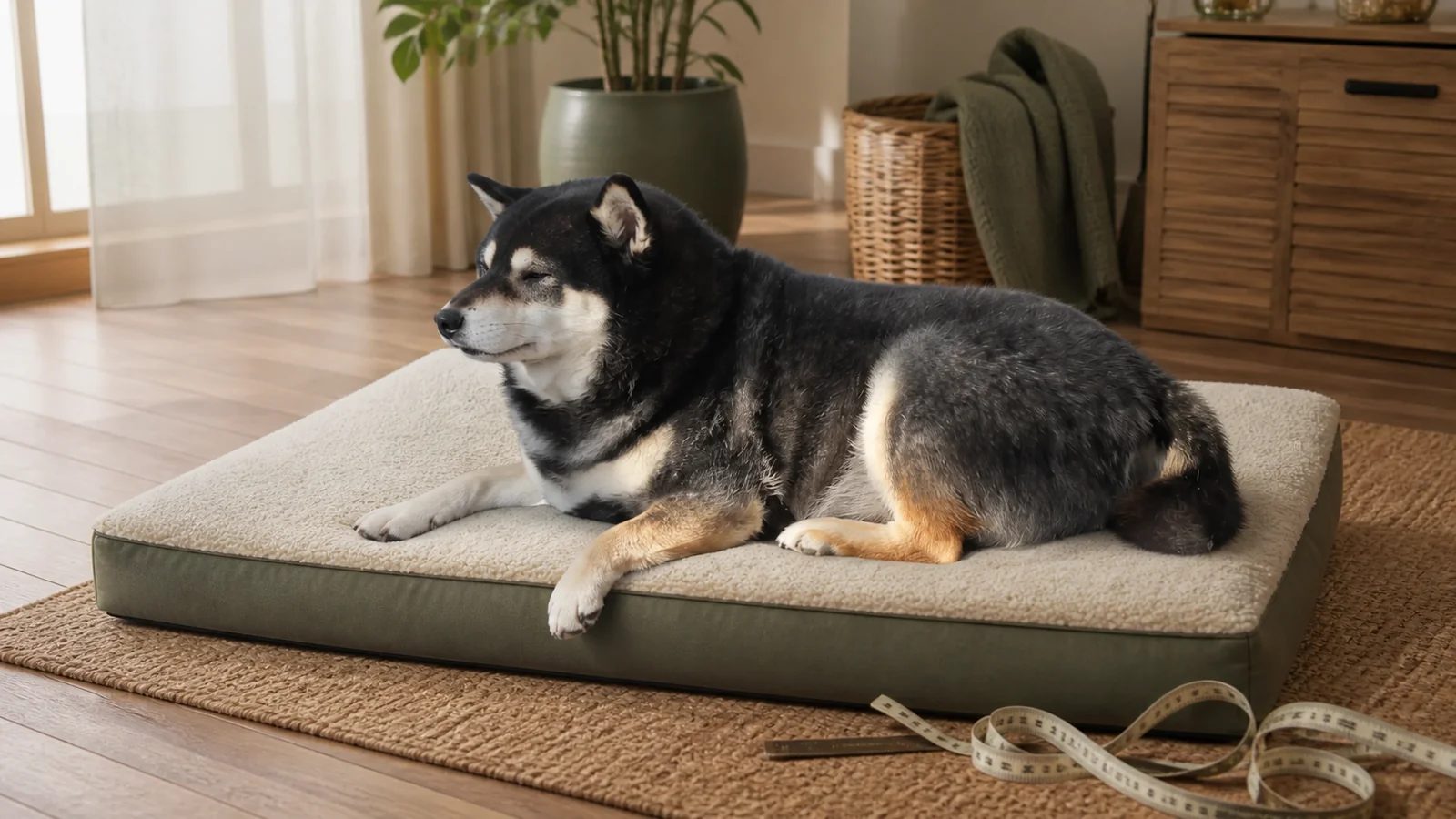
Dog bed sizing should start with your dog on the floor, sofa, or current bed, not with a breed chart. Dogs of the same breed can sleep differently, carry weight differently, and use very different amounts of space.
This guide supports the Dog Beds pillar and helps you choose a size before comparing orthopedic beds, washable beds, bolsters, or crate mats.
Quick read
TL;DR
- Measure your dog lying down, not only standing.
- Add room for movement so the bed does not force one tight position.
- Sprawlers need length and width. Curlers may prefer round or bolster shapes.
- Check usable sleep area on bolster beds because raised sides take up space.
- Room placement matters: a bed that blocks doors or walkways will not work long term.
- For puppies, buy for the current stage or choose a washable budget option until adult size is clearer.
Quick answer
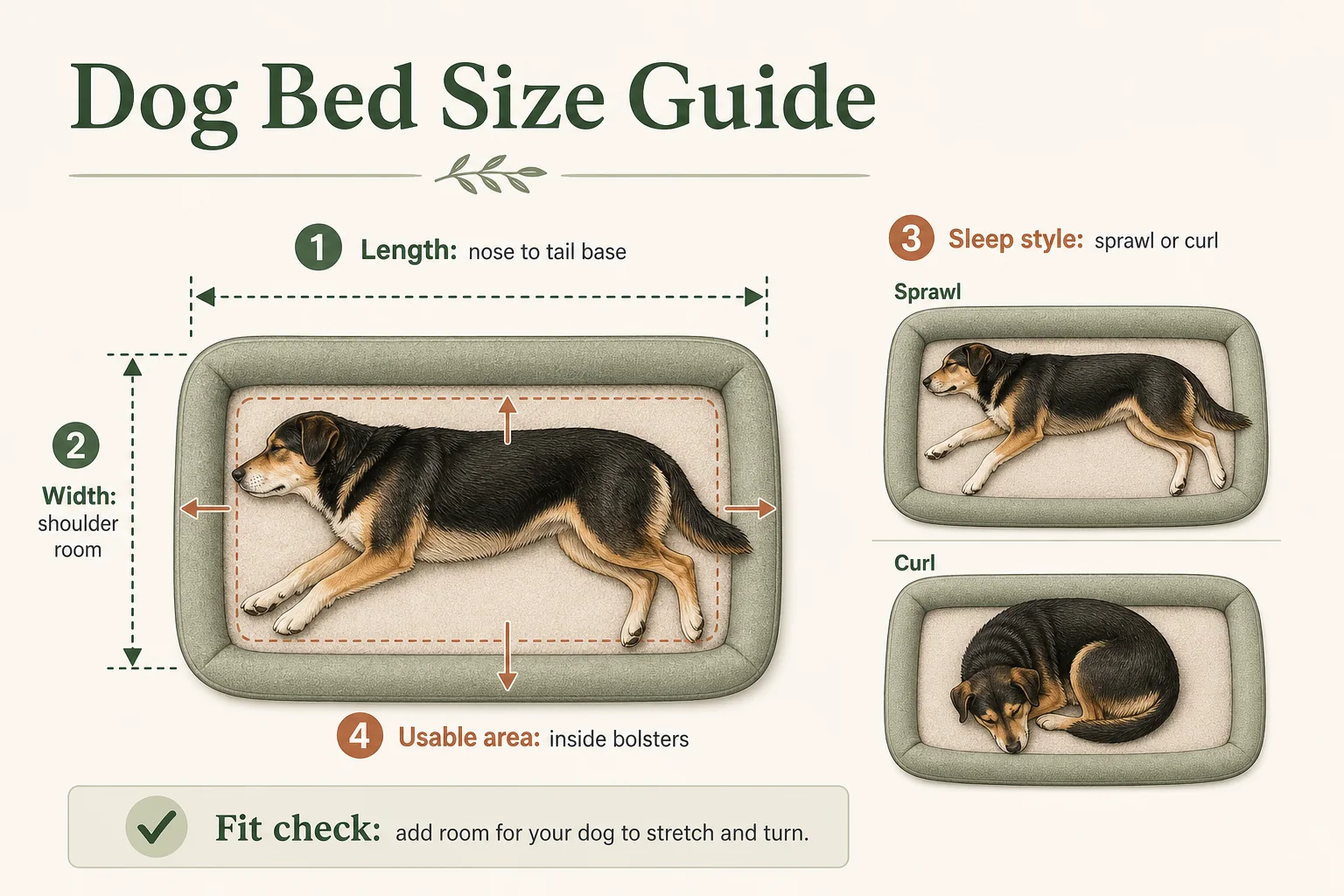
Measure your dog in their most common relaxed sleep position, then add several inches of usable space on each side. If your dog sprawls, measure the full stretched posture too. If your dog curls, measure the curled shape but still leave room for turning and repositioning.
A bed should let your dog rest naturally without hanging off the edge or being trapped in one position. For a large dog, a rectangular bed is usually easier to size than a round bed. For a dog that curls tightly, a round bed or bolster can work, but the inner area still needs to fit the dog.
Share & embed
Dog sprawls or sleeps on side
Rectangular bed
- Look for
Full body length, enough width, flat surface
- Avoid
Small round beds, narrow bolsters
Dog curls tightly
Round or bolster bed
- Look for
Cozy edge, enough inner diameter, soft but stable sides
- Avoid
Outside dimensions that hide a tiny center
Dog switches positions
Larger flat bed
- Look for
Extra surface area, room to rotate, easy entry
- Avoid
Beds that only fit one posture
Bed goes in a crate
Crate mat or low-profile bed
- Look for
Fits floor space, does not block door, washable
- Avoid
Thick beds that reduce usable height
Measure the dog, not just the breed
Breed labels are only rough hints. A lean long dog, a stocky dog, and a senior dog with stiff joints may all need different bed shapes even if their weight is similar.
Start with two measurements:
- Relaxed length: nose to tail base while your dog is lying normally.
- Relaxed width: the widest part of the body in that sleep position.
Then watch how your dog actually sleeps. Some dogs curl into a small circle at first but stretch later. Some sleep against furniture. Some rotate between belly, side, and back positions. Size for the largest normal position if you want the bed to be useful throughout the day.
Match size to sleep style
Sleep style is the most useful sizing clue. A sprawler needs a longer, wider surface. A curler may use a round or bolster bed. A leaner may enjoy one raised edge. A senior dog may need extra space to reposition slowly.
Sprawlers
Sprawlers often sleep on their side, belly, or back with legs extended. They usually need rectangular beds, orthopedic foam beds, or wide mats. Do not buy the smallest size that technically fits the dog's body. If legs hang off the side, the bed may not support the dog well.
Curlers and nesters
Curlers may like round beds, oval beds, cave-style beds, or bolsters. The key is inner space. A bed can look large from the outside while the usable center is much smaller because of thick sides.
That difference is especially consequential in small dog beds, where a plush rim can take a large share of a compact footprint. For a dog that actively burrows, the cave dog bed guide adds opening and exit checks to the inner-space measurement.
Dogs that change positions
Dogs that change positions need more room than a single measurement suggests. Choose a shape that gives them turning space. A flat rectangular bed is often the safest option when you are unsure.
Bolster beds and usable area
Bolster beds are easy to undersize. The listing may show outside dimensions, but your dog sleeps inside the raised edges. A bed that says 36 inches long may have a much smaller inner sleep area.
Before buying a bolster bed, look for interior dimensions or estimate how much space the bolsters take. If the listing does not make that clear, read recent reviews and compare product photos with dog sizes carefully.
| Option | Best for | Key features | Caveat | Merchant |
|---|---|---|---|---|
Flat rectangular bed | Sprawlers and dogs that change positions | Easy to measure, flexible room placement | Less nest-like for curlers | |
Round dog bed | Dogs that curl tightly | Cozy shape, compact footprint | Poor fit for sprawlers | |
Bolster bed | Dogs that lean or rest heads on edges | Raised support, secure feel | Inner sleep area may be much smaller | |
Crate mat | Crates and travel setups | Low profile, easier to fit inside crate | Less support than a full bed |
Puppies and growing dogs
Puppies complicate sizing because adult size may not be clear. For many puppies, it is practical to start with a washable, budget-friendly bed that fits the current stage rather than buying an expensive adult bed too early. Chewing, accidents, and fast growth can make premium beds a poor first purchase.
If you do buy larger, make sure the puppy can still use the bed comfortably now. Very large beds can feel awkward in small spaces and may be harder to wash after accidents.
Account for the room
A bed needs to fit your home. Measure the space where the bed will sit, including door swings, drawers, walkways, crate doors, and furniture. A bed that is technically perfect for the dog but blocks the room may be moved constantly and used less. For a deeper placement workflow, use the Dog Bed Placement Guide.
Dogs often choose beds near people. A smaller bed in the right location may get more use than a larger bed tucked into an unused corner.
Category picks
These are category-level recommendations, not fixed single-product winners.
Common mistakes
✓ Better buying habits
- Measure your dog in a real sleep position.
- Add room for turning, stretching, and repositioning.
- Check inner dimensions on bolsters.
- Measure the room before buying a large bed.
- Choose washable options for puppies and messy dogs.
× Mistakes to avoid
- Buying only by breed or weight range.
- Assuming outside dimensions equal sleep area.
- Choosing a bed that blocks doors or walkways.
- Buying an expensive adult bed too early for a chewing puppy.
- Ignoring entry height for senior or stiff dogs.
Related guides
For support-focused sizing, read Best Orthopedic Dog Beds for Support. Use the Dog Bed Materials Guide before choosing between foam, fill, liners, plush tops, or woven covers. For room setup, read the Dog Bed Placement Guide. If the bed may sit inside a crate, compare Dog Bed vs Crate Mat before choosing a thick bed or low-profile mat. For cleaning questions, use Washable Dog Beds for Easier Cleanup. For the full category overview, return to the Dog Beds pillar.
Frequently asked questions
Should puppies get full-size adult beds?
Not always. A washable bed that fits the current stage can be more practical until adult size, chewing habits, and house routines are clearer.
What if my dog sleeps in several positions?
Size for the largest normal sleep position. A flat rectangular bed is usually the safest shape when a dog changes positions often.
How much extra room should a dog bed have?
Add enough room for the dog to turn, stretch, and shift without hanging off the edges. The exact amount depends on dog size and sleep style.
Are bolster beds smaller than they look?
Often yes. The raised sides reduce usable space, so check inner dimensions whenever possible.
Can a dog bed be too large?
It can be awkward for the room or harder to wash, but most dogs prefer extra surface area over a bed that is too tight.
Should crate mats follow the same sizing rules?
Crate mats must fit the crate floor without blocking the door or bunching at the sides. They are usually sized by crate dimensions as much as dog dimensions.