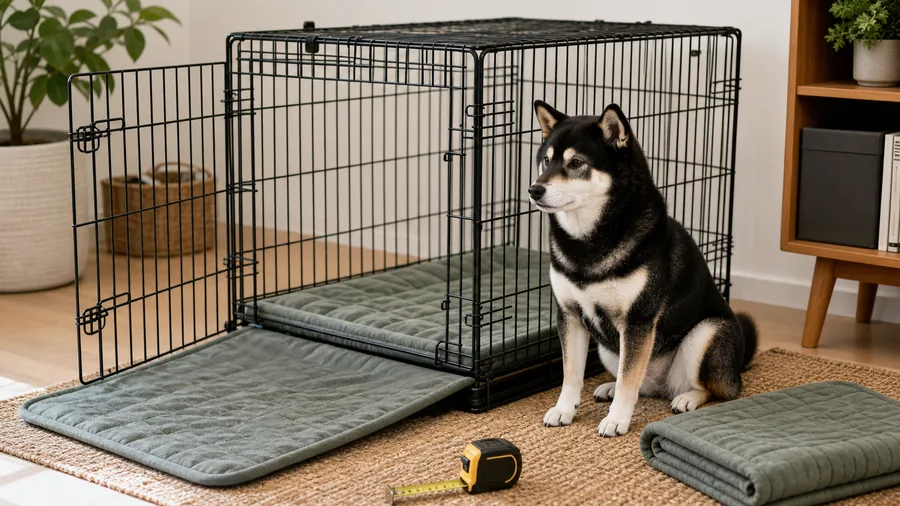
A crate mat should make a suitable crate more comfortable without blocking the door, reducing usable height too much, trapping odor, or creating chewing and ingestion risk. The best mat is not always the thickest one. It is the one that fits the crate pan, the dog, the crate routine, and the cleaning plan.
Start with the Dog Crates pillar for the full crate framework. Use this guide after checking crate size and before comparing mats, pads, liners, and bedding. If you are unsure whether the crate needs a full bed or a lower mat, read Dog Bed vs Crate Mat first. If the mat will go inside a decorative end-table crate or enclosed furniture-style crate, read the Dog Crate Furniture Guide before choosing thickness and shape. If listings mix dog crate, dog kennel, dog cage, carrier, and outdoor-run wording, read Dog Kennel vs Dog Crate before choosing bedding.
Quick read
TL;DR
- Fit the mat to internal crate dimensions, not the outside crate size.
- Keep thickness practical so the dog still has usable standing height and the door moves freely.
- Washable crate mats are usually safest for puppies, seniors, and muddy routines.
- Avoid loose fill and exposed edges for dogs that dig, shred, or swallow fabric.
- Check cover fabric, seam exposure, zipper placement, and backing, not only softness.
- Non-slip backing helps, but it should not bunch, curl, or trap moisture.
- Dogs that chew bedding need simple supervised setups, not fluffy loose materials.
- A crate mat adds comfort but does not replace safe crate introduction or routine support.
Quick answer
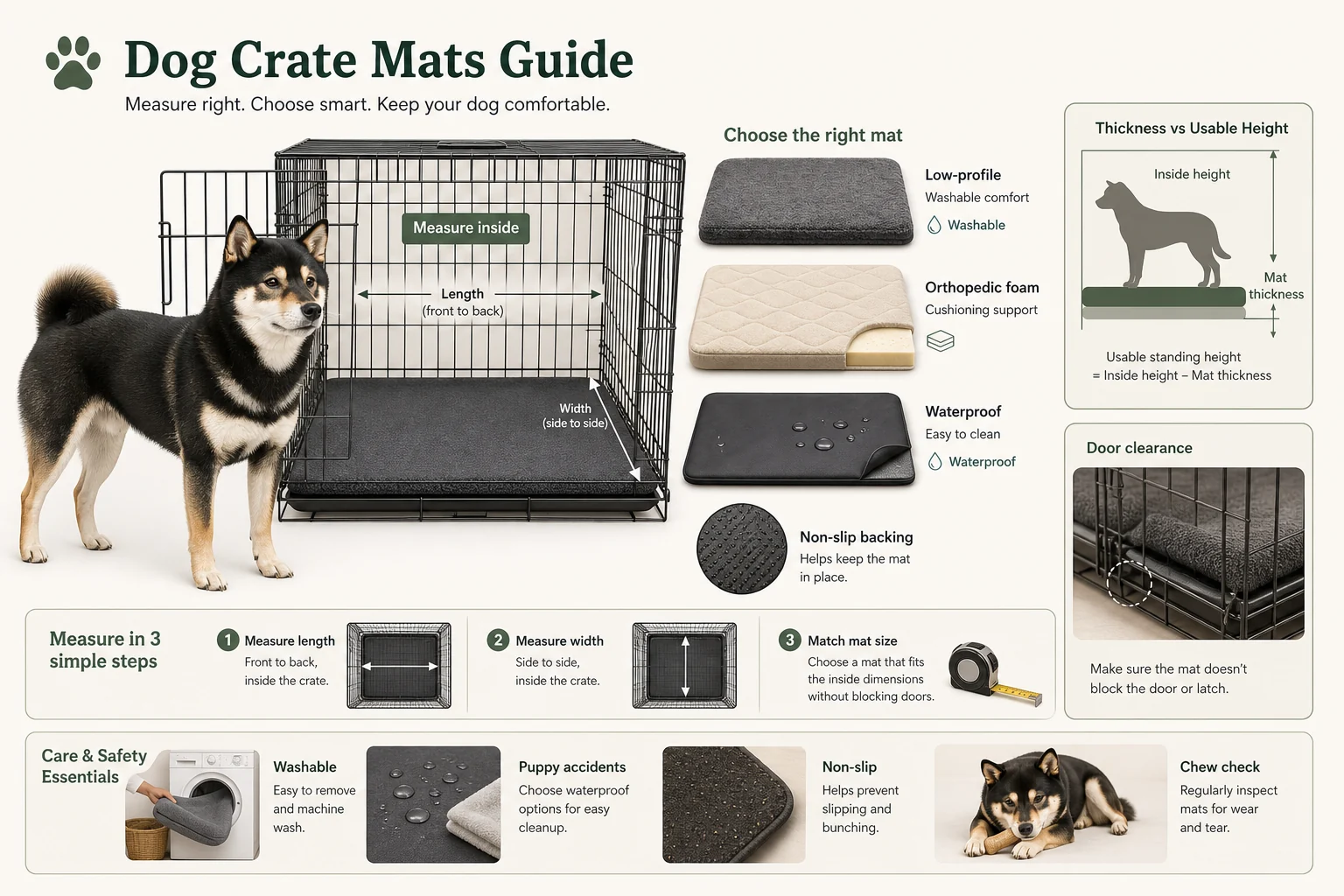
Choose a dog crate mat that lies flat inside the crate, matches the internal floor or pan size, is thin enough to preserve usable height, and can be removed for washing. For puppies, accidents, drool, or damp paws, prioritize washable covers and moisture protection. For senior or stiff dogs, choose a low-profile mat with enough cushioning to reduce hard-floor pressure without making entry awkward. For dogs that dig or chew, prioritize simple construction, protected seams, and no loose fill.
Share & embed
Puppy crate
Washable low-profile mat
- Look for
Easy removal, fast drying, divider-friendly fit
- Avoid
Thick bedding that blocks the door or becomes a chewing target
Adult home crate
Flat crate pad or mat
- Look for
Internal floor fit, comfort, simple cleaning
- Avoid
Oversized beds that bunch at the corners
Senior or stiff dog
Supportive low-entry mat
- Look for
Stable surface, enough cushioning, non-slip backing
- Avoid
Tall bolsters or slippery covers
Travel setup
Packable washable mat
- Look for
Lightweight, folds flat, dries reasonably fast
- Avoid
Bulky mats that reduce carrier space
What this guide can and cannot claim
This is a researched buying guide, not a veterinary recommendation, behavior plan, or product test. What Dogs Like does not claim that any crate mat is universally safe, escape resistant, chew resistant, or right for every dog.
If your dog chews bedding, swallows fabric, panics in a crate, damages crate parts, or shows distress when confined, remove unsafe materials and ask a veterinarian or qualified behavior professional. A crate mat can improve comfort, but it cannot make an unsuitable crate routine safe by itself.
Safety first: chewing and ingestion risk
Crate mats are different from normal floor beds because the dog is inside a smaller boundary. If a dog digs at corners, pulls at seams, or opens a zipper, loose polyester fill, shredded foam, fabric strips, and backing pieces can become ingestion hazards.
For chewers and diggers, compare flat shapes, fewer raised seams, hidden or protected zipper areas, tougher woven covers, and solid foam or mat-style construction instead of loose pillow fill. Terms like ballistic nylon, Cordura-style fabric, ripstop, high denier, YKK zipper, and tie-down loops are useful only when the listing clearly explains them.
Fit the crate floor first
Measure the crate's internal floor space before buying a mat. Outside crate dimensions can be misleading because trays, rounded corners, frames, and door hardware reduce usable interior space.
A mat should sit flat without curling into the door track or bunching at the back wall. If the mat is too long, dogs may paw at the folded edge. If it is too small, it may slide around or leave hard edges exposed.
Most product listings use familiar crate length categories such as 24, 30, 36, 42, and 48 inches. Those labels are not exact mat dimensions. Brands such as MidWest Homes for Pets often use standardized crate and tray sizes, but the safest check is still the inside floor or pan measurement for the exact crate in your home.
Use the Dog Crate Size Guide and Dog Crate Size Calculator before choosing mat dimensions.
Thickness vs usable height
Thick bedding looks comfortable, but it changes crate fit. A mat that adds two or three inches of height may make a crate feel smaller, especially for tall dogs, large puppies, or crates that were already close to the minimum height.
For many crates, a flat washable mat is more practical than a deep pillow bed. Save thicker bedding for dogs that do not chew and crates with enough height and door clearance.
When a “dog crate bed” is worth the extra thickness
Buy a deeper crate bed only after checking four separate measurements: the pan's clear length and width, the door threshold, the dog's standing height with the bed installed, and the bed's compressed thickness under the dog. The phrase “fits a 36-inch crate” is not enough; crate pans, rounded corners, dividers, and door hardware vary. A supportive low-profile foam bed may make sense for a calm crate-trained dog that rests for longer periods and does not chew it. A thin washable mat is easier to remove and dry for a puppy, travel crate, or accident-prone setup. If the dog cannot stand, turn, lie, and exit normally once the bedding is installed, the thicker bed is the wrong fit regardless of its comfort label.
The Dog Bed vs Crate Mat Guide compares full beds with low-profile options, including an exact foam-bed Amazon example. Keep the crate routine and chewing behavior in the decision: no amount of cushioning justifies leaving swallowable damaged material in a confined space.
Material and construction checks
The weak point of a crate mat is often not the center of the fabric. It is the corner, seam, zipper pull, piping edge, or loose backing that gives the dog something to grip.
Use these checks before buying:
- Core: solid foam, thin pad, washable fill, or no-fill mat construction.
- Cover: fleece, microfiber, oxford fabric, ripstop, canvas, ballistic nylon, or Cordura-style weave.
- Seams: flat and protected, not bulky external edges.
- Closure: hidden zipper, recessed zipper, hook-and-loop flap, or no zipper.
- Backing: non-slip, but not peeling, brittle, or easy to chew.
- Anchoring: tie-down loops or a stable fit can help some mats stay flat, but they must not create new chewing targets.
For foam mats, CertiPUR-US-style claims can be useful when the listing clearly says which foam layer is certified. For fabric claims, denier ratings such as 600D, 1000D, or 1680D can help compare textile weight, but they are not a guarantee of safety.
Washable covers and moisture
Crate mats get dirty quickly. Puppies, muddy paws, drool, shedding, and accidents make washable construction more important than decorative texture.
Look for removable covers, clear wash instructions, fast drying, and foam or fill protection. If the whole mat is washable, check whether it can actually fit your washer and dry fully. Damp padding can hold odor.
For housebreaking puppies, avoid thick absorbent bedding until the routine is clearer. A plush mat can hide accidents and stay damp. If the puppy is still learning, use a simple washable low-profile mat only when it can be kept clean and safe.
Non-slip backing and stability
A non-slip bottom can keep a mat from sliding when the dog enters or turns. It is especially useful on plastic trays and smooth crate floors.
The backing should stay flat and should not peel, curl, or trap moisture. If a dog chews edges, inspect the backing often and remove damaged mats.
Heat, airflow, and enclosed crate floors
A plastic or metal crate tray can change how a mat feels. Dense foam, waterproof layers, and thick fleece can hold warmth. Smooth waterproof surfaces can be easier to wipe but may feel slick, stiff, or warm. Breathable spacer mesh, thinner washable pads, or packable mats can work better for dogs that leave bedding because they overheat.
Check the setup in the room where the crate actually sits. Sun, floor vents, radiators, air conditioning, and closed room airflow can matter as much as the mat material.
Puppies and chewing risk
Puppies often chew, dig, paw, and test edges. Keep crate bedding simple until chewing habits are clearer. Avoid loose fill, decorative edges, weak seams, or mats that shred easily.
If a puppy destroys bedding or swallows pieces, remove unsafe materials and revisit supervision, routine, enrichment, and professional support where needed. A tougher mat alone is not a safe training plan.
Senior dogs and comfort
Senior or stiff dogs may benefit from a mat that softens the crate floor, but entry height and stability still matter. A low-profile supportive mat can be easier than a thick pillow that shifts underfoot.
If pain, limping, stiffness, recovery, or sudden mobility changes are part of the decision, ask a veterinarian instead of treating bedding as the solution.
Crate mat choice by dog and routine
Use this matrix to narrow the first comparison set. It is not a medical or behavior chart; always check the exact product listing, the dog, and the crate routine.
| Option | Best for | Key features | Caveat | Merchant |
|---|---|---|---|---|
Crate-trained adult dog | Low-profile washable mat | Internal pan fit, door clearance, removable cover, stable backing | Still inspect seams and backing after use | See direct product examples below |
Puppy with accidents | Thin washable or wipeable mat | Fast cleaning, low absorbency, simple shape, divider-friendly fit | Avoid thick plush if it hides urine or stays damp | See direct product examples below |
Senior or stiff dog | Low-profile orthopedic crate pad | Enough cushion without blocking entry, stable surface, removable cover | Ask a veterinarian about pain, stiffness, or recovery needs | See direct product examples below |
Digger or fabric puller | Tough woven no-loose-fill mat | Protected seams, flat corners, tougher cover, limited zipper access | Remove bedding if chewing or swallowing appears | See direct product examples below |
Warm sleeper or travel crate | Thin breathable mat or packable pad | Less bulk, easier airflow, lighter carry weight | May offer less support than a home mat | See direct product examples below |
Budget and durability tiers
Low-cost plush pads can be fine for calm, crate-trained dogs when they fit and wash well. They are a poor match for dogs that dig, shred, or swallow bedding because loose fill and exposed seams can become hazards.
Mid-range washable crate mats usually improve cover construction, backing, drying time, and fit options. This is often the practical range for puppies, muddy routines, and travel setups.
Premium crate pads usually focus on tougher woven covers, orthopedic foam, protected seams, replaceable covers, or brand-specific durability systems. A higher price still does not remove the need to check internal dimensions, door movement, chewing risk, and current product details.
Crate mat types compared
| Option | Best for | Key features | Caveat | Merchant |
|---|---|---|---|---|
Washable crate mat | Puppies, muddy paws, daily cleaning | Easy removal, practical routine, often low profile | May offer limited support | See direct product examples below |
Orthopedic crate mat | Older dogs and longer rest periods | More cushioning, flatter support | Can reduce usable height | See direct product examples below |
Waterproof kennel mat | Accidents, drool, damp paws | Moisture barrier, easier cleanup | May feel stiff or warm | See direct product examples below |
Fleece crate pad | Short-coated dogs and cozy rest | Soft surface, warm feel | Can trap hair and dry slowly | See direct product examples below |
Travel crate mat | Trips and temporary setups | Lightweight, foldable, easy to carry | Less cushion than home mats | See direct product examples below |
Direct product examples to inspect
These are direct Amazon product examples, not final rankings. Product details, sizes, colors, prices, materials, and availability can change, so check the current listing before buying.
Category options to compare
These are category-level starting points, not product rankings. Compare current listings by internal size, mat thickness, cover design, drying instructions, non-slip backing, chewing risk, and recent owner feedback.
Direct product examples
Revisit the measured crate-pad examples
What Dogs Like may earn from qualifying purchases. Affiliate links do not change the crate mat checks in this guide.
Common mistakes
✓ Better buying habits
- Measure the internal crate floor before buying.
- Check mat thickness against usable crate height.
- Choose washable mats for puppies and messy routines.
- Confirm the door opens and closes freely with the mat inside.
- Inspect backing, seams, and corners after use.
- Keep puppy bedding simple until chewing habits are clear.
× Mistakes to avoid
- Buying by crate model size without checking internal floor space.
- Adding thick bedding that makes the crate too low.
- Letting mats bunch into the door track.
- Using loose or shredded bedding with dogs that chew.
- Ignoring drying time after washing.
- Treating a mat as a substitute for safe crate introduction.
Related guides
Use Dog Bed vs Crate Mat before choosing between a room bed, crate bed, or low-profile mat. Use the Dog Crate Size Guide and Dog Crate Size Calculator before choosing mat dimensions. Use the Dog Crate Setup Checklist to compare crate floor, tray, bedding, latches, and room placement.
For home setup, read Best Dog Crates for Home Setup. If the crate is meant to look like furniture, use the Dog Crate Furniture Guide to check ventilation, cleaning access, door swing, and top-surface limits before adding a mat. For puppies, read Best Dog Crates for Puppies and print the Puppy Crate Training Schedule. If the product category is unclear, use Dog Kennel vs Dog Crate to separate indoor crates, travel kennels, outdoor kennels, and dog cage listings. For crate type tradeoffs, compare Soft Dog Crates vs Wire Dog Crates and Wire vs Plastic Dog Crates. Return to the Dog Crates pillar for the full crate framework.
Frequently asked questions
Should a dog crate have a mat?
Often yes, if the dog can use bedding safely. A mat can add comfort and protect the floor, but it should fit flat, stay clean, and not create chewing risk.
How thick should a crate mat be?
Thick enough to soften the floor, but not so thick that the dog loses standing height or the door catches. Low-profile washable mats are practical for many crates.
How do I choose the exact mat size for a wire crate?
Measure the inside crate floor or tray, not only the crate label. Standard crate lengths such as 24, 30, 36, 42, and 48 inches are helpful starting points, but rounded corners, doors, frames, and trays can reduce the usable interior footprint.
Can I use a normal dog bed in a crate?
Sometimes, but many beds are too bulky for crate doors and corners. Check internal dimensions, door movement, height, and chewing risk first.
What mat is best for puppies?
A simple washable low-profile mat is usually a safer starting point than thick fluffy bedding. Recheck fit as the divider moves and the puppy grows.
Should I put a plush mat in a crate during housebreaking?
Use caution. Thick absorbent bedding can hide accidents and stay damp. Some puppies do better with a simple washable mat only after the crate routine and potty schedule are more predictable.
What if my dog chews crate mats?
Remove damaged bedding and keep the setup simple. If chewing creates risk, revisit supervision, crate routine, enrichment, and qualified support.
What fabric is best for a dog that digs at crate bedding?
Look for flatter construction, protected seams, limited zipper exposure, and tougher woven covers such as ripstop, canvas, ballistic nylon, or Cordura-style fabric when clearly described by the listing. Remove the mat if digging turns into tearing or swallowing.
Are orthopedic crate mats worth it?
They can be worth comparing for senior dogs, large dogs, or dogs that rest in a crate for longer periods, but the mat still needs to preserve usable height and door clearance. Ask a veterinarian about pain, stiffness, recovery, or sudden mobility changes.