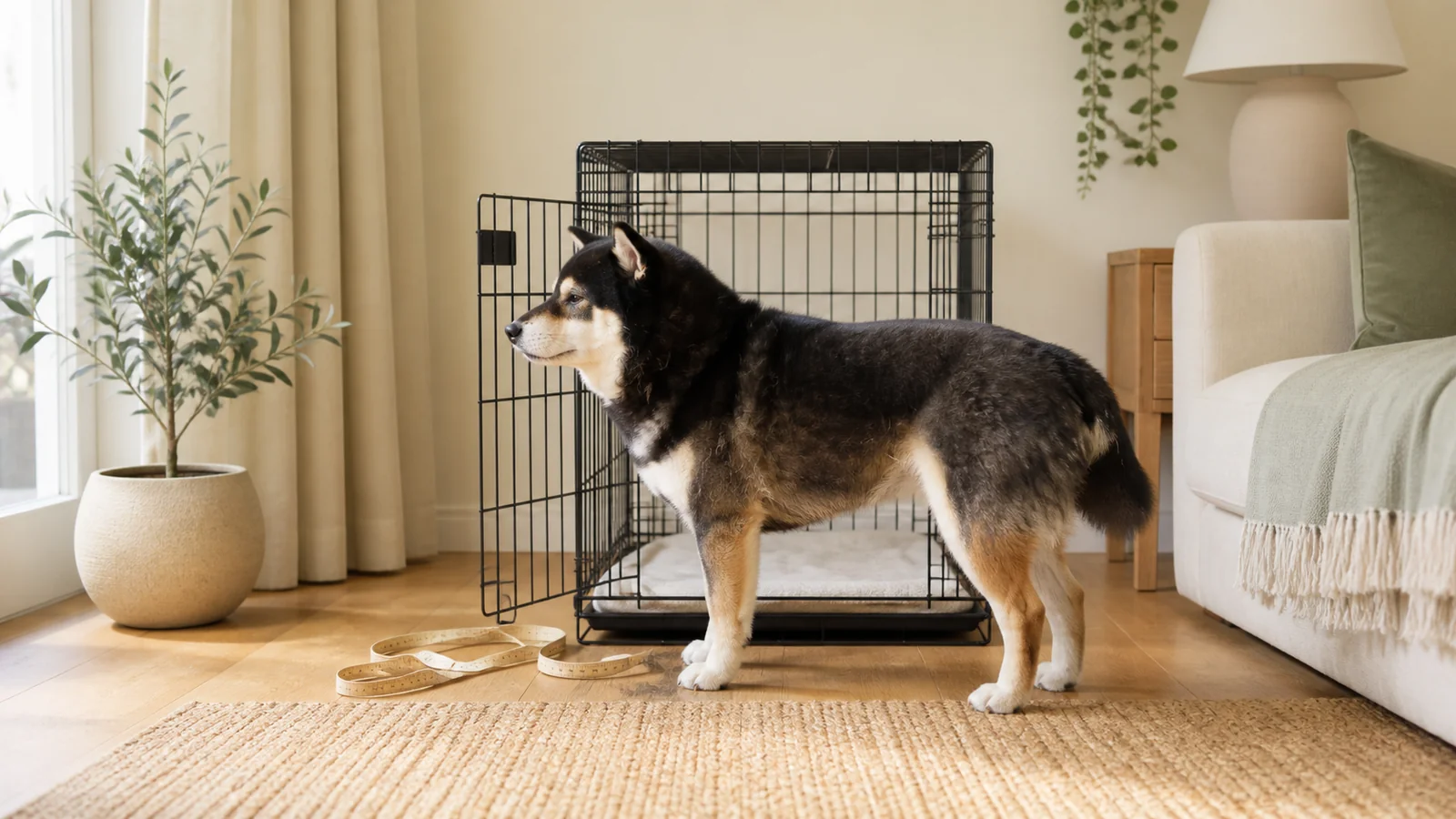
Crate sizing starts with your dog's body, not a generic breed chart. The goal is enough room to stand, turn around, and lie down comfortably while still keeping the crate appropriate for the use case.
This guide supports the Dog Crates pillar and should be read before comparing Large Dog Crates, Small Dog Crates, home crates, Dog Kennel vs Dog Crate, or soft vs wire crates.
For a printable version of the measurement and setup checks, use the Dog Crate Setup Checklist after estimating your dog's crate range. For young puppies, use the Puppy Crate Training Schedule to plan potty breaks, naps, short training, and gradual crate comfort.
Quick read
TL;DR
- Measure height and length before choosing a crate.
- Use internal dimensions, not only outside dimensions.
- The dog should usually stand, turn, and lie down comfortably.
- Bedding changes usable height and floor space.
- Puppies often need dividers so the crate can grow with them.
- Too small is uncomfortable; too large can be less useful for some training routines.
Quick answer
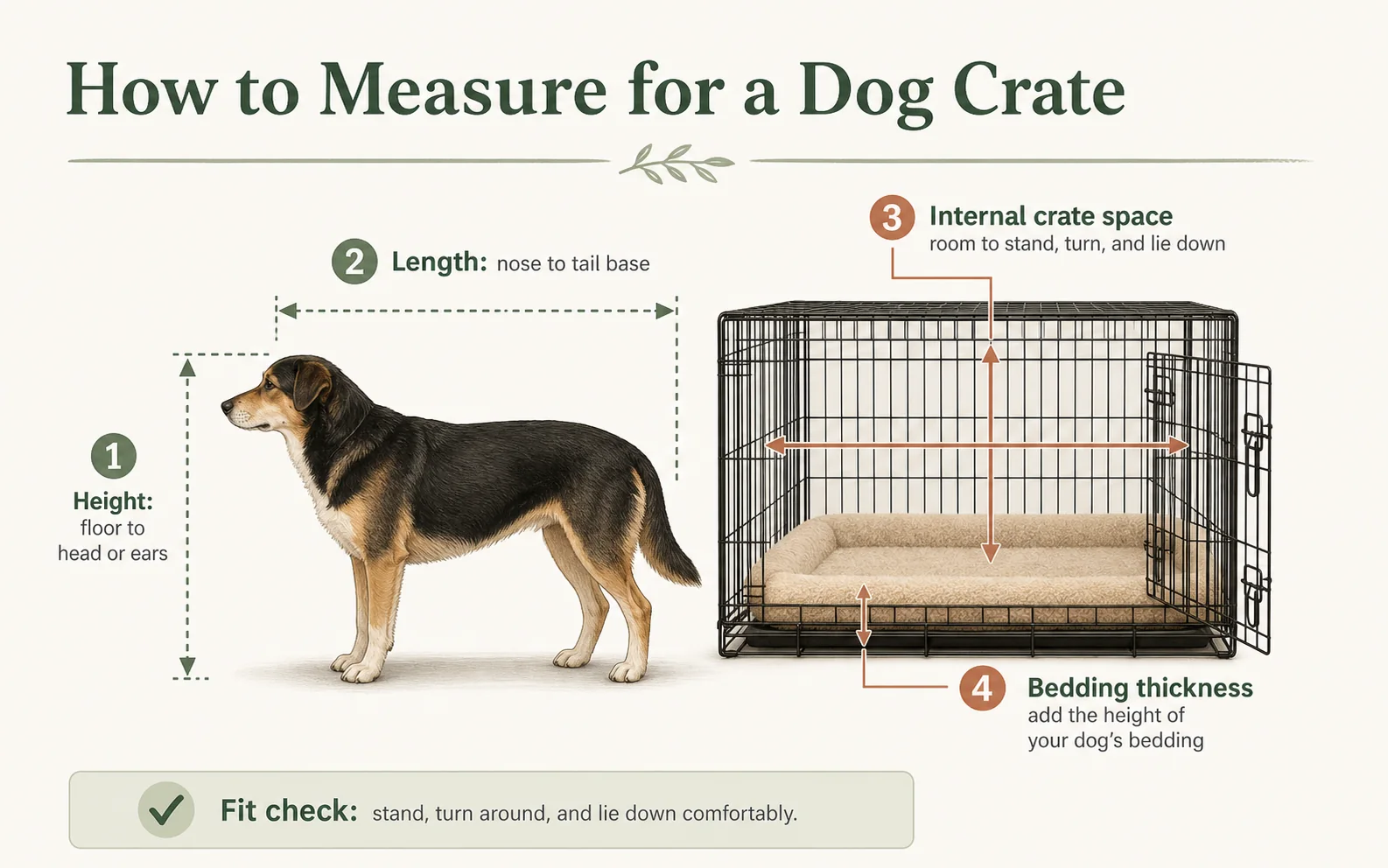
Measure your dog from the floor to the top of the head or ears, whichever is taller in normal posture. Measure length from nose to tail base. Add practical room, then compare those numbers with the crate's internal dimensions.
If your dog is still growing, consider a crate with a divider. If your dog is fully grown, choose a crate that fits their normal standing and resting posture without forcing them to crouch or twist.
Share & embed
Adult dog
Crate based on current body measurements
- Look for
Internal height, internal length, room to turn
- Avoid
Breed chart alone
Growing puppy
Crate with divider
- Look for
Adjustable usable space, secure divider, easy cleaning
- Avoid
Huge empty crate without divider
Dog uses thick bedding
Slightly more height and floor clearance
- Look for
Mat thickness, door movement, turning room
- Avoid
Bedding that blocks the door
Travel or car use
Purpose-specific crate or carrier
- Look for
Rules, safety claims, ventilation, fit
- Avoid
Assuming any crate works for travel
Measure height and length
For height, measure your dog standing naturally. If the ears sit higher than the head in normal posture, include them. A dog should not need to crouch to stand in a routine home crate.
For length, measure from the nose to the tail base, not the full tail. Add enough space for the dog to lie down and turn. Very exact numbers are less useful than observing whether the crate allows normal movement.
Signs a crate is too small
A crate is likely too small if your dog crouches while standing, cannot turn around, avoids lying down, presses against the sides awkwardly, or has to curl tightly even when they normally sprawl.
Do not rely on the dog entering the crate as proof that the size is right. Some dogs will enter spaces that are not comfortable for longer rest.
Signs a crate is too large
For adult dogs using a crate as a rest space, extra room is not always a problem. For some puppy training routines, though, a crate that is much too large can stop feeling like a defined rest area. A divider is usually better than buying a small crate that will be outgrown quickly.
The right amount of room also depends on how the crate is used. A bedroom rest crate can usually be a little more generous than a puppy crate used during house-training routines. A recovery crate may need guidance from a vet, especially if movement should be limited after a procedure. A travel carrier may have separate sizing rules from the carrier maker, airline, or safety standard. Do not force one home-sizing rule onto every situation.
For travel-specific decisions, compare your crate or carrier against the actual trip requirements. The CDC's pet travel safety guidance is a useful external reference for planning beyond normal home crate sizing.
If your dog has a deep chest, long legs, a very fluffy coat, or a curled tail that changes how they turn, watch them move inside the crate before deciding the fit is right. The numbers get you close, but the final check is whether the dog can enter, turn, stand, and settle without awkward body compression.
Puppy divider panels
Divider panels let one crate adjust as a puppy grows. Check that the divider attaches securely and does not wobble or leave gaps. It should be easy to move as the puppy gets larger.
The divider should create enough room for standing, turning, and lying down, not a cramped box. Recheck often during growth spurts.
Bedding and mats
Bedding changes crate fit. A thick mat reduces standing height and can interfere with the door. A soft bed may bunch at the edges. A crate mat should lie flat, fit the floor, and be washable.
For puppies or dogs that chew bedding, start simple. Loose bedding can become unsafe if the dog tears it apart.
Use the Dog Crate Mats Guide when mat thickness, internal floor fit, non-slip backing, or washable covers are part of the decision.
| Option | Best for | Key features | Caveat | Merchant |
|---|---|---|---|---|
Wire crate with divider | Puppies and growing dogs | Adjustable space, airflow, removable tray | Can rattle and feel exposed | |
Standard adult crate | Fully grown dogs | Sized to current body, simple setup | Less flexible if measurements are wrong | |
Washable crate mat | Comfort inside crate | Low profile, removable, easier cleaning | Less support than full bed | |
Plastic crate | Dogs needing more enclosure | Den-like feel, portable shell | Internal shape can reduce usable room |
Category picks
These are category-level recommendations, not fixed single-product winners.
Common mistakes
✓ Better buying habits
- Measure height and length in normal posture.
- Compare against internal crate dimensions.
- Include bedding thickness in the fit.
- Recheck puppy fit during growth.
- Use dividers instead of guessing future size.
× Mistakes to avoid
- Buying only from a breed chart.
- Forgetting that plastic crates can have smaller usable interiors.
- Choosing bedding that blocks the door.
- Letting a puppy outgrow the divider setup.
- Assuming a travel crate follows the same rules as a home crate.
Related guides
After sizing, use the Dog Crate Setup Checklist before comparing listings. Use the Dog Crate Mats Guide before choosing thick bedding, washable crate pads, or waterproof mats. If the crate is for a new puppy, print the Puppy Crate Training Schedule to plan daily routine checks. Read Best Dog Crates for Home Setup for room placement and crate type. If the crate will double as an end table, nightstand, or visible room furniture, compare Dog Crate Cover vs Furniture Crate and use the Dog Crate Furniture Guide before comparing decorative listings. Use Dog Kennel vs Dog Crate when listings mix indoor crates, travel kennels, outdoor dog runs, and dog cage wording. Use Soft Dog Crates vs Wire Dog Crates for material tradeoffs. Return to the Dog Crates pillar for the broader framework.
Frequently asked questions
How much room should a dog have in a crate?
Enough to stand, turn around, and lie down comfortably. The crate should not force crouching or awkward compression.
Should I size a crate by weight?
Weight can be a rough clue, but body measurements are better. Dogs with the same weight can have very different height and length.
Should puppies get adult-size crates?
Often yes if the crate includes a secure divider. Without a divider, a very large crate may be less useful for some routines.
Do I measure to the end of the tail?
Usually measure to the tail base for crate length. The goal is body comfort and movement, not extra space for the full tail.
Can bedding make a crate too small?
Yes. Thick mats reduce height and can block the door or bunch at the sides.
Are soft crate sizes measured the same way?
Use the same body measurements, but check shape carefully. Fabric sides, angled frames, and soft corners can reduce usable space.