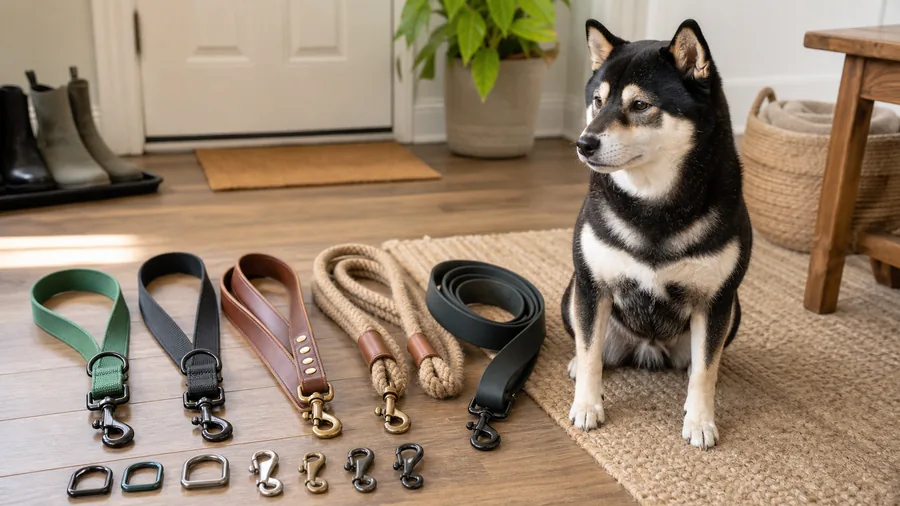
Dog leash material changes grip, cleaning, weather handling, weight, hardware feel, and how the leash behaves under sudden tension. Length matters, but the material, stitching, and clip are what you trust every day.
Start with the Harnesses, Collars & Leashes pillar for the full walking gear framework. Use this guide when the main question is whether nylon, leather, rope, coated webbing, or another leash material fits your routine. If the leash is for first puppy walks, start with Best Leash for Puppy before comparing materials.
Quick read
TL;DR
- Nylon webbing is the practical default for many daily walks, but thickness, edge feel, stitching, and UV wear matter.
- Full-grain leather can feel comfortable over time, but it needs care and should be kept dry, conditioned, and inspected.
- Rope can feel secure, especially in open-space routines, but sudden tension can be hard on hands.
- Coated webbing, including BioThane-style materials, can be easy to wipe clean, useful for rain, mud, snow, beach walks, and odor control.
- Hardware matters as much as material: clip type, metal quality, swivel movement, stitching, D-rings, and handle comfort all affect safety.
- No leash material replaces training, fit checks, or appropriate handling.
Quick answer
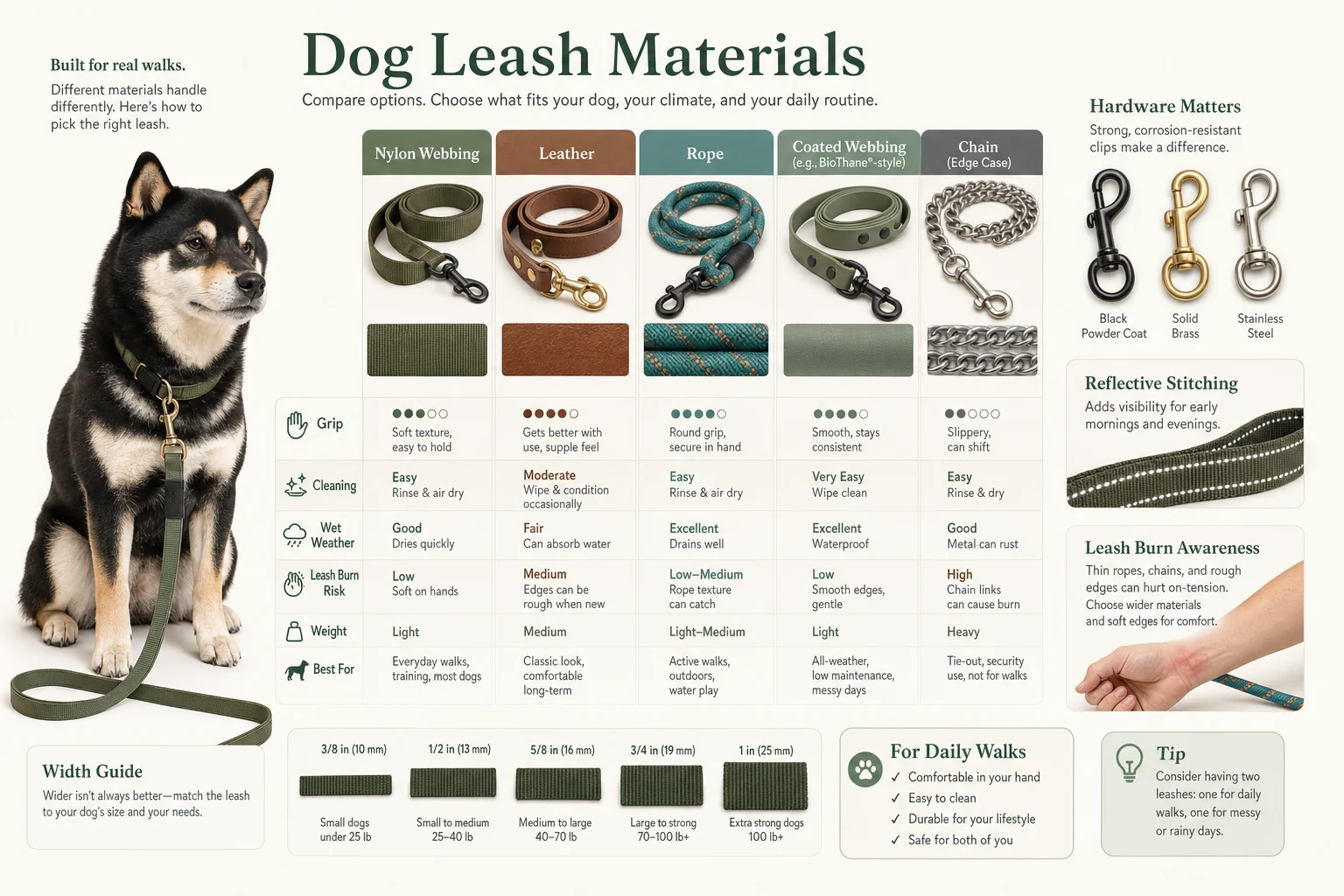
Choose leash material by matching the walk: nylon for simple everyday use, full-grain leather for handlers who want a traditional feel and will maintain it, rope for secure grip in open routines, and coated webbing for wet, muddy, or odor-prone walks. Then check clip size, metal quality, leash width, stitching, handle comfort, visibility, and how the leash feels under tension.
Share & embed
Everyday neighborhood walks
Nylon leash
- Look for
Lightweight, affordable, easy to find, predictable
- Avoid
Weak stitching or clips that are too heavy or too small
Rain, mud, odor, beach, or snow
Coated webbing leash
- Look for
Wipes clean, dries fast, resists odor better than absorbent fabric
- Avoid
Very stiff material or slippery grip
Handlers who like a broken-in feel
Leather leash
- Look for
Comfortable grip, durable when maintained, classic handling
- Avoid
Neglecting care, cracks, water damage
Open-space walking or training
Rope leash or long line
- Look for
Secure hand feel, visible structure, useful lengths
- Avoid
Leash burn, tangles, heavy hardware
What this guide can and cannot claim
This is a researched buying guide, not a lab test. What Dogs Like does not claim that one leash material is universally strongest, safest, or right for every dog. Product listings, manufacturer ratings, hardware choices, stitching quality, age, UV exposure, chewing, and daily wear all change real-world safety.
Use manufacturer-stated break strength, working-load guidance, material details, return policies, and recent owner feedback when comparing exact products. If your dog is very strong, reactive, difficult to physically control, or has a history of escaping gear, treat leash choice as one part of a broader handling and training plan.
Nylon webbing
Nylon is common because it is affordable, light, strong enough for many dogs, and available in many widths and lengths. It is a sensible first comparison point for everyday walks.
The weak points are usually stitching, clip quality, UV wear, edge feel, and hand comfort. Thin flat nylon can cut into hands under sudden tension. Very wide nylon can be bulky for small dogs. Reflective stitching and a padded handle can be useful, but they do not compensate for poor hardware.
For stronger dogs, compare denser webbing, reinforced stitching, and rounded or tubular nylon construction. Be cautious with vague terms like "military grade" unless the listing explains webbing width, thickness, stitching, clip type, and any manufacturer load rating.
Leather
Leather can become comfortable in the hand and can last when cared for. It is often heavier and more expensive than nylon, and it does not like neglect, repeated soaking, or poor storage.
Full-grain leather is generally the phrase to look for when durability matters because it keeps the outer grain of the hide. Be more cautious with vague "genuine leather" wording, bonded leather, decorative braided sections, or listings that do not show stitching and hardware clearly.
Check the clip, rivets or stitching, handle construction, and whether the leather feels flexible without cracking. Leather is not the simplest choice for constant mud, rain, beach, or odor-heavy routines.
Rope
Rope leashes can feel secure and substantial. They are common for training lines, thicker everyday leashes, and handlers who prefer a rounded grip.
Climbing-style rope leashes often use kernmantle-style construction: a core for strength and an outer sheath for abrasion resistance. That structure can feel substantial, but the leash is still only as trustworthy as its stitching, handle join, and clip.
The tradeoff is hand safety. A rope leash can create friction if it slides quickly through your hand. Long rope lines can tangle, drag dirt, and let a dog build speed before reaching the end. Use longer rope lines only where there is space and attention.
Coated webbing
Coated webbing, including BioThane-style materials and other waterproof-coated straps, is useful when cleaning matters. It can wipe down after rain, mud, snow, or beach walks and may hold less odor than absorbent fabric.
BioThane® is a registered coated-webbing brand often used in dog gear, horse tack, and outdoor straps. If a listing says BioThane, check whether it clearly names the material and shows the hardware and stitching. If it says only "BioThane-style" or "coated webbing," treat it as a category description rather than proof of a specific substrate or rating.
The tradeoff is feel. Some coated leashes feel stiff, slick, or heavy depending on width and coating. Check grip, flexibility, edge feel, and clip weight before choosing it for a small dog or strong puller.
Chain and specialty materials
Chain leashes are a narrow-use option. They may deter some leash chewing, but they are heavy, less comfortable to handle, noisy, and not a fix for behavior. For most daily walks, start with a normal leash material and address chewing, arousal, or handling problems directly.
Reflective panels, traffic handles, bungee sections, and padded handles can be helpful when they solve a real walking problem. Avoid adding features before checking basic length, material, clip strength, and comfort.
Hardware, width, and handle feel
A leash is only as useful as its clip and stitching. Check the snap, swivel, D-rings, rivets, sewn seams, and handle. The clip should match the dog's size and the attachment point. A huge clip can be uncomfortable for small dogs. A tiny clip can be wrong for stronger dogs.
Width also matters. Thin leashes can be light but hard on hands. Wide leashes can be easier to grip but may be heavy. If you walk in low light, reflective details on the leash help, but the dog should still have visible gear too.
Material choice by dog and environment
Use this matrix to narrow the first comparison set. It is not a universal size chart; always check the current product listing, hardware, and manufacturer guidance.
| Option | Best for | Key features | Caveat | Merchant |
|---|---|---|---|---|
Large or powerful puller | Dense nylon, rope, or rated coated webbing | Secure clip, reinforced stitching, comfortable handle | Do not rely on vague heavy-duty wording alone | See direct product examples below |
Rain, mud, snow, beach, or odor-prone walks | Coated webbing or BioThane-style leash | Wipe-clean surface, corrosion-aware hardware | Stiff or slick material can feel awkward | See direct product examples below |
Traditional daily walks | Full-grain leather or sturdy nylon | Comfortable grip, maintained material, reliable snap | Leather needs care and nylon can fray | See direct product examples below |
Open-space long-line practice | Rope or coated long line | Visible line, swivel clip, manageable weight | Tangles and sudden speed increase risk | See direct product examples below |
Small dogs and puppies | Light nylon or narrow coated webbing | Low clip weight, soft handle, simple length | Oversized hardware can pull on the harness or collar | See direct product examples below |
Budget and safety tiers
Low-cost leashes can work for calm, small, or short daily routines, but the cheapest options often save money through thinner webbing, basic stitching, and generic snap hooks. Inspect them more often and replace them when edges fray, clips stick, or stitching loosens.
Mid-range leashes usually improve handle comfort, reflective stitching, webbing thickness, and clip quality. This is often the sensible range for everyday nylon, rope, and padded-handle designs.
Premium leashes tend to use branded coated webbing, full-grain leather, stronger hardware, reinforced joins, or locking clips. A higher price still does not remove the need to check fit, length, grip, and current product details.
Leash materials compared
| Option | Best for | Key features | Caveat | Merchant |
|---|---|---|---|---|
Nylon webbing | Most daily walks | Light, common, affordable, many sizes | Can fray and may be rough under tension | See direct product examples below |
Leather | Handlers who maintain gear | Comfortable grip, classic feel, durable with care | Needs maintenance and dislikes repeated soaking | See direct product examples below |
Rope | Open areas and secure grip preference | Substantial hand feel, many long-line options | Can burn hands and tangle | See direct product examples below |
Coated webbing | Rain, mud, odor, snow, beach | Wipes clean, dries fast, resists moisture | Can feel stiff or slick | See direct product examples below |
Chain | Specific chewing edge cases | Harder for some dogs to chew through | Heavy, noisy, uncomfortable handling | See direct product examples below |
Direct product examples to inspect
These are direct Amazon product examples, not final rankings. Product details, colors, sizes, prices, and availability can change, so check the current listing before buying.
Direct examples to revisit
These links return to the specific product examples shown above. They are not rankings; compare current listings by material feel, clip size, width, handle comfort, stitching, visibility, cleaning, and recent owner feedback.
Direct product examples
Revisit the leash examples by material and routine
What Dogs Like may earn from qualifying purchases. Affiliate links do not change the leash material checks in this guide.
Common mistakes
✓ Better buying habits
- Match material to weather, cleaning, and walking environment.
- Check clip size and stitching before color.
- Choose leash width that fits both the dog and your hand.
- Use reflective details for low-light walks.
- Inspect fraying, cracks, stiff clips, and worn stitching.
- Pair longer lines with a well-fitted harness where sudden tension is possible.
× Mistakes to avoid
- Choosing a leash only by color.
- Buying heavy hardware for a small dog.
- Using slippery or stiff material where grip matters.
- Letting rope slide quickly through bare hands.
- Treating chain as a training plan.
- Keeping damaged leashes in daily use.
Related guides
Use the curated Dog Leashes hub to move between length, material, puppy, and everyday handling decisions. Use the Dog Leash Length Guide to choose between 4-foot, 6-foot, 10-foot, long-line, and retractable options. Read Collars and Leashes for Everyday Walks for a complete daily setup.
For harness pairing, use the Dog Harness Fit Guide and print the Harness Fit Checklist. For puppies, read Best Leash for Puppy and the Puppy Harness Size Guide, then use the Puppy Walking Gear Checklist before choosing leash material, clip weight, collar ID setup, and first-walk gear. For clip placement, compare Front Clip vs Back Clip Harnesses. For collar role and ID fit, use the Dog Collar Size Guide. For sizing tools, use the Dog Harness Fit Calculator and Dog Collar Size Calculator. Return to the Harnesses, Collars & Leashes pillar for the full walking gear framework.
Frequently asked questions
What is the best dog leash material?
For many daily walks, nylon webbing is the simplest starting point. Leather, rope, and coated webbing can be better when they match your weather, cleaning, grip, and handling needs.
Is BioThane or coated webbing good for dog leashes?
Coated webbing can be useful for rain, mud, snow, beach walks, and odor control because it wipes clean. Check stiffness, grip, width, and hardware before buying.
Is BioThane better than nylon for wet walks?
For wet, muddy, snowy, or beach routines, coated webbing or BioThane-style leashes are often easier to clean than absorbent nylon because the surface can be wiped down. Nylon can still be a better everyday value if you want softer hand feel, lower cost, or more flexible webbing. Compare the exact listing, not only the material name.
Are leather leashes worth it?
They can be worth it for handlers who like the feel and will maintain the material. Leather should be inspected for cracking, water damage, stitching, and clip wear.
Is leather or nylon better for a strong dog?
Neither material is automatically better. Dense nylon or tubular webbing can be practical for strong daily walkers because it is easy to inspect and replace. Full-grain leather can be durable when maintained, but it can crack or stretch if neglected. For strong dogs, hardware, stitching, width, and manufacturer guidance matter as much as the material.
Can rope leashes hurt your hands?
They can if the leash slides quickly under tension. Use careful handling, avoid wrapping rope around your hand, and choose materials you can grip safely.
What leash hardware should I avoid?
Avoid worn, rusty, sticky, bent, or poorly described hardware. Be cautious with very cheap snap hooks on strong dogs, especially when the listing does not explain the metal, swivel, stitching, or weight rating. Replace any leash with a clip that no longer closes cleanly.
How should I clean a nylon dog leash?
Brush off dry dirt first, then wash gently with mild soap or follow the maker's care instructions. Avoid bleach and high heat because harsh cleaning can weaken fibers or stitching. Air dry fully before putting the leash back into daily use.
Should I use a chain leash for chewing?
Usually only as a narrow edge-case tool. Chain is heavy and uncomfortable to handle, and chewing or leash biting should be addressed with safer handling and training support.