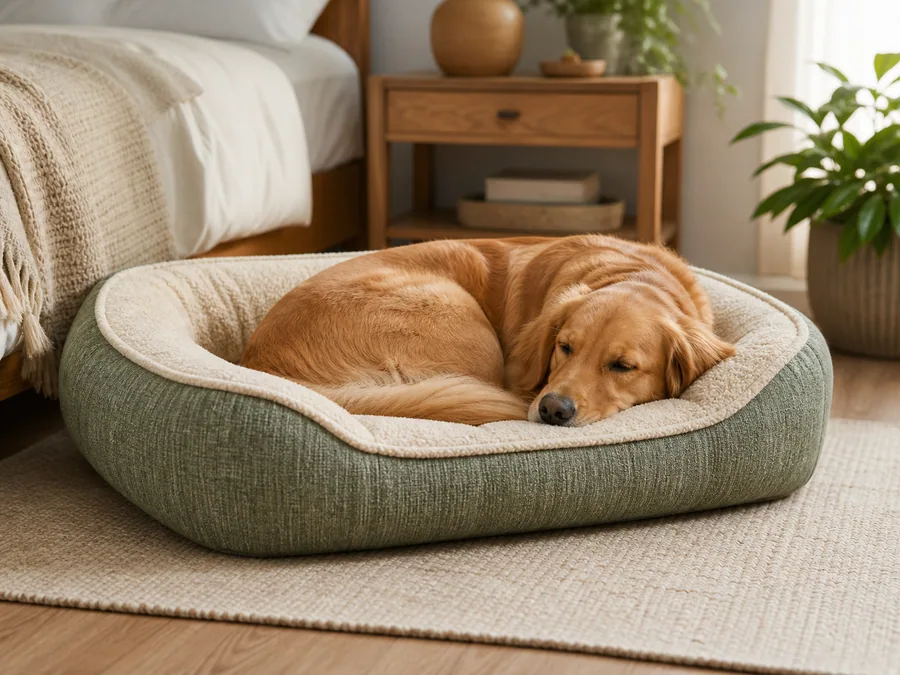
Dog beds look simple until you compare support, size, cleaning needs, sleep position, materials, room placement, and how your dog actually rests. A good bed is not only a soft place to lie down. It should fit your dog's body, match their sleep style, hold up to everyday cleaning, and work in the space where the bed will live.
This guide is a practical starting point for choosing a dog bed without relying on fake testing claims or vague "best overall" language. Use it to narrow the type of bed worth considering, then use the supporting guides for sizing, support, washable construction, waterproof liners, and room placement.
Quick read
TL;DR
- Best first choice for many homes: a washable bed with enough room for your dog’s normal sleep position.
- Choose orthopedic foam when support, weight, age, or long rest periods are the main concern.
- Choose a bolster bed when your dog curls, leans, or likes a raised edge around them.
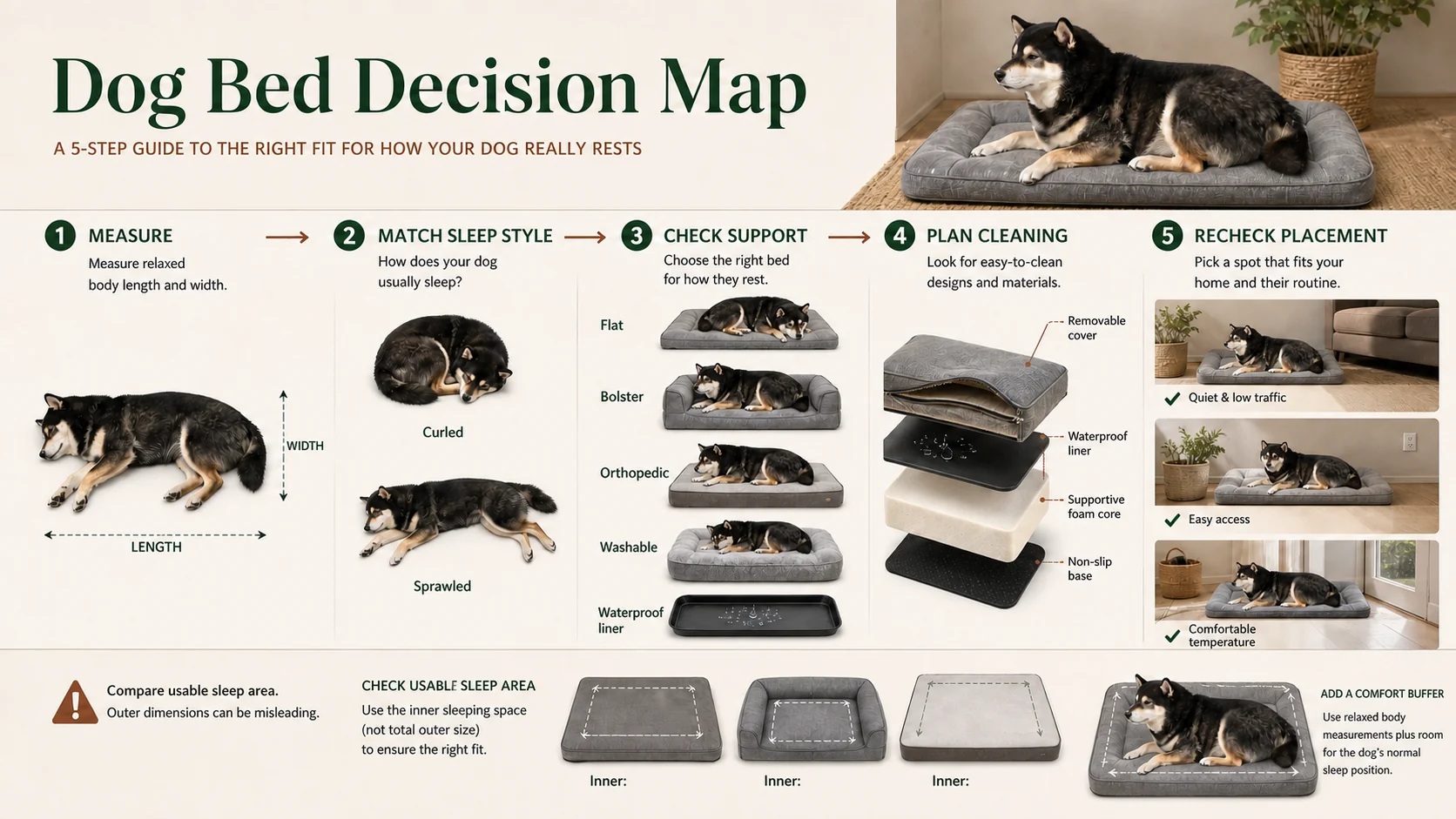
- Measure the sleep area, not just the outside dimensions, especially on bolster and furniture-style beds.
- Prioritize cleaning for puppies, shedders, outdoor-loving dogs, odor control, and apartment living.
- Avoid fake certainty: product labels are useful starting points, but size charts, materials, cover design, and recent owner feedback matter more.
Share & embed
Quick answer
For many homes, the best starting point is a washable bed that fits your dog’s usual sleep position. Use these quick filters before comparing specific listings:
- Sprawlers: start with a flat rectangular bed, orthopedic foam bed, or wide mat-style bed.
- Curlers and leaners: consider a bolster, round bed, or bed with one raised side.
- Senior or stiff dogs: look for supportive foam, low entry, and enough room to change positions.
- Puppies and muddy paws: prioritize washable covers, simple construction, and fast drying.
- Warm sleepers: avoid very plush beds unless the cover is breathable and easy to wash.
- Persistent chewing or shredding: use Best Chew-Proof Dog Beds to match edge access, digging, and ingestion risk to construction.
- Hot-weather comfort: compare water-core mats and breathable cots in Best Cooling Dog Beds without treating either as heatstroke prevention.
- Small apartments: choose a shape that fits the room without blocking walkways or doors.
Senior dogs, large breeds, and dogs that spend long stretches resting in one spot may benefit from a supportive foam bed. That does not mean every dog needs the thickest orthopedic option. Support, entry height, cover design, heat retention, and your dog’s mobility all matter.
If you are unsure where to start, choose a bed that is large enough for your dog’s relaxed sleep position, has a removable washable cover, and is easy to place in the room where your dog already likes to rest.
If your dog sprawls
Flat or orthopedic foam bed
- Look for
Wide usable sleep surface, removable cover, foam that does not flatten quickly
- Avoid
Small round beds, narrow bolsters, vague size labels
If your dog curls or leans
Bolster or round dog bed
- Look for
Raised edge, soft but stable sides, enough interior sleep space
- Avoid
Tall sides that make entry hard or reduce usable room
If cleaning is the pain point
Washable cover bed
- Look for
Removable cover, sturdy zipper, clear wash and drying instructions
- Avoid
Beds that only say washable without explaining which part
If support matters most
Orthopedic-style foam bed
- Look for
Foam thickness, low entry, protected foam core, flat sleep surface
- Avoid
Marketing claims without material or dimension details
How to choose a dog bed
Start with your dog, not the product listing. Weight ranges and breed labels can be useful, but they do not tell the full story. Two dogs of the same breed may sleep differently, chew differently, shed differently, and use a bed in completely different parts of the home.
Sleep style
Watch how your dog sleeps for a few days. A dog that curls into a tight circle may enjoy a round bed, cave-style bed, or bolster bed with a cozy edge. A dog that stretches out on the floor usually needs a flatter, longer surface. A dog that leans against furniture may use a bolster as a headrest or back support.
Sleep style also affects whether raised sides help or get in the way. Bolsters can be comforting for some dogs, but they reduce usable stretch-out space. For dogs with stiff joints, a flat bed with low entry can be easier than climbing into a deep nest-style bed.
Size and shape
Measure your dog while they are lying in a relaxed position, then add room for movement. If your dog sprawls, measure the full stretched posture too. The dog bed size guide covers this in more detail, but the basic rule is simple: a dog should be able to rest naturally without being forced into one position.
Shape matters as much as length. Rectangular beds are flexible and easy to place against a wall or sofa. Round beds can work well for dogs that curl. Crate mats are useful inside crates or travel setups, but many are thinner than full beds.
Support
Support matters most for large dogs, senior dogs, heavy dogs, and dogs that rest for long periods. Orthopedic-style beds are worth considering when a thin pillow bed compresses too much or when your dog seems to prefer firmer surfaces.
The word “orthopedic” is not a regulated guarantee. Look for practical details: foam thickness, whether the sleep surface stays flat under weight, whether the foam is protected from moisture, and whether the cover is removable. The best orthopedic dog beds guide goes deeper into support-focused choices.
Useful support signals include:
- A flat sleep surface that does not collapse into a thin cushion.
- Enough foam depth for your dog’s weight and resting habits.
- A cover that can be removed without fighting the foam insert.
- Low enough entry for dogs with stiffness or limited mobility.
- Moisture protection if accidents, drool, or damp paws are likely.
Cleaning
Cleaning is not a minor feature. It is one of the main reasons some beds stay useful and others get replaced quickly. A removable washable cover is often the most realistic option for medium and large beds. Fully machine-washable small beds can be convenient, but large foam beds usually rely on a cover and sometimes a liner.
For puppies, heavy shedders, dogs that track dirt inside, or homes where odor control matters, prioritize cleaning before decorative shape. The washable dog beds guide covers cover design, zippers, liners, and drying needs. Use the Dog Bed Cleaning Schedule when you want a printable routine for cover washing, liner checks, foam inspection, and drying notes.
Materials and comfort
Common bed materials include polyester fill, shredded foam, solid foam, memory foam, fleece-style surfaces, canvas-like covers, and microfiber covers. Softer is not always better. Some dogs like plush surfaces, while others overheat or prefer a firmer place to stretch out. Use the Dog Bed Materials Guide when cover fabric, foam, liners, warmth, odor, or hair release are the main decision.
Pay attention to cover texture, noise, and heat. Waterproof liners can be useful, but some add a crinkly feel. Plush tops can feel cozy, but they may trap hair and warmth. Tighter woven covers may be easier to wipe down, but they might not feel as soft.
Home placement
A dog bed should fit your room as well as your dog. Before buying, decide where the bed will live: bedroom, living room, crate area, office corner, hallway, or travel setup. Measure the space, check door swings and walking paths, and think about whether the bed needs to move between rooms.
Dogs often use beds that are placed near people, not tucked away in unused corners. A bed that looks good but sits where your dog never relaxes will not solve much. A simpler bed in the right location can be the better choice. For a room-by-room setup workflow, use the Dog Bed Placement Guide.
Before choosing a large bed, quickly check:
- The bed will not block doors, drawers, crate doors, or common walking paths.
- Your dog already relaxes near that spot.
- The cover can be removed without dragging the whole bed through the house.
- The color and fabric can handle visible hair, lint, and everyday wear.
Dog bed types compared
Use this table as a starting point, not as a final verdict. The right option depends on your dog’s sleep style, mobility, cleaning needs, and the room where the bed will live.
| Option | Best for | Key features | Caveat | Merchant |
|---|---|---|---|---|
Orthopedic foam bed | Senior dogs, large breeds, and sprawlers | Supportive foam core, flat sleep surface, many removable covers | Can be warm, heavy, and more expensive | |
Bolster bed | Dogs that curl, lean, or like edges | Raised sides, nesting feel, headrest support | Less usable space for dogs that stretch out | |
Washable cover bed | Shedders, puppies, and everyday cleanup | Removable cover, easier odor control, practical maintenance | Zippers and drying time matter | |
Crate mat | Crates, travel, and backup resting spots | Low profile, portable, easy to place | Usually less support than a full bed | |
Cooling-style bed | Warm climates and dogs that overheat | Elevated or breathable surface, better airflow | Not every dog likes the firmer feel | |
Furniture-style dog bed | Living rooms and design-conscious homes | More polished appearance, often structured shape | Can cost more and be harder to clean |
Category picks
These are category-level recommendations, not fixed single-product winners. Use them to start comparison shopping, then check current listing details, dimensions, wash instructions, return policy, and recent owner feedback before buying.
An orthopedic foam bed is worth considering when support is the main problem to solve. Look for enough surface area, a removable cover, and a foam core that does not compress flat under your dog’s weight.
A washable cover bed is often the safest first choice for busy homes. It may not be the most premium-looking option, but easy cleaning can matter more than decorative details.
A bolster bed can be a good fit for dogs that like to nest or rest their head on an edge. Make sure the usable inner space is large enough, especially for medium and large dogs.
Common mistakes
✓ Better buying habits
- Measure your dog in a real sleep position before choosing a size.
- Prioritize removable washable covers for everyday homes.
- Match the bed shape to how your dog actually sleeps.
- Check interior dimensions on bolster beds, not just the outside size.
- Choose low-entry beds for dogs with stiffness or mobility concerns.
- Read recent owner feedback for zipper quality, cover shrinkage, odor, and foam compression.
- Compare return policies before buying a large or expensive bed.
- Put the bed where your dog already chooses to rest.
× Mistakes to avoid
- Buying only by breed or weight range.
- Treating “orthopedic” as a guaranteed quality claim.
- Choosing a bed that looks good but blocks the room or sits where the dog never rests.
- Ignoring drying time, zipper quality, and foam protection.
- Buying a tight bolster bed for a dog that usually sprawls.
- Assuming the outside dimensions are the usable sleep area.
- Choosing a plush top for a dog that already overheats.
- Forgetting that very thick beds can be harder for some dogs to step into.
Related guides
- Best Dog Steps for High Beds for measured bed height, tread depth, foam versus rigid construction, stable placement, and ramp alternatives.
Use the Waterproof Dog Bed Guide when liner coverage, seams, zippers, accidents, drying, and foam protection are the main buying questions.
For support-focused choices, start with Best Orthopedic Dog Beds for Support. That guide explains what “orthopedic” usually means, why the label can be vague, and what to look for in foam construction. If you are comparing support wording against a specific foam material, use Orthopedic vs Memory Foam Dog Bed.
For aging dogs, read Best Dog Beds for Senior Dogs. It combines low-entry access, surface stability, washable layers, temperature, placement, and changing mobility needs without treating bedding as medical care.
For fit and dimensions, use the Dog Bed Size Guide. It focuses on measuring your dog, matching shape to sleep style, and accounting for room placement. For bedroom, living room, office, crate-adjacent, and small-space setup decisions, read the Dog Bed Placement Guide.
For cleaning and odor control, read Washable Dog Beds for Easier Cleanup. It covers removable covers, washable small beds, waterproof liners, and why foam protection matters. Use the Dog Bed Cleaning Schedule to keep those checks practical after the bed arrives.
For large breeds and heavier dogs, read Best Dog Beds for Large Dogs. It focuses on surface area, foam compression, entry height, and cover durability.
For a patio, porch, or campsite, use Best Outdoor Dog Beds to compare raised cots with washable low pads and to check shade, weather exposure, and full drying. For compact dogs, Best Dog Beds for Small Dogs explains why inner sleeping area and entry height matter more than a weight label. If your dog voluntarily burrows under blankets, Best Cave Dog Beds compares hood openings, round versus rectangular fit, and easy exit.
For shape decisions, compare Bolster vs Flat Dog Beds. It helps match raised edges or open surfaces to the way your dog sleeps.
For material decisions, use the Dog Bed Materials Guide before choosing between plush tops, woven covers, foam cores, liners, and fill. If the bed may go inside a crate, compare Dog Bed vs Crate Mat before choosing a thick bed, low-profile mat, or crate-adjacent rest setup.
Helpful authority resources
For senior dogs, mobility changes, or discomfort after rest, use dog bed advice as a comfort starting point and ask a veterinarian when health is part of the decision. The AAHA senior care guidelines for dogs and cats are a useful veterinary reference for thinking about aging, mobility, comfort, and home adjustments.
Frequently asked questions
What type of dog bed is best for most dogs?
For many dogs, a washable bed with enough room for their usual sleep position is the best starting point. From there, choose more support for large or senior dogs, bolsters for dogs that curl or lean, and lower-entry shapes for dogs with mobility concerns.
How big should a dog bed be?
The bed should let your dog rest naturally without forcing one tight position. Measure your dog while relaxed, add room for movement, and choose the shape that matches how they sleep. Sprawlers usually need more surface area than dogs that curl.
Are orthopedic dog beds worth it?
They can be worth considering for senior dogs, large dogs, heavy dogs, and dogs that rest for long periods. Look for actual foam thickness, cover quality, and whether the bed stays supportive under your dog’s weight.
How often should a dog bed cover be washed?
For many homes, every one to two weeks is a practical rhythm. Wash more often for allergies, heavy shedding, outdoor dogs, muddy paws, odor, or accidents. Always follow the cover’s care instructions.
Is memory foam always better?
No. Memory foam can be helpful, but it can also retain heat and cost more. The right choice depends on your dog’s weight, mobility, heat sensitivity, sleep style, and whether the cover is easy to remove and wash.
Should a dog bed go inside a crate?
A crate mat or low-profile washable bed can work inside a crate if it fits safely and does not interfere with the crate door. For regular sleep outside the crate, many dogs benefit from a larger full-size bed with more support.