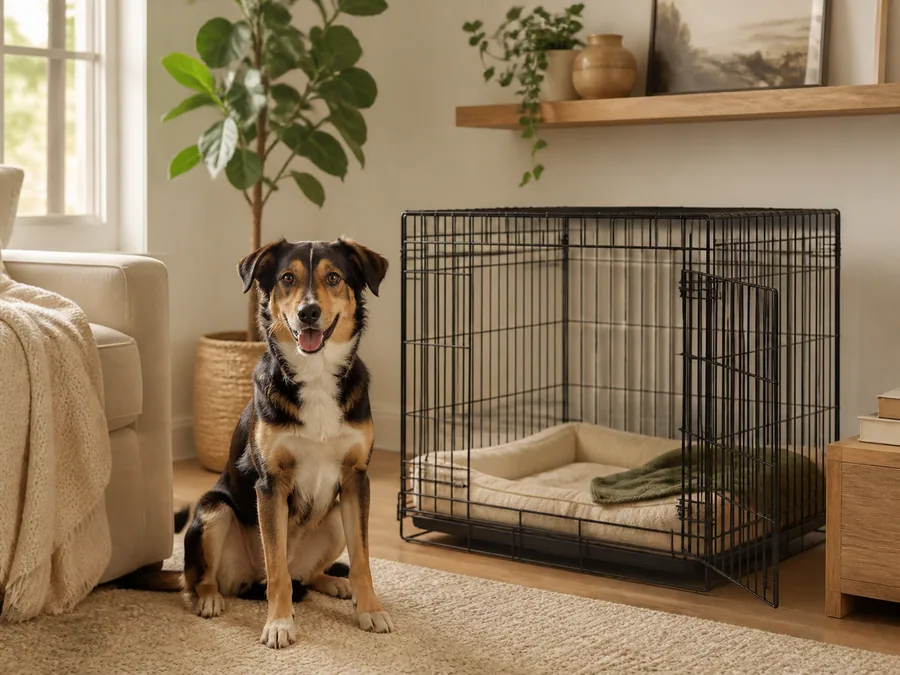
A crate should fit the dog, the room, and the job. A home crate for quiet rest is not the same decision as a portable travel crate, a puppy training setup, or a crate used during short recovery periods.
This guide is a practical hub for choosing a crate without treating every dog or every home the same. Use it to decide what kind of crate makes sense, then use the supporting guides for sizing, home setup, large- and small-dog fit, crate furniture, kennel-versus-crate wording, and soft-versus-wire tradeoffs.
Quick read
TL;DR
- Best first choice for many homes: a folding wire crate with the right internal dimensions and a removable tray.
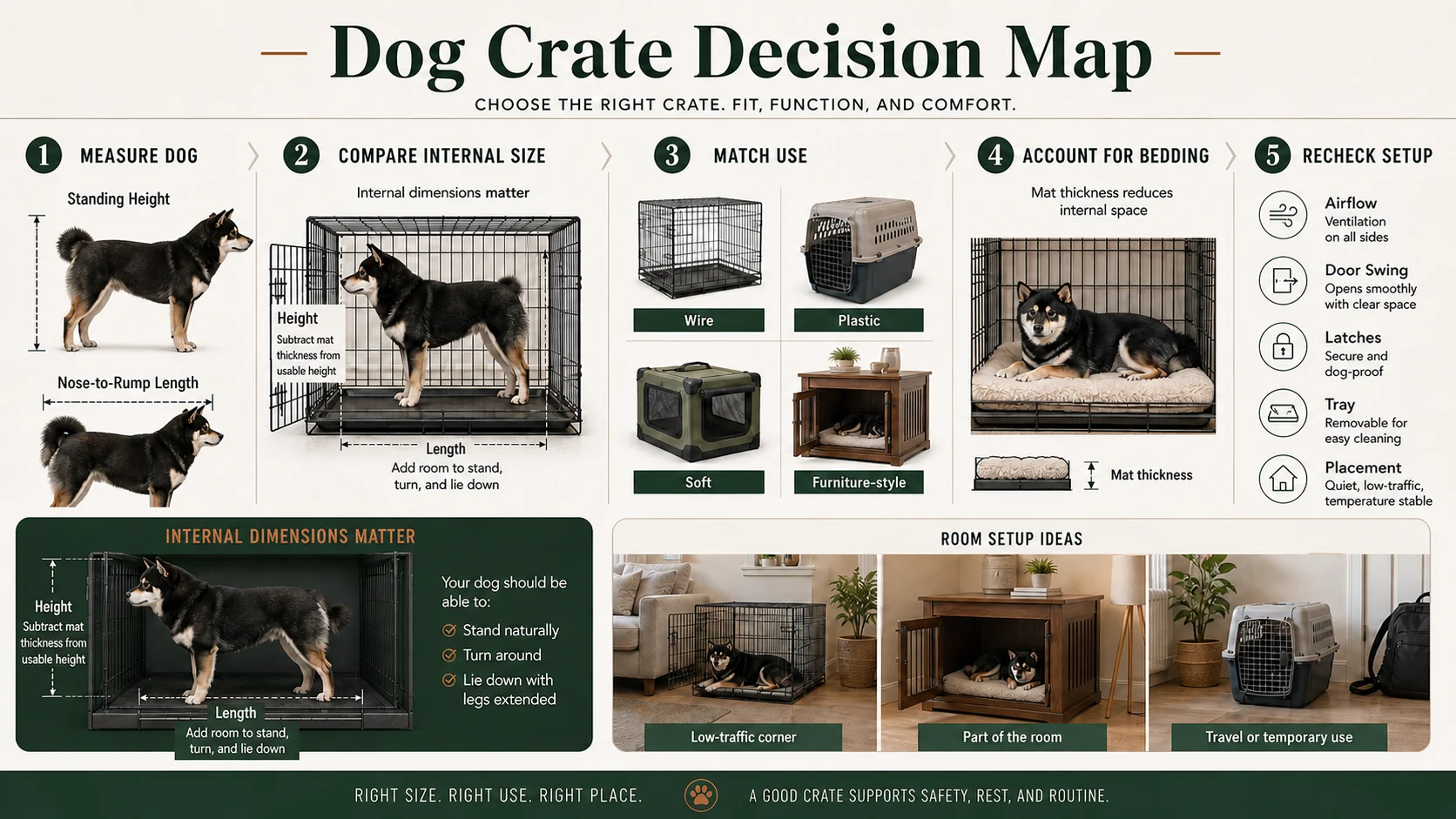
- Measure the dog first, then compare internal dimensions instead of relying only on breed labels.
- Choose wire crates for visibility, airflow, divider options, and routine home use.
- Choose soft crates only for calm, crate-comfortable dogs in appropriate supervised settings.
- Choose furniture-style crates when room appearance matters, but still check ventilation, door design, and cleaning.
- Avoid safety shortcuts: a crate is useful only when it fits, is introduced thoughtfully, and matches the dog's behavior.
Share & embed
Quick answer
For many owners, the safest starting point is a well-sized folding wire crate with a removable tray, secure doors, and a divider if the dog is still growing. It is not the prettiest option, but it is flexible, ventilated, widely available, and easier to evaluate than many decorative crates.
Use these quick filters before comparing listings:
- Puppies: consider a wire crate with a secure divider panel and easy-clean tray.
- Calm adult dogs at home: start with wire, furniture-style, or plastic depending on room placement and visibility needs.
- Dogs that chew or push barriers: avoid soft crates and weak latches.
- Dog damages standard crates: read Best Heavy-Duty Dog Crates before escalating containment, especially when anxiety may be involved.
- Light travel with crate-trained dogs: soft crates can be convenient when the dog is calm and supervised.
- Living-room setups: compare furniture-style crates carefully, especially ventilation, door swing, and cleaning access.
- Apartments: prioritize quiet setup, floor protection, door access, and a crate location that does not block daily movement.
If you are unsure, choose a crate that lets your dog stand, turn around, and lie down comfortably; can be cleaned after accidents; and fits the room where your dog can rest without being isolated.
For a printable pre-purchase workflow, use the Dog Crate Setup Checklist alongside the Dog Crate Size Calculator. If you are comparing broad listings for dog kennels, dog cages, indoor crates, or outdoor runs, read Dog Kennel vs Dog Crate before shopping. If the crate will sit in a living room, bedroom, or office, use Dog Crate Cover vs Furniture Crate and the Dog Crate Furniture Guide before choosing a decorative end-table crate. For new puppies, use the Puppy Crate Training Schedule to plan potty breaks, meals, naps, and gradual crate practice.
If your dog is a puppy
Wire crate with divider
- Look for
Adjustable space, removable tray, good airflow, simple monitoring
- Avoid
Oversized crates without a divider or fabric crates for chewing puppies
If the crate stays at home
Folding wire or furniture-style crate
- Look for
Room fit, ventilation, door access, cleaning, stable floor placement
- Avoid
Choosing by looks before checking internal dimensions
If you need light travel
Soft crate for calm trained dogs
- Look for
Low weight, carry handles, foldable frame, washable fabric panels
- Avoid
Using soft crates for escape artists or destructive dogs
If appearance matters
Furniture-style crate
- Look for
Ventilation, door design, chew-resistant surfaces, easy cleaning access
- Avoid
Decorative crates with poor airflow or awkward doors
How to choose a dog crate
Start with the real use case. "Dog crate" can mean a rest space in the living room, a puppy management tool, a travel setup, a quiet bedroom crate, or a temporary place for recovery. The right crate depends on which job matters most.
Size and movement
Crate size should start with your dog's body. A typical crate should allow the dog to stand in a normal posture, turn around, and lie down comfortably. Too small is uncomfortable and unfair. Too large can be less useful for some puppy routines because it stops feeling like a defined rest space.
The dog crate size guide goes deeper into measuring height and length, but the basic process is simple: measure your dog, add practical room, then compare against the crate's internal dimensions. External dimensions can be misleading when thick frames, angled sides, trays, or rounded corners reduce usable space.
Home setup
A crate only works if the home setup works. Before buying, decide where the crate will sit and how the door will open. Check walking paths, furniture clearance, outlets, heating vents, direct sun, cold drafts, and whether the crate can be cleaned without dragging it through the house.
Dogs often settle better when the crate is near normal household life but not in the busiest traffic lane. A crate tucked into a noisy hallway or isolated room may be less useful than a simple crate in a calmer corner of the living area.
For a deeper home-focused breakdown, use the best dog crates for home setup guide.
Safety and behavior
Crates are not a shortcut for training, supervision, or exercise. They can support routines, travel, rest, and recovery, but they should be introduced thoughtfully and used with humane time limits. A crate that causes panic, repeated escape attempts, or injury risk is not solving the problem.
Behavior matters when choosing material. A soft crate can be fine for a calm, crate-comfortable dog, but it is a poor fit for dogs that scratch, chew, paw at mesh, or try to force zippers. Wire crates are more structured, but they still need secure latches, smooth edges, and a stable floor.
Materials and construction
Common crate materials include coated wire, plastic shell, fabric over a frame, and furniture-style wood or composite panels. Each material changes airflow, visibility, cleaning, portability, noise, and durability.
Wire crates usually offer the best visibility and ventilation. Plastic crates can feel more enclosed and may suit some travel or den-like rest needs. Soft crates are light and portable, but depend heavily on fabric, zipper, mesh, and frame quality. Furniture-style crates can blend into a room, but need extra scrutiny because appearance can hide weak cleaning access or limited airflow.
Cleaning
Cleaning is a core buying criterion, especially for puppies, senior dogs, muddy paws, illness, and shedding. A removable tray makes wire crates easier to manage after accidents. Fabric crates may have washable panels or mats, but the exact design matters. Furniture-style crates can be harder to clean if panels, corners, or seams trap dirt.
Before buying, check:
- Whether the tray or floor liner removes easily.
- Whether a mat can fit without blocking the door.
- Whether fabric panels can be wiped or washed.
- Whether the crate can be moved for floor cleaning.
- Whether latches, corners, and seams look like they will collect hair or debris.
Travel and portability
Travel needs change the decision. A crate for light visits to family is not the same as an airline carrier or a crash-tested car restraint. Do not assume a crate is travel-safe just because it is portable. Check the actual manufacturer claims and match the product to the type of travel.
Soft crates can be useful for calm dogs in supervised travel settings. Wire crates can fold for storage but may be heavier. Plastic crates are common for certain travel use cases, but size, ventilation, door security, and rules matter.
Dog crate types compared
Use this table as a starting point. The best crate depends on your dog, the room, cleaning needs, and whether the crate needs to move.
| Option | Best for | Key features | Caveat | Merchant |
|---|---|---|---|---|
Folding wire crate | Most home routines and puppy setups | Ventilation, visibility, divider options, removable tray | Can rattle, look utilitarian, and feel exposed | |
Furniture-style crate | Living rooms and design-conscious homes | Blends with decor, enclosed feeling, can double as furniture | Often pricier, heavier, and harder to clean | |
Soft crate | Calm crate-trained dogs and light travel | Lightweight, foldable, easier to carry | Poor match for chewers, scratchers, or escape artists | |
Plastic crate | More enclosed rest and some travel needs | Den-like shell, portable, less visually busy | Less airflow and visibility than wire | |
Heavy-duty crate | Dogs that damage standard crates, under guidance | Stronger frame and latches | Expensive, heavy, and not a training substitute | |
Crate mat or pad | Comfort inside a suitable crate | Adds cushioning, removable, washable options | May be unsafe for dogs that chew bedding |
Category picks
These are category-level recommendations, not fixed single-product winners. Use them to start comparison shopping, then check current listing details, internal dimensions, latch design, tray design, return policy, and recent owner feedback before buying.
A folding wire crate is the most practical first comparison point for many homes. It is easy to size, easy to clean, and easier to inspect than many decorative alternatives.
A furniture-style crate can be a good fit when appearance is important, but it should still be judged like dog gear. Ventilation, usable interior space, cleaning, and durability matter more than the finish.
A soft crate is a convenience option, not a universal crate. It makes the most sense after a dog is already comfortable in a crate and the setting is appropriate.
Common mistakes
✓ Better buying habits
- Measure the dog before comparing crate listings.
- Check internal dimensions, not just the outside footprint.
- Choose the crate type by use case: home, puppy setup, travel, or room appearance.
- Prioritize safe latches, smooth edges, stable floors, and easy cleaning.
- Put the crate where the dog can rest without being isolated or overstimulated.
- Use a divider for many growing puppies instead of buying a huge empty space.
- Match bedding to chewing habits and cleaning needs.
- Read recent owner feedback for rattling, latch issues, tray quality, and assembly problems.
× Mistakes to avoid
- Buying only by breed chart.
- Choosing a decorative crate before checking ventilation and cleaning.
- Using a soft crate for a dog that chews, scratches, or pushes barriers.
- Assuming portable means safe for every kind of travel.
- Placing the crate in a drafty, hot, noisy, or high-traffic spot.
- Leaving a dog crated for unrealistic stretches of time.
- Adding thick bedding that blocks the door or reduces usable height.
- Treating a stronger crate as a substitute for training or behavior support.
Related guides
Use the Large Dog Crate Guide when doorway size, bedding height, room footprint, floor load, or stronger construction matters. Use the Small Dog Crate Guide when compact interiors, bar spacing, lightweight hardware, puppy growth, or home-versus-travel use shapes the decision.
For room layout, crate style, and day-to-day setup, start with Best Dog Crates for Home Setup. If ordinary wire has failed, use Best Heavy-Duty Dog Crates to separate latch manipulation and material damage from panic or confinement distress. If the crate needs to blend into a visible room, read Dog Crate Cover vs Furniture Crate before deciding whether a fabric cover is enough, then use the Dog Crate Furniture Guide before comparing end-table crates, crate covers, and convertible crate gates. If the search term is broader, use Dog Kennel vs Dog Crate to separate indoor crates, travel kennels, outdoor kennels, and dog cage listings.
For measurements, puppy divider decisions, and internal dimensions, use the Dog Crate Size Guide. Read it before buying a crate by breed or weight range.
For bedding, mat thickness, washable crate pads, and crate-floor fit, read Dog Bed vs Crate Mat and the Dog Crate Mats Guide before choosing a thick cushion or low-profile mat.
For material tradeoffs, compare Soft Dog Crates vs Wire Dog Crates. It explains when soft crates make sense and when wire crates are the better baseline.
For vehicle travel, use Best Dog Crates for Car Travel to compare current certification evidence, vehicle fit, anchor methods, ventilation, and access. If portability is the main question, follow with Soft vs Collapsible Dog Crates for Car Travel and keep destination convenience separate from crash-protection claims.
For puppy-specific setup, read Best Dog Crates for Puppies. It covers dividers, cleaning, chewing, crate mats, growth, and early routines. Use the Puppy Crate Training Schedule when you need a printable daily routine framework.
For enclosed versus open crate styles, compare Wire vs Plastic Dog Crates. It focuses on airflow, visibility, cleaning, and travel limitations.
Helpful authority resources
For crate introduction and routine-building, the AKC's step-by-step crate training guide is a useful external reference. For travel, the CDC's pet travel safety guidance is a better starting point than assuming a home crate is appropriate for every trip.
Frequently asked questions
Should every dog use a crate?
No. Crates can be useful for rest, travel, recovery, and some training routines, but they are not mandatory for every dog. They should be introduced thoughtfully and used with humane time limits.
What size dog crate should I buy?
Start with your dog's measurements. The dog should usually be able to stand, turn around, and lie down comfortably. For puppies, a crate with a divider can help adjust the usable space as the dog grows.
Are wire crates better than soft crates?
Wire crates are usually a better first choice for home routines because they are ventilated, visible, structured, and easier to clean. Soft crates are best for calm, crate-trained dogs in appropriate supervised settings.
Should a crate include a bed or mat?
Often yes, but the mat should fit safely and match the dog's chewing habits. For puppies or dogs that chew bedding, a simpler washable mat or no loose bedding may be more appropriate until habits are clearer.
Is a furniture-style dog crate worth it?
It can be worth considering when the crate will stay in a visible room. Check ventilation, cleaning access, door design, chew resistance, and internal dimensions before paying extra for appearance.
Can a dog crate be used for car travel?
Do not assume any crate is safe for car travel just because it is portable. Check the manufacturer's claims, the crate's intended use, and whether you need a crash-tested restraint or carrier for your situation.