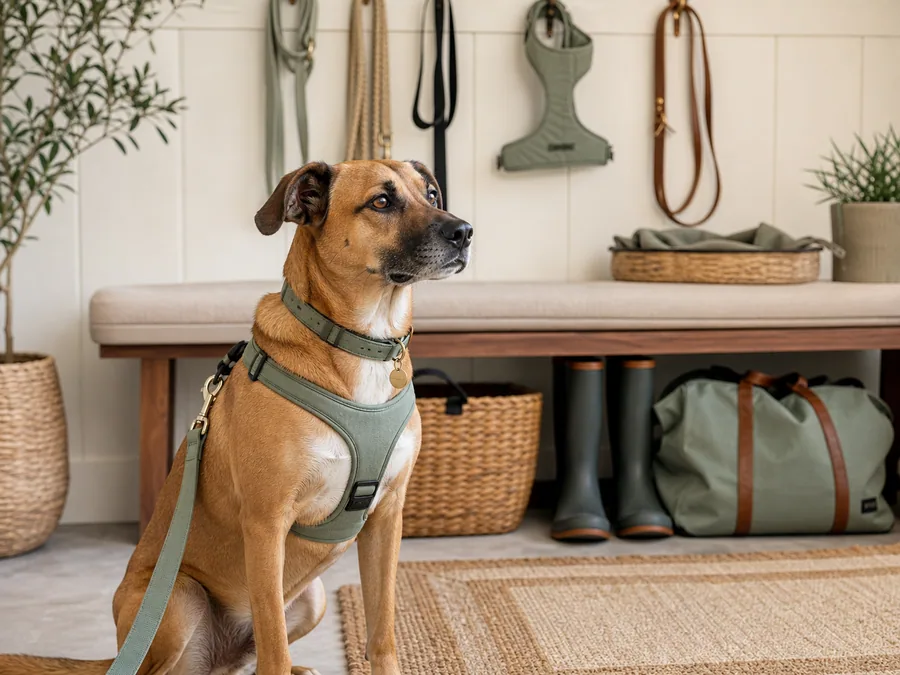
Walking gear should be comfortable, secure, and easy to use every day. The best setup depends on your dog's size, body shape, pulling behavior, training stage, handling needs, and where you walk.
This guide is a practical hub for choosing harnesses, collars, and leashes without pretending one setup fits every dog. Use it to narrow the category, then follow the curated Dog Harnesses, Dog Collars, or Dog Leashes subhub for the exact equipment question.
Quick read
TL;DR
- Best first setup for many dogs: a well-fitted harness for walks, a flat collar for ID, and a simple six-foot leash.
- Fit matters more than features: rubbing, shifting, and blocked shoulder movement can make good gear unpleasant.
- Use collars carefully: a collar is useful for ID and some calm routines, but it is not the best sole control point for every dog.
- Start with a six-foot leash for everyday walks before adding long lines, hands-free leashes, or retractable options.
- Match gear to behavior: pulling, sudden lunging, small-dog fragility, and large-dog strength all change the choice.
- Avoid novelty-first buying: reflective trim, colors, and extra handles help only after fit, security, and handling are right.
Share & embed
Quick answer
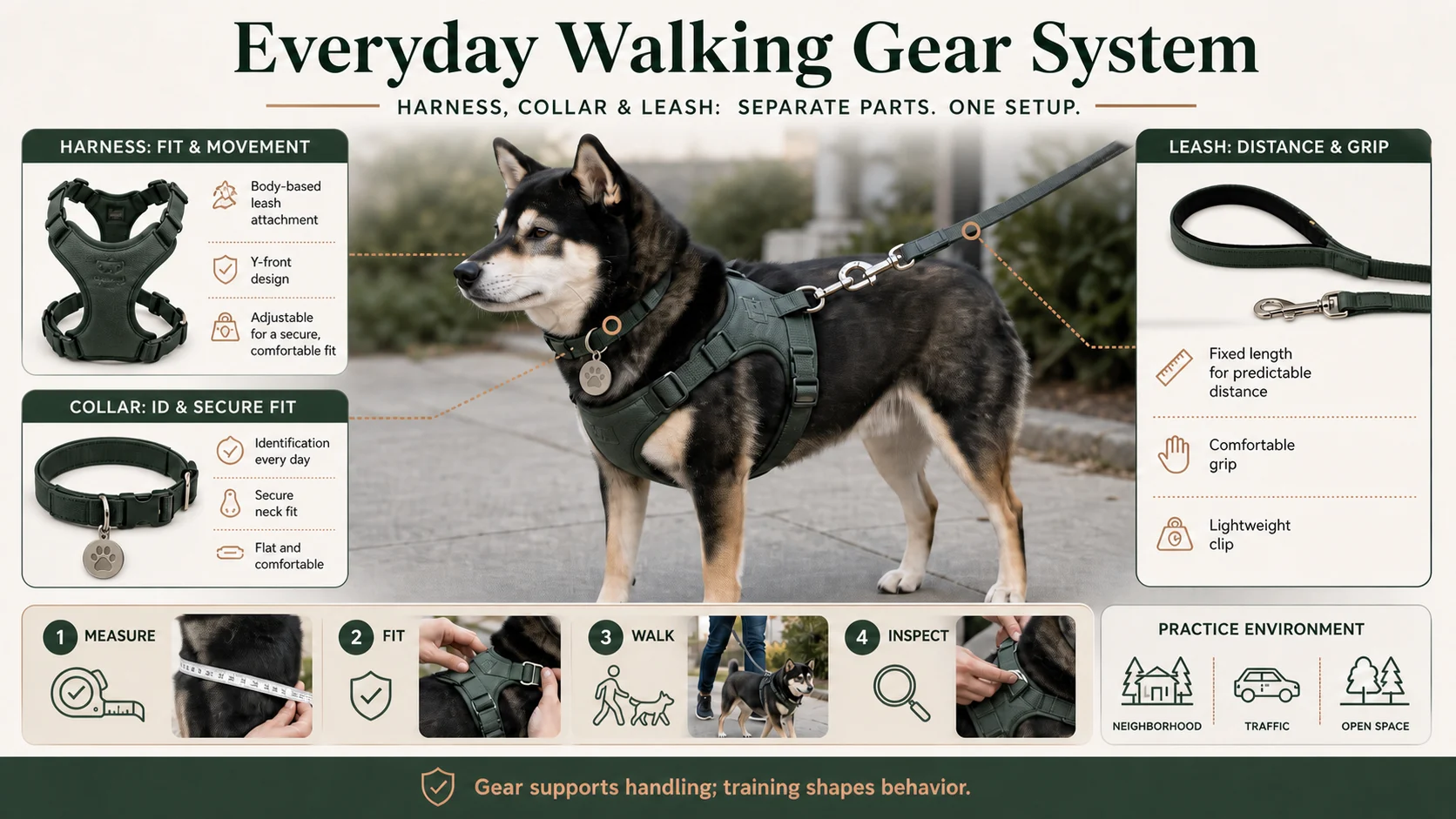
For many homes, the most reliable walking setup is a secure everyday harness, a flat collar with ID tags, and a comfortable six-foot leash. That combination separates identification from body-based walking control and keeps the leash length predictable in normal neighborhoods.
Use these quick filters before comparing specific products:
- Dogs that pull: start with a well-fitted harness and training plan; a front clip may help handling but does not train by itself.
- Small or delicate dogs: avoid relying only on neck pressure; prioritize light harnesses with good chest fit.
- Large strong dogs: look for sturdy hardware, comfortable handles, and predictable leash length.
- Dogs that slip gear: check adjustment points, neck opening, chest fit, and whether the harness shape matches the body.
- Night walks: add reflective materials or lights after the basic fit is right.
- Open spaces and training: consider a long line only where there is enough room and the handler can manage it safely.
If you are unsure, choose gear that is simple, adjustable, easy to put on, and easy to inspect for wear. The best walking gear is the gear you can fit correctly and use calmly every day.
If fit is the problem
Adjustable Y-front harness
- Look for
Chest girth range, shoulder freedom, multiple adjustment points, return policy
- Avoid
Harnesses that rub behind the front legs or restrict movement
If ID is the priority
Flat collar
- Look for
Secure buckle, readable tag attachment, comfortable everyday width
- Avoid
Loose collars that slip off or heavy collars for small dogs
If daily control matters
Six-foot leash
- Look for
Comfortable handle, sturdy clip, predictable length, suitable width
- Avoid
Retractable leashes in crowded or high-traffic areas
If training needs distance
Long line
- Look for
Appropriate length, grippy material, open-space use, handler skill
- Avoid
Using long lines on sidewalks, parking lots, or tight paths
How to choose walking gear
Start with the walk you actually take. A quiet neighborhood walk with a small relaxed dog calls for different gear than a city sidewalk, a strong adolescent dog, a reactive dog, or a training session in an open field.
Harness fit
A harness should stay secure without rubbing, pinching, or blocking natural movement. The chest strap should sit where the design intends, buckles should not press into sensitive areas, and straps should not slide into the armpits during normal walking.
The dog harness fit guide covers measurement and adjustment in more detail. The most important starting point is chest girth: measure around the widest part of the rib cage, then compare that number to the brand's size chart. Weight alone is a weak sizing method because dogs with the same weight can have very different chest shapes.
Collar role
A flat collar is still useful for ID tags and simple routines. It should be snug enough that it does not slide over the head, but loose enough to avoid pressing into the neck. Growing puppies, thick-coated dogs, and dogs that gain or lose weight need regular fit checks.
For many dogs, the collar should not be the only walking control point. Dogs that pull hard, lunge suddenly, have airway sensitivity, or are very small may be better walked from a harness while the collar carries ID.
Leash length and handling
Leash choice affects the whole walk. A simple six-foot leash is a strong default because it gives enough room for normal movement while keeping the dog close enough for sidewalks, crossings, and passing people. Use the Dog Leash Length Guide if you are deciding between 4-foot, 6-foot, 10-foot, long-line, or retractable leash options.
Retractable leashes can create problems in crowded places because the length changes quickly and the handle is harder to control under sudden tension. Long lines can be valuable for training and decompression walks in open areas, but they require space, attention, and handling practice.
Control and training
Gear can improve handling, but it does not replace training. A front-clip harness may reduce leverage for some dogs, but it will not teach loose-leash walking on its own. A stronger leash can help safety, but it will not fix lunging, over-arousal, or fear.
Choose gear that gives you a manageable setup while you work on behavior. If a dog is hard to physically control, focus on fit, hardware quality, leash length, and professional training support where appropriate.
Safety and visibility
Safety features matter after the core fit is correct. Reflective stitching, bright colors, lights, traffic handles, and backup clips can all be useful, but none of them compensate for a harness that slips or a leash clip that is too weak.
For night walks, look for reflective surfaces on both the dog and handler side. For wet or muddy walks, check whether materials dry reasonably quickly and whether hardware resists corrosion. For city walks, prioritize short predictable handling over extra freedom.
Materials and hardware
Common materials include nylon webbing, polyester webbing, rope, leather, mesh padding, neoprene padding, and metal or plastic buckles. Softer padding can improve comfort, but it may hold odor or dry slowly. Thin lightweight gear may suit small dogs, while wide heavy gear may be too bulky for them.
Hardware deserves attention. Check leash clips, D-rings, buckles, sliders, stitching, and tag rings. A beautiful harness with weak adjustment sliders is not a good everyday choice.
Use the Dog Leash Materials Guide when grip, weather, cleaning, coated webbing, leather, rope, nylon, or hardware are the main comparison points.
Walking gear compared
Use this table as a starting point. The right setup depends on your dog's shape, behavior, walking environment, and handler comfort.
| Option | Best for | Key features | Caveat | Merchant |
|---|---|---|---|---|
Y-front harness | Everyday walks where shoulder freedom matters | Allows natural movement, often adjustable, good body-based control | Fit can be brand-specific and must be checked carefully | |
Back-clip harness | Relaxed walkers and simple routines | Easy leash attachment, less neck pressure than collar-only walking | May give strong pullers more leverage | |
Front-clip harness | Some pulling management and training support | Changes leash angle, can improve handling for some dogs | Not a replacement for training and may fit awkwardly on some bodies | |
Flat collar | ID tags and calm everyday wear | Simple, lightweight, easy to size | Not ideal as sole control for every dog | |
Six-foot leash | Most daily neighborhood walks | Predictable length, simple handling, good control | Less freedom than long lines | |
Long line | Training and open spaces | Controlled distance, recall practice, decompression walks | Needs space and careful handling |
Category picks
These are category-level recommendations, not fixed single-product winners. Use them to start comparison shopping, then check current size charts, material details, hardware photos, return policies, and recent owner feedback before buying.
An adjustable Y-front harness is a strong first comparison point because fit and movement are easier to evaluate than with many novelty harnesses. It still needs careful sizing.
A flat collar is useful even when the dog walks on a harness. Think of it first as an ID carrier, then decide whether it also has a role in calm handling.
A six-foot leash is not exciting, but it is one of the most useful pieces of dog gear. Start there before adding more specialized leash types.
Common mistakes
✓ Better buying habits
- Measure chest girth before choosing a harness size.
- Watch your dog walk in the harness before assuming the fit is right.
- Use a collar for ID even when the leash attaches to a harness.
- Start with a predictable six-foot leash for daily walks.
- Match leash width and clip size to the dog, not just to appearance.
- Check reflective details for early morning or evening walks.
- Reinspect stitching, buckles, leash clips, and tag rings regularly.
- Keep specialized gear tied to a real use case, such as training or open-space walks.
× Mistakes to avoid
- Buying a harness only by weight range.
- Ignoring rubbing behind the front legs.
- Using a collar as the only control point for a dog that pulls hard.
- Treating a front clip as a complete pulling solution.
- Using retractable leashes in crowded sidewalks, parking lots, or tight paths.
- Choosing heavy hardware for a small dog.
- Leaving a wet or muddy harness on long after the walk.
- Keeping gear in use after buckles, stitching, or clips show wear.
Related guides
Use the curated Dog Harnesses hub for fit, no-pull designs, clip position, puppy growth, and car restraint. Use the Dog Collars hub for size, material, martingale collars, and ID use. Use the Dog Leashes hub for length, materials, puppy leashes, and daily handling.
For measurement, adjustment, and movement checks, read the Dog Harness Fit Guide and print the Harness Fit Checklist. For puppies, use the Puppy Harness Size Guide and print the Puppy Walking Gear Checklist so collar ID, harness fit, leash setup, and growth rechecks stay together. Use them before deciding a harness is too big, too small, or simply the wrong shape.
For pulling management, use the No-Pull Dog Harness Guide without treating equipment as a training result. For limited-slip collar fit, use the Martingale Collar Guide. For vehicle restraint, use the Dog Seat Belt and Car Harness Guide and verify current independent evidence for the exact model and size.
For simple daily walking setups, read Collars and Leashes for Everyday Walks. It focuses on collar fit, leash length, and practical everyday handling. Use Dog Collar Materials Guide when nylon, leather, coated webbing, reflective collar details, cleaning, or ID hardware are the main comparison. Use Dog Harness vs Collar when the main question is leash attachment versus ID use, and use Dog Collar vs Harness for Puppy plus Puppy Harness Size Guide when the decision involves puppy growth, ID tags, first walks, and neck-pressure caution. Use Best Leash for Puppy when the first leash needs to stay light, predictable, and easy to handle. Use the Dog Leash Length Guide when leash length is the main decision.
Use the Dog Leash Materials Guide when the main question is nylon, leather, rope, coated webbing, clip hardware, wet-weather cleaning, or grip.
For harness category choices, read Best Dog Harnesses for Everyday Walks. It compares Y-front, back-clip, front-clip, step-in, padded, and lightweight options.
For camping, hiking, beach, boating, and biking preparation, use the Dog Adventure Gear Checklist. Organize water, cleanup, safety supplies, food, and documents with the Dog Gear Bag Guide.
For leash attachment decisions, compare Front Clip vs Back Clip Harnesses. It explains pulling management, fit, leash angle, and training limits.
For collar measurements, use the Dog Collar Size Guide. It covers neck sizing, puppies, coat changes, width, hardware, and ID use.
Helpful authority resources
For daily walk routines, the ASPCA's tips for getting more out of walks with your dog are a practical external reference. For safety around stress, body language, and bite prevention, use the ASPCA's dog bite prevention resource alongside fit and handling guidance.
Frequently asked questions
Is a harness better than a collar?
It depends on the dog and use case. Many dogs benefit from a harness for walks and a collar for ID tags. Fit, behavior, and handling needs matter more than the label.
How tight should a harness be?
A common starting point is snug enough that it does not shift, with enough room to fit two fingers under key straps. Always follow the manufacturer's size chart and check movement during a real walk.
Should my dog wear a collar and harness at the same time?
Often yes for walks: the collar can carry ID, while the harness can be the leash attachment point. Remove walking gear after the walk if the harness is not designed for all-day wear.
Are front-clip harnesses good for pulling?
They can help some handlers manage pulling by changing the leash angle, but they do not train loose-leash walking by themselves. Fit and training still matter.
What leash length is best for everyday walks?
A six-foot leash is a practical default for many neighborhoods because it gives predictable control without keeping the dog unnaturally close. Long lines are better saved for open spaces and training.
Are retractable leashes safe?
They can work for some calm dogs in open areas, but they are harder to manage in crowded sidewalks, parking lots, bike paths, and tight spaces. A standard leash is usually easier for everyday control.