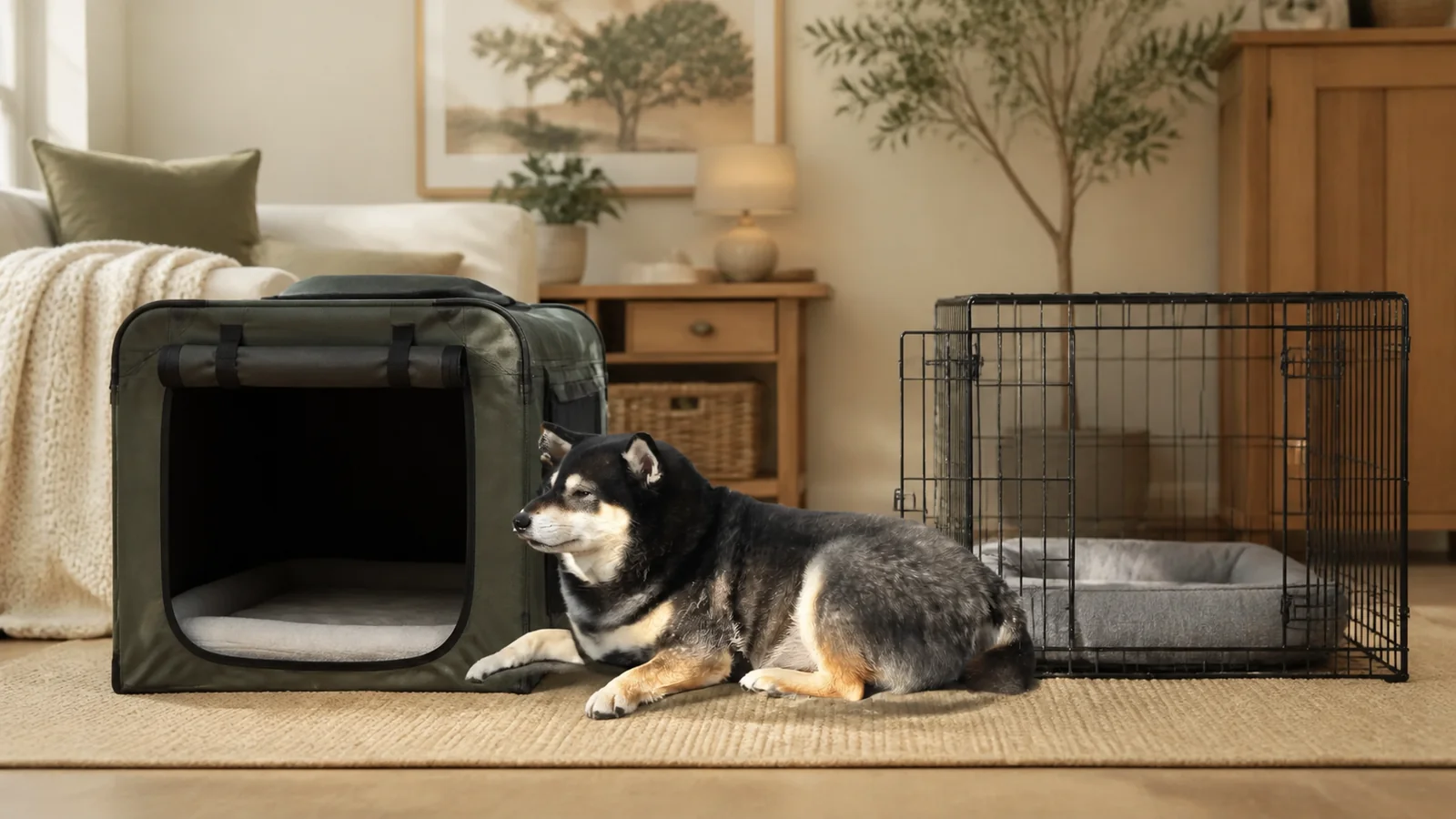
Soft crates and wire crates solve different problems. A soft crate can be convenient for calm dogs and light travel, while a wire crate is often more practical for home routines, puppies, and dogs that need structure.
For the full framework, start with the Dog Crates pillar. For sizing, use the Dog Crate Size Guide. For room setup, read Best Dog Crates for Home Setup. If appearance is the main reason you are avoiding a standard wire crate, compare Dog Crate Cover vs Furniture Crate and use the Dog Crate Furniture Guide before choosing a decorative crate.
Once you know which material type is likely, use the Dog Crate Setup Checklist to compare dimensions, latches, bedding, cleaning, and room placement. Use the Dog Crate Mats Guide if bedding thickness, washable pads, or crate-floor fit are part of the final decision.
Quick read
TL;DR
- Best default for home use: wire crate, because it is structured, ventilated, visible, and easier to clean.
- Soft crates are convenience gear, not a universal crate choice.
- Avoid soft crates for chewers, scratchers, and escape-prone dogs.
- Wire crates can rattle and may feel exposed, but mats, placement, and partial covers can help.
- Travel needs vary: portable does not automatically mean safe for car or airline use.
- Choose by dog behavior first, then by room appearance or portability.
Quick answer
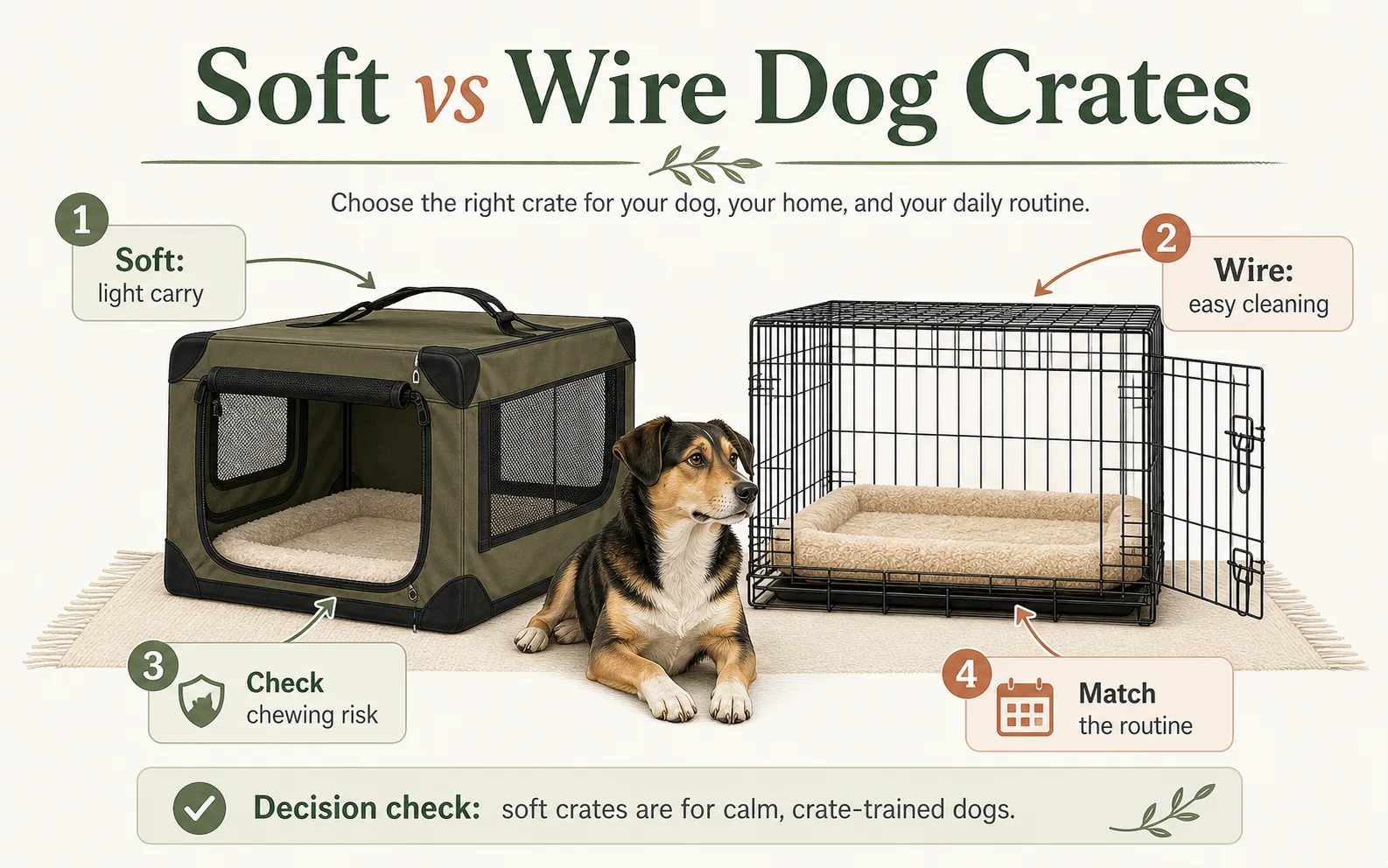
Choose a wire crate if you need a reliable home crate, a puppy crate with divider options, easier accident cleanup, or a setup where you can monitor the dog clearly. Choose a soft crate only when the dog is already crate-comfortable, calm, not destructive, and the setting is appropriate.
Soft crates are lighter and easier to carry, but mesh, zippers, seams, and fabric are weak points for dogs that paw, chew, scratch, or panic. Wire crates are less cozy-looking, but they are usually more forgiving for daily routines.
Share & embed
Home routine or puppy setup
Wire crate
- Look for
Structure, visibility, airflow, divider options, tray cleanup
- Avoid
Soft crates for chewing puppies
Calm trained dog on visits
Soft crate
- Look for
Lightweight, foldable, easy to carry
- Avoid
Unsupervised use with escape-prone dogs
Dog likes more enclosure
Plastic or covered wire crate
- Look for
More den-like feel, still structured
- Avoid
Closing off airflow completely
Apartment setup
Wire crate with mat or floor protection
- Look for
Easy cleaning, stable setup, lower cost
- Avoid
Ignoring rattle and floor marks
Soft crates
Soft crates usually use fabric panels over a folding frame, with mesh windows and zipper doors. They are lighter than most wire crates and easier to carry to a class, hotel, relative's house, or calm travel setting.
They work best for dogs that already understand crates and are not trying to escape. A soft crate is not a way to contain a dog that is anxious, destructive, or untrained. Mesh can tear, zippers can fail, and fabric can hold odor.
When soft crates make sense
Soft crates make sense for calm dogs, short visits, supervised rest, and situations where portability matters more than durability. They can also be useful as a secondary crate when the dog already has a reliable home setup.
Look for sturdy zippers, reinforced corners, washable surfaces, good ventilation, and a frame that does not collapse easily. Check whether the bottom is padded, removable, or easy to wipe.
When soft crates are the wrong choice
Avoid soft crates for puppies that chew, dogs that scratch at barriers, dogs with separation distress, escape artists, and dogs that have not already been introduced to crate rest. A dog that damages a soft crate can also create a safety risk.
Wire crates
Wire crates are common because they are practical. They ventilate well, offer visibility, fold for storage, and often include divider panels for puppies. Removable trays make cleanup easier after accidents.
The tradeoff is that wire crates can rattle, look utilitarian, and feel exposed. Placement and setup matter. A quiet room corner, stable mat under the crate, and appropriate bedding can make a wire crate calmer.
When wire crates make sense
Wire crates are strong starting points for home routines, puppy management, training setups, and dogs that need structure. They are also easier to inspect for size, latch quality, tray design, and cleaning.
When wire crates are not ideal
Some dogs do not rest well when they can see everything around them. A partial cover may help, but airflow must remain safe. Wire crates can also be noisy on hard floors if the tray shifts or the frame rattles.
Soft vs wire compared
| Option | Best for | Key features | Caveat | Merchant |
|---|---|---|---|---|
Soft crate | Calm crate-trained dogs and light travel | Lightweight, foldable, easier to carry | Poor match for chewers or escape artists | |
Wire crate | Home routines and puppies | Ventilation, visibility, divider options, removable tray | Can rattle and feel exposed | |
Plastic crate | Dogs that prefer enclosure | Den-like shell, portable, less visual stimulation | Less airflow and visibility than wire | |
Furniture-style crate | Permanent room setup | Looks more polished, enclosed feel | Harder to clean and move |
Cleaning and durability
Wire crates are usually easier to clean because the tray can slide out. Fabric crates may need spot cleaning or panel washing, depending on the design. If odor, accidents, or muddy paws are likely, wire is usually easier.
Durability depends on the dog. A calm dog may use a soft crate for years. A determined dog can damage mesh or zippers quickly. Wire crates can bend or rattle, but they usually tolerate routine home use better.
Travel limits
Do not assume a soft crate is safe for car travel just because it is portable. Travel safety depends on the product's intended use, attachment method, crash-testing claims, airline rules, and your dog's behavior.
For car or airline use, check the actual requirements rather than using a home crate as a substitute.
Category picks
These are category-level recommendations, not fixed single-product winners.
Common mistakes
✓ Better buying habits
- Choose crate material by dog behavior first.
- Use wire as the safer baseline for puppies and home routines.
- Reserve soft crates for calm, trained dogs.
- Check zipper, mesh, latch, and tray quality.
- Match the crate to the real travel use case.
- Read recent owner feedback for escapes, rattling, and cleaning.
× Mistakes to avoid
- Buying a soft crate because it looks cozy without considering chewing.
- Assuming portable means car-safe or airline-approved.
- Ignoring cleaning after accidents.
- Covering a wire crate so much that airflow suffers.
- Using any crate as a shortcut for training or behavior support.
- Choosing only by appearance or room decor.
Related guides
Use the Dog Crate Setup Checklist before opening current listings. Read Dog Crate Size Guide before choosing dimensions. Use the Dog Crate Mats Guide before adding washable pads, thick bedding, or waterproof mats inside the crate. Use Best Dog Crates for Home Setup for placement and room decisions. Use Dog Crate Cover vs Furniture Crate if you are deciding between a fabric cover and a more permanent decorative crate. Use the Dog Crate Furniture Guide if you are comparing crate end tables, crate covers, or convertible crate gates for a visible room. For portable destination crates and their vehicle limits, read Soft vs Collapsible Dog Crates for Car Travel. Return to the Dog Crates pillar for the complete crate framework.
Frequently asked questions
Are soft crates escape-proof?
No. A determined dog may damage mesh, zippers, seams, or the frame. Soft crates are best for calm dogs and appropriate supervised use.
Which crate is easier to clean?
Wire crates with removable trays are often simpler for accidents. Soft crates may have washable fabric, but cleaning depends on the exact construction.
Are wire crates cruel?
No crate type is automatically humane or inhumane. Fit, introduction, duration, setup, and the dog's comfort matter. Crates should be used thoughtfully.
Can I use a soft crate for a puppy?
Usually it is not the best first choice. Puppies often chew, scratch, and have accidents, which makes wire with a divider more practical.
Can a wire crate feel too exposed?
Some dogs rest better with less visual stimulation. A partial cover may help, but keep airflow and safety in mind.
Which crate is better for apartments?
Wire crates are often easier to clean and size, but they can rattle. Use floor protection, stable placement, and the right mat to reduce noise.