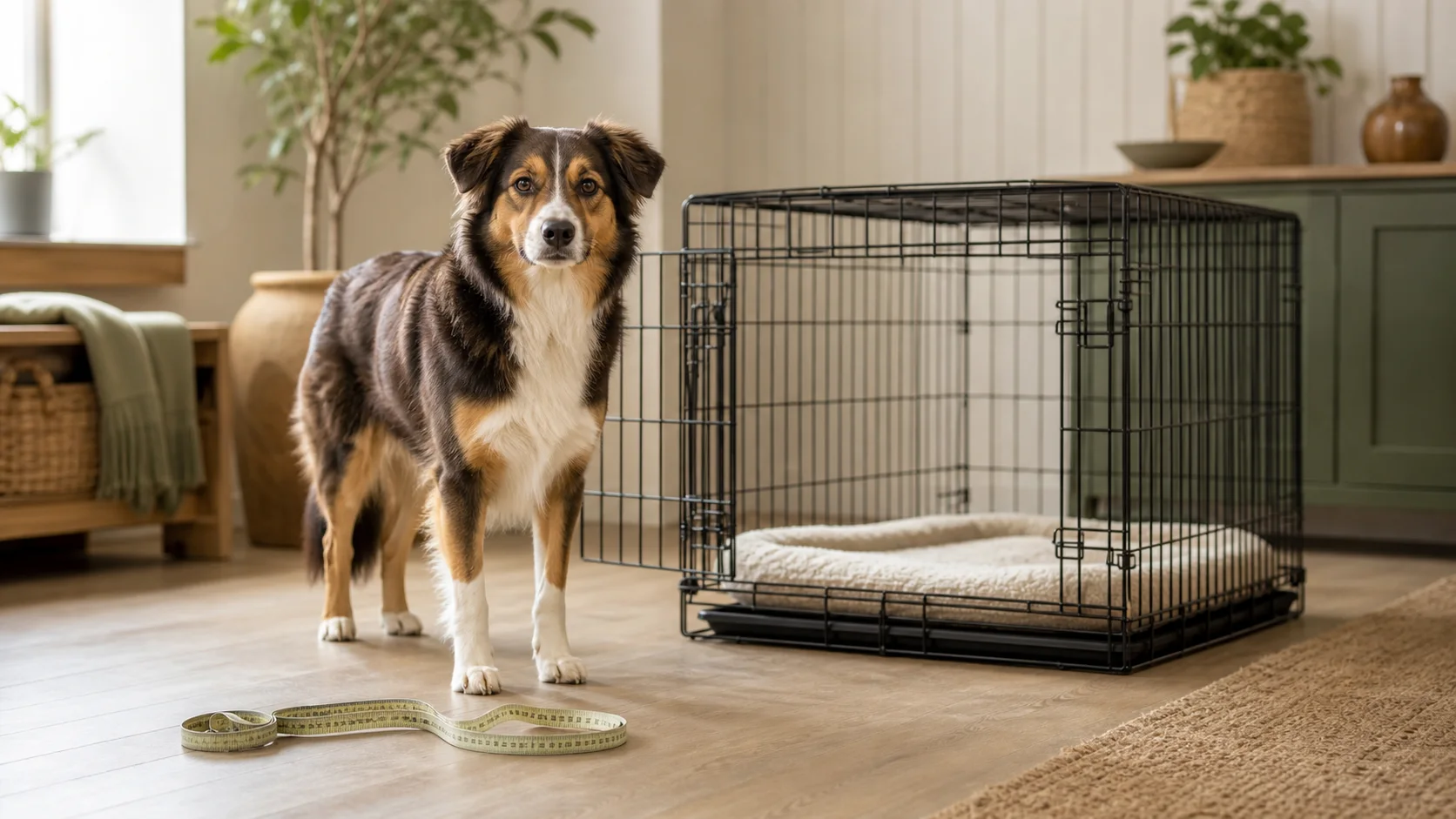
Crate sizing should be based on internal dimensions and the way your dog stands, turns, and lies down. Outside dimensions, breed labels, and rough weight ranges can be misleading because frames, trays, rounded corners, and door hardware can reduce usable interior space.
Use this calculator before comparing home crates, puppy crates with dividers, crate mats, plastic carriers, or broad dog kennel listings. The result is a cautious starting range for normal home setup, not a travel or medical confinement rule.
Measure first · choose thoughtfully
Dog Crate Size Calculator
Enter your dog's body length and standing height in inches. The result estimates internal crate dimensions and reminds you when bedding changes usable space.
Enter your dog's measurements to see a cautious starting range. Always compare the result with the brand's own size chart before buying.
How to measure for a dog crate
Measure your dog standing naturally on a flat surface. For height, measure from the floor to the top of the head or ears, whichever is taller in normal posture. For length, measure from the nose to the tail base, not the full tail.
Use the result against internal crate dimensions. A crate should usually allow the dog to stand, turn around, and lie down comfortably without crouching or twisting.
How to read the result
The result estimates internal length and height to compare first. If you plan to use a thick crate mat, treat the height result as more important because bedding reduces standing room. If your dog is still growing, look for a crate with a secure divider instead of buying a very large empty crate and hoping it works for every stage.
For travel, airline, recovery, or safety-certified crate decisions, follow the crate maker's specific guidance and any relevant travel or veterinary requirements.
Before you buy
Check internal dimensions, divider stability, latch design, and tray fit. Use the Large Dog Crate Guide for doorway, room-footprint, floor-load, and bedding-height checks, or the Small Dog Crate Guide for compact interiors, bar spacing, hardware scale, and puppy growth. Puppies often do better with a properly adjusted divider than with a huge empty crate. For a printable purchase workflow, use the Dog Crate Setup Checklist. For mat thickness, washable covers, non-slip backing, and puppy accident cleanup, read Dog Bed vs Crate Mat and the Dog Crate Mats Guide. For a young puppy routine, use the Puppy Crate Training Schedule. If you are measuring multiple gear categories, use the Dog Gear Measurement Kit. For broader setup choices, use the Dog Crates pillar.
✓ Better buying habits
- Measure height and length before shopping.
- Compare internal dimensions.
- Account for bedding thickness.
- Choose divider crates for growing puppies.
- Check latch, tray, and door clearance.
× Mistakes to avoid
- Buying only from a breed chart.
- Forgetting that plastic crates can have smaller interiors.
- Adding a thick bed that blocks the door.
- Using a soft crate for a dog that chews or scratches.
- Treating travel carrier sizing like normal home crate sizing.
Best next step
For most puppy and home routines, start by comparing dog crates with dividers. If you want a crate that doubles as visible room furniture, compare Dog Crate Cover vs Furniture Crate and read the Dog Crate Furniture Guide before comparing decorative end-table crates. If listings mix kennel, cage, carrier, and crate wording, read Dog Kennel vs Dog Crate. If you are still deciding on material, read Soft Dog Crates vs Wire Dog Crates or return to the Dog Crates pillar.