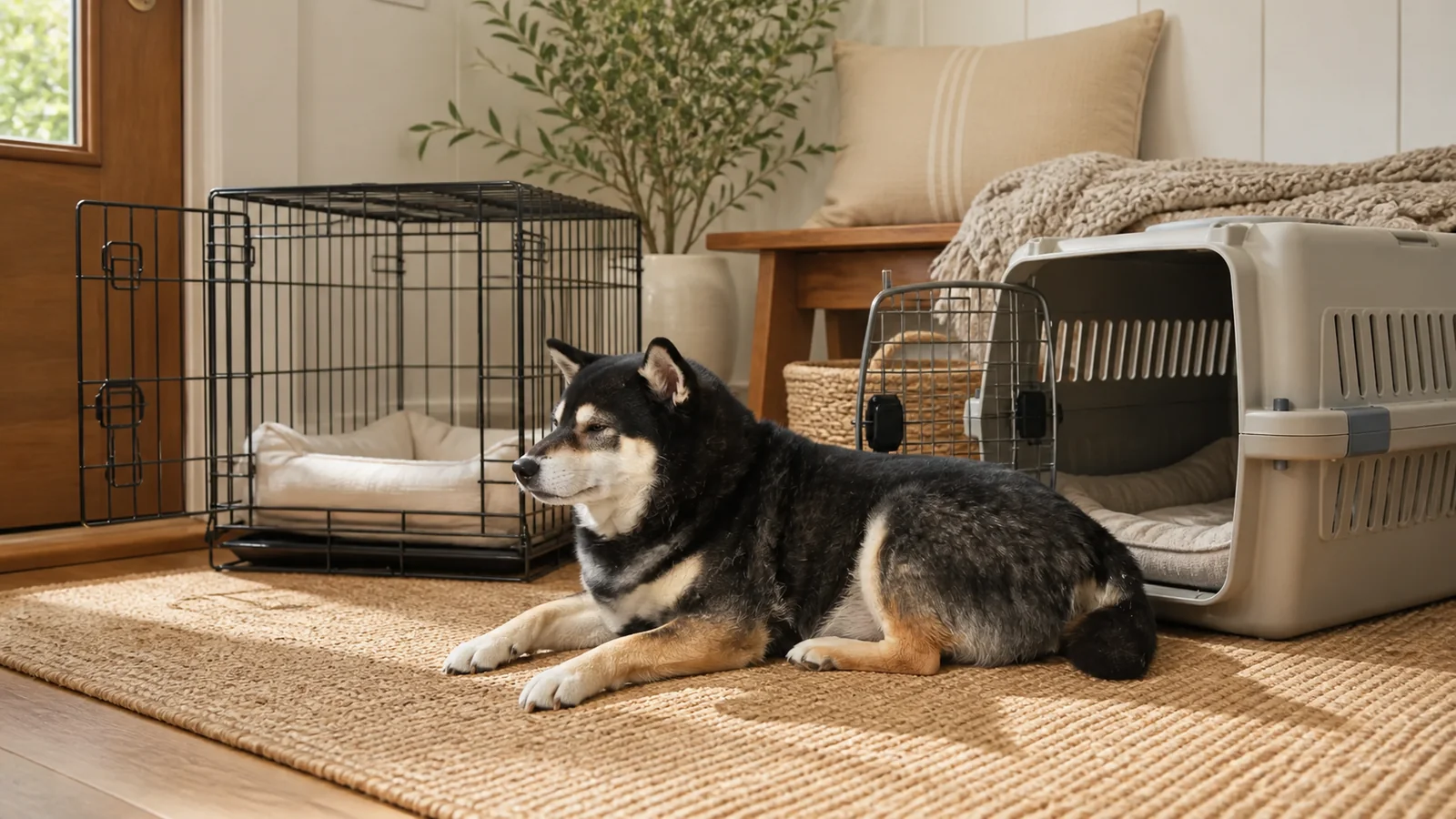
Wire and plastic crates both work for some dogs, but they feel different in daily use. Wire crates are open, ventilated, and easy to monitor. Plastic crates feel more enclosed and may be useful for dogs that rest better with less visual stimulation.
Use the Dog Crates pillar for the full buying framework. This guide compares wire and plastic crates specifically, without assuming one is best for every dog. If broad listings mix crate, kennel, carrier, and dog cage wording, read Dog Kennel vs Dog Crate before buying. If the crate is for daily home use, also read Best Dog Crates for Home Setup before buying. If appearance is driving the choice, compare Dog Crate Cover vs Furniture Crate and the practical tradeoffs in the Dog Crate Furniture Guide before choosing a decorative crate.
Quick read
TL;DR
- Choose wire crates for airflow, visibility, divider options, and easy home cleaning.
- Choose plastic crates when a more enclosed feel or certain travel-style use cases matter.
- Wire crates can rattle and feel visually exposed.
- Plastic crates can reduce airflow and usable interior space.
- Travel rules vary: do not assume any plastic crate is automatically airline or car safe.
- Measure internal dimensions for both types before buying.
- Chewing, panic, or escape attempts change the decision and may require behavior support before changing equipment.
Quick answer
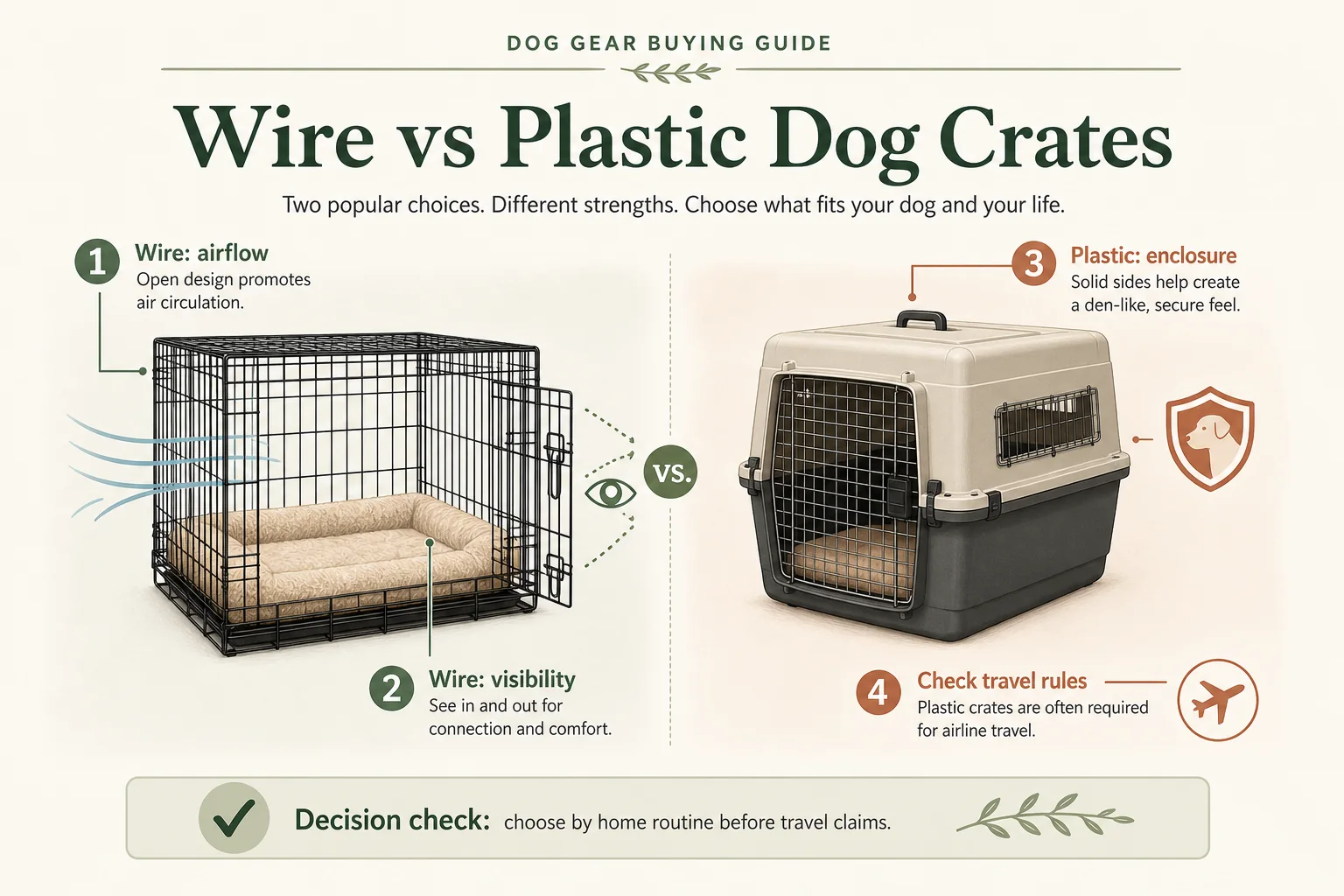
For general home use, wire crates are usually the better first comparison point because they are ventilated, visible, often foldable, and commonly available with dividers. For dogs that settle better in a more enclosed space, plastic crates can be worth comparing.
If the crate is for travel, check the product's stated use, carrier rules, ventilation, door security, fasteners, and sizing requirements. Portable does not automatically mean travel-safe.
Share & embed
Home routine
Wire crate
- Look for
Airflow, visibility, removable tray, divider options
- Avoid
Rattle and exposed feeling
Dog prefers enclosure
Plastic crate
- Look for
More den-like shell, less visual stimulation
- Avoid
Less airflow and visibility
Puppy setup
Wire crate with divider
- Look for
Adjustable space, easy monitoring, tray cleanup
- Avoid
Plastic crate without flexible sizing
Travel-style use
Purpose-specific plastic carrier
- Look for
Shell structure, handles, rule compatibility
- Avoid
Assuming all plastic crates meet travel rules
Selector matrix
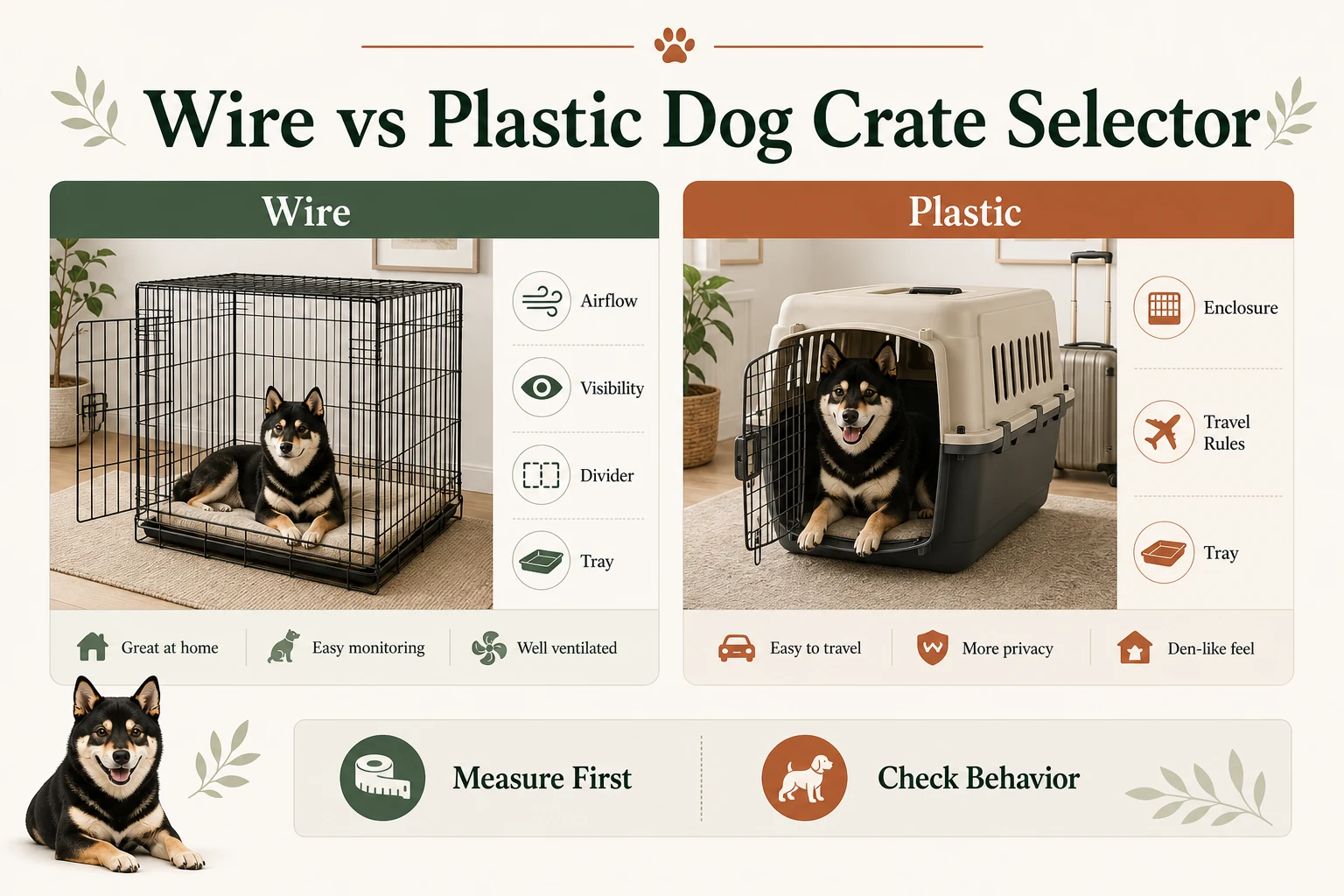
The right crate type depends on the dog, the room, and the task. A calm puppy at home is a different decision from a dog that chews barriers or a dog flying in cargo.
Share & embed
| Option | Best for | Key features | Caveat | Merchant |
|---|---|---|---|---|
Calm home routine | Most crate-trained adult dogs | Wire crate with removable tray or premium collapsible crate | Rattle and visual exposure may bother some dogs | See direct product examples below |
Growing puppy | House training and changing size needs | Wire crate with stable divider and washable tray | Oversizing without a divider can undermine the routine | See direct product examples below |
Dog that prefers less visual input | Calm dogs that rest better with enclosure | Rigid plastic crate with enough ventilation and interior room | Can feel stuffy in warm rooms if ventilation is limited | See direct product examples below |
Cargo-style travel planning | Owners checking airline or cargo requirements | Purpose-specific rigid travel kennel with metal hardware where required | Airline, route, and destination rules must be checked before purchase | See direct product examples below |
Dog that damages crates | Chewing, bending wire, or repeated escape attempts | Pause and review behavior, supervision, and stronger crate categories | Neither basic wire nor basic plastic is a shortcut solution | See direct product examples below |
Wire crate strengths
Wire crates are practical for home routines. They let you see the dog, offer strong airflow, fold for storage, and usually have removable trays. Many include divider panels for puppies.
The openness can also be a drawback. Some dogs rest poorly when they can see every movement in the room. A partial cover can help, but airflow should remain safe.
Look beyond the word heavy-duty. Check bar spacing, latch placement, weld or joint quality, divider stability, tray fit, and whether the crate flexes after assembly. If a dog bites wire, bends panels, or pushes hard against the door, stop using that setup and review the behavior problem instead of simply adding a cover.
Plastic crate strengths
Plastic crates can feel more den-like. They reduce visual stimulation and may be easier to carry than furniture-style crates. Some travel carriers are plastic, but travel suitability depends on the exact product and rules.
Plastic crates can have rounded corners, angled walls, and smaller usable interiors than the outside dimensions suggest. Measure carefully.
For plastic crates, check whether the shell feels rigid, whether the top and bottom halves use secure hardware, whether the door locks at the top and bottom, and whether the ventilation pattern fits the room or travel use. Avoid assuming that a plastic crate is stronger or safer just because it looks enclosed.
Material and hardware checks
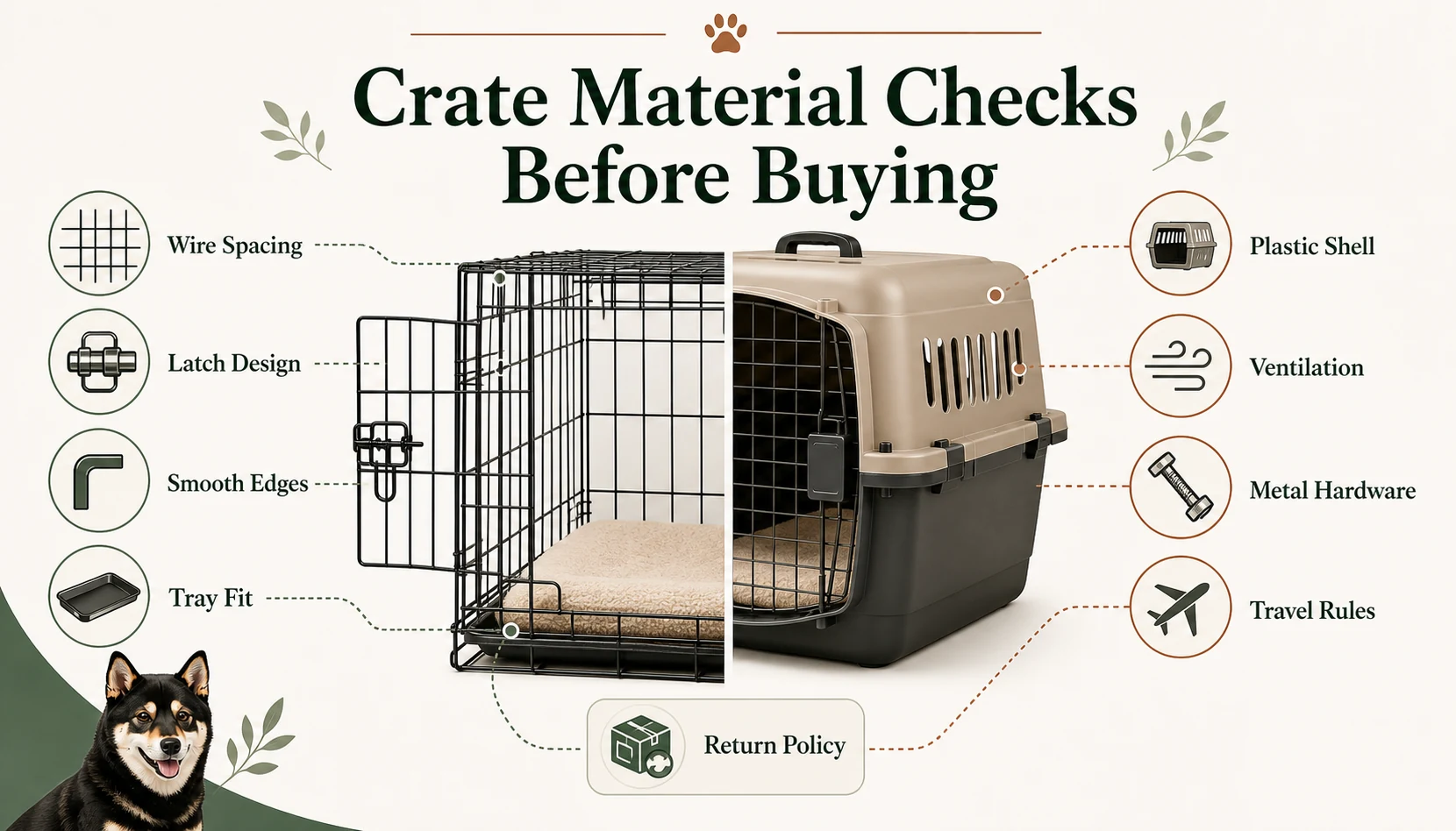
Wire and plastic crates fail in different ways. Wire crates depend on panel stiffness, bar spacing, latches, tray fit, and smooth edges. Plastic crates depend on shell rigidity, hardware, ventilation, door security, and usable interior space.
Share & embed
Use these checks before keeping the crate:
- Wire spacing: the dog should not be able to push a paw, jaw, or collar hardware into risky gaps.
- Latch design: latches should close cleanly and not be easy for the dog to bump open from inside.
- Smooth edges: run your hand around door openings, corners, tray lips, vents, and fasteners.
- Tray or floor fit: a loose tray can rattle, slide, or create a lip that catches bedding.
- Plastic shell: check for flex, thin-feeling walls, sharp molding seams, and weak clip-only assembly.
- Ventilation: enclosed plastic can feel calmer, but warm rooms and travel contexts need careful airflow checks.
- Metal hardware: travel-style plastic carriers often need stronger fasteners than clip-only shells.
- Return policy: crate sizing mistakes are common, so check return terms before assembly.
Travel and airline checks
All-wire crates are generally a home-use category, not a cargo-air-travel solution. IATA's pet container guidance says airlines use internal measurements to check that an animal can turn, stand, sit, and lie naturally, and it links to current container requirements for dogs and cats. USDA APHIS pet travel guidance also emphasizes destination rules, paperwork, airline processes, and veterinarian involvement before travel.
That means a plastic crate can be travel-style without being right for your airline, route, destination, or dog. Before buying for air travel, check the current airline rules, IATA guidance, USDA APHIS guidance, veterinary paperwork, breed restrictions, temperature rules, and whether metal hardware is required.
Cleaning, airflow, and visibility
Wire crates with slide-out trays are often easiest for accidents. Plastic crates can wipe down well, but corners, door grooves, and ventilation openings still collect hair and dirt.
Airflow is usually stronger in wire crates. Plastic crates vary by ventilation holes and door design. In warm rooms, airflow matters more than a cozy enclosed feeling.
| Option | Best for | Key features | Caveat | Merchant |
|---|---|---|---|---|
Wire crate | Most home routines and puppies | Airflow, visibility, divider options, removable tray | Can rattle and feel exposed | See direct product examples below |
Plastic crate | Dogs that prefer enclosure | Den-like feel, portable shell, less visual stimulation | Less airflow and visibility | See direct product examples below |
Wire crate with divider | Growing puppies | Adjustable space, easy monitoring | Less enclosed than plastic | See direct product examples below |
Plastic travel carrier | Some travel-style needs | Structured shell, handles, enclosed sides | Rules and safety claims must be checked | See direct product examples below |
Direct product CTAs
These are direct Amazon product examples for comparison, not fixed universal winners. Check the current listing, dimensions, hardware, return policy, and your dog's behavior fit before buying.
What Dogs Like may earn from qualifying purchases. Affiliate links do not change the checks in this guide.
Common mistakes
✓ Better buying habits
- Choose by dog behavior and room setup.
- Check internal dimensions for both crate types.
- Prioritize airflow in warm spaces.
- Use wire crates as the practical home baseline.
- Check travel rules before relying on a plastic crate.
- Inspect latches, edges, panel stiffness, and hardware after assembly.
- Remove collars, harnesses, and dangling tags before crating when snag risk is possible.
× Mistakes to avoid
- Assuming plastic always means travel-safe.
- Choosing wire without considering visual stimulation.
- Covering wire crates too heavily.
- Ignoring rounded corners and usable space in plastic crates.
- Buying by outside dimensions alone.
- Treating a crate as a solution for panic, separation distress, or destructive escape attempts.
Related guides
Read Soft Dog Crates vs Wire Dog Crates for fabric-versus-structure tradeoffs. Use Best Dog Crates for Home Setup for placement, latches, cleaning access, and behavior fit. Use Dog Crate Cover vs Furniture Crate before deciding whether to cover a wire crate or replace it with a decorative crate. Use the Dog Crate Furniture Guide before replacing a simple wire or plastic crate with an end-table crate, crate cover, or decorative gate. Use the Dog Crate Size Guide or Dog Crate Size Calculator before choosing dimensions. Use the Dog Crate Mats Guide before adding bedding, washable pads, or waterproof mats to either crate style. Print the Dog Crate Setup Checklist before comparing current listings. Return to the Dog Crates pillar for the full crate framework.
Frequently asked questions
Are wire crates better than plastic crates?
For many home routines, wire crates are easier to size, monitor, ventilate, and clean. Plastic crates can be better for dogs that prefer more enclosure.
Are plastic crates safer for travel?
Not automatically. Check the product's intended use, carrier rules, safety claims, and sizing requirements.
Which crate is easier to clean?
Wire crates with removable trays are often easiest for accidents. Plastic crates can wipe down well but still have grooves and corners.
Which crate has better airflow?
Wire crates usually have better airflow. Plastic crates vary by ventilation design.
Can I cover a wire crate?
Sometimes, but keep airflow safe and avoid creating heat buildup or chewing hazards.
Are all-wire crates allowed for airline cargo travel?
Do not assume so. For cargo-style air travel, check the current airline rules plus IATA and USDA APHIS guidance. Many travel situations require a rigid container with solid walls, ventilation, secure door hardware, and metal fasteners.
Is plastic better for anxious dogs?
Plastic can reduce visual stimulation for some calm dogs, but it is not a treatment for anxiety or panic. If a dog tries to escape, chews the crate, or injures themselves in confinement, stop using that setup and seek qualified help.
What should I check on a wire crate?
Check internal size, bar spacing, latches, divider stability, tray fit, smooth edges, panel stiffness, and whether the crate rattles or shifts in the room.
What should I check on a plastic crate?
Check the usable interior space, ventilation openings, door security, hardware, shell rigidity, cleaning grooves, assembly fasteners, and whether the crate is meant for home use or travel.