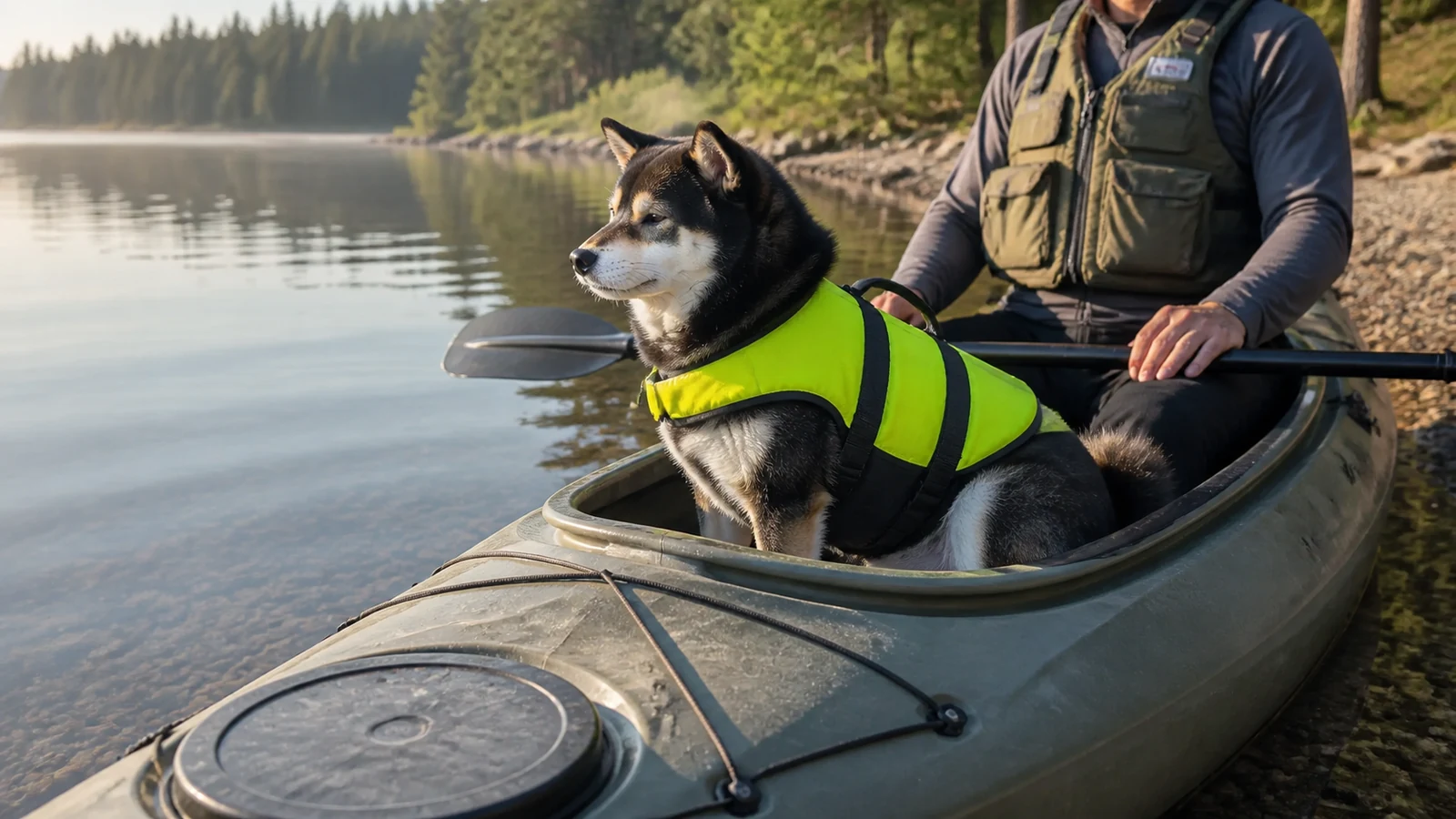
The best dog life jacket for kayaking fits snugly without trapping a front leg or restricting a horizontal swimming stroke, stays visible in poor light, and gives the paddler a realistic recovery handle. Fit matters more than breed confidence: strong swimmers can become tired, disoriented, separated from the boat, or caught in current. The handler still needs a human PFD, a capsize plan, and constant supervision.
Quick read
Quick answer
- Measure chest girth at the manufacturer's specified point and use weight only as a secondary check.
- Choose bright color, reflective details, adjustable neck and body straps, and flotation that does not block shoulder movement.
- A top handle is for controlled assistance; plan how two people would recover a large dog without relying on one strap.
- Introduce the jacket on land, then test movement and buoyancy in calm shallow water with an easy exit.
- Keep the jacket on around the launch, dock, kayak, paddleboard, boat, and open water—even for an experienced swimmer.
Fit is a five-part test
Share & embed
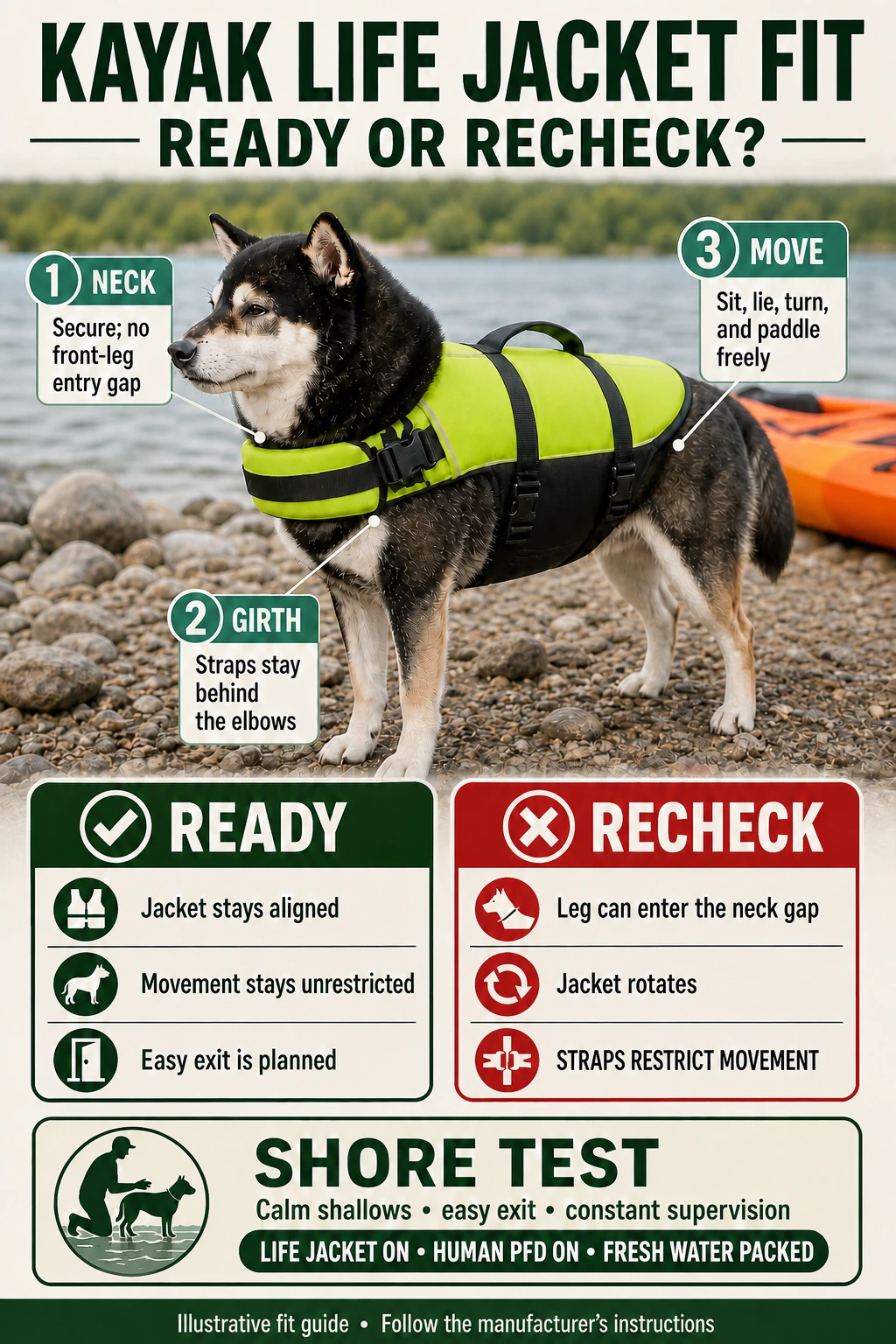
AKC's current water-safety guidance recommends a properly fitted life jacket in good condition, gradual water introduction, constant supervision, rest breaks, and fresh drinking water. It also warns that a loose neck can let a front leg become caught. UC Davis School of Veterinary Medicine's summer water-safety guidance independently recommends pet life jackets for boating or swimming, including for comfortable swimmers, plus fresh drinking water and attention to posted water-quality warnings.
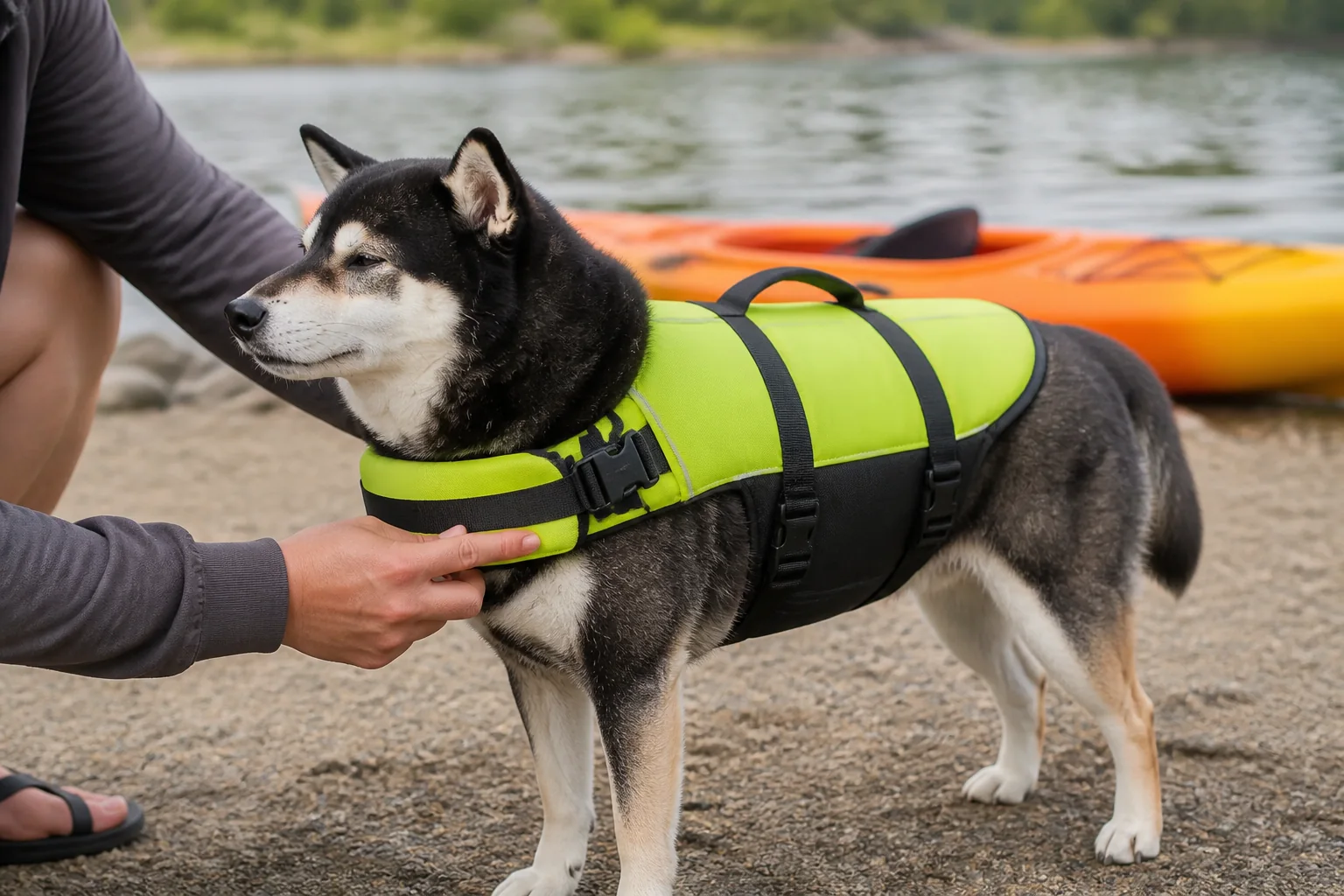
Measure girth around the widest part of the rib cage while the dog stands. Compare neck range, back length, and stated weight guidance for the exact size. Tighten straps evenly; the jacket should not slide over the head, rotate under the belly, or pull into the armpits. The dog must be able to sit, lie down, turn, and walk without a shortened stride.
Calm recreational kayak
Dog sits predictably and shore is nearby
- Look for
Streamlined jacket, bright color, secure handle
- Avoid
Bulky vest that blocks cockpit movement
Large dog
Recovery exceeds one person's safe lift
- Look for
Two handles or planned two-person assist
- Avoid
Assuming one fabric handle can lift any dog
Puppy or senior
Lower stamina or unfamiliar movement
- Look for
More supportive coverage, short shore sessions
- Avoid
Long first trip in deep water
Deep or moving water
Greater separation and fatigue risk
- Look for
High visibility, secure fit, conservative route
- Avoid
Using a pool vest without verifying coverage
Life jacket vs lighter swim vest
| Design | Best for | Strength | Tradeoff | Verify |
|---|---|---|---|---|
Full-coverage flotation jacket | Kayaking, boating, open water | More buoyancy coverage and visibility | Can be warmer or bulkier on deck | Shoulder clearance, neck gap, sit and lie movement |
Streamlined flotation jacket | Active dog in a small cockpit | Less bulk and easier deck movement | May offer less head or body support | Flotation placement, girth range, recovery handles |
Light swim vest | Supervised pool or shallow-water confidence | Low bulk for casual swimming | May not suit deep-water or boat recovery needs | Manufacturer's intended use and coverage |
Jacket with one handle | Small or medium dog and brief assistance | Simple grab point | Can rotate dog and overload one point | Handle stitching and a second-hand body support plan |
Jacket with two handles | Large dog or planned assisted recovery | Spreads handler grip across two locations | Extra bulk and snag points | Handle placement, strap path, kayak clearance |
Do not assume a canine product has the same certification regime as a human PFD. Treat manufacturer specifications as product information and build safety around fit, supervision, route, conditions, and recovery practice.
Two current Amazon options
These products represent maximum-coverage and streamlined designs. We have not tested buoyancy, handle loads, or long-term wear. Confirm the current size chart, instructions, exact variant, seller, and return terms.
Practice on land before water
Let the dog investigate the jacket. Put it over the back for seconds, reward calm behavior, remove it, then progress to loosely fastening and walking. Check behind elbows, along the sternum, under every buckle, and around the neck after five and fifteen minutes.
Next, sit in the kayak on dry ground. Teach a stable station on a non-slip pad, an enter cue, exit cue, and “wait” while the paddle moves. The dog should not chase the blade or shift across the cockpit whenever the handler changes sides.
Move to calm shallow water with a gently sloped exit and a second adult. Support the jacket, let the dog choose entry, and test a few strokes toward shore. Never throw the dog into water. The jacket must stay centered and the dog's mouth and nose must remain clear without forcing the body vertical.
Build a recovery plan
Decide what happens if the kayak tips, the dog exits unexpectedly, or wind separates dog and boat. The paddler's first job is staying afloat in a human PFD. Practice reaching the dog, controlling the jacket, and moving toward shore without panicked climbing onto the paddler.
For a small dog, a handle plus a second hand supporting the body may allow a controlled assist. For a large dog, lifting from water into a narrow kayak may be unrealistic; plan for two adults, a stable platform, or immediate shore access. Never rehearse by repeatedly lifting a dog by one handle if the manufacturer does not specify that use.
Keep leashes short and controlled around docks, but avoid attaching a dog to the kayak or leaving a line that can wrap legs, hardware, or a paddle during a capsize. Check local boating rules and water advisories. Blue-green algae, current, cold water, heat, hooks, and boat traffic can cancel a trip regardless of jacket quality.
Make the kayak itself dog-ready
Add a non-slip pad where the dog is expected to sit or lie; wet molded plastic is difficult to brace on. Keep deck lines, hooks, clips, dry-bag straps, and the paddle leash outside the dog's leg space. Load the boat so the dog's movement does not bury an edge or make re-entry impossible.
Begin with minutes near shore, not a full-day route. Practice launching, landing, quiet sitting, paddle movement, and an early return while conditions are easy. Schedule water and rest breaks on land. Rinse and dry the jacket after fresh water according to its care instructions, and rinse promptly after salt water. Before the next trip, inspect foam shape, strap ends, buckle engagement, handle stitching, reflective panels, and any fabric abraded by the cockpit rim.
Cold water deserves special caution even on a warm day. A life jacket adds buoyancy but is not insulation for every condition. If the dog shivers, stiffens, becomes quiet, or struggles to coordinate movement, get ashore, dry and warm the dog gradually, and obtain veterinary advice when signs persist or are severe.
Prove the handle plan without lifting the dog
A large top handle can look like permission to lift, but the complete recovery load includes a wet dog, moving water, an unstable kayak edge, the handler's reach, and the jacket's fit. Start on land with the dog standing. Close your hand around the handle while the other hand supports the chest or body, then apply only light upward tension. Watch whether the jacket rotates, compresses the neck, pulls into the armpits, or concentrates force at one strap.
Next, rehearse the human movement without the dog. From the seated paddling position, identify where one hand stabilizes the kayak, where the paddle goes, and how a second adult would help. If the dog is too heavy to move from a low kneeling position without twisting or overreaching, one-handle re-entry into that kayak is not a realistic plan. Choose immediate shore access, a stable platform, a larger craft, or a two-person recovery route.
Do not repeatedly suspend a dog on land to “test” handle strength. Manufacturer statements about handles and flotation do not establish that one paddler can safely lift every dog over a cockpit rim. Inspect the handle base and load-bearing seams after every trip and retire the jacket when stitching stretches, fabric tears, foam shifts, or buckles no longer close positively.
A dog that freezes is not ready for water
Freezing, crouching, refusing food, or moving with a persistently shortened gait can mean the jacket feels unfamiliar, restrictive, or frightening. Shorten the session rather than trying to make the water exciting enough to override the response. Present the jacket, touch the body briefly, drape it without fastening, close one buckle, and build duration across separate sessions.
Movement should look normal on land before kayak practice begins. If the dog remains distressed after gradual introduction, recheck neck shape, girth, body length, foam placement, buckle noise, and strap contact. Try another correctly sized design when appropriate, or postpone the trip. A dog that cannot comfortably wear the required safety layer should not be taken into a situation that depends on it.
FAQ
The following additions address recurring Reddit questions about a dog freezing in a new life jacket and introducing a large dog to a kayak. Community accounts help reveal preparation gaps; they are not buoyancy or handle-load test data.
Does every dog need a life jacket in a kayak?
Yes, a properly fitted canine flotation device is a prudent layer for kayaking, including for strong swimmers. Fatigue, current, cold, disorientation, and capsize are not swimming-skill tests.
How tight should a dog life jacket be?
Snug enough not to rotate, slip over the head, or create a front-leg entry gap, but not so tight that it restricts breathing, shoulder movement, sitting, or lying down. Follow the exact product instructions.
Can I lift my dog into the kayak by the handle?
Use the handle for controlled assistance only within the manufacturer's guidance. Support the body and plan a two-person or shore-based recovery for a dog too heavy or awkward for one safe lift.
Should I attach the leash to the life jacket D-ring?
Only as directed and while actively controlled. Do not tether a dog to the kayak or leave a dangling line that can snag during an unexpected exit or capsize.
What should I do if my dog freezes when the life jacket goes on?
Remove pressure and return to very short land-based steps. Recheck fit and movement after each buckle is added. Do not proceed to the kayak or water until the dog can walk, sit, turn, and settle comfortably in the jacket; persistent distress means the fit, design, or trip plan needs to change.
Can one handle lift a 60-pound dog back into a kayak?
Do not assume so. The dog's wet weight, cockpit edge, jacket rotation, handler reach, and boat stability can make the lift unsafe. Follow the manufacturer's instructions and plan two-person assistance, body support, a stable platform, or immediate shore access for a dog beyond one controlled assist.
Should I choose the highest-buoyancy jacket even if it is bulky?
Not without checking movement and cockpit fit. More coverage can help flotation but may restrict sitting, shoulder movement, or the space available in the kayak. Choose the design that passes the complete fit, movement, visibility, and recovery plan for the actual route.
My dog keeps trying to jump out of the kayak. Will a life jacket solve that?
No. Flotation cannot make an unsettled passenger safe to paddle with. Our recommendation is to return to short, rewarded sessions with a stable boat on land, then practice calm entry and settling near an easy shore exit. The AKC's water-safety guidance recommends gradual introductions and never forcing a reluctant dog into water. Do not tether the dog to the boat to prevent jumping; postpone the trip if calm participation is not possible.
Should my dog wear a walking harness underneath the life jacket?
Only if the life-jacket manufacturer permits that combination and you verify the complete fit. Our concern is that extra buckles and straps can change how the jacket rests or create pressure and snag points. A jacket's advertised swimming support, such as Ruffwear's Float Coat design, does not certify every layered setup. Ask about the exact combination and arrange secure handling ashore; never assume an ordinary harness is a flotation device.
What if the jacket fits on land but my dog struggles to keep their nose clear?
End the water session and help the dog to a safe exit without putting yourself at risk. Do not add homemade foam or keep testing in deep water. The AKC's water-safety guidance calls for secure fit and continuous supervision. Our recommendation is to have the design and fit reassessed before another outing, even if it seems comfortable ashore. Breathing difficulty or collapse after water exposure needs urgent veterinary attention.
Bottom line
The best kayak life jacket is one part of a practiced system: correct girth and neck fit, free movement, visible material, realistic handles, land training, calm-water proof, and a recovery route. If the water or weather exceeds that plan, stay ashore.