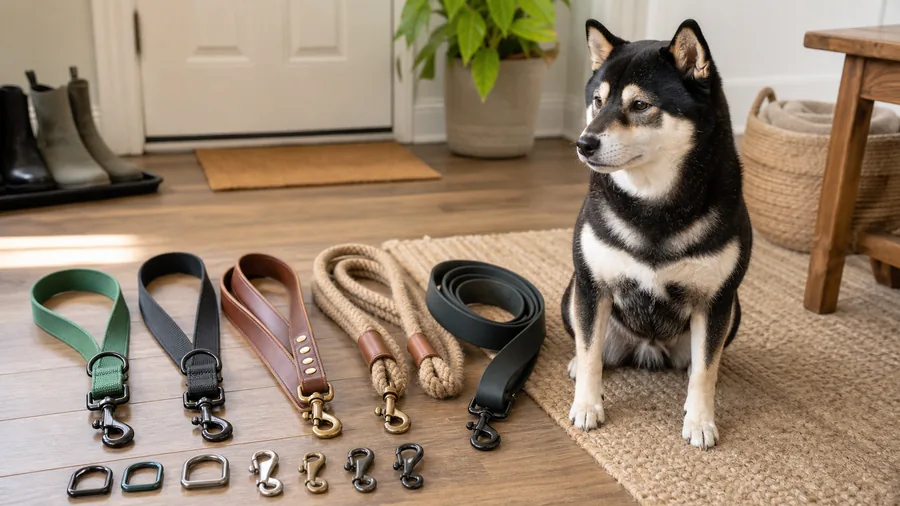
Leash choice affects distance, grip, timing, and how predictable a walk feels. A simple six-foot leash is a useful default for many neighborhood walks, but shorter traffic leashes, lightweight puppy leashes, coated wet-weather leashes, and long lines each solve different problems.
This curated hub organizes the What Dogs Like leash guidance by length, material, puppy use, daily handling, and safety. Return to the broader Harnesses, Collars & Leashes hub when the decision also involves collar or harness fit.
Quick read
Quick path
- Choosing between 4, 6, 10 feet, or a long line: use the Dog Leash Length Guide.
- Comparing nylon, leather, rope, or coated webbing: read the Dog Leash Materials Guide.
- Buying a first puppy leash: use Best Leash for Puppy.
- Walking or jogging with both hands free: compare belt, bungee, handle, and route safety in Best Hands-Free Dog Leashes.
- Hiking on narrow or busy trails: compare fixed length, wet grip, locking clips, close handles, and snag risk in Best Dog Leashes for Hiking.
- Building a simple daily setup: read Collars and Leashes for Everyday Walks.
- Choosing the attachment point: compare Dog Harness vs Collar.
Share & embed
Start with the walking environment
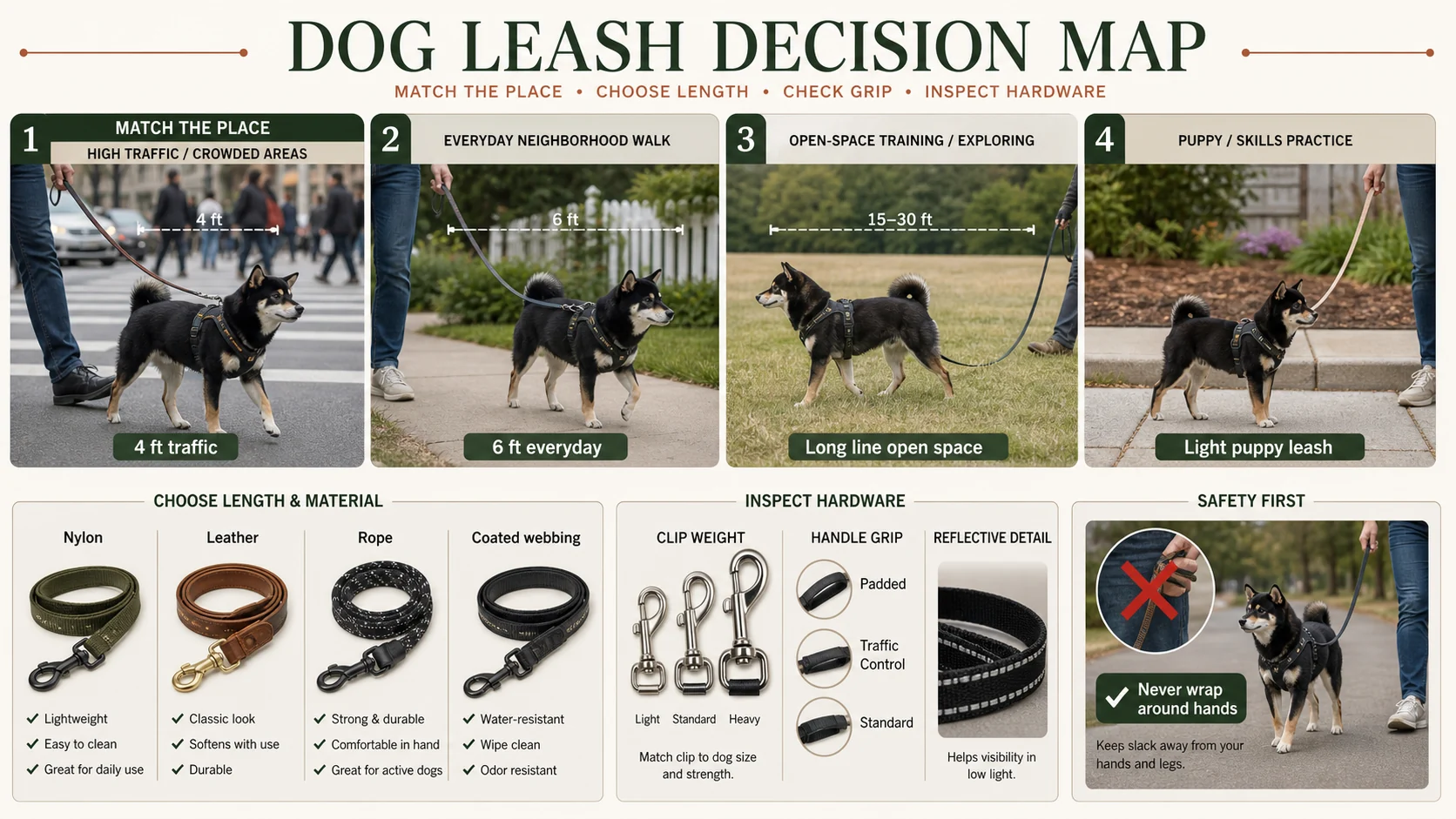
The best leash length depends on where the dog will use it. Crowded sidewalks, elevators, parking lots, and road crossings favor shorter, predictable handling. Normal neighborhood walks often work well with six feet. Open-space training can justify a long line when the handler has enough room and knows how to manage slack.
Retractable leashes change length continuously and can be difficult to control in traffic, crowded paths, and sudden encounters. They are not equivalent to a fixed long line. A standard fixed-length leash is usually easier for learning calm timing and predictable distance.
Choose length and material together
Busy sidewalks and crossings
4-foot or controlled 6-foot leash
- Look for
Predictable distance, comfortable handle, reliable clip
- Avoid
Long or retractable lines around traffic
Everyday neighborhood walks
6-foot fixed leash
- Look for
Balanced movement and control, suitable width and grip
- Avoid
Oversized clips on small dogs
Puppy practice
Light 4-6 foot leash
- Look for
Low clip weight, soft grip, indoor practice before busy walks
- Avoid
Heavy rope or chain that changes movement
Open-space training
Long line
- Look for
Open area, grippy material, careful slack handling
- Avoid
Wrapping line around hands or using near traffic
Wet and muddy walks
Coated webbing
- Look for
Wipe-clean surface, smooth edges, corrosion-aware hardware
- Avoid
Assuming coated materials cannot wear
Nylon is light and widely available. Leather can become comfortable in the hand but needs care after wet use. Rope can offer grip and visibility, although it may become heavy when wet and can cause friction burns. Coated webbing is easier to wipe clean but can feel slick or stiff. The Dog Leash Materials Guide compares the practical tradeoffs.
Hardware and handler comfort
Match clip weight and leash width to the dog. A heavy clip can pull on a small puppy or lightweight harness. A very narrow leash may dig into the hand under tension, while an unnecessarily heavy leash can make normal movement awkward.
Inspect the clip gate, swivel, stitching, handle, reflective trim, and any second traffic handle. A padded handle can be comfortable, but padding does not compensate for weak stitching or poor grip when wet.
Do not wrap a leash or long line around the hand, wrist, or fingers. Keep slack away from legs and avoid grabbing a moving line with bare hands. Strong pulling, repeated lunging, or unsafe handling deserves qualified training support as well as equipment review.
Puppy leashes
For a first puppy leash, simplicity matters. Choose a light clip, manageable width, and fixed 4-6 foot length. Practice attaching and carrying the leash in a calm environment before asking the puppy to manage busy outdoor distractions.
Use the Puppy Walking Gear Checklist to coordinate leash choice with collar ID, harness fit, first walks, and growth rechecks. A leash should attach to correctly fitted gear, not compensate for loose collars or poorly adjusted harnesses.
Continue by question
- Dog Leash Length Guide for 4-foot, 6-foot, 10-foot, long-line, and retractable tradeoffs.
- Dog Leash Materials Guide for nylon, leather, rope, coated webbing, grip, cleaning, and weather.
- Best Leash for Puppy for a light, predictable first leash.
- Best Hands-Free Dog Leashes for waist systems, convertible leads, and walk-before-run checks.
- Best Dog Leashes for Hiking for route rules, fixed lines, secure hardware, passing control, and trail packing.
- Collars and Leashes for Everyday Walks for a simple daily setup.
- Dog Harness Fit Guide and Dog Collar Size Guide for secure attachment points.
- Dog Seat Belt and Car Harness Guide for vehicle restraint; a walking leash is not a crash restraint.