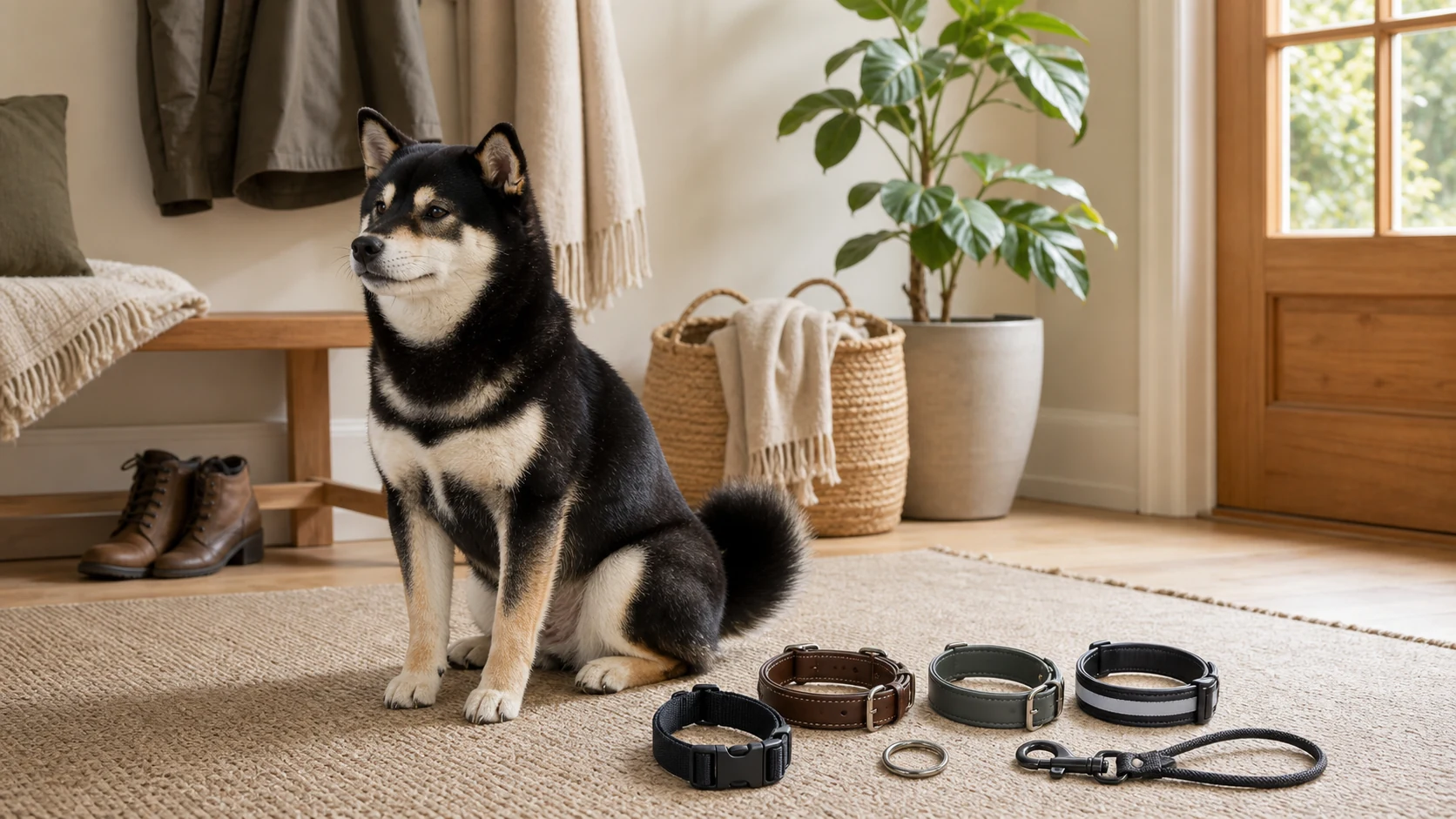
A dog collar usually has two practical jobs: carrying identification and supporting calm everyday handling. It should fit securely without pressing continuously into the neck, sliding over the head, or adding unnecessary hardware weight.
This hub organizes the What Dogs Like collar guidance by size, material, puppy growth, collar-versus-harness roles, and limited-slip designs. Return to the broader Harnesses, Collars & Leashes hub when the decision also involves leash or harness choice.
Quick read
Quick path
- Need the right adjustment range: use the Dog Collar Size Guide and Dog Collar Size Calculator.
- Comparing nylon, leather, or coated webbing: read the Dog Collar Materials Guide.
- Dog can reverse out of a flat collar: read the Martingale Collar Guide before considering a limited-slip design.
- Need a recovery tracker: compare cellular, radio, and nearby-finding systems in Best GPS Dog Collars.
- Puppy setup: compare Dog Collar vs Harness for Puppy.
- Deciding where to attach the leash: use Dog Harness vs Collar.
Share & embed
Measure before choosing a label
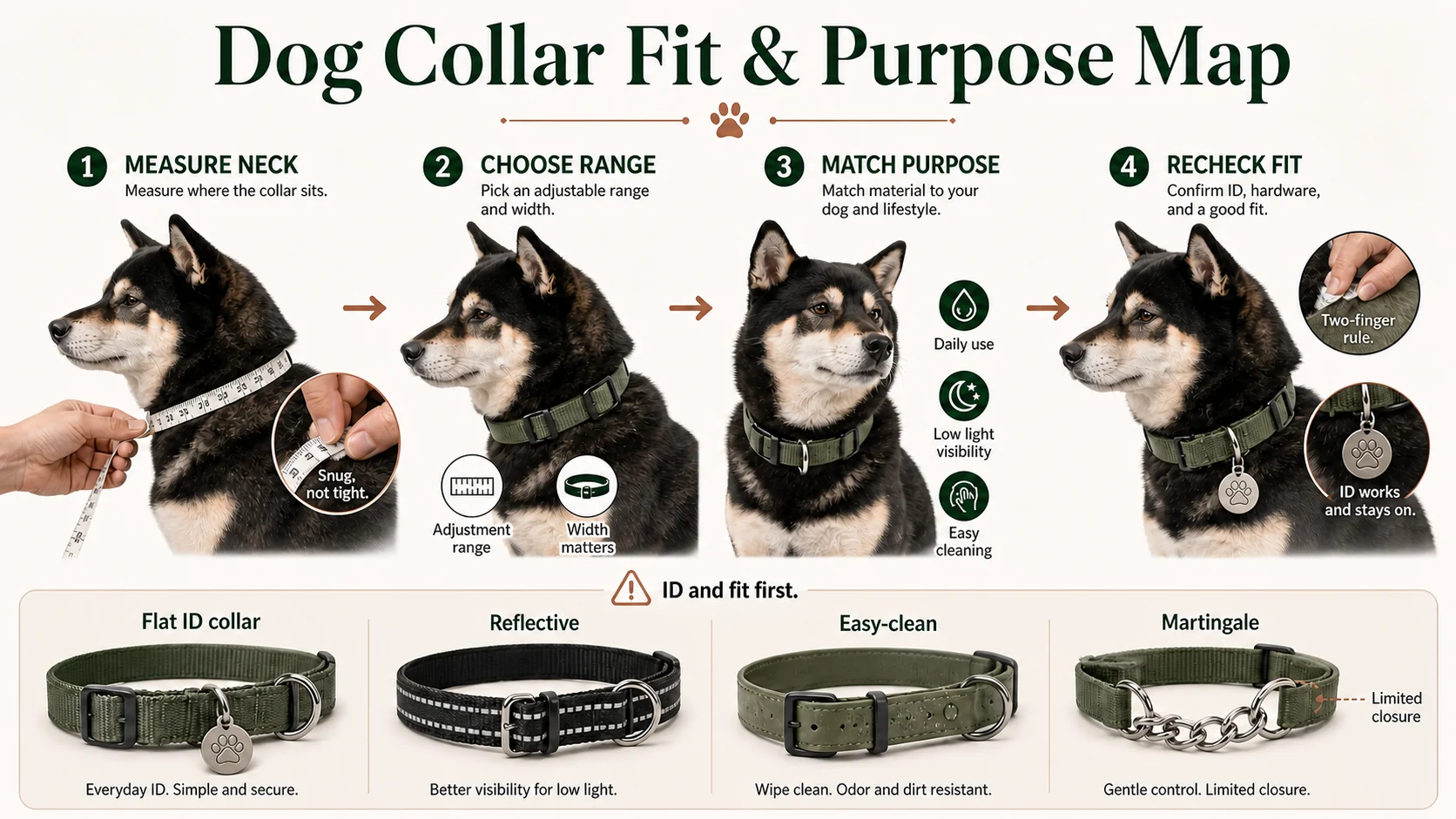
Measure the neck where the collar will sit, using a flexible tape without compressing the coat. Compare the measurement to the current brand chart and choose an adjustment range that places the neck measurement away from either extreme.
The common two-finger check is a useful starting point, not a universal rule. Finger size, coat thickness, collar width, and dog shape vary. The collar should not slide over the head during normal movement, yet it should not leave persistent pressure marks or interfere with swallowing and breathing.
Growing puppies, thick double coats, seasonal grooming, and weight changes require frequent rechecks. Use the Dog Collar Size Calculator for a cautious starting range, then confirm the actual fit on the dog.
Choose by purpose
Everyday identification
Adjustable flat collar
- Look for
Readable ID, secure buckle, comfortable width, suitable hardware weight
- Avoid
Using decorative hardware that is too heavy
Wet or muddy routine
Coated webbing or easy-clean nylon
- Look for
Smooth edges, corrosion-aware hardware, simple cleaning
- Avoid
Assuming waterproof means maintenance-free
Low-light visibility
Reflective flat collar
- Look for
Visible trim, secure ID ring, normal fit
- Avoid
Treating reflectivity as a substitute for lights and safe handling
Narrow head or backing-out risk
Correctly fitted martingale collar
- Look for
Limited closure, clear adjustment, supervised use
- Avoid
Using unlimited-slip or tightening the collar excessively
Leash control
Often a well-fitted harness
- Look for
Body-based attachment and stable fit
- Avoid
Relying on neck pressure for a hard-pulling dog
Material and hardware
Nylon is a practical starting point because it is common, adjustable, and available in lightweight widths. Leather can become comfortable with care but needs sensible drying and inspection. Coated webbing is easier to wipe after mud or rain, although some versions feel stiff or slick.
Inspect the complete collar rather than only the strap material. Buckles, D-rings, separate ID rings, stitching, rivets, sliders, and edge finishing determine whether the collar is comfortable and easy to trust. The Dog Collar Materials Guide compares these tradeoffs in detail.
Flat collars and martingale collars
A flat collar is the simplest choice for identification and many calm daily routines. A martingale collar has a limited section that tightens when tension is applied. It can help reduce backing-out risk for some dogs with narrow heads, but it must be adjusted so it cannot keep tightening without limit.
Martingale collars are not punishment devices and should not be used to jerk, choke, or correct a dog. Remove them when unsupervised or when there is an entanglement risk, following the manufacturer's instructions. Use the Martingale Collar Guide for fit and use boundaries.
Collar and harness roles
Many dogs can wear a flat collar for ID while the leash attaches to a harness. This separates identification from walking control and can reduce routine neck pressure. It is especially worth considering for small dogs, hard pullers, and dogs that cough or gag under leash tension.
Persistent coughing, neck sensitivity, pain, skin changes, or sudden resistance to collar handling deserves veterinary guidance. Pulling, lunging, or escape behavior may also need qualified training support rather than stronger neck equipment.
Continue by question
- Dog Collar Size Guide for measuring, adjustment range, width, coat, and hardware.
- Dog Collar Materials Guide for nylon, leather, coated webbing, reflectivity, and cleaning.
- Martingale Collar Guide for limited-slip fit and safety boundaries.
- Best GPS Dog Collars for coverage, subscription, battery, fit, and field-test decisions.
- Dog Harness vs Collar for identification versus leash attachment.
- Dog Collar vs Harness for Puppy for first gear and growth checks.
- Collars and Leashes for Everyday Walks for a simple daily setup.