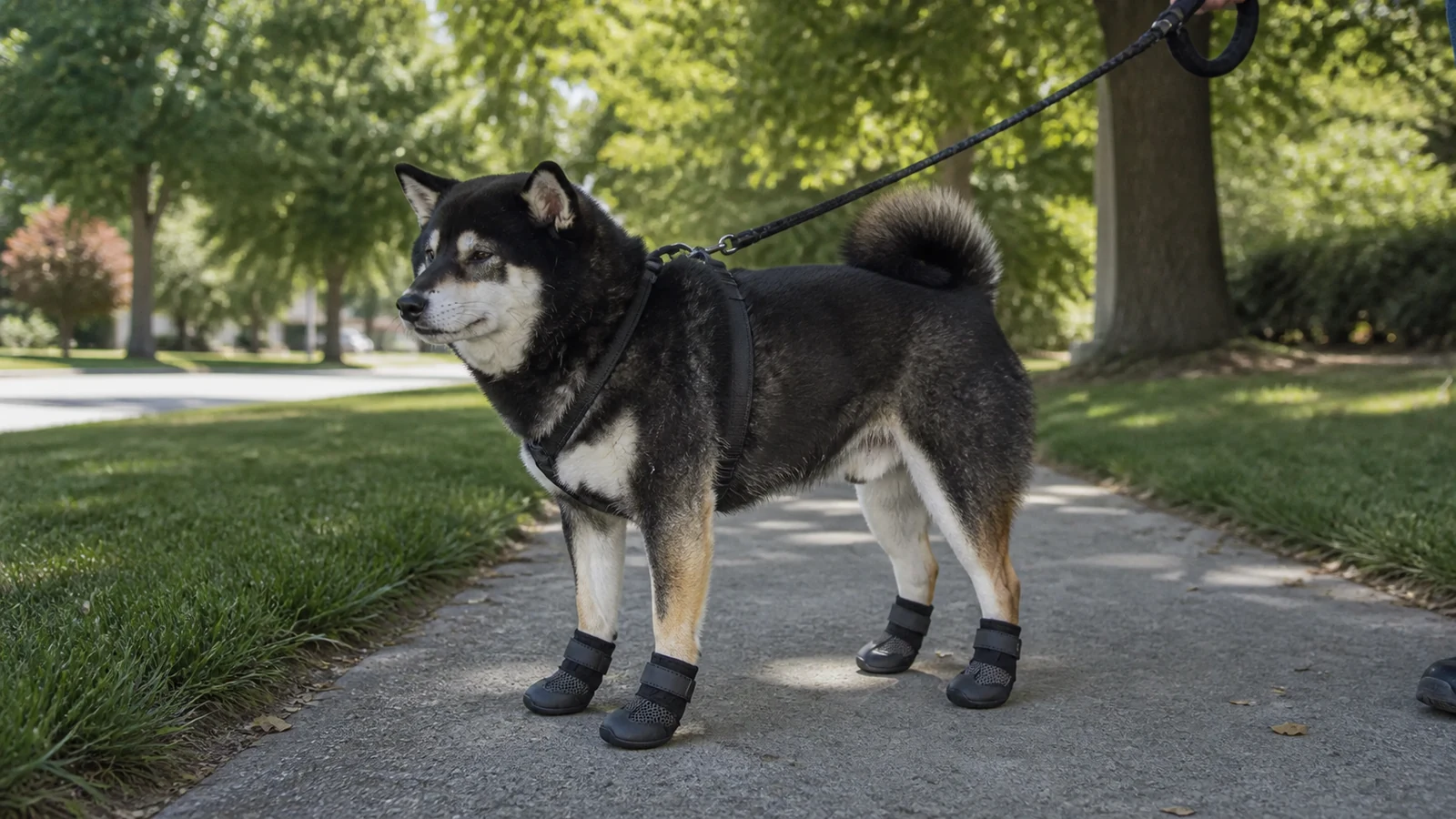
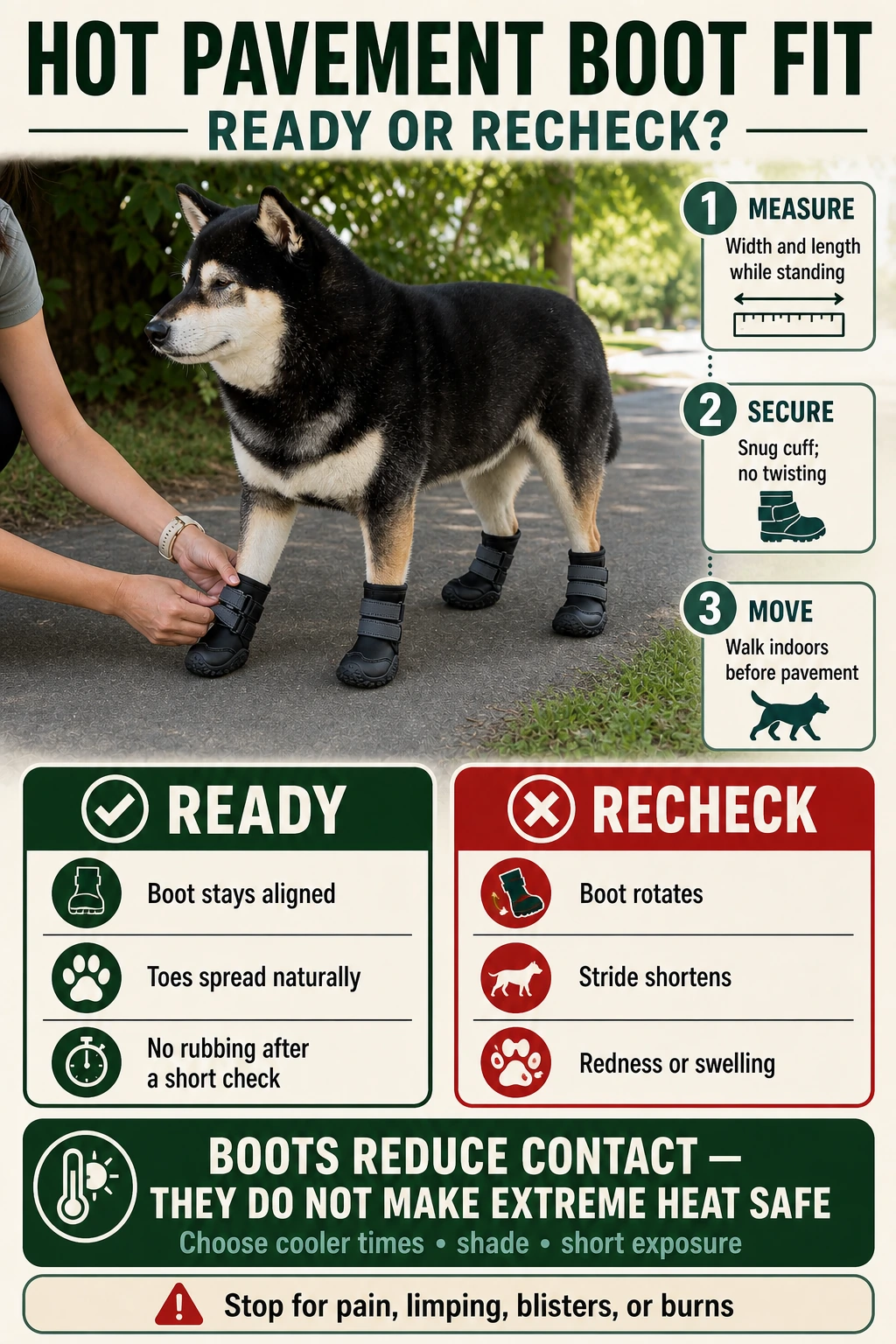
The best dog boots for hot pavement cover the loaded paw pad, stay aligned without strangling the leg, flex with the dog's stride, and come off for frequent skin and heat checks. Boots add a barrier; they do not make an unsafe temperature, overheated dog, or long exposed route safe. Change the time, surface, shade, and distance first—then use boots for the unavoidable transition.
Quick read
Quick answer
- Measure front and rear paws while the dog is standing with weight on them; do not assume all four match.
- Choose complete sole coverage, a breathable upper, smooth interior seams, and an adjustable closure above the paw.
- Introduce boots indoors, then test for five minutes on a cool surface before any warm-weather use.
- Remove and inspect for twisting, heat, dampness, redness, rubbed dewclaws, and altered gait.
- Avoid the hottest hours and choose shade or grass even when boots are worn.
Heat safety comes before boot shopping
AKC's hot-pavement guidance explains that asphalt and artificial surfaces can cause discomfort, blisters, and burns, and can also contribute to rising body temperature. It recommends cooler times, grassy or shaded routes, gradual boot introduction, and a snug—but neither tight nor loose—fit. VCA's veterinary overview of paw injuries and burns likewise warns that hot pavement can burn paw pads and describes swelling, redness, and blistering as warning signs.
Share & embed
Do not rely on one air-temperature threshold or a timer alone. Sun, wind, humidity, surface color, material, and duration all change exposure. Touch the actual surface where the dog will walk and observe the dog continuously. Heavy uncontrolled panting, weakness, confusion, vomiting, collapse, or abnormal gum color can be an emergency; stop activity, move to a cooler place, and contact a veterinarian promptly.
Measure paws under load
Place one paw on paper while the dog stands squarely. Mark the widest points and the front-to-back pad length without including fur. Repeat for both front and rear paws; front paws are often wider. Compare the measurements with the current manufacturer chart for the exact product and variant.
If a paw lands between sizes, do not automatically size up. A loose boot can rotate, fold under, and create friction. A tight boot can compress toes and trap heat. Check the manufacturer's advice, return policy, and whether mixed-size sets or pairs are available.
Short urban crossings
Mostly shade or grass with brief pavement
- Look for
Light breathable boot, complete sole, easy removal
- Avoid
Treating boots as permission for a midday walk
Trail plus warm parking area
Abrasive ground and brief hot surfaces
- Look for
Flexible rugged sole, secure cuff, debris check
- Avoid
Heavy insulated winter boot
Wide front / narrow rear paws
Measurements differ materially
- Look for
Brand offering pairs or suitable separate sizes
- Avoid
Forcing one size onto all four feet
Sensitive dewclaws
Closure sits near the dewclaw
- Look for
Smooth cuff, precise strap position, frequent checks
- Avoid
Tightening until the boot cannot move at all
Sole, upper, and closure
| Component | Look for | Why | Warning sign | Recheck |
|---|---|---|---|---|
Sole | Full pad coverage and natural flex | Separates pads from heat and abrasion | Sole folds, rotates, or is rigid at the toes | Alignment after five minutes |
Upper | Breathable, smooth, debris-resistant material | Reduces trapped moisture and grit | Hot, wet interior or rough seam | Skin and fur after removal |
Opening | Wide enough for calm paw insertion | Avoids bending toes and forcing nails | Dog resists because paw catches | Nails, toe placement, closure path |
Closure | Adjustable above paw without dewclaw pressure | Helps retention through stride | Indentation, swelling, strap migration | Two-finger feel where applicable |
Height | Enough cuff for retention without restricting joint | Balances staying on and free movement | Shortened stride or boot striking joint | Walk, turn, sit, and lie down |
“Water-resistant” and “breathable” are not the same. Neoprene can conform and protect but may retain warmth and water. Mesh can ventilate yet allow fine grit. Match construction to the route and remove the boots during long rests so paws can be checked and dried.
Two current Amazon options
These products illustrate two summer-capable constructions. We have not measured internal temperature, abrasion life, or retention on an individual dog. Verify the exact size chart, chosen variant, seller, care, and returns.
A calm boot-training sequence
Start on a non-slip floor. Show one boot, reward calm investigation, touch the leg, insert one paw, fasten lightly, then remove. Over several sessions add a second boot and a few steps. The exaggerated “high-stepping” gait many dogs show at first should settle quickly; persistent freezing, kicking, limping, or biting the boots means stop and reassess.
When all four stay aligned indoors, walk for five minutes on cool dry pavement. Remove every boot and compare paws. Look between toes and around nails and dewclaws for pink skin, pressed fur, moisture, grit, or strap marks. Repeat after ten minutes before attempting a necessary warm-surface transition.
Carry the dog's normal leash rather than pulling forward to make the dog walk. A fixed hiking leash and properly fitted harness let the handler guide without neck pressure. Pack spare socks only if the boot manufacturer supports them; extra layers can change fit and heat.
When boots fall off or twist
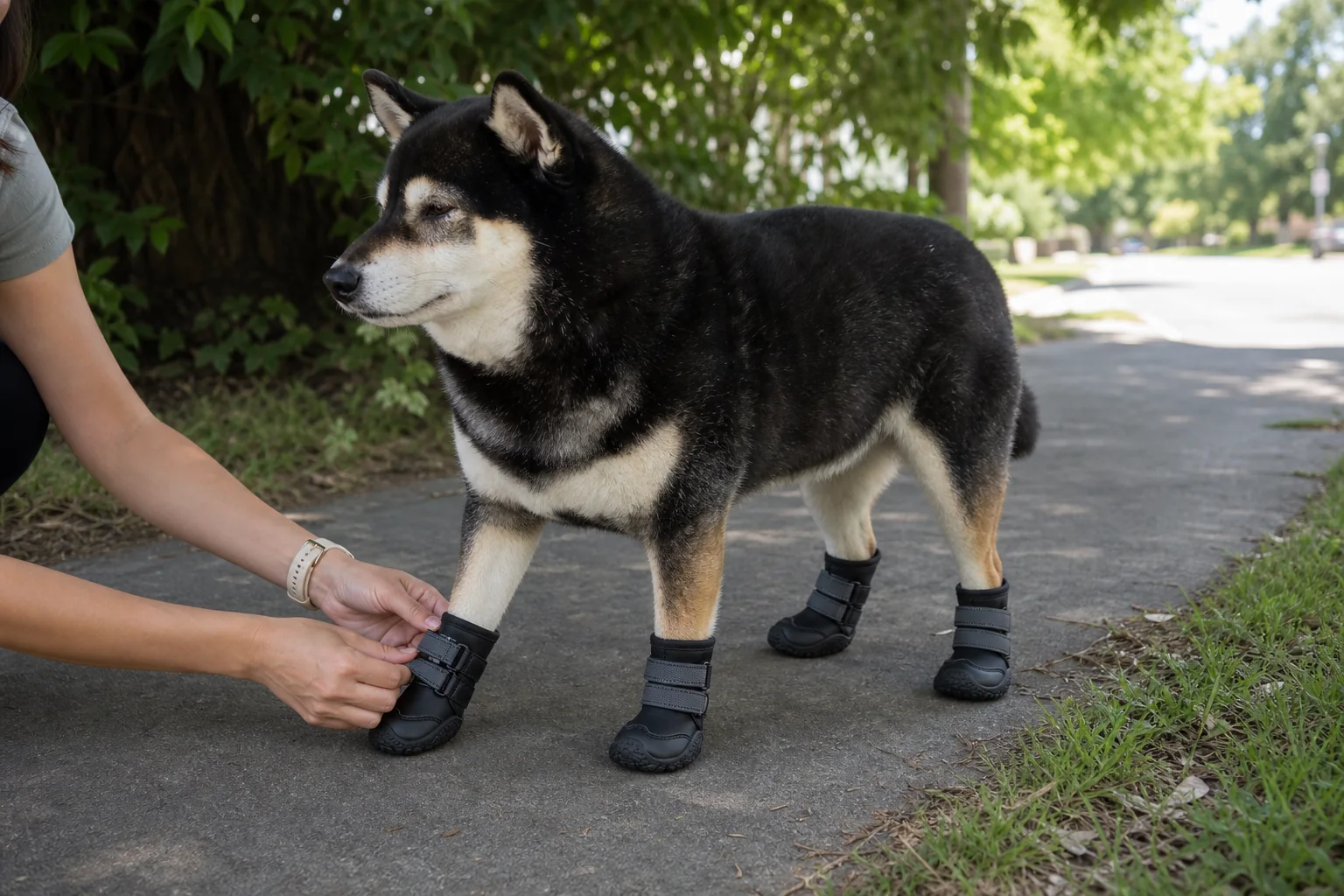
First confirm the measured size and that nails are not preventing the paw from seating fully. Open the boot completely, place toes at the front without curling, settle the paw, then close the lower and upper straps in the specified order. Do not simply pull harder on the straps.
Hair, sand, and wet neoprene change friction. Stop after puddles or swimming, remove the boots, dry the paws, empty debris, and refit. If the boot repeatedly rotates on one leg, compare that paw with the chart and inspect gait; an asymmetric movement may deserve veterinary attention.
Hot sand, wet crossings, and car parks
Sand can become dangerously hot and work into the boot opening. Test the surface, choose cooler hours, and stop often to empty grit. After a creek, beach, or swimming stop, remove boots rather than allowing wet material to sit against the skin for the rest of the outing. Dry the paws, inspect between toes, and refit only if the route still needs protection.
Parking areas are easy to underestimate because the dog may wait while the handler unloads equipment. Plan a shaded standing mat, prepare the leash before opening the vehicle, and move directly to a cooler surface. Never leave the dog standing in boots on hot asphalt while bags, strollers, or kayaks are organized.
If a pad is red, swollen, blistered, peeling, painful, or the dog is limping, stop the walk and contact a veterinarian. Do not apply human burn creams or adhesive coverings unless a veterinarian directs them; licking and trapped heat can complicate an injury.
Front and rear sizing is a purchasing problem
Many product pages show one size for a four-boot set, but a dog's front and rear paws may cross different chart bands. Measure every paw while it bears weight and write the values down by position: left front, right front, left rear, right rear. Compare both width and any length measurement the maker requests. Do not average the four numbers.
If the front paws need one size and the rear paws another, first look for products sold in pairs or brands that explicitly support split sizing. Buying two full sets can work only when both variants are returnable and the unused pairs have a legitimate planned use; otherwise it doubles cost and waste. A boot that fits the widest front paw may rotate on a narrower rear paw even when the strap feels tight.
The cuff and closure position matter as much as the sole. Mark where each dewclaw sits when the dog stands. The boot opening, seam, or upper strap should not press or repeatedly sweep across it. Do not compensate by tightening until toes compress or by placing an unapproved thick layer beneath the strap. If the maker permits liners or socks, remeasure with the approved layer because it changes internal volume.
Use the return window as a fit trial
Keep the boots clean and indoors until the fit is credible. Seat each paw fully, fasten according to the instructions, and photograph the closure position. Have the dog stand, walk straight, turn both ways, stop, and lie down on a cool non-slip floor. Check whether the sole remains beneath the pads rather than rotating to the side.
Remove all four after two minutes, then five, then ten. Compare skin color, fur compression, moisture, strap marks, nail position, and dewclaw contact. A faint temporary fur line is different from a deep indentation, redness, warmth, or pain. Stop at the first sign of rubbing rather than waiting for a full outdoor walk.
Only after the indoor sequence passes should you try cool clean pavement. Reinspect again before the boots become dirty enough to affect returns. Record which paw loses alignment first; that evidence is more useful than tightening every strap equally.
FAQ
The added questions come from recurring Reddit discussions about front and rear paws needing different boot sizes and boots rubbing dewclaws. These reports surface fit problems but do not prove that one boot design works for every dog.
Do dog boots make hot pavement safe?
They add a barrier but do not protect the whole dog from heat or justify a dangerous route. Cooler timing, shade, grass, shorter duration, water, and monitoring remain primary.
Should dog boots be tight?
Secure enough to stay aligned, never so tight that they compress toes, leave deep marks, restrict movement, or press a dewclaw. Use the exact manufacturer's fitting directions.
Do dogs need different front and rear sizes?
Sometimes. Measure all paws under load. If the difference crosses the size chart, look for pairs, split sizes, or another product rather than forcing one set.
How long can a dog wear summer boots?
There is no universal safe duration. Begin with minutes, remove for frequent skin and heat checks, and shorten use in warm or wet conditions.
Why do correctly sized boots still fall off the rear paws?
Rear paws may be narrower or shaped differently even when their length matches the chart. The cuff may also sit at a different taper. Measure each paw under load, verify that toes reach the front without curling, and choose split sizes or another construction rather than overtightening one four-boot set.
How can I prevent a dog boot from rubbing the dewclaw?
Choose a cuff and closure that sit clear of the dewclaw, introduce wear in minutes, and inspect after every early session. Use only liners, socks, or protective layers allowed by the manufacturer or veterinarian. Stop for redness, swelling, broken skin, repeated licking, or pain.
Can I solve twisting by tightening the straps more?
Not safely by default. Twisting can indicate the wrong width, internal volume, sole shape, paw seating, or closure height. Excess tension can compress toes and irritate skin or dewclaws. Refit from the open boot, then change size or design if alignment still fails.
My dog refuses to walk in boots. How should I introduce them?
Do not make hot pavement the training surface. The AKC notes that dogs need time to adjust to shoes. Our approach is brief, rewarded practice indoors: let the dog investigate, introduce the boots gradually, and encourage a few voluntary steps. Stop for distress or discomfort and recheck fit. Until the dog moves normally, choose cooler walking times and suitable surfaces instead of dragging the dog through an outing.
Can dog socks replace boots for summer pavement walks?
Do not assume a sock sold for indoor grip or as a boot liner provides outdoor heat protection. For example, Ruffwear describes its Bark'n Boot socks as liners for use with boots. Our recommendation is to check the intended use of the exact product, not just its rubber dots or thickness. A compatible liner may help the boot system, but it does not turn an unsafe route into a safe one.
Is paw wax an alternative if my dog will not tolerate boots?
We would not rely on wax as a heat barrier. The AKC distinguishes pad moisturizers from protective footwear and emphasizes avoiding hot surfaces. A balm's skin-care role does not establish a safe pavement temperature or walking duration. If boots are not tolerated, change the timing and route or use a cooler exercise space. Ask your veterinarian about sore or damaged pads rather than covering them and continuing the walk.
Bottom line
The best hot-pavement boot is the one that fits each loaded paw, stays aligned through a normal gait, and can be removed for inspection. It remains one layer in a larger heat plan. If the route itself is unsafe, change the route.