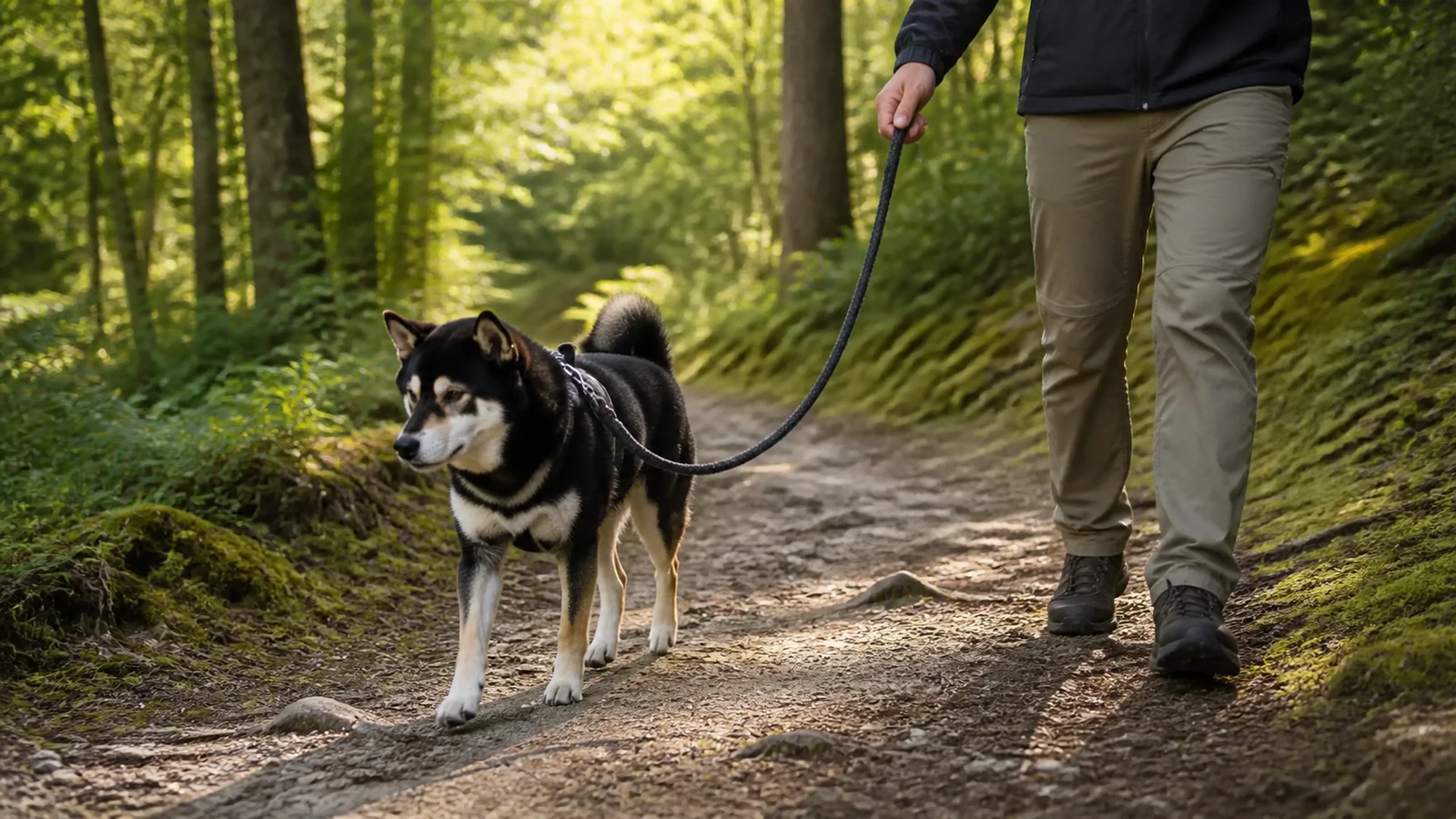
The best dog leash for hiking is usually a fixed line short enough to prevent a dog reaching wildlife or wrapping a tree, yet long enough for a natural stride on the trail. For many public trails, a grippy 4- to 6-foot leash with a secure clip and a reachable close-control handle is a stronger default than a retractable line or long bungee. The route rules and the narrowest encounter decide the setup.
Quick read
Quick answer
- Check whether dogs are allowed and the exact leash-length rule before leaving home.
- Use a fixed 4- to 6-foot leash on narrow, busy, rocky, or wildlife-rich trails.
- Prioritize wet-hand grip, a secure clip, visible webbing, and a handle you can reach before passing.
- Use a long line only in open permitted training spaces with managed slack—not around trees, ledges, bikes, or other hikers.
- Attach to a well-fitted hiking harness and carry a backup leash, water, waste bags, ID, and first-aid basics.
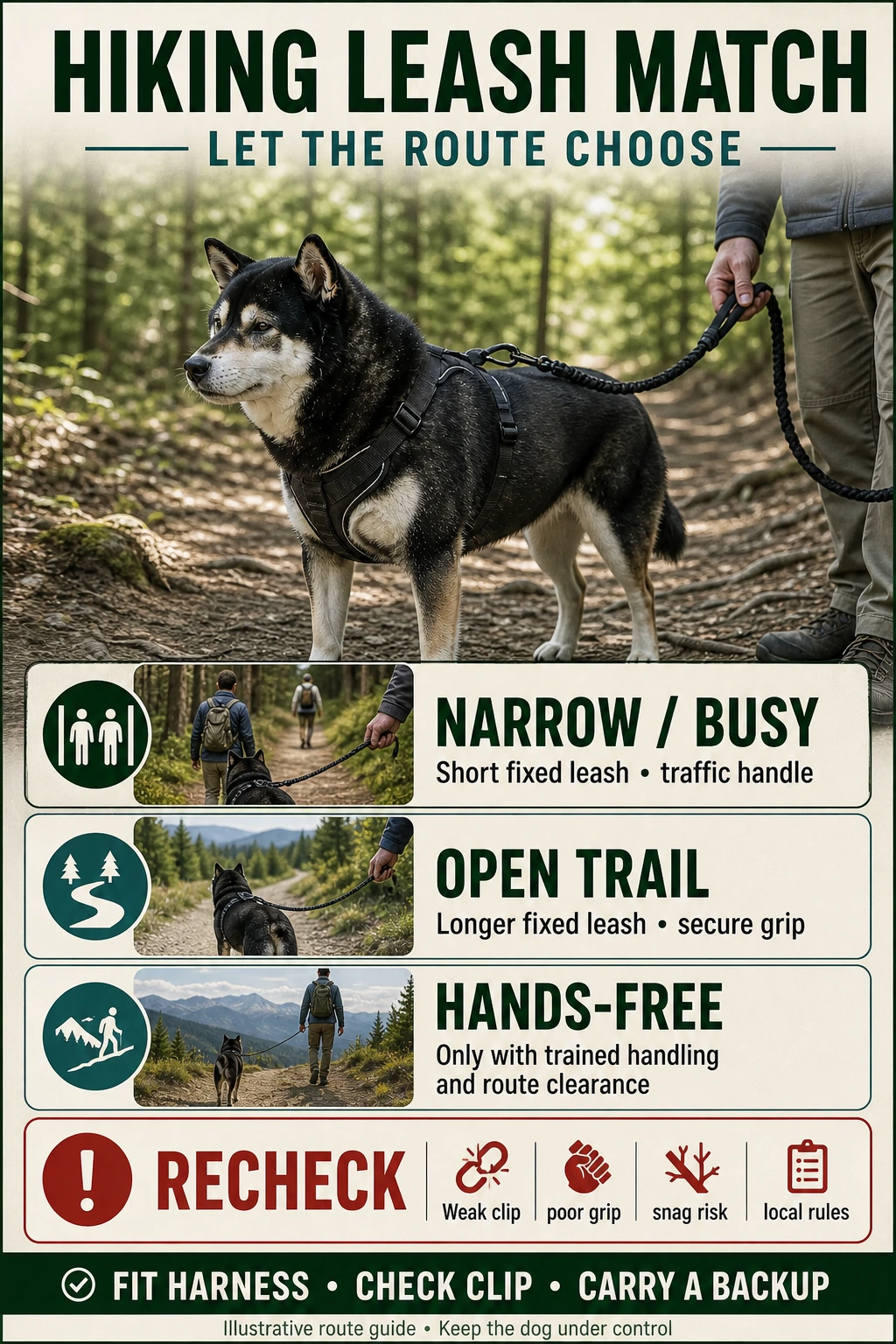
Let the route choose the leash
Share & embed
The National Park Service's hiking-with-pets guidance says to check each park, keep pets on a 6-foot leash, assess trail fitness, bring extra water, take breaks, pack out waste, and keep dogs away from wildlife. Some parks do not allow pets on trails at all. A “hiking leash” label never overrides a local rule.
Narrow or busy trail
Frequent passing and snag points
- Look for
4-6 ft fixed line, close handle, secure clip
- Avoid
Retractable cord or loose long line
Open permitted trail
Clear sight lines and predictable dog
- Look for
6 ft fixed line with comfortable grip
- Avoid
Assuming open space means off leash
Wet or muddy route
Gloves, rain, creek crossings
- Look for
Grip that works wet, cleanable material, corrosion-aware hardware
- Avoid
Smooth handle and untreated hardware
Strong sudden puller
Wildlife or dog reactions possible
- Look for
Training support and direct hand control
- Avoid
Body tether that can pull handler off balance
Length, elasticity, and snag risk
A six-foot line offers useful movement on ordinary trails while keeping the dog within a controllable radius. A four-foot line can be easier through switchbacks, boardwalks, parking areas, and crowded approaches. Shorten before passing; do not wait until two dogs are nose-to-nose.
Bungee absorbs small pace changes but also stores energy and creates extra travel. That may feel smooth on a wide running route yet reduce precision near rocks, roads, horses, children, and wildlife. A fixed line gives clearer distance. If you use elastic, compare both relaxed and fully extended length and insist on a non-elastic close handle.
Long lines are training tools for open areas. They can wrap legs, burn skin, catch brush, and pull a dog or handler off balance. Never coil a loaded line around the hand. A retractable housing adds another drop risk and the thin extended cord can be hard for other trail users to see.
Grip and hardware deserve more attention than “heavy duty”
| Feature | Why it matters | Useful when | Tradeoff | Inspect |
|---|---|---|---|---|
Flat webbing | Broad predictable hand contact | Everyday trails and easy cleaning | Edges can feel sharp under a hard pull | Handle seam, wet grip, fraying |
Climbing-style rope | Rounded hand feel and visible body | Dry trails and secure carabiner preference | Can hold water, grit, and weight | Core exposure, clamps, handle stitching |
Locking carabiner | Reduces accidental gate opening when correctly locked | Brush, repeated movement, dogs that roll | Heavier and slower than a snap | Gate closes, sleeve turns, no grit |
Traffic handle | Quick shortening before passing | Busy trails, roads, overlooks | Can hang low and catch a leg | Reach, placement, seam strength |
Reflective thread | Helps return light in low visibility | Dawn, dusk, wooded shade | Does not make the dog visible from every angle | Reflectivity after cleaning and wear |
Match hardware weight to the dog and harness. A large steel carabiner may be reassuring on a big dog but can bounce against a small dog's shoulder. Swivels reduce ordinary twisting but do not prevent the leash looping a leg. Sand and grit can keep gates from closing; rinse according to the manufacturer instructions and inspect before every outing.
Two current Amazon options
These are different fixed-line formats. We have not tested their long-term abrasion, wet grip, or breaking strength. Confirm the current listing, exact leash and hardware dimensions, seller, and returns.
Harness connection and passing protocol
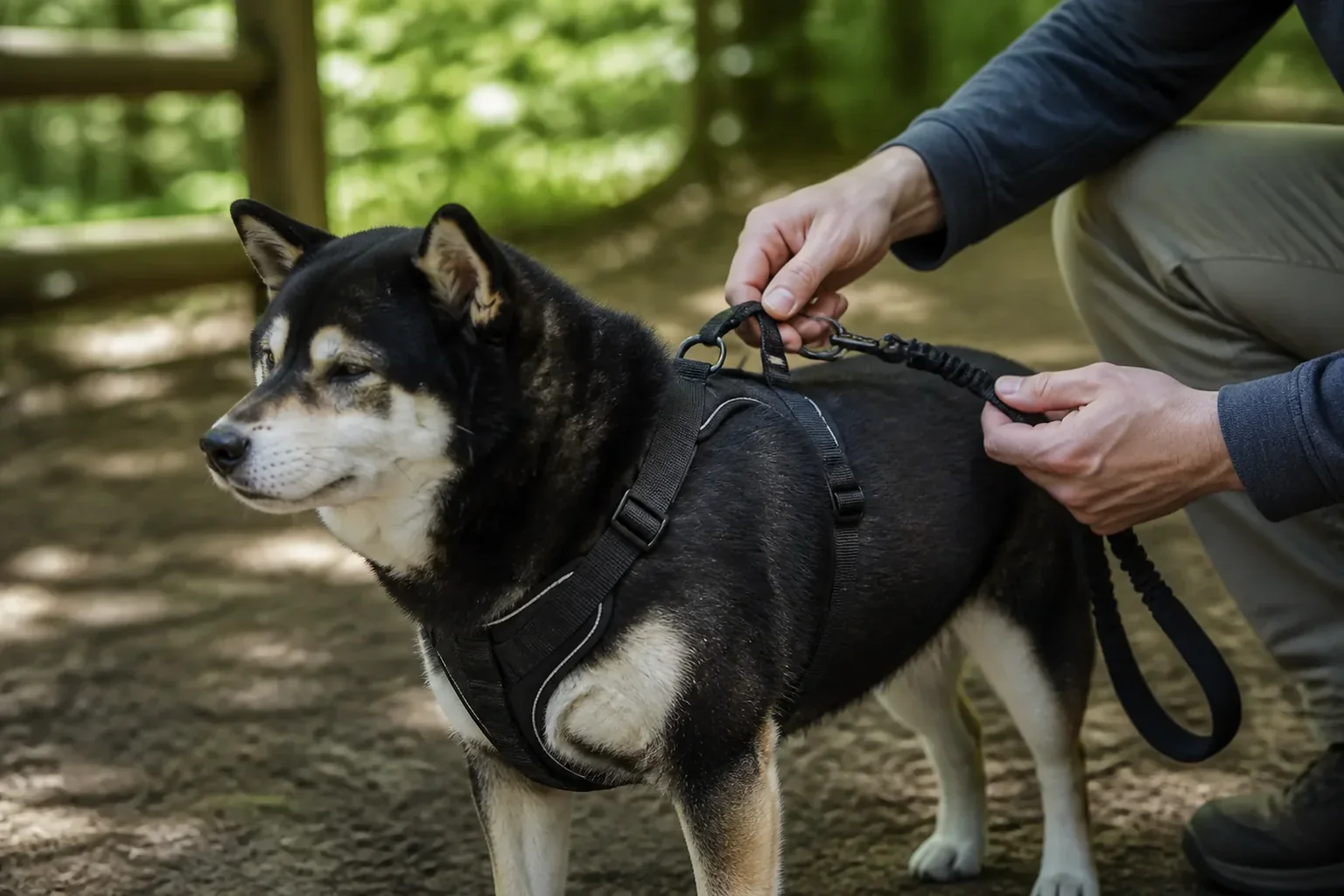
Use a harness that stays clear of the shoulder, does not rub behind the elbows, and cannot slide over the head when the dog backs up. Recheck fit over seasonal coat changes. Our dog harness fit guide gives a movement-based check; the harness-versus-collar guide explains attachment tradeoffs.
Before a blind corner, call the dog to the side away from the drop, road, horse, bike, or oncoming dog. Shorten using the close handle or gather the leash in broad folds without wrapping the hand. Step off only where doing so will not damage vegetation or create unsafe footing. Communicate early with the other handler.
Loose-leash skills matter more than a padded handle. AKC's hiking training guidance recommends ordinary obedience, focus work, recall, and polite leash walking before trail freedom. Practice “side,” “wait,” “behind,” “leave it,” and an emergency turn in a low-distraction place.
Pack and post-hike checks
Carry more water than the expected walk requires, a collapsible bowl, waste bags, ID, backup fixed leash, light, small towel, and pet first-aid supplies. Do not rely on streams as drinking water. Know the nearest veterinary option and turn around before fatigue changes gait or responsiveness.
After the hike, inspect paw pads, nails, between toes, armpits, chest straps, leash webbing, handle seams, clip gate, and reflective material. Dry wet gear fully. Retire a leash with core exposure, cut fibers, loose load-bearing stitches, cracked clamps, a bent gate, or a lock that no longer closes cleanly.
Weather changes the handling plan
Rain makes roots, rock, rope, and coated handles behave differently. Test grip with damp hands at home and carry gloves only if they still allow you to operate the clip and close handle. In snow, prevent the line from disappearing beneath the surface or wrapping a leg. In strong wind, avoid extra line that can blow across brush or another hiker.
Cold, heat, elevation, and humidity also change the dog's capacity before they change leash strength. Turn around for slowing pace, repeated stopping, altered gait, excessive panting, or reduced responsiveness. The goal is not to finish a planned distance; it is to return while the dog still moves comfortably and the handler can manage every pass safely.
Hands-free with trekking poles is a system decision
Trekking poles do not automatically make a waist leash the better choice. A body attachment frees both hands, but it also transfers a sudden pull into the handler's hips or torso while the poles occupy the hands. On descents, loose rock, narrow ledges, wildlife areas, or routes with dogs approaching from behind, that can reduce the time available to shorten the line and stabilize.
Before combining the systems, rehearse three transitions on flat ground: release one pole and reach the close handle, bring the dog behind or beside the body, and disconnect or convert to hand control without dropping the remaining pole. The leash must not cross a pole tip, wrap the handler's legs, or run under a pack strap. A quick-release feature is only useful if the handler can find and operate it under load; test the actual mechanism without the dog pulling.
Measure the full working length from the body attachment to the harness when elastic is relaxed and extended. A seven-foot bungee may create much more travel than expected before the handler reaches the close handle. That can be unsuitable where the trail rule is six feet or where the dog could reach a ledge, cyclist, horse, or another dog. Route rules and control distance still apply when the leash is attached to a belt.
For a dog with unpredictable prey drive, lunging, or leash reactivity, retain direct hand control and work with a qualified trainer before adding poles and a body tether. Hands-free equipment is a convenience for an already manageable situation, not a substitute for response training.
Test the complete leash before trail day
Clip the leash to the actual hiking harness and wear the pack, gloves, jacket, and belt planned for the route. Walk stairs, turn in both directions, step over a low obstacle, gather slack, and move from normal grip to the traffic handle. Wet the handle lightly and repeat the grip test. Confirm that the clip gate closes after contact with dust or fine grit, following the maker's cleaning instructions.
Inspect where metal rubs webbing, where a carabiner contacts a belt ring, and where a bungee joins fixed material. Look for a small wear point rather than waiting for the whole leash to appear old. Pack a simple fixed backup leash that can replace the primary without changing harness fit or local rule compliance.
FAQ
These additions reflect recurring questions in Reddit threads about waist leashes and sudden pulling on hikes and combining trekking poles with a leash. The discussions reveal handling concerns; they are not durability tests or safety standards.
Is a 6-foot leash good for hiking?
It is a useful default on many permitted trails and matches the maximum specified by many park rules. Narrow or crowded areas may require you to hold the dog closer.
Are hands-free leashes good for hiking?
Only for a predictable dog, stable handler, appropriate route, and safe transition to hand control. A sudden pull transfers force to the body. Compare that setup in our hands-free leash guide.
Is a carabiner safer than a snap hook?
A correctly closed locking carabiner can reduce accidental opening, but it can collect grit and may be heavy. Any clip can fail or be left partly open, so inspect and operate it before each hike.
Should I use a long line on a hiking trail?
Usually not on narrow, wooded, busy, rocky, or wildlife-rich trails. Use one only where rules allow, the space is open, and the handler can manage slack without wrapping it around hands or bodies.
Can I safely use trekking poles with a hands-free dog leash?
Only when the dog is predictable, the route provides margin, the leash stays clear of the poles, and the handler has rehearsed immediate hand control. On technical descents or around wildlife and other trail users, use the arrangement that preserves the fastest reliable control—even if that means stowing one pole.
Does a bungee make a sudden pull safer?
It can soften small pace changes, but it also increases travel and stores energy. It cannot make an unpredictable lunge safe or prevent a handler fall. Compare fully extended length, close-handle position, body attachment, and the handler's balance before choosing elasticity.
What leash should I use when my dog has poor recall?
Recall does not change the leash rule or remove snag risk. On ordinary public trails, a fixed 4- to 6-foot line usually preserves more direct control. Use a long line only in an open permitted training space with managed slack, not as simulated off-leash freedom on a narrow trail.
What should I compare when a leash becomes heavy or slippery after getting wet?
Compare wet grip, water retention, drying instructions, and the weight of the complete leash and clip. Our recommendation is to wet a short section at home and check handling before a hike, without the dog pulling against it. A wipe-clean coating is not automatically grippier than webbing. If mud makes reliable control difficult, shorten the outing and use equipment you can hold securely; do not wrap a moving line around your fingers to compensate.
What should I do when the leash keeps catching around trees or rocks?
Reduce working length before entering obstacles and guide the dog around the same side as you. The AKC's hiking guidance emphasizes loose-leash walking and pace control on uneven routes. Our recommendation is to stop and retrace the line safely if it snags, rather than pulling the dog through brush or unclipping beside a hazard. Repeated tangles mean that the chosen length or route needs changing, even where longer lines are allowed.
Is a retractable leash okay if I keep it locked short on the trail?
Our preference on narrow or busy trails is a fixed-length leash: it avoids relying on a reel lock for working length and makes shortening predictable. If considering a retractable model, read its operating limits and the trail's current leash rules first. A locked reel does not resolve line-contact or dropped-handle risks. The National Park Service's pet-hiking guidance is a useful starting point; check the specific destination before setting out.
Bottom line
Choose a hiking leash for control during the hardest encounter: wet hands, a blind corner, a passing dog, or wildlife beside the path. A fixed 4- to 6-foot line, reliable grip, secure clip, and reachable close handle form a strong default. The complete trip checklist lives in the Dog Travel & Outdoor Gear hub.