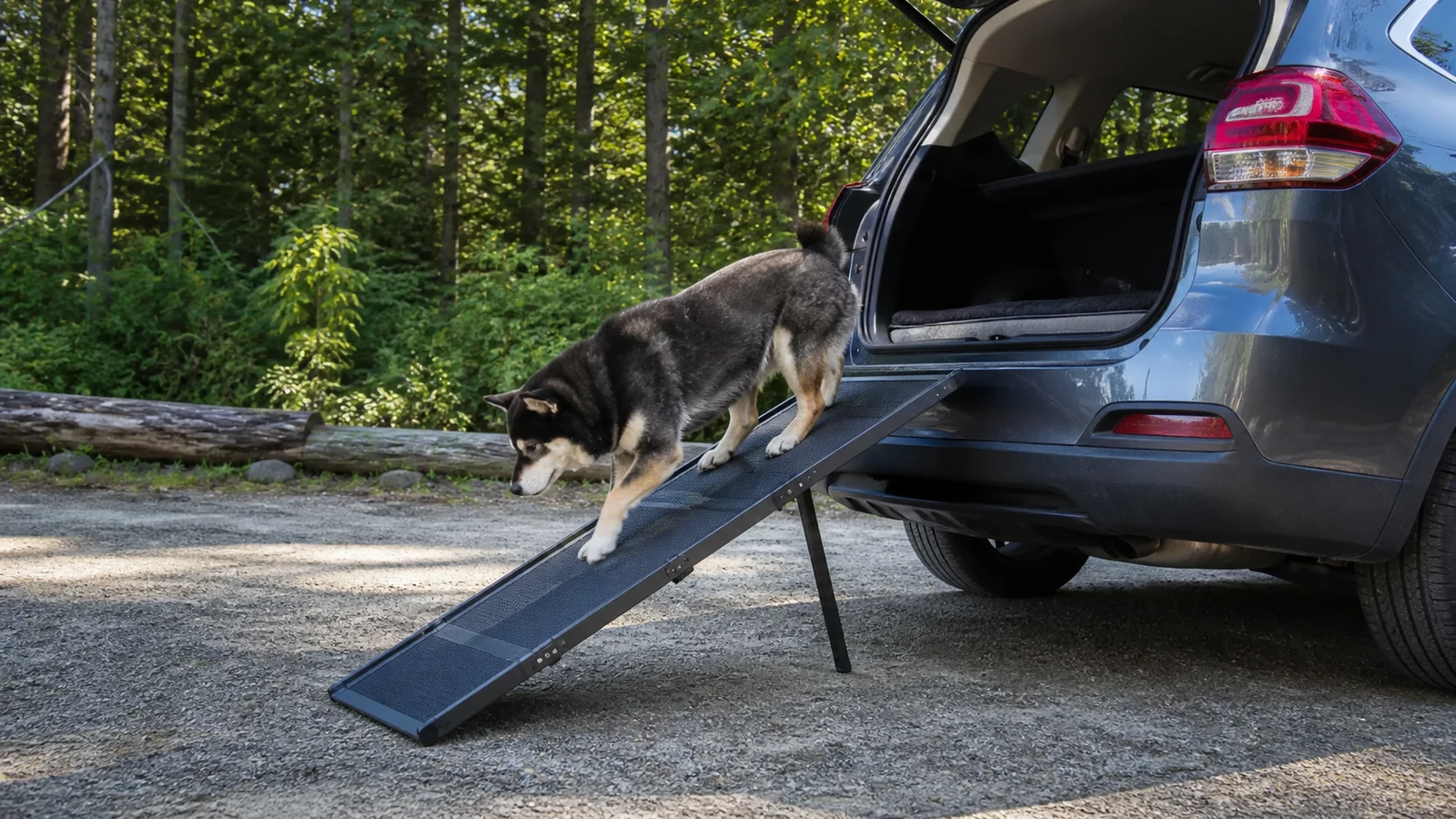
The best dog ramp for an SUV is not automatically the longest or strongest listing. It is the ramp that makes full, stable contact with your actual vehicle opening, creates a manageable slope for your dog, offers reliable traction, and can be lifted and stored by the person who will use it. A ramp that is left in the garage because it is awkward solves nothing.
Quick read
Quick answer
- Measure cargo-sill height, clear opening width, bumper shape, and available setup space before comparing ramps.
- A longer usable deck normally creates a gentler approach, but only if it fits the vehicle and the parking space.
- Choose a folding ramp for fast compact storage; choose a telescoping ramp when adjustable length matters more.
- Treat a side door as a separate fit problem: the door must open wide enough and the ramp top must land on a strong, flat surface.
- Support the ramp during early training and never force, drag, or lure a frightened dog onto a steep unstable deck.
Measure the SUV, not the brochure photo
Low or medium cargo sill
Enough ground space behind the vehicle
- Look for
Folding ramp with secure top lip and grippy deck
- Avoid
Buying by weight capacity alone
High cargo sill
Dog needs smaller height change per step
- Look for
Long or telescoping deck with stable contact
- Avoid
Short deck that creates a steep climb
Side-door access
Door opens fully and threshold accepts the ramp
- Look for
Narrow stable ramp or purpose-built side-door solution
- Avoid
Resting the ramp on plastic trim or a curved step
Limited handler strength
Ramp must be moved every trip
- Look for
Low carry weight, latch, balanced handle
- Avoid
A heavy ramp the handler cannot control
Share & embed
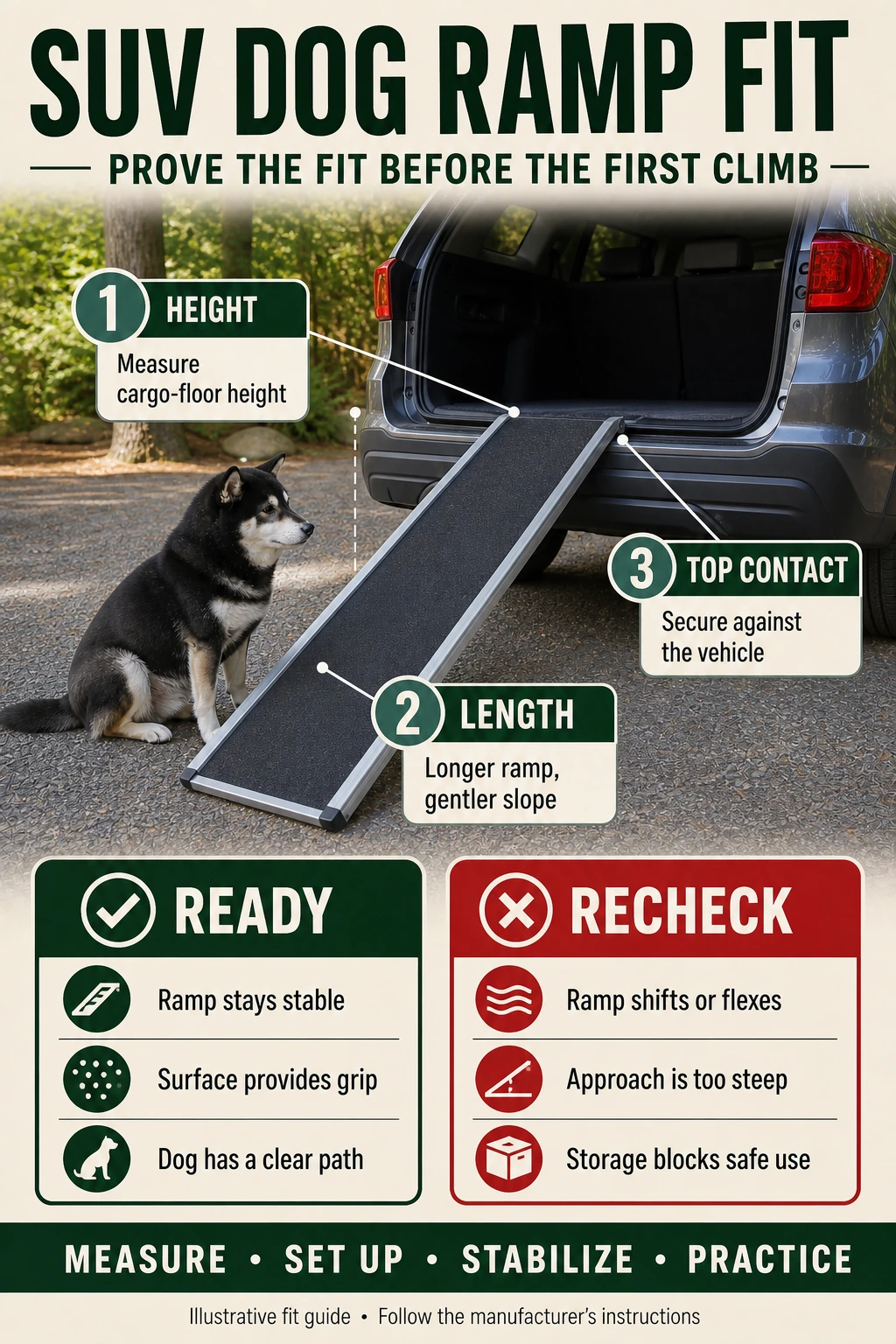
Measure from the ground to the intended landing surface, not to the bumper's lowest point. Record the clear width between hatch trim, the depth of the flat landing area, and how far the ramp can extend before it reaches traffic, a wall, or an uneven shoulder. For a side door, also measure the door angle and the distance between the threshold, front seat, and door edge.
The slope matters because every inch of vehicle height has to be gained across the ramp's usable deck. Marketing length may include hinges or end lips, so confirm usable walking length. Longer is generally gentler, but the deck still needs a top lip that sits flat and bottom feet that contact the same stable surface.
Veterinary guidance supports changing the environment rather than expecting a mobility-compromised dog to keep jumping. VCA's mobility-compromised home guidance recommends sturdy, good-traction ramps and notes that getting in and out of vehicles can be risky for dogs with mobility concerns. Cornell's osteoarthritis guidance similarly includes non-slip rugs and ramps for beds, couches, and cars. A ramp is an access aid, not a diagnosis or treatment; new pain, weakness, toe dragging, or refusal to move deserves veterinary assessment.
Folding vs telescoping ramps
| Ramp type | Best for | Main advantage | Main tradeoff | Check before buying |
|---|---|---|---|---|
Folding ramp | Frequent cargo-area loading with simple storage | Fast setup and a compact folded shape | Fixed length fixes the slope | Folded dimensions, latch, hinge gap, carry balance |
Telescoping ramp | Several vehicles or changing sill heights | Length can be adjusted to the site | Sliding sections can be longer to manage | Locking method, pinch points, clean slide rails |
Side-door ramp | Back-seat access when cargo space is occupied | Avoids routing the dog through the rear | Door geometry often limits safe placement | Door opening, top lip contact, front-wheel clearance |
Portable steps | Confident dog that climbs steps evenly | Shorter footprint than a gentle ramp | Repeated step-up motion and smaller treads | Tread depth, total height, wobble, top alignment |
A folding ramp should lock closed for carrying and open without a hinge ridge that catches nails. A telescoping model should extend and retract without the handler placing fingers inside sliding pinch points. Neither format is inherently safer: top contact, slope, deck grip, and handling determine the real setup.
Traction needs a dry and a damp check. Coarse sandpaper-like coatings can grip but may be uncomfortable for sensitive paws; carpet-like surfaces can offer texture but hold water and grit. Verify the cleaning instructions and inspect for lifting edges. Side rails should be high enough to provide a boundary without narrowing the usable deck below the dog's stance.
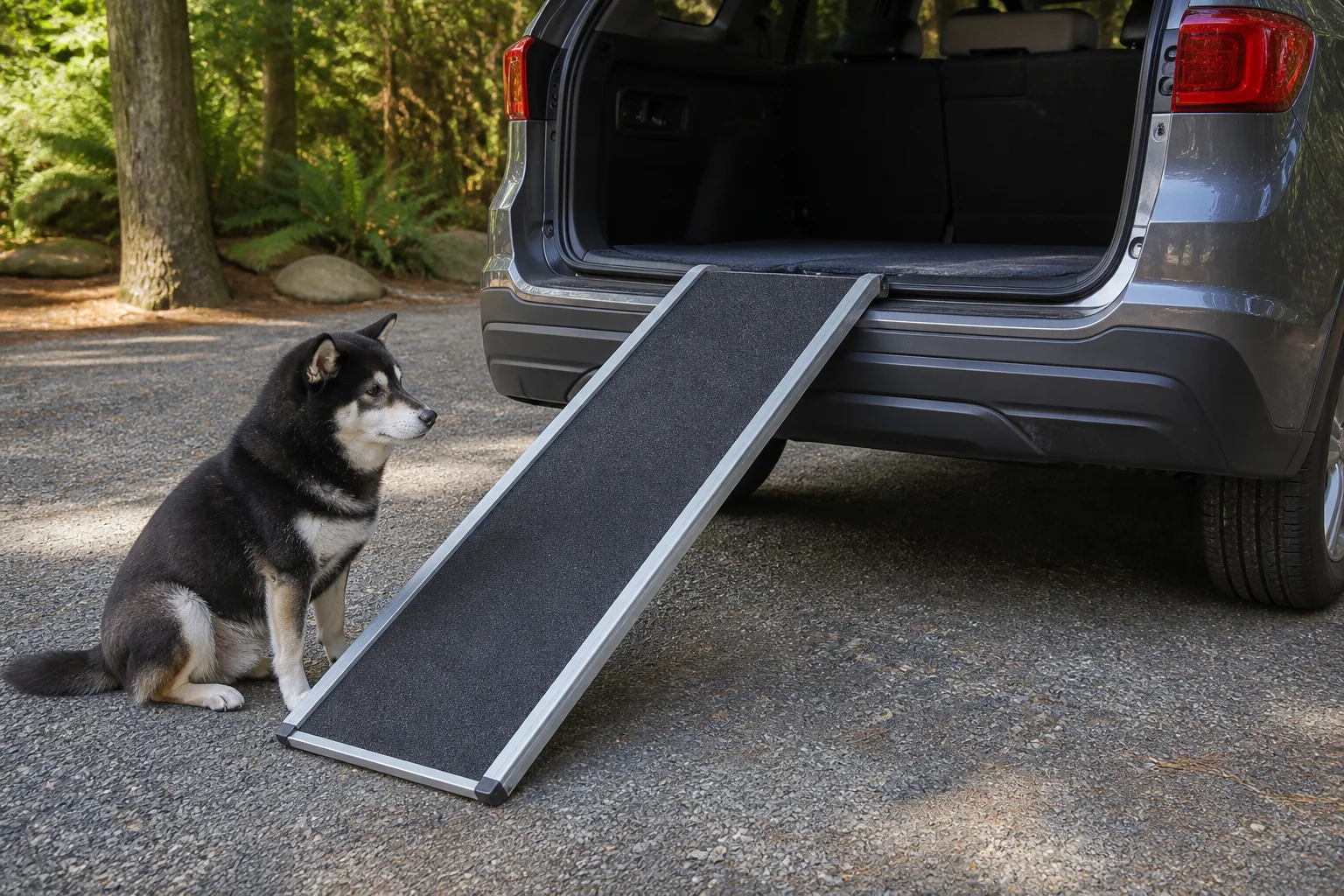
Two current Amazon options
These are two different mechanisms, not a claim that one fits every SUV. We have not performed hands-on durability testing. Verify the current listing, exact dimensions, manufacturer instructions, seller, and return terms.
A seven-part fit test at home
- Park on level ground, set the brake, switch off the vehicle, and keep the area free of moving traffic.
- Place the empty ramp and press each corner. The top must not rock, slide sideways, or load fragile trim.
- Walk the deck yourself only if the manufacturer explicitly permits human loading; otherwise apply controlled hand pressure along its length.
- Let the dog investigate the flat ramp on the ground. Reward looking, sniffing, and one calm paw without pulling the leash.
- Raise it onto a very low stable surface, support the side, and practice up and down separately.
- Progress to the vehicle only after the dog walks the low setup without rushing, jumping off, or freezing.
- Use a fitted harness and a second adult when needed; one stabilizes the ramp while the other guides without dragging.
Do not create a food trail that encourages a worried dog to lunge forward and lose footing. A non-slip mat at the ramp's bottom can improve the transition on smooth garage floors. Keep nails maintained and the deck clean, because traction claims cannot compensate for mud, ice, oil, or worn tread.
Large dogs, senior dogs, and weak back legs
For a large dog, handler lifting ability matters as much as product capacity. Practice removing, opening, positioning, and stowing the ramp without the dog present. If the handler cannot control it in wind or on a slope, choose another model or obtain help.
For senior dogs, watch movement rather than age labels. Shortened stride, hesitation, slipping, asymmetric weight bearing, or sudden refusal can signal pain or weakness. A ramp may reduce jumping, but a steep or slippery ramp can still be inappropriate. The mobility-harness guide explains rear-only versus full-body assistance; the senior dog bed guide covers the rest area after the transfer.
Build a driveway mock-up before the return window starts
A capacity number cannot tell you whether the ramp will work behind your vehicle. Before ordering, mark the listed usable length on the driveway with painter's tape. Measure the SUV sill height, then hold a string from the taped bottom position to the intended top contact. This does not reproduce deck flex or traction, but it reveals three common deal-breakers: the ramp reaches into traffic, the hatch cannot stay fully open, or the approach is much steeper than the listing photography suggests.
Repeat the layout in the place where the ramp will actually be used. A suburban driveway, narrow garage, roadside shoulder, campsite, and veterinary parking area offer different ground run and side clearance. Include enough room for the handler to stand beside the dog without stepping into the vehicle path. If the only workable position rests the top on curved plastic trim or puts one bottom foot on gravel and one on pavement, the product does not fit that location.
On delivery day, keep packaging intact while you verify closed length, carry weight, latch, handle balance, full deck width, usable length, top lip, and bottom feet. Deploy it without the dog several times. A ramp that pinches the handler, twists while opening, or cannot be lifted back into the cargo area is unlikely to be used consistently. The return-window test should prove both dog access and human setup.
Why flat-ramp practice can fail at the SUV
A dog may walk across the ramp on the floor and still stop when it reaches the vehicle. The final setup adds height, a visible drop at both sides, a dark cargo opening, vehicle smells, a hollow deck sound, and a transition over the top lip. Treat that as a new training stage rather than stubbornness.
Lower the difficulty one variable at a time. First raise the ramp only a few inches onto a broad stable platform. Add a grippy landing mat at the top. Practice approaching and backing away without asking for a complete climb. At the SUV, let the dog inspect the open hatch and ramp separately before connecting them. Work in daylight on level ground with the engine off and no traffic pressure.
Stop if the dog freezes, scrambles, tries to jump off the side, or rushes the final section. Do not solve fear by shortening the ramp and making it steeper. A different entry point, longer deck, stable platform step, clinician-approved support harness, or lower vehicle may be the safer answer. For a painful or neurologically weak dog, ask the veterinary or rehabilitation team to observe the proposed movement rather than repeatedly rehearsing a failed transfer.
FAQ
The questions below were added after reviewing recurring concerns in Reddit discussions about a large dog refusing an SUV ramp and helping senior dogs enter cars. Reddit is used here to surface buyer questions, not as product-testing or veterinary evidence.
How long should a dog ramp be for an SUV?
Long enough to create a slope the dog can walk calmly while the top and bottom remain stable. Measure the sill height and available ground run, then compare the listing's usable deck length rather than relying on an SUV label.
Is a folding or telescoping ramp better?
Folding is usually faster and more compact at one fixed length. Telescoping is useful across different heights and spaces. The better choice is the one the handler can position securely every time.
Can a dog ramp work at an SUV side door?
Only when the door opens wide enough and the top lip rests fully on a strong, flat threshold without contacting unstable trim. Many cargo ramps are not designed for narrow or angled side-door geometry.
Should a dog walk up and down the ramp on a collar?
A well-fitted body harness generally offers better guidance without concentrating force at the neck. Keep the leash loose enough for balance and never pull the dog up the ramp.
Why will my dog use the ramp flat but refuse it at SUV height?
The raised setup changes slope, sound, edge exposure, top transition, and the appearance of the cargo opening. Return to a very low stable incline, add only one difficulty at a time, and stop before the dog rushes or jumps. Refusal can also reflect pain or weakness, so a sudden change deserves veterinary attention.
What if there is not enough space behind the SUV for a gentle ramp?
Do not force a short steep setup into the available space. Check whether a manufacturer-approved side-door solution, stable intermediate platform, lower vehicle, or assisted transfer plan fits better. Any alternative must preserve full contact, level footing, handler clearance, and the dog's medical restrictions.
Can a mobility harness make a steep ramp safe?
No. A harness can provide prescribed support, but it does not correct an excessive slope, unstable contact, or poor traction. The ramp must work as a surface first, and the handler must be able to keep the dog's body level without pulling upward from one point.
My dog walks up the ramp but wants to jump off on the way down. What now?
Treat descent as a separate skill, not proof that the dog is being stubborn. Our recommendation is to return to a securely supported low incline and reward slow, voluntary movement in both directions. Do not block a frightened dog into a jump or pull them down by the collar. AAHA includes ramps and non-slip surfaces in environmental adaptations. New reluctance, weakness, or pain needs veterinary assessment before further practice.
What if the ramp grips when dry but becomes slippery in rain?
Pause use until the deck, upper contact, and ground feet provide reliable traction in those conditions. Our recommendation is to check the manufacturer's wet-use and cleaning instructions and ask about an approved replacement tread. Do not add a loose towel or a makeshift covering that can slide. VCA's mobility guidance stresses a sturdy, non-slip surface; a ramp's weight rating does not tell you whether wet footing is suitable.
Would folding steps be better than a ramp for a large older dog?
Possibly, but neither format wins from age or body weight alone. Our recommendation is to compare the dog's ability to lift each foot, turn, and descend with the actual step height or ramp slope, then check setup stability and your own handling space. If joint disease or weakness is involved, ask the veterinary team to assess both options. Cornell's osteoarthritis guidance supports an individualized management plan rather than a gear-only answer.
Bottom line
Buy the geometry, not the headline. Measure the SUV opening, calculate the practical slope, verify top and bottom contact, and prove that the handler can deploy the ramp. Then train on the ground before the first vehicle transfer. For a broader trip system—restraint, crate, life jacket, boots, and trail gear—use the Dog Travel & Outdoor Gear hub.