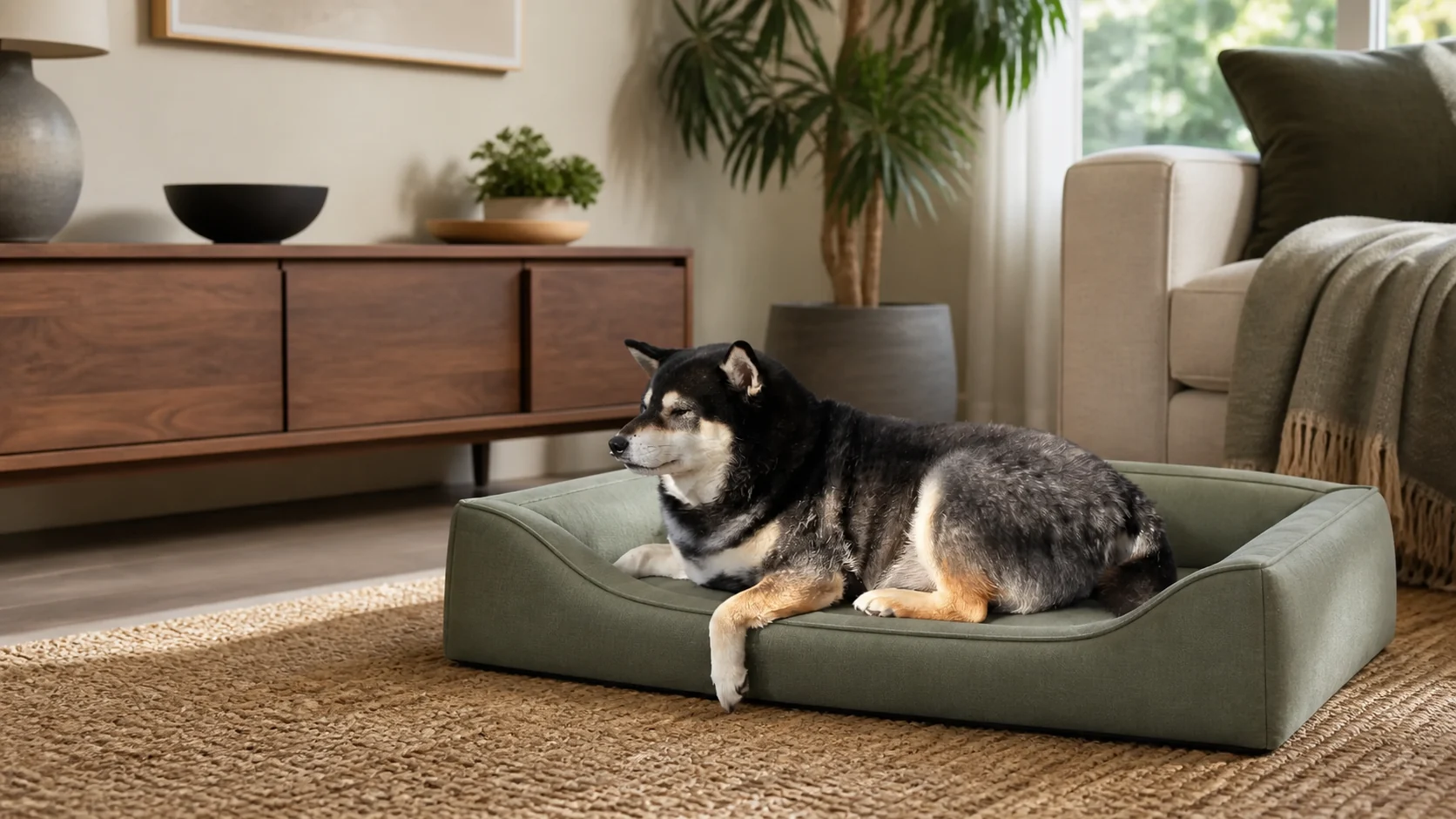
The best dog bed for a senior dog is supportive, easy to step onto, stable underfoot, and simple to keep clean. Thick foam can help, but entry height, usable sleep area, cover design, floor traction, and temperature matter just as much as the word “orthopedic.”
This guide is for choosing a bed, not diagnosing pain or arthritis. New stiffness, limping, trouble standing, accidents, or a sudden change in sleep habits should be discussed with a veterinarian.
Quick read
Quick answer
- Best starting point: a low-entry rectangular foam bed with a stable surface, removable washable cover, and enough room to change position.
- For arthritis or stiffness: prioritize easy access, supportive foam, and a non-slip route to the bed rather than buying the thickest model.
- For accidents: look for a washable outer cover plus a separate moisture-resistant liner around the foam.
- For warm sleepers: compare breathable covers and avoid deep plush sides that trap heat.
- Measure the usable sleep surface, especially when bolsters reduce the interior area.
- Reassess the setup when mobility, continence, vision, hearing, or sleep position changes.
What type of bed is best for a senior dog?
For many senior dogs, a flat or low-sided orthopedic-style foam bed is the most practical starting point. It provides a broad surface for stretching and repositioning without forcing the dog to climb over a tall bolster.
A bolster can still work when a dog likes to curl or lean, provided one side has a low opening and the inner sleep area is large enough. A waterproof liner is useful for drool, damp coats, or accidents, but it should sit under a comfortable washable cover rather than becoming the sleep surface.
The AAHA senior-care guidance includes appropriate beds, accessible placement, traction aids, and other home modifications among the considerations that can support senior-pet mobility and quality of life.
Stiff or slow to rise
Low-entry flat foam bed
- Look for
Stable support, open sides, non-slip route, enough turning room
- Avoid
Deep nest beds, tall bolsters, slippery floors
Accidents or damp coats
Foam bed with washable cover and protective liner
- Look for
Two-layer cleaning system, strong zipper, complete drying
- Avoid
Unprotected foam, vague “washable” claims
Dog curls and leans
Low-opening bolster bed
- Look for
Supportive base, one easy entry, usable inner dimensions
- Avoid
Bolsters that leave too little room
Dog overheats easily
Breathable flat bed
- Look for
Airflow, lighter cover, cool room placement
- Avoid
Deep plush fabric, heated beds without veterinary guidance
Share & embed
Observe your dog before shopping
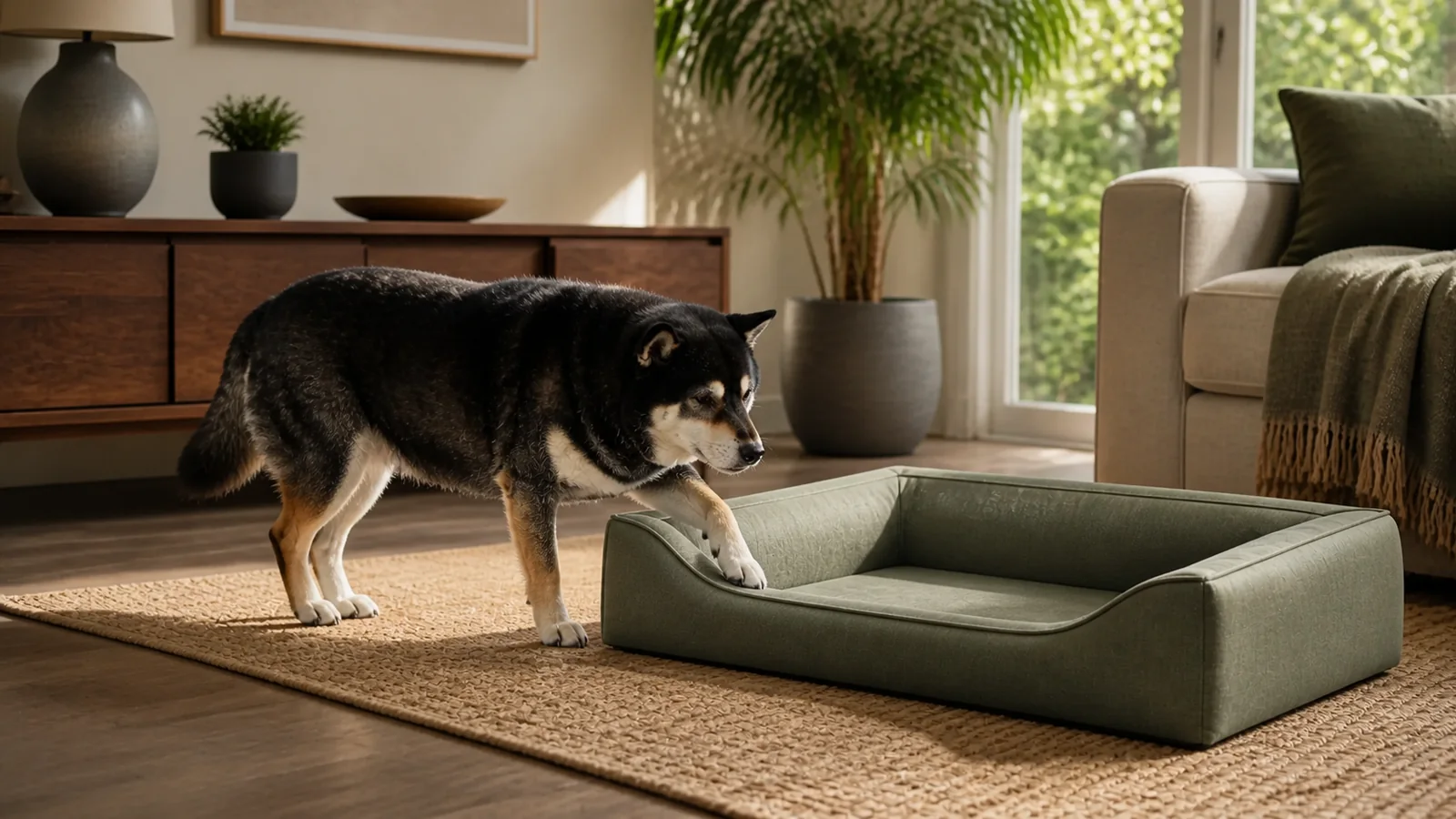
A short observation log is more useful than a breed-based “senior” recommendation. For three ordinary days, note where your dog chooses to sleep, how they lower themselves, whether they change position, and how they get up. Include one daytime rest and one overnight period if possible.
Record practical details rather than trying to score pain:
- whether the dog steps onto the bed cleanly or catches a paw;
- whether they circle, brace, or hesitate before lying down;
- whether they choose the floor after initially using the bed;
- whether they sprawl, curl, lean, or switch between positions;
- whether the current bed slides during entry or standing;
- where heat, drafts, noise, or household traffic affect rest; and
- whether dampness, hair, or accidents reach the foam.
This produces a usable shopping brief. A dog that sprawls and changes sides may need open space more than bolsters. A dog that approaches slowly on a smooth floor may benefit from a grippy route and lower edge before extra foam depth. A dog that repeatedly leaves a plush bed may be too warm, crowded, or unstable.
Do not use the log to delay veterinary care. Sudden changes, obvious discomfort, weakness, new accidents, or difficulty standing are reasons to contact a veterinarian.
Seven checks before buying
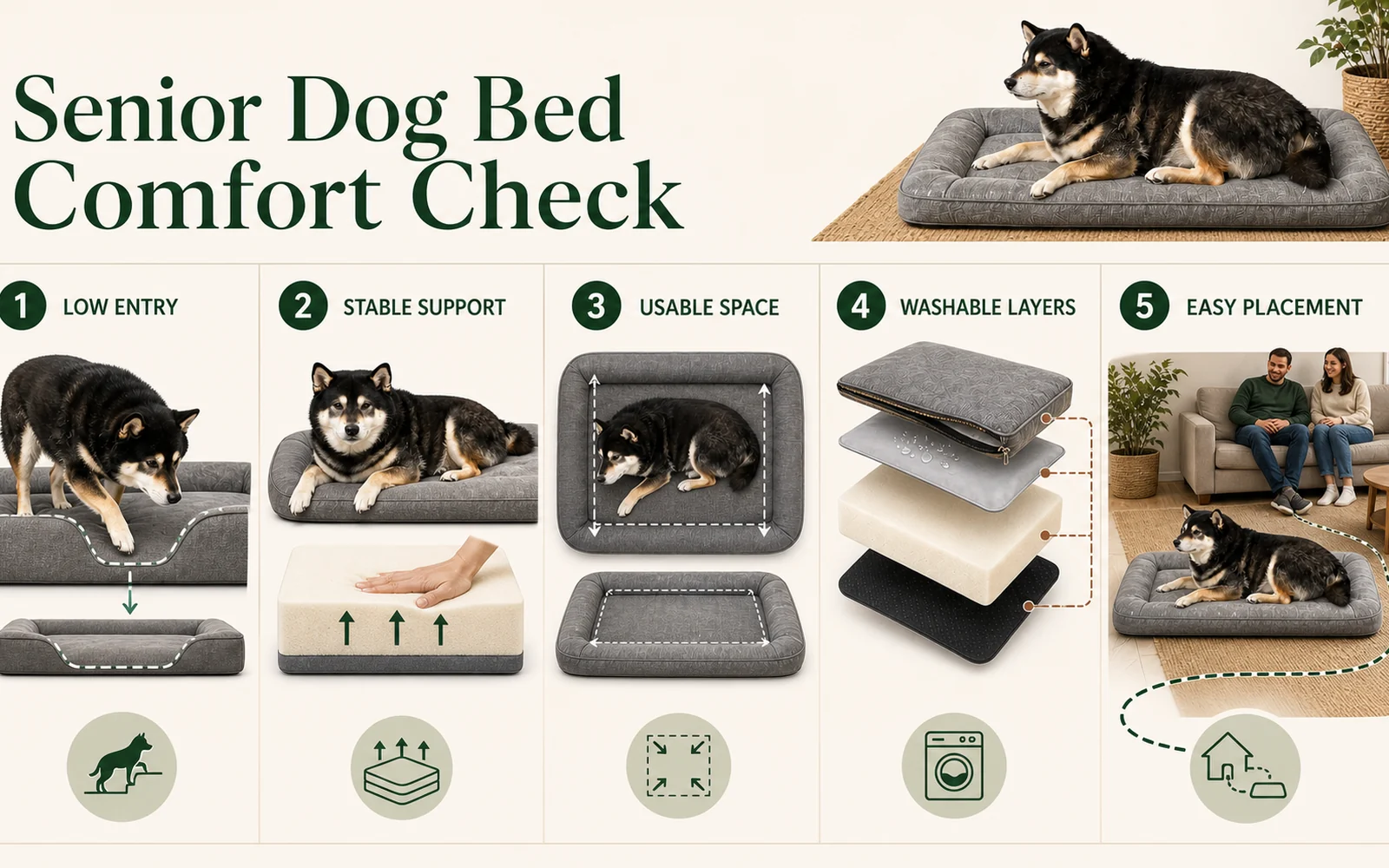
1. Entry height
A very thick bed can become a step. Watch how your dog approaches their current bed: do they hesitate, circle repeatedly, catch a paw on the edge, or choose the floor instead? A lower edge or one open side may be more useful than extra foam depth.
2. Surface stability
The bed should not slide when the dog steps on or pushes up from it. Check the underside for grip, but also look at the floor around the bed. Rugs or runners can create a steadier route across smooth flooring.
3. Support without deep sinking
Supportive foam should keep the dog from resting directly against the hard floor. Very soft foam can feel cozy yet make standing and turning harder. Compare foam construction, total depth, dog-weight guidance, and recent owner comments about flattening.
The orthopedic dog bed guide explains foam, entry, bolsters, and cover systems in more detail. Use Orthopedic vs Memory Foam Dog Bed before assuming memory foam is automatically firmer or more supportive.
4. Real sleep area
Measure your dog in their usual relaxed position and add room to shift. For a bolster bed, compare the inner dimensions, not the outside footprint. A dog that alternates between curling and sprawling needs more usable area than a tight breed-based chart may suggest.
Use the Dog Bed Size Calculator and Dog Bed Size Guide as starting points, then verify the current listing dimensions.
5. Washable layers
The most practical senior-dog bed separates comfort from moisture protection:
- a soft removable outer cover;
- a protective liner around the foam; and
- a foam core that can be inspected and kept dry.
Check how the cover comes off, whether the zipper opens widely, and how long every layer takes to dry. The Washable Dog Beds Guide and Waterproof Dog Bed Guide cover these decisions in depth.
6. Temperature
Senior dogs are not all cold sleepers. Foam and plush bolsters can retain heat, while thin elevated beds may feel cool or unstable. Choose based on the dog, season, and room. If heated bedding is being considered, use a pet-specific product and ask a veterinarian when health, sensation, or mobility issues could affect safe use.
7. Placement
Put the bed where the dog can remain near normal household activity without blocking a walkway. Avoid direct drafts, heat vents, steep stairs, and long slippery routes. The Dog Bed Placement Guide provides room-by-room checks.
Senior dog bed types compared
| Option | Best for | Key features | Caveat | Merchant |
|---|---|---|---|---|
Flat orthopedic foam bed | Many senior dogs, sprawlers, large dogs | Broad surface, easy access, stable support | Can retain heat; foam and cover quality vary | Best general starting point |
Low-opening bolster bed | Dogs that curl or lean | Head support plus easier entry on one side | Bolsters reduce usable area | Check inner dimensions |
Waterproof-liner bed | Accidents, drool, damp coats | Protects foam and simplifies cleanup | Some liners feel warm or noisy | Keep a comfortable cover above liner |
Cooling or breathable bed | Warm sleepers and warm rooms | Lighter sleep surface and airflow | May offer less cushioning | Balance temperature with support |
Elevated cot-style bed | Outdoor or airflow-focused use | Easy hair release and airflow underneath | Step-up height and surface tension may not suit every senior | Assess entry and stability first |
How to compare foam and construction claims
Product pages often make the bed sound more precise than the available information supports. “Orthopedic,” “medical grade,” and “premium memory foam” do not reveal the full foam stack, firmness, density, usable depth, or how the bed performs under a particular dog.
Look for construction facts you can verify:
- Core type: a single solid slab is different from shredded fill or loose fiber.
- Layer order: a softer comfort layer may sit above a firmer support layer.
- Usable foam depth: exclude a lofty cover or thin base pad from the support estimate.
- Dog-weight guidance: treat it as a screening clue, not proof of comfort.
- Cover and liner access: confirm that both can be removed without forcing or bending the foam.
- Replacement parts: a replaceable cover or liner can extend the useful life of the bed.
- Return terms: foam feel cannot be judged reliably from a screen.
When owner reviews are available, prioritize recent comments that mention the same dog size, sleep style, flooring, and cleaning needs. One complaint about firmness is less useful than a repeated pattern of foam bottoming out, zipper failure, liner noise, or a cover shrinking after the stated wash cycle.
A simple floor-pressure check after arrival
With the bed on its normal floor, press gradually through the sleep surface with a flat hand. Then watch the dog lie down and rise without guiding them. The goal is not a scientifically measured firmness score; it is to notice obvious collapse, sliding, edge instability, or a surface the dog avoids.
Keep packaging until you have checked the bed in the real location. A bed that looks generous in an empty room can become difficult to enter when wedged beside furniture or placed on a slippery route.
Arthritis, stiffness, and changing mobility
A bed can improve the resting setup, but it is not treatment for arthritis or pain. If a dog is struggling to stand, avoiding stairs, limping, panting at rest, or changing behavior, ask a veterinarian rather than trying to solve the problem through bedding alone.
Bed choice should work with the surrounding environment. An accessible bed on a slippery floor may still be hard to use. Likewise, a supportive bed in a distant room may be ignored if the dog wants to rest near the family.
VCA's home guidance for mobility-compromised dogs also emphasizes non-slip surfaces, accessible resting areas, and environmental changes that reduce difficult movement. Use those principles to evaluate the whole route to the bed, not as proof that one foam construction treats arthritis.
Set up the room around the bed
The final setup is a small mobility system, not just a cushion. Leave enough open space for the dog to approach from their preferred side and turn without backing into furniture. Stabilize nearby rugs so they do not bunch up. Keep water accessible and avoid forcing repeated stair use just to reach the only comfortable resting place.
Many homes work better with two simpler beds in the dog’s main resting areas than one premium bed in a distant room. Duplicate beds do not need to be identical, but the dog should have a familiar, accessible option near daytime activity and another near the overnight routine.
If vision or hearing is changing, keep the route predictable. Avoid frequently moving the bed, adding obstacles around it, or placing it where someone can surprise the sleeping dog from a blind side.
Recheck the bed after 7 and 30 days
At one week, inspect whether the dog enters voluntarily, uses the whole surface, and can stand without the bed sliding. Remove the cover and check for moisture, compressed areas, split seams, exposed zippers, or liner noise that may explain avoidance.
At about one month, repeat the relaxed body measurement and compare the bed with the observation log. Reassess sooner after a health change, a new medication, weight change, warmer weather, an accident, or a new sleeping pattern. A bed that was suitable six months ago may no longer match current mobility or temperature needs.
A practical buying shortlist
Before opening product listings, write down:
- the dog’s relaxed length and width;
- preferred sleep position;
- easiest step-on height;
- whether accidents or damp coats are common;
- whether the dog sleeps warm or cold;
- the available floor space; and
- how the cover and liner will be washed and dried.
Then compare three suitable beds instead of dozens of unrelated options. Reject any listing that hides usable dimensions, foam construction, or care instructions.
Amazon comparison options
These direct Amazon examples are comparison points, not universal winners or medical products. Measure the usable sleep area and entry height first, then recheck the current size, foam, cover, liner, care instructions, seller, and return policy. What Dogs Like may earn from qualifying purchases.
Related guides
Coordinate the bed with the access route. Compare Dog Steps for High Beds only when the dog's movement suits stairs, use Dog Ramps for SUVs for measured vehicle access, and ask the veterinary team whether a Mobility Harness for Weak Back Legs belongs in the care plan.
Start with the Dog Beds hub for the complete category. Compare support claims in Best Orthopedic Dog Beds, measure with the Dog Bed Size Calculator, and plan maintenance with the Dog Bed Cleaning Schedule.
Frequently asked questions
What is the best dog bed for senior dogs?
For many senior dogs, a low-entry rectangular foam bed with a stable surface, removable washable cover, and enough room to change position is the best starting point.
Is an orthopedic dog bed good for a senior dog with arthritis?
Supportive bedding may make rest more comfortable, but it does not treat arthritis. Choose accessible, stable bedding and ask a veterinarian about pain or mobility changes.
Are elevated dog beds good for older dogs?
They can provide airflow and easy cleaning, but the step-up height and taut surface may not suit every older dog. Check entry, stability, and the dog’s preference.
Should a senior dog bed be firm or soft?
It should cushion the dog without collapsing so deeply that turning or standing becomes difficult. Foam construction and dog weight matter more than a simple firm-or-soft label.
What bed is easiest to clean after accidents?
A bed with a removable machine-washable cover and a separate protective liner around the foam is usually the easiest system to maintain.
Is the softest bed always best for an older dog with arthritis?
No. The surface should cushion without collapsing so deeply that turning or standing becomes harder. A Reddit discussion about a senior dog seeming stiffer after using a new bed captures a common concern, but individual anecdotes cannot establish the cause or the right firmness. Observe entry, rest, and rising, and discuss new stiffness or pain with a veterinarian.
How do I protect the foam when a senior dog has accidents?
Use separate layers: a comfortable washable outer cover, a moisture-resistant liner around the foam, and a washable absorbent layer where appropriate. Confirm that each layer can be removed and dried fully. A Reddit question about urine reaching supposedly washable senior-dog-bed foam is useful question discovery, not proof that a named liner works; verify the current construction and return terms yourself.
Why does my older dog choose the tile floor instead of an orthopedic bed?
Temperature, entry height, location, or the surface may affect that choice; it does not prove the bed is supportive or unsuitable. VCA notes that dogs often seek cool hard surfaces and recommends accessible bedding that does not retain heat. Our recommendation is to offer a low, stable bed beside the preferred spot without forcing use. Watch rising and turning, and discuss new stiffness, skin pressure points, or discomfort with your veterinarian.
My senior dog keeps changing beds and pacing at night. Should I buy a different mattress?
A purchase should not replace an assessment of a new behavior change. Veterinary guidance on senior-dog behavior identifies restlessness and altered sleep patterns as reasons to investigate underlying needs. Our recommendation is to record the timing, toileting, movement, and any panting or difficulty settling, then speak with your veterinarian. Keep familiar, accessible resting options available. Do not assume every restless older dog needs softer foam, a sedative, or dementia treatment.
How can I move my senior dog from my high bed to a safer floor-level bed?
Our recommendation is to place the new bed beside yours, keep familiar bedtime cues, and reward voluntary settling there while you are nearby. Make the approach non-slip and prevent access to an unsafe jumping route when you cannot supervise. AAHA's senior pain-management guidance includes environmental adaptations as part of care. If furniture access is still appropriate, ask the veterinary team about a suitable ramp or steps rather than relying on repeated lifting or jumps.