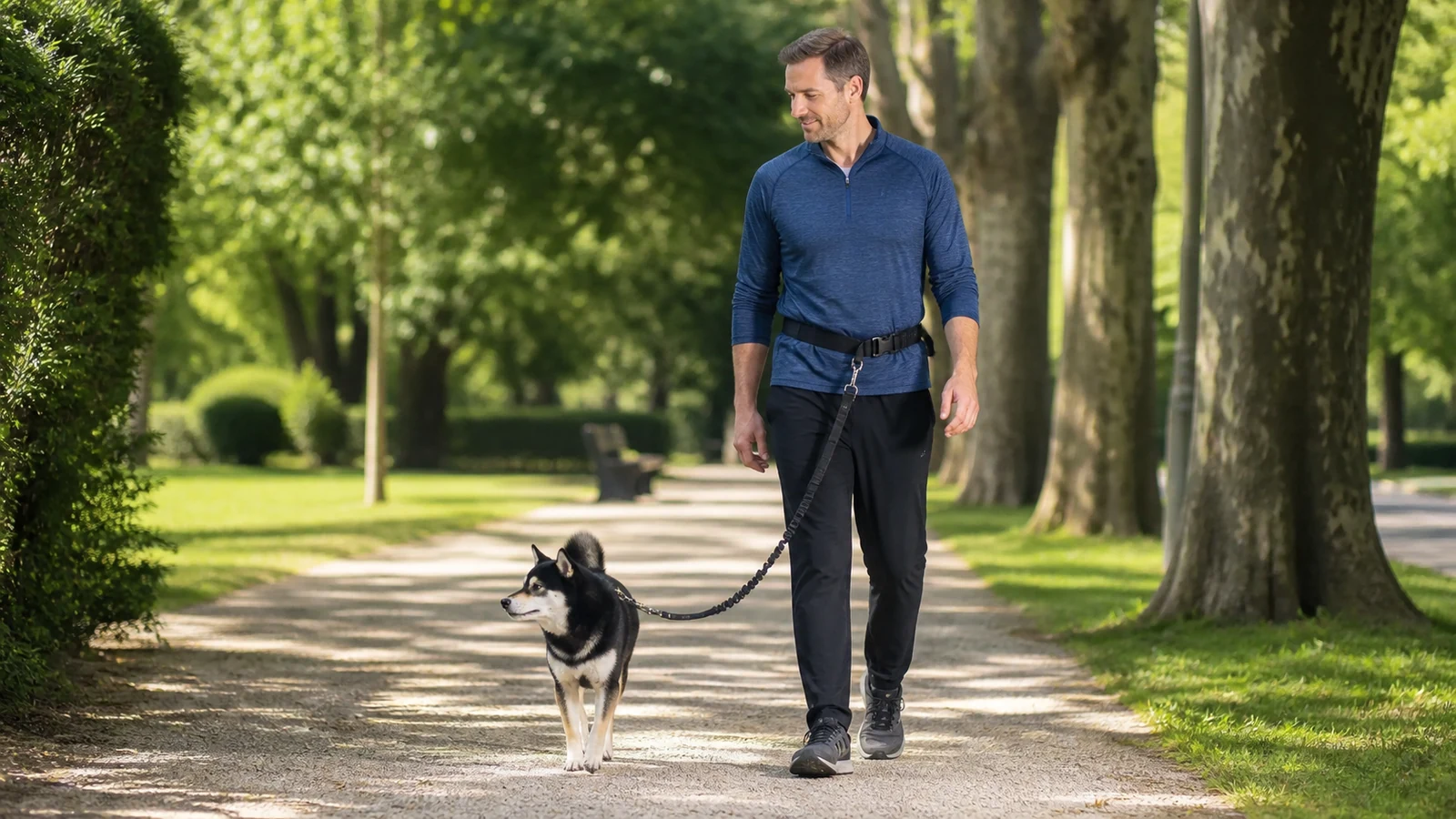
A hands-free dog leash can free both arms for walking, jogging, treats, or mobility aids, but it also transfers a sudden pull to your body. The best setup therefore depends on the dog's leash skills, the handler's balance, the route, and whether the activity is ordinary side-by-side movement or true canicross pulling.
Quick read
Quick answer
- For everyday walking, choose a stable belt, moderate leash length, swivel, and reachable traffic handle.
- For jogging, first confirm the dog is physically ready and reliably walks on a loose leash beside one chosen side.
- Use a lower, broader canicross belt and purpose-built pulling harness only for trained pulling sport—not a casual waist lead.
- Avoid hands-free attachment near traffic with a dog that lunges, crosses in front, or outweighs the handler's control.
- Test at walking speed on a quiet closed route before running.
Start with activity, not accessories
Everyday walking
Dog usually keeps a loose leash
- Look for
Stable waist belt, sliding attachment, traffic handle
- Avoid
Long elastic line with no close-control grip
Jogging beside you
Dog holds one side and ignores routine distractions
- Look for
Moderate bungee, low-profile belt, reflective details
- Avoid
Starting at speed before loose-leash skills
Canicross pulling
Dog and handler are trained for the sport
- Look for
Purpose-built low belt, long bungee line, pulling harness
- Avoid
Clipping a pulling dog to an ordinary collar
Hands-free convenience only
Need both hands briefly but retain control
- Look for
Convertible leash that can return to hand-held mode
- Avoid
Permanent waist attachment in crowded areas
Share & embed
The American Kennel Club's running guidance recommends mastering loose-leash walking before running and building distance gradually. Its canicross overview makes an important distinction: a dog intentionally pulling in sport needs a correctly shaped pulling harness, bungee line, and low belt. That is a different mechanical job from keeping a pet beside you on a neighborhood jog.
| Setup | Best for | Strength | Tradeoff | Verify before use |
|---|---|---|---|---|
Waist belt with bungee lead | Predictable side-by-side walking or jogging | Hands remain available; mild elasticity smooths pace changes | A lunge loads the handler's body and elastic can add travel | Verify belt stability, relaxed and stretched length, traffic handle, and quick-release access |
Convertible multi-position leash | Walkers who switch between hand-held, waist, and shoulder use | One line can return to direct hand control in busy areas | More clips and adjustment points create more possible setup errors | Load every chosen configuration gently and confirm unused loops cannot catch a limb |
Low canicross belt system | Conditioned dog and handler trained for intentional pulling sport | Low load transfer, long bungee line, and sport-specific movement | Wrong choice for casual control, neck attachment, or an untrained puller | Use a pulling harness, learn cues, and begin with coached short sessions |
Hand-held leash with traffic handle | Crowded routes, uncertain dogs, and crossings | Fast close control without tethering a lunge to the torso | Does not free both hands and still requires sound grip technique | Confirm both handles are reachable and the loop cannot drag or catch a leg |
Belt position and load transfer
A narrow strap around the soft waist can rotate, ride up, or concentrate force during a lunge. A broader belt that sits securely at the intended position spreads load better, but the correct design still depends on your body, mobility, and activity. People with back, hip, balance, pregnancy, or fall-risk concerns should ask an appropriate healthcare professional before using a body-tethered leash.
Test the belt over the clothing you actually wear. Confirm that the buckle cannot be accidentally pressed by an arm or jacket, the leash attachment cannot slide into an uncomfortable position, and the belt remains stable when the dog changes sides.
An emergency quick release can be useful, but it must be reachable under tension and protected from accidental opening. Practice operating it without the dog attached, then with another adult applying mild controlled tension.
Leash length, bungee, and traffic handles
Too much length creates a trip loop and lets the dog reach a driveway before the handler. Too little keeps continuous tension and encourages both partners to brace. Measure from the belt attachment to the dog's harness while the dog stands in the intended position, then allow only the working room the route needs.
A bungee section softens small pace differences; it does not make a hard lunge safe. More elasticity can also delay feedback and store energy. For urban use, a fixed or mildly elastic line with a close traffic handle is often easier to shorten at crossings.
The traffic handle should be reachable without bending into the dog's path. It must not hang low enough to catch a front leg. A second handle near the middle can help transition from open path to sidewalk.
Hardware inspection
Compare the weakest component, not the strongest marketing phrase. Inspect the belt buckle, leash clip, swivel, rings, stitching, elastic cover, and handle seams. A heavy carabiner is not useful if it clips to a thin non-load-rated loop.
Swivels reduce ordinary twisting but can still jam with sand or grit. Clips should close fully without hair or fabric in the gate. Retire equipment with bent gates, cut webbing, cracked buckles, exposed elastic, or loose load-bearing stitching.
A route test before the first run
- Walk the route without the dog and identify crossings, narrow sections, bikes, loose-dog areas, and poor footing.
- Fit the dog in an appropriate walking harness and the handler in the belt.
- Practice start, slow, stop, side, turn, and close cues in a quiet fenced area.
- Walk ten minutes with the leash at working length.
- Shorten using the traffic handle before a marked practice point.
- Simulate a mild distraction at a safe distance with a helper.
- End if the dog crosses in front, the belt rotates, or either partner braces repeatedly.
Only add short jogging intervals after the walking system stays predictable. Puppies, dogs with medical or orthopedic concerns, seniors, and dogs not conditioned for running need veterinary guidance. Heat, humidity, and hot pavement can make an otherwise easy route unsafe.
One dog, two dogs, and a size mismatch
A waist system should be evaluated against the strongest realistic event, not the calmest minute of the walk. A dog that outweighs the handler's comfortable control, accelerates suddenly, or changes sides behind the knees can create a fall even when the leash and belt remain intact. Start with a hand-held leash and professional training support when the handler cannot safely absorb an ordinary turn or stop.
With two dogs, train the complete route separately before combining them. Matching pace is not enough: each dog should respond to slow, stop, side, and close cues while the other dog or a mild distraction is present at a safe distance. Opposing lunges can rotate the belt, pull across the handler's legs, or load one dog's harness through the other line. A coupler does not solve different stride, size, or reactivity.
If a two-dog setup is eventually appropriate, confirm that each line can be shortened independently, neither bungee crosses the other dog's body, and both dogs can turn without wrapping the handler. Return to separate hand-held walks when footing, traffic, arousal, or visibility becomes less predictable.
Practice the emergency transition
Do not discover the quick release during a real lunge. Without the dog attached, practice locating and opening it with either hand and while wearing gloves or a jacket. Then have another adult apply mild steady tension while you release, grasp the traffic handle, and return the line to hand-held control. Never rehearse by creating a hard jerk or allowing the dog to run to the end.
Plan a transition point before every crossing, narrow bridge, blind corner, or crowded entrance. Shorten early, move the leash to the hand, and keep the dog on the side away from traffic. If the product cannot move cleanly from waist to close control, it is a poor match for a mixed urban route.
Seasonal clothing changes fit. Test the belt over the thickest layers you will use, then again over lighter clothing; an adjustment that is stable on a winter coat may rotate over a thin shirt. After rain, snow, sand, or road grit, dry the webbing and inspect the buckle, swivel, and clip gate before the next outing. Add visibility to both handler and dog, but treat reflective trim as a supplement to route choice and lighting.
Two current Amazon options
These listings offer two different starting points: a dedicated waist/bungee lead and a convertible multi-position leash. We have not personally run with them. Check the current size, complete hardware, use instructions, seller, and return terms.
When not to go hands-free
Keep the leash in hand when approaching a road, crowded entrance, veterinary lobby, narrow trail edge, or dog whose reaction distance is unknown. Do not attach a strong lunging dog to a child, a wheeled device, or an unstable handler.
Two dogs can multiply rather than divide risk. Separate waist attachment points may help organized teams, but dogs with different pace, size, or reactivity can pull in opposing directions. Train one dog at a time before considering a shared system.
FAQ
Are hands-free leashes safe for running?
They can be appropriate when dog and handler are physically ready, loose-leash skills are reliable, the equipment suits the activity, and the route is controlled. A waist leash does not make an untrained lunge safe.
Should the leash attach to a collar or harness?
Use the equipment recommended for the activity and product. For running and sudden load, a well-fitted harness generally avoids concentrating force at the neck. True pulling sport requires a specific pulling harness.
How long should a hands-free leash be?
Long enough for a natural stride without constant tension, but short enough that no loop reaches the feet and the dog cannot enter traffic. The correct length changes with activity and route.
Is more bungee always better?
No. Elasticity smooths small pace changes but can store energy, delay control, and create more travel during a lunge. Compare stretch range as well as relaxed length.
What if my dog suddenly lunges while attached to my waist?
Do not rely on the belt or bungee to stop a lunge safely. Our recommendation is to use hand-held control if a sudden pull could unbalance you, and avoid body-tethered running while lunging remains unpredictable. When you spot a trigger, slow down and create space before your dog reaches the end of the line; do not unclip the only restraint beside traffic.
Dogs Trust's reactivity guidance recommends increasing distance, rewarding calm behavior, and avoiding punishment or forced encounters. Repeated lunging needs a training and handling plan, not simply a stronger belt.
Why does my hands-free leash belt keep riding up?
Check the belt's intended position and adjustment range against its own instructions. A narrow waist strap and a shaped hip belt are different designs; one universal placement rule will not suit both. For example, Ruffwear's Trail Runner Belt is a hip-belt system with adjustable sizing, not evidence that every waist leash should sit the same way.
For a practical fit check, walk first in your usual clothing and watch whether the belt migrates or rotates. If comfortable adjustment cannot keep it stable, return to hand-held use and compare a different fit. Do not tighten through pain or add improvised straps to hold it down.
Can I run hands-free if my dog stops to sniff or switches sides?
Start with walking practice until your dog can stay on one side and respond to a change of pace. The AKC's running guide recommends loose-leash skills, a consistent side, gradual speed changes, and frequent breaks. Build sniffing and bathroom stops into the outing rather than expecting continuous running from the start.
If your dog stops or crosses your path, slow to a walk and regain clear leash positioning. Do not keep running and let the bungee pull the dog along. Our recommendation is to keep using a hand-held leash if repeated stops or side changes put the line around your legs.
Bottom line
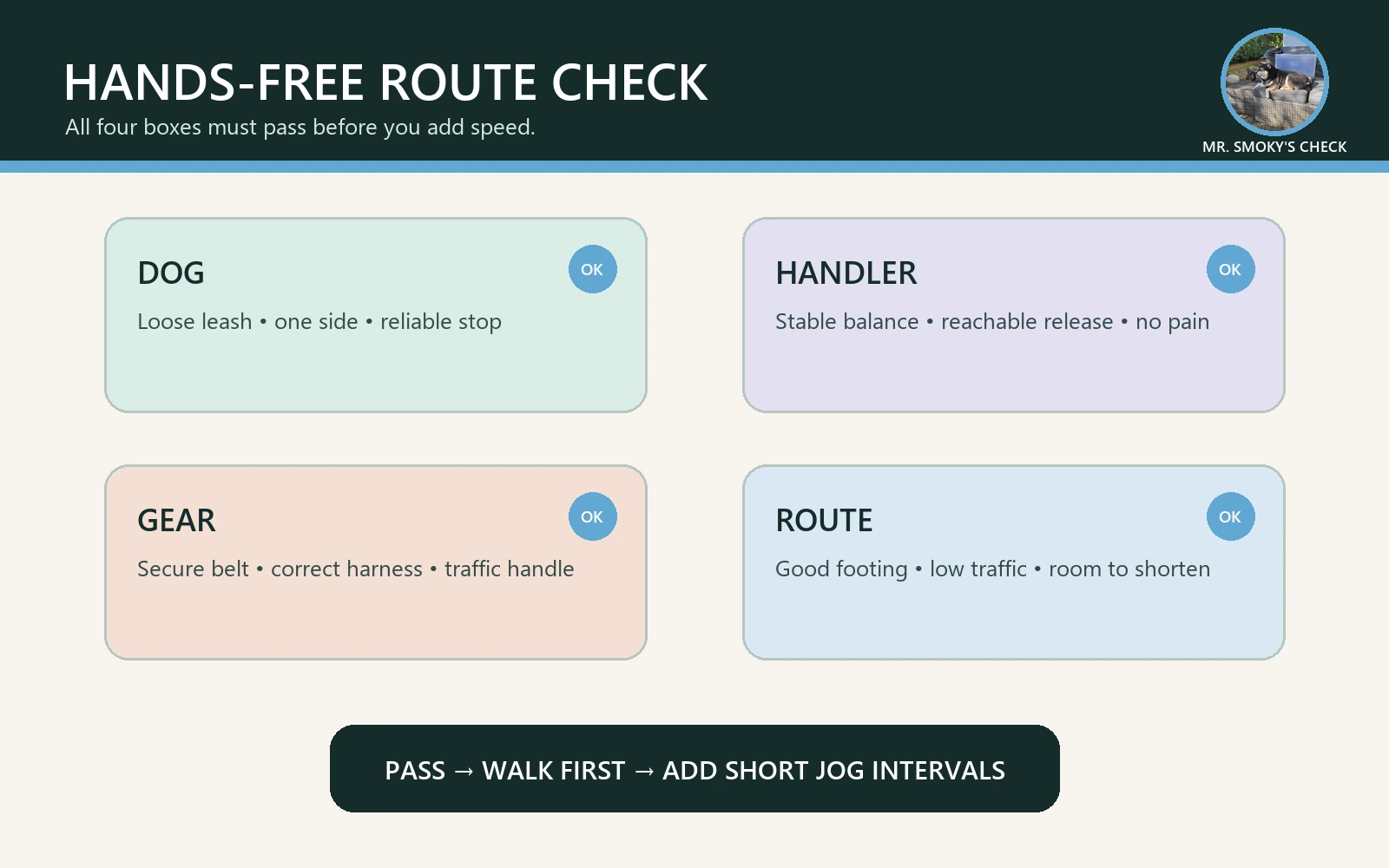
The best hands-free leash is a matched system: physically ready dog, stable handler, correct harness, controllable line, and appropriate route. Begin at a walk, prove side position and close control, then add speed gradually. If any part fails the route check, switch back to a hand-held leash.