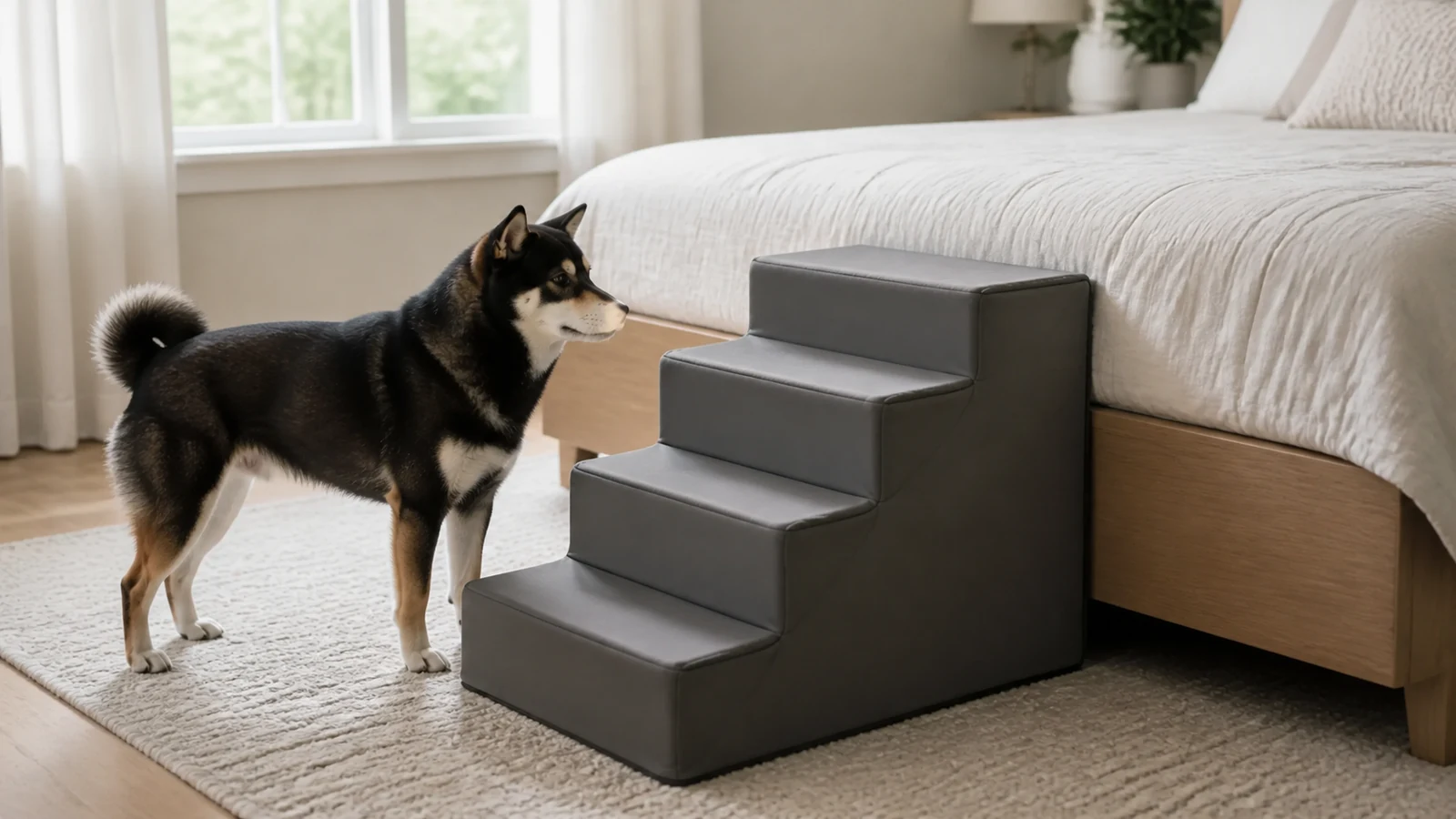
The best dog steps for a high bed reach the mattress edge without a final jump, stay planted when the dog turns, and provide treads deep enough for the dog's whole movement pattern—not just the front paws. Start by measuring the bed and watching how the dog currently climbs ordinary stairs. Some dogs need a ramp instead, and some need a veterinary mobility plan before either product is appropriate.
Quick read
Quick answer
- Measure floor to the top of the compressed mattress where the dog actually lands.
- The top step should sit close to that height; a large final gap defeats the purpose.
- Deep, wide, rigid treads suit confident climbers. Dense foam can be quieter and lighter but must not collapse or slide.
- Use a ramp when the dog struggles with repeated step-up motion and there is room for a gentle slope.
- Block unsupervised access until the setup is stable and the dog uses it calmly in both directions.
First decision: steps, ramp, or no furniture access
Share & embed
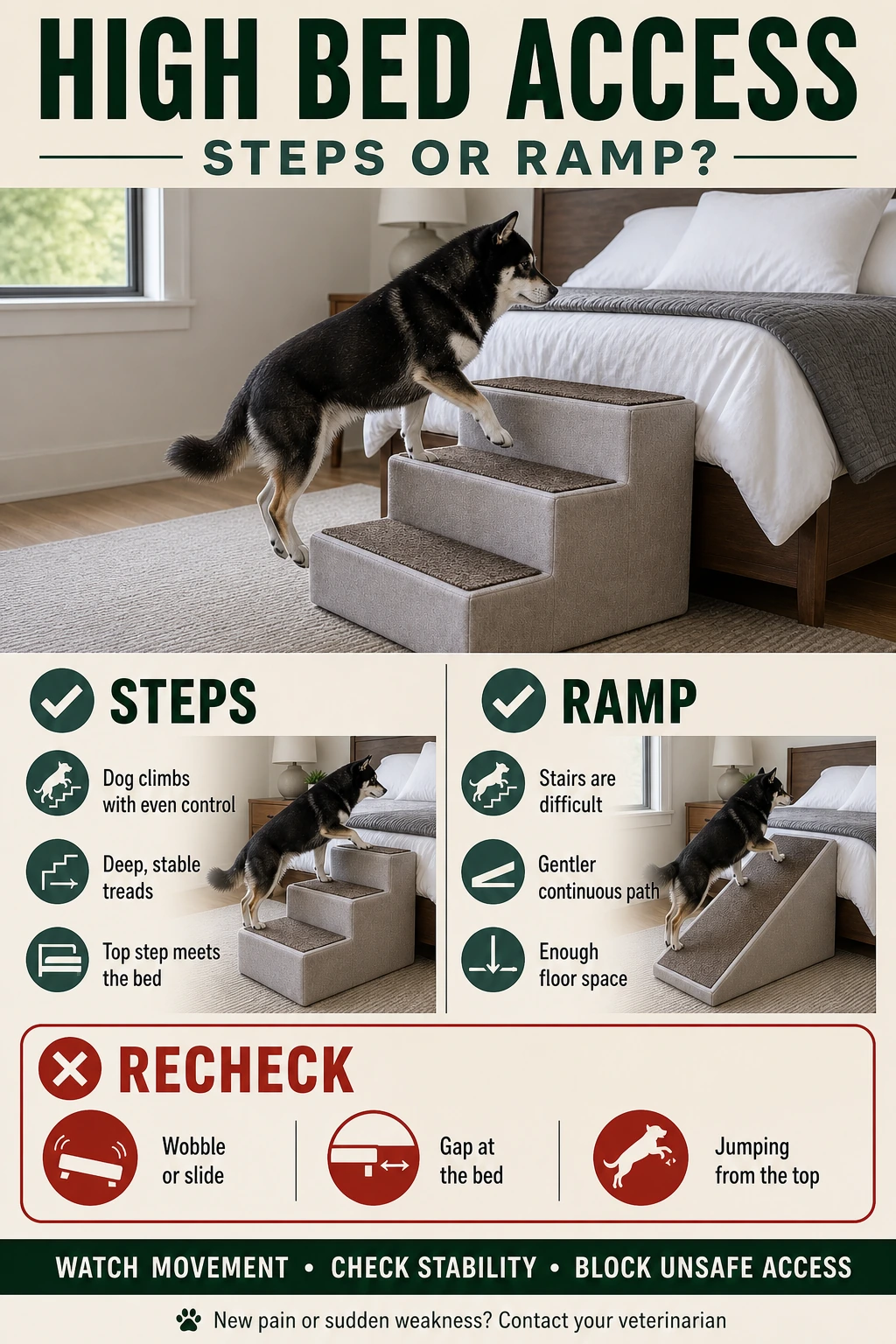
VCA's mobility-compromised home guidance recommends non-slip surfaces and notes that ramps can be preferable to stairs for some dogs. Its arthritis guidance also says some dogs may need to be restricted from stairs to prevent pain or falls. A product page cannot tell you which group your dog belongs to.
Choose steps only when the dog can place each foot deliberately, flex the joints needed to climb, and descend without jumping the last half. A ramp may be a better starting category for dogs with pain, weakness, a long back, poor balance, or a stiff gait—provided the room allows a gentle, grippy slope. If neither route is calm, preventing bed access and creating an inviting floor-level orthopedic bed may be the kinder plan.
Confident small or medium dog
Climbs household stairs evenly
- Look for
Deep foam or rigid steps aligned to mattress
- Avoid
Tiny decorative treads
Large dog
Needs full paw placement and lateral stability
- Look for
Extra-wide rigid steps with deep landings
- Avoid
Narrow lightweight tower
Senior or painful dog
Movement changes or hesitation
- Look for
Veterinary advice; consider gentle ramp
- Avoid
Assuming more steps solve pain
Limited floor space
Ramp would block a walkway
- Look for
Stable steps only if gait suits them
- Avoid
Placing access gear in a trip path
Measure total rise and every step
Measure from the floor to the top of the mattress while a person of typical sleeping weight is on it. Thick mattresses compress; using the unloaded height can leave the top step too low. Record available floor depth and width, baseboard clearance, bed-frame overhang, nearby furniture, and the door path.
Then compare five listing dimensions:
- Overall height: the top landing should minimize the final step or jump.
- Rise per step: lower rises can reduce the height gained with each movement, but create more repetitions.
- Tread depth: the dog's paws and body must transition without balancing on an edge.
- Usable width: include raised sides or sloping foam that reduce the flat walking area.
- Base footprint: it must fit fully on a non-slip surface and cannot obstruct a human walkway.
Do not use a nominal “four-step” or “large dog” label as a dimension. Two four-step products can have different total heights and tread geometry.
Foam vs rigid pet stairs
| Construction | Best for | Advantage | Tradeoff | Verify |
|---|---|---|---|---|
Dense foam | Small or medium dogs that prefer a quiet forgiving surface | Light to move; no hard tread edges | Can compress, tip, or feel unstable if too soft | Foam density, loaded shape, washable cover, base grip |
Rigid plastic | Dogs needing a consistent surface and handler-friendly cleaning | Predictable geometry and removable tread covers | Can sound hollow or slide on smooth floors | Weight guidance, rubber feet, tread attachment, joints |
Wood frame | Permanent bedroom setup with broad treads | Can be heavy and laterally stable | Hard edges and difficult moving | Finish, exposed hardware, carpet grip, frame weight |
Ramp | Dog struggles with repeated step-up motion | Continuous incline rather than separate rises | Needs more floor run for a gentle angle | Length, slope, traction, top alignment |
Soft does not always mean stable. Press down on each edge of a foam step with your hand before use. It should rebound consistently without the front face rolling under. A washable cover is useful, but a loose cover can rotate or bunch and become a slip layer.
Rigid stairs need rubber feet or a separate non-slip foundation. Removable carpet treads should lie flat after washing. Inspect snap-together joints and side-to-side flex; a stated weight limit does not describe wobble when a dog turns.
Two current Amazon options
These products represent different structures. We have not performed hands-on testing. Confirm the current height, tread measurements, dog-size guidance, assembly, seller, and return terms.
Placement is part of the product
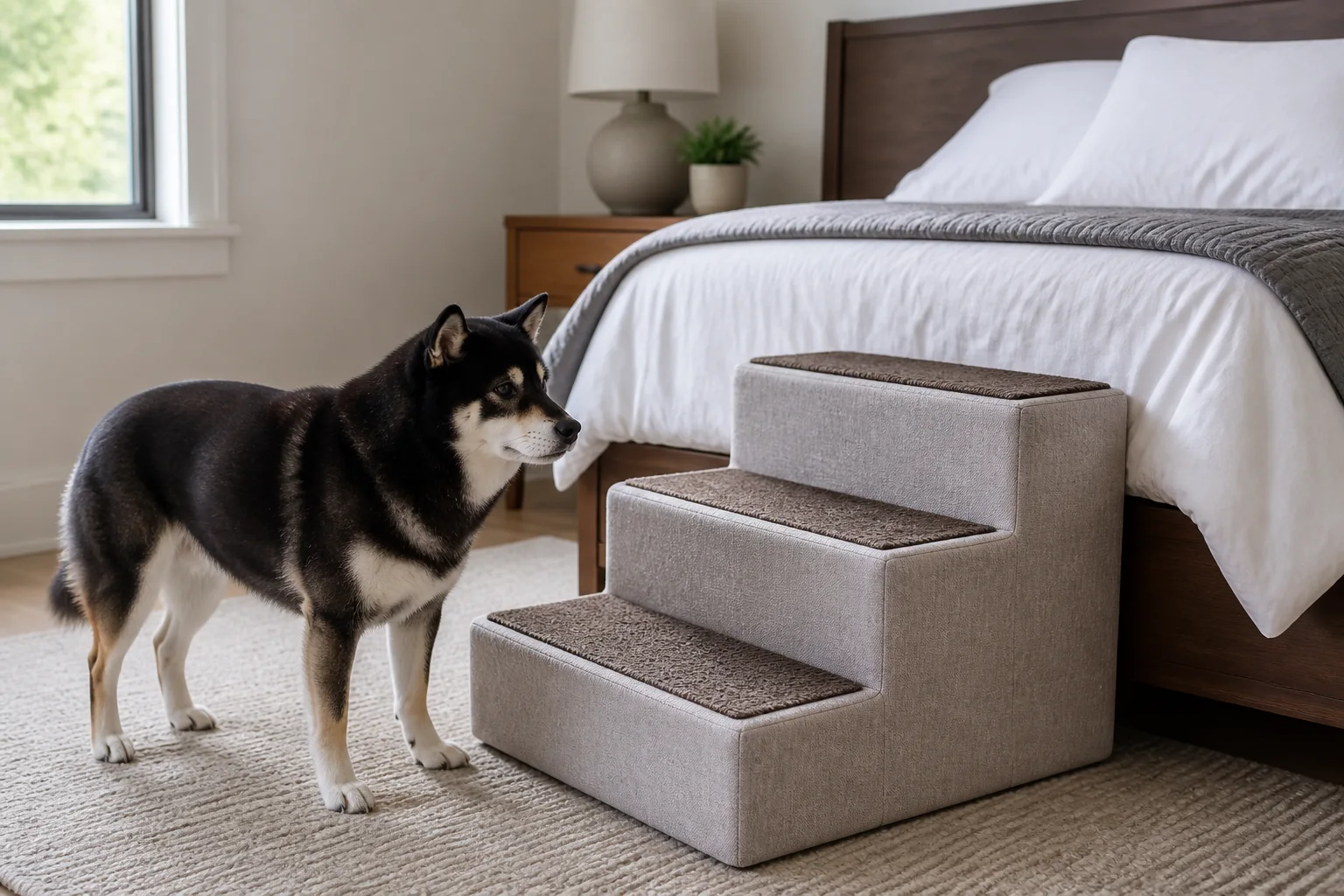
Put the steps perpendicular to a clear section of mattress, not beside a nightstand, sharp bed-frame corner, or loose blanket. The top should sit close enough that the dog cannot place a paw into a gap. The base belongs entirely on a grippy rug or manufacturer-approved non-slip mat; half on carpet and half on smooth flooring can create uneven movement.
Leave enough run-off space at the bottom for the dog to turn without colliding with a wall. Use a night light if the room becomes dark, but keep cords outside the route. Recheck the position after vacuuming, making the bed, or moving furniture.
Teach both directions
Practice while the bedroom is calm and the mattress is not occupied by an exciting person or another pet. Begin with the product on the floor if its construction allows it. Reward approaching, then one paw, then a complete slow pass. Guide with a fitted harness and loose leash; do not pull from the collar.
Descending is often harder than climbing. Practice it separately, one step at a time, with the handler beside rather than below the dog. If the dog skips steps, leaps from the middle, freezes, scrambles, or repeatedly turns sideways, stop. More treats do not repair unsuitable geometry.
Inspect nails, paw fur, tread covers, cover seams, base grip, and frame joints weekly. Clean accidents promptly and dry every layer fully before reuse. A foam insert returned to its cover while damp can trap odor and moisture.
Dogs with weak back legs or arthritis
Difficulty rising, falling, toe dragging, a hunched posture, or a sudden change in stair use is a health signal, not a shopping prompt. Cornell's osteoarthritis guidance explains that osteoarthritis can cause stiffness, gait change, trouble with stairs or furniture, and difficulty getting up. Veterinary examination comes before selecting a mobility aid.
If assistance has been prescribed, a rear sling or full-body mobility harness may help with brief transfers, while the veterinarian or rehabilitation professional defines how much weight to support. For daily recovery, coordinate the access route with a senior dog bed and a non-slip path to water and the exit.
Run a return-window stability test
Test the steps before the dog climbs them. Assemble every joint, install the cover and tread pieces, and place the unit exactly where it will stay. Press the center and both outside edges of each tread with your hands. Watch for side-to-side rocking, foam rolling under the front edge, fabric rotating around the insert, plastic joints separating, or the base creeping across the floor.
Next, measure the real geometry rather than trusting the model name. Record the compressed-mattress height, top-step height, gap to the bed, usable tread depth, usable width, and total floor footprint. A top step several inches below the mattress can still require a final jump. A deep-looking tread may lose usable space to a sloped riser or raised side. Photograph the setup from the side so you can compare the dog's back angle and foot placement during a slow supervised trial.
Begin with one complete ascent and one descent. The dog should place paws rather than launch, keep the body mostly aligned, and reach the mattress without climbing a blanket or bed-frame edge. Stop for repeated sideways movement, skipped steps, slipping, hesitation, or a leap from the middle. Those signs are acceptance-test failures, not reasons to extend the session until the dog is tired.
Recheck after washing the cover because fit and traction can change. If the steps only remain stable when wedged against furniture, taped to the floor, or held by a person, return them and choose a structure that is stable on its own under the manufacturer's instructions.
Plan for nighttime and changing mobility
Furniture access is unsupervised access once people are asleep. Keep the route illuminated, remove loose bedding from the top transition, and protect the human walking path. A dog that uses steps confidently during the day may misjudge them after waking suddenly, when the room is dark, or when stiffness is worse after rest.
Repeat the movement check whenever the mattress, bed frame, rug, grooming schedule, medication, or dog mobility changes. The correct setup can become wrong without the product breaking. If the dog begins pausing at the top, descending faster, missing a tread, or choosing not to use the steps, block access and reassess rather than assuming the dog needs more encouragement.
FAQ
The questions below reflect recurring concerns in Reddit discussions about steps for a large dog at a high bed and choosing between foam steps, rigid stairs, and ramps. Community anecdotes identify useful questions, but they do not establish that a design is safe for an individual dog.
How tall should dog steps be for a high bed?
Close to the top of the compressed mattress so the dog does not face a large final jump. Measure the exact bed; “high bed” is not a standard dimension.
Are foam steps safe for large dogs?
Only if the exact product's size and structure suit the dog and remain stable under real movement. Many foam listings target small or medium pets. Large dogs usually need wider, deeper, more laterally stable construction.
Are dog stairs or a ramp better for arthritis?
It depends on the dog's diagnosis and movement. A ramp can reduce repeated step-up motion, but a steep ramp may still be unsuitable. Ask the veterinarian or rehabilitation professional who has assessed the dog.
Can the steps stay beside the bed all night?
Only after the dog uses both directions predictably and the product cannot slide, tip, gap, or block a human route. Gate access when supervision or lighting is inadequate.
Why does my dog climb household stairs but refuse pet steps?
Pet steps may be narrower, softer, steeper, less stable, or end below the mattress. Compare rise, tread depth, width, surface firmness, and top transition with the stairs the dog already uses. Refusal is information about the setup; do not pull the dog upward or keep raising the reward.
Are improvised ottomans or mattress pieces safe as dog steps?
Only if each surface is structurally stable, non-slip, wide enough, and cannot separate or roll under movement. Household furniture is not automatically designed for repeated edge loading by a dog. A single broad platform may work for some confident dogs, but it still needs a complete supervised movement and stability check.
How do I know the foam is too soft?
Press the center and edges while watching how quickly the foam rebounds. During one slow supervised pass, stop if a tread collapses unevenly, the front rolls under, the cover shifts, or the dog widens the stance and scrambles for balance. A listed weight limit does not describe those movement effects.
Bottom line
For a high bed, count inches rather than steps. Match overall height, rise, tread depth, width, base grip, and top alignment to the dog and the room. If the dog cannot climb and descend slowly without compensating, change the category or the furniture-access plan—not the reward value.