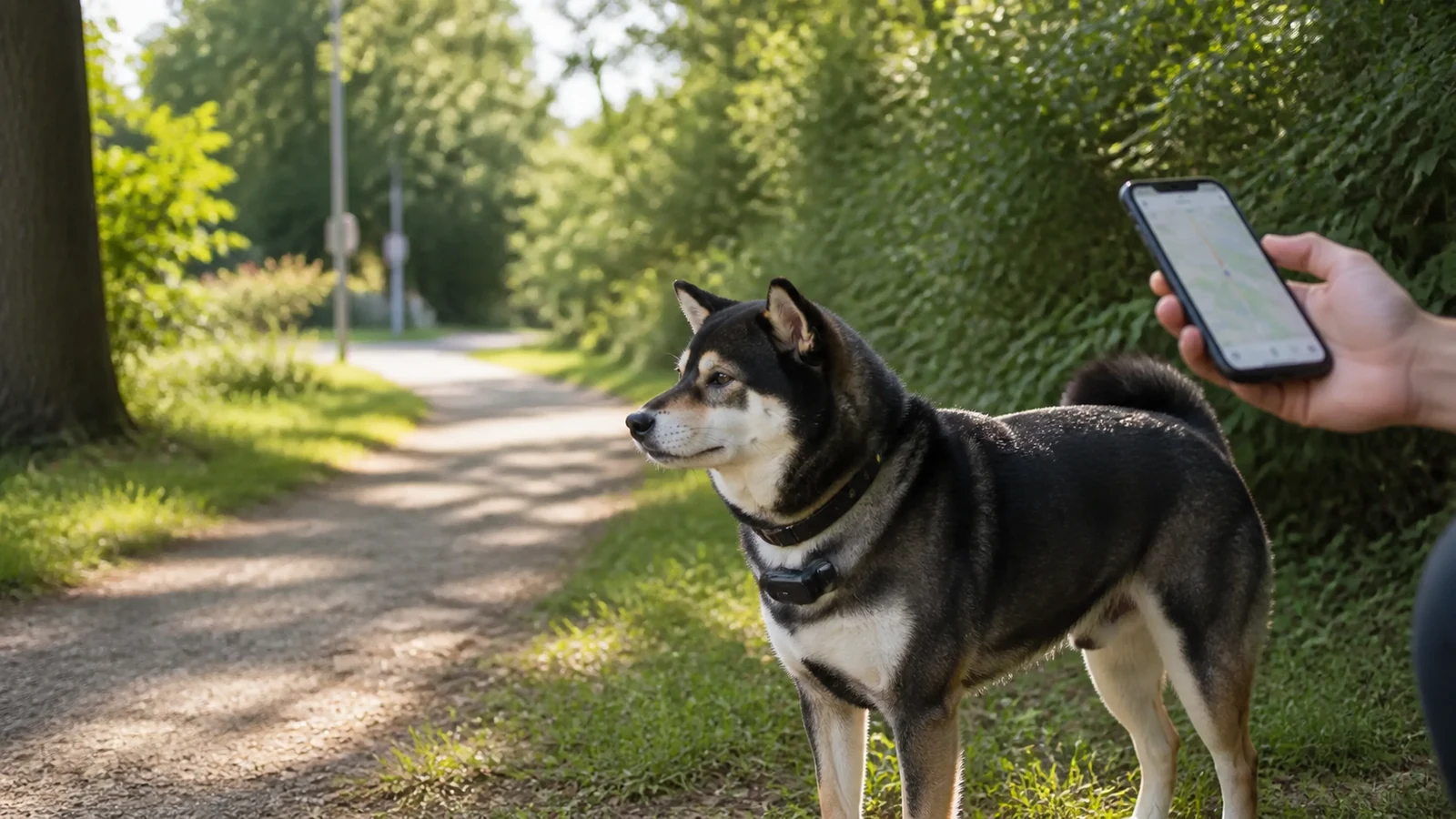
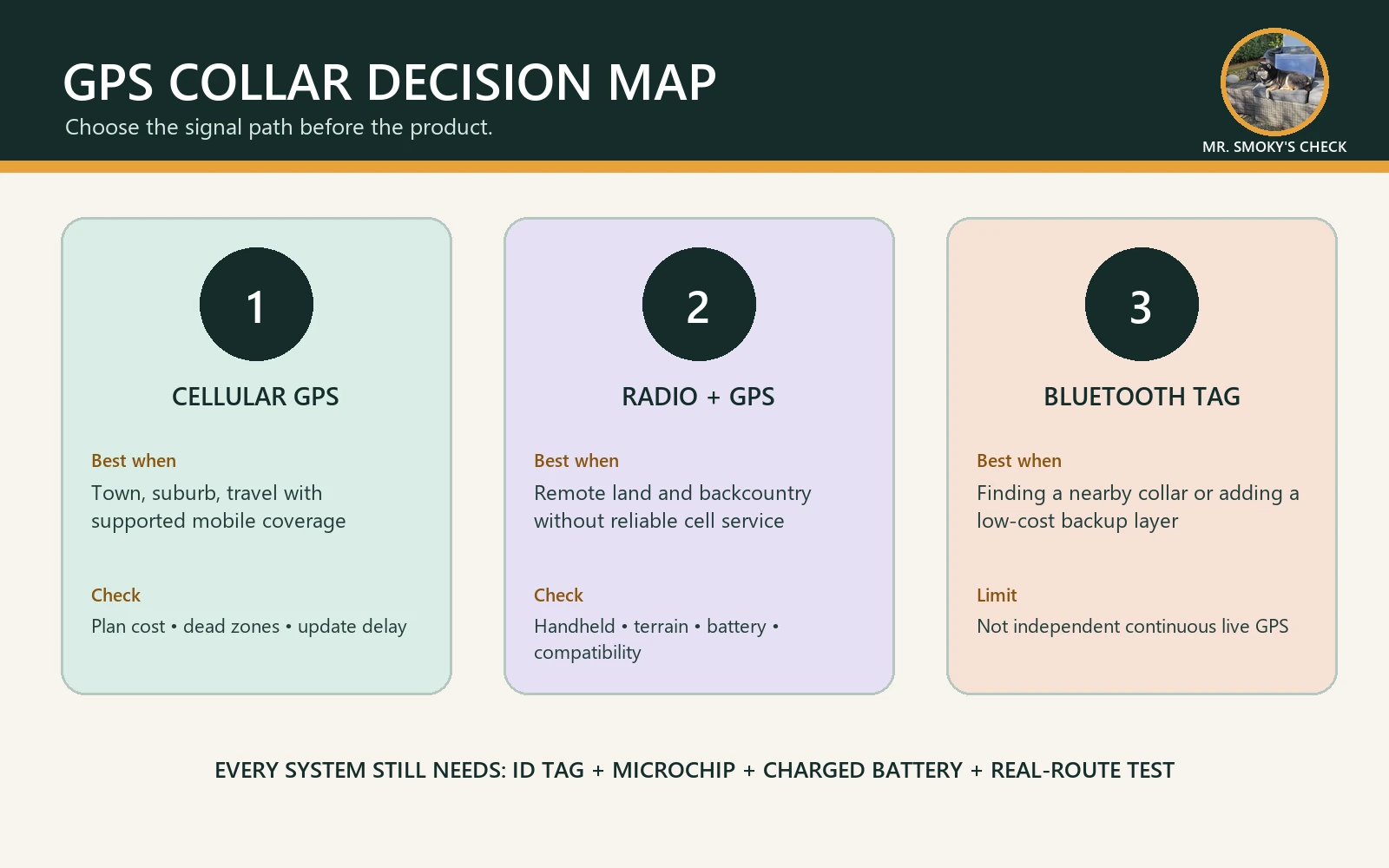
The best GPS dog collar is the one that can send a useful location where your dog is most likely to get lost. A cellular tracker can be convenient around towns and suburbs but depends on supported network coverage and usually a subscription. A dedicated radio/GPS system can work beyond cellular service, but it is bulkier and requires a compatible handheld. Bluetooth tags are useful for finding nearby belongings; they are not a direct substitute for a purpose-built live dog tracker.
Quick read
Quick answer
- Choose cellular GPS for everyday neighborhoods, travel, and app-based live tracking when coverage and a recurring plan are acceptable.
- Choose a radio/GPS system for remote land where cellular service is unreliable and you are willing to carry a dedicated receiver.
- Do not buy from the advertised maximum range alone. Test coverage, update delay, battery behavior, fit, and alerts on your actual routes.
- Keep a visible ID tag and current microchip registration. A tracker is an additional recovery layer, not identification or a physical restraint.
- Run a supervised escape drill before relying on the device.
The three tracker systems are not interchangeable
Cellular GPS
Neighborhoods, suburbs, road trips, and app-based monitoring
- Look for
Wide practical coverage where the supported mobile network works; usually subscription
- Avoid
Dead zones, roaming support, plan terms, update interval
Radio + GPS
Hunting, remote acreage, and backcountry use
- Look for
Direct collar-to-handheld communication without a cellular plan
- Avoid
Higher initial cost, bulk, licensing or regional compatibility, handheld battery
Bluetooth / community finding
Finding a nearby collar or item
- Look for
Small and inexpensive
- Avoid
Not continuous independent GPS; usefulness depends on nearby compatible devices
Share & embed
Garmin's Alpha T 20 specifications are a useful example of the dedicated-radio category: they list VHF communication and a replaceable rechargeable battery, while Garmin's fitting instructions require correct antenna orientation and a snug position around the middle of the neck. Those details show why “GPS collar” is too broad a shopping label. A phone-app tracker and a handheld radio system solve the location problem differently.
Choose by the place your dog could disappear
Write down three realistic loss scenarios before comparing products: slipping through the front door, backing out of a harness on a walk, and becoming separated on a remote trip. For each scenario, note whether a supported phone network normally works, how quickly you would notice, and who would search.
For a suburban door-dasher, fast app alerts, a reliable home safe zone, and a charged device may matter more than a long theoretical range. For acreage at the edge of coverage, the tracker must be tested at the property boundaries rather than at the house. For remote recreation, direct radio communication may be the only appropriate primary electronic layer.
Coverage maps are planning tools, not proof of performance at ground level. Hills, buildings, vegetation, device orientation, network congestion, and the dog's movement can affect results. Test from several points and at more than one time of day.
Subscription versus no subscription: calculate the real cost
Cellular trackers usually need service because they send location data over a mobile network. Compare the device price plus the required plan over the period you expect to use it. Check whether the advertised price requires a long commitment, whether cancellation is possible, and whether travel countries are supported.
A radio/GPS collar may avoid a mobile subscription, but “no subscription” does not mean “no extra cost.” A compatible handheld, replacement battery, antenna, charging equipment, maps, or regional radio requirements can make the upfront system substantially more expensive. Compare a complete working system, not the collar module alone.
| Question | Cellular GPS | Radio + GPS | Bluetooth/community tag |
|---|---|---|---|
Question | Cellular GPS | Radio + GPS | Bluetooth/community tag |
How location reaches you | Mobile network to app | Direct radio link to handheld | Nearby phone or community network |
Recurring plan | Commonly required | Usually no mobile plan | Varies by ecosystem |
Remote suitability | Only where supported network works | Designed for direct off-grid use within real conditions | Poor as primary live tracker |
Typical interface | Phone app | Dedicated handheld | Phone app |
Main failure mode | Dead zone, expired plan, phone/app issue | Uncharged handheld, obstruction, incompatible setup | No nearby participating device |
Fit, weight, and collar compatibility
A tracker that rotates under the throat, strikes the shoulder, or catches on objects is not correctly integrated. Weigh the entire collar assembly, not just the module. Compare it with the dog's neck circumference, coat, activity, and the manufacturer's minimum size guidance.
Fit the collar according to the device instructions and recheck it after several minutes of normal movement. Confirm that breathing and swallowing are unrestricted, the buckle cannot be pulled over the head, and the module does not repeatedly hit the jaw or shoulder. Long-coated dogs may need a second check after the coat compresses.
Do not attach a leash to a tracker mount unless the product explicitly provides a load-rated leash point. A tracking collar and a walking harness can be separate systems. For dogs that reverse out of equipment, see our escape-proof harness guide.
Battery planning beats a headline runtime
Published battery figures are usually based on defined settings. More frequent location updates, weak signals, cold conditions, screen use on a handheld, and an aging battery can reduce practical runtime. Build a routine around the shortest outing and longest delay you must cover.
Use a pre-trip threshold such as “do not leave below 80%,” keep the correct cable in the dog gear bag, and enable low-battery notifications where available. A long battery specification has no value when the tracker was left on the charger or the handheld is empty.
A 20-minute supervised field test
- Charge the tracker, phone or handheld, and any backup battery.
- Confirm the account, plan, permissions, and current firmware or app requirements.
- Fit the device and walk normally for five minutes.
- Have a second adult take the dog along a safe predetermined route while you remain at the start.
- Record the first alert time, apparent update interval, and any missing positions.
- Repeat near the edge of your common coverage area.
- Trigger sound or light only if the manufacturer provides it and the dog has been calmly conditioned to it.
- Check the collar position and skin after the test.
Repeat the test after a major app update, plan change, long period of non-use, or move to a new area. Never stage a test by letting the dog loose.
Current Amazon options to compare
These are comparison starting points, not claims that we personally field-tested the products. Verify the current variant, supported country, plan requirement, device size, seller, and return terms on Amazon.
When a GPS collar is the wrong purchase
Do not buy a tracker to compensate for a broken fence, unreliable gate, poorly fitted collar, or untrained recall. Fix the physical escape path first. A device only helps after separation and can itself be lost with the collar.
A tracker also cannot replace a microchip or readable ID. Batteries expire, accounts lapse, and electronics fail. Keep contact information current in each recovery layer.
FAQ
Is there a GPS dog collar with no monthly fee?
Yes, dedicated radio/GPS systems commonly work without a cellular subscription, but usually require a compatible handheld and have a higher initial system cost. Some products advertised as “no fee” are Bluetooth finders rather than independent live GPS trackers.
How accurate is a GPS dog collar?
Accuracy varies with satellites, signal path, environment, update interval, and device design. Test the exact device in the places that matter instead of relying on one advertised number.
Can I leave the tracker on all day?
Follow the fit, skin-contact, charging, and environmental instructions for the device. Recheck position and skin regularly, especially with heavy modules or dense coats.
Does a tracker prevent escape?
No. It is a recovery aid. Secure doors and fences, appropriate restraint, identification, training, and supervision remain the preventive layers.
Can an AirTag replace a GPS tracker on a woodland walk?
We would not use it as the primary recovery device for that route. Apple explains that an AirTag broadcasts Bluetooth signals detected by nearby Find My devices, which report its location. That is different from a tracker sending its own position over cellular or radio. In sparsely visited woodland, a missing update may mean no participating device passed nearby. Keep identification current and choose recovery equipment for the actual coverage.
Why does my tracker lose contact when my phone still has signal?
The phone and tracker may use different networks or frequency bands. Tractive's coverage guidance explicitly notes that its tracker cannot access every band a smartphone can. Our recommendation is to check the location timestamp and test the exact tracker along your route while the dog remains securely leashed. Do not interpret an old map pin as a current position or assume a subscription removes dead zones.
Why does the battery drain much faster during live tracking?
Tractive identifies frequent LIVE Tracking and poor cellular signal as major battery drains. A headline runtime measured largely at home is therefore not a lost-dog search budget. Before a trip, record battery use during a supervised tracking walk, charge both tracker and phone, and take the correct charging equipment. Do not wait for an actual escape to discover how long your chosen update mode lasts.
Bottom line
Choose the signal system before the brand: cellular for connected everyday use, direct radio for remote work, and Bluetooth only as a nearby-finding supplement. Then verify full ownership cost, fit, battery routine, and real-route performance. The best tracker is not the one with the loudest range claim; it is the one you have charged, fitted, and successfully tested before an emergency.