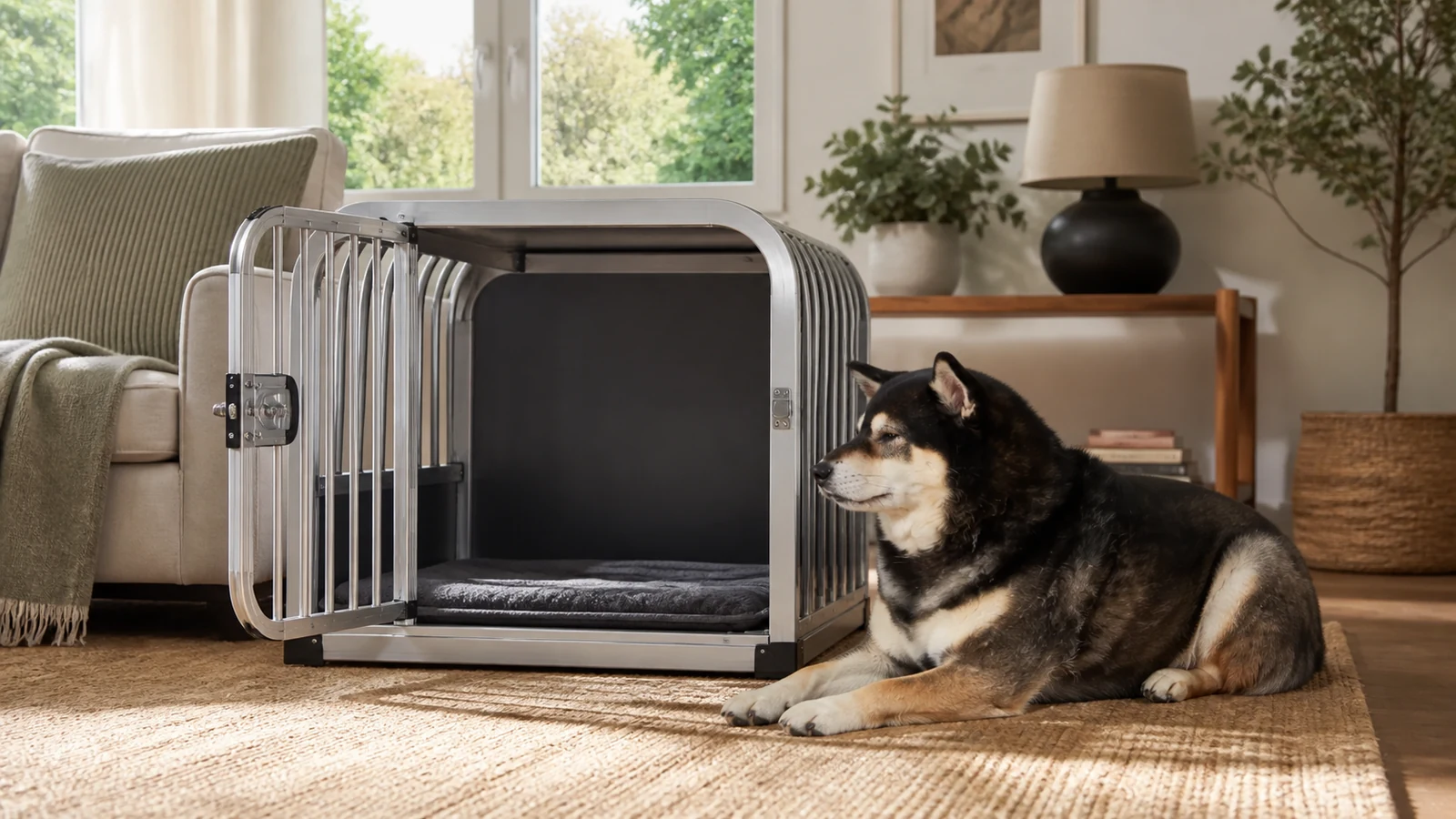
A heavy-duty dog crate can contain a dog that bends ordinary wire, works simple latches, or damages plastic. It cannot treat separation anxiety, confinement distress, or panic. If a dog pants heavily, drools, screams, eliminates, breaks teeth, tears nails, or throws their body against a crate, choosing a stronger box without addressing the cause can increase injury risk.
Quick read
Quick answer
- First distinguish boredom, learned latch-opening, ordinary chewing, and true panic using a camera and professional guidance.
- Stop unsupervised crating after self-injury, frantic escape attempts, or sustained distress; contact a veterinarian or qualified behavior professional.
- Compare smooth interior surfaces, ventilation, latch protection, door gap, structural joints, usable interior size, and emergency access.
- Introduce the crate with the door open and build calm duration gradually.
- “Heavy duty” and “high anxiety” are product categories, not guarantees or behavioral treatment.
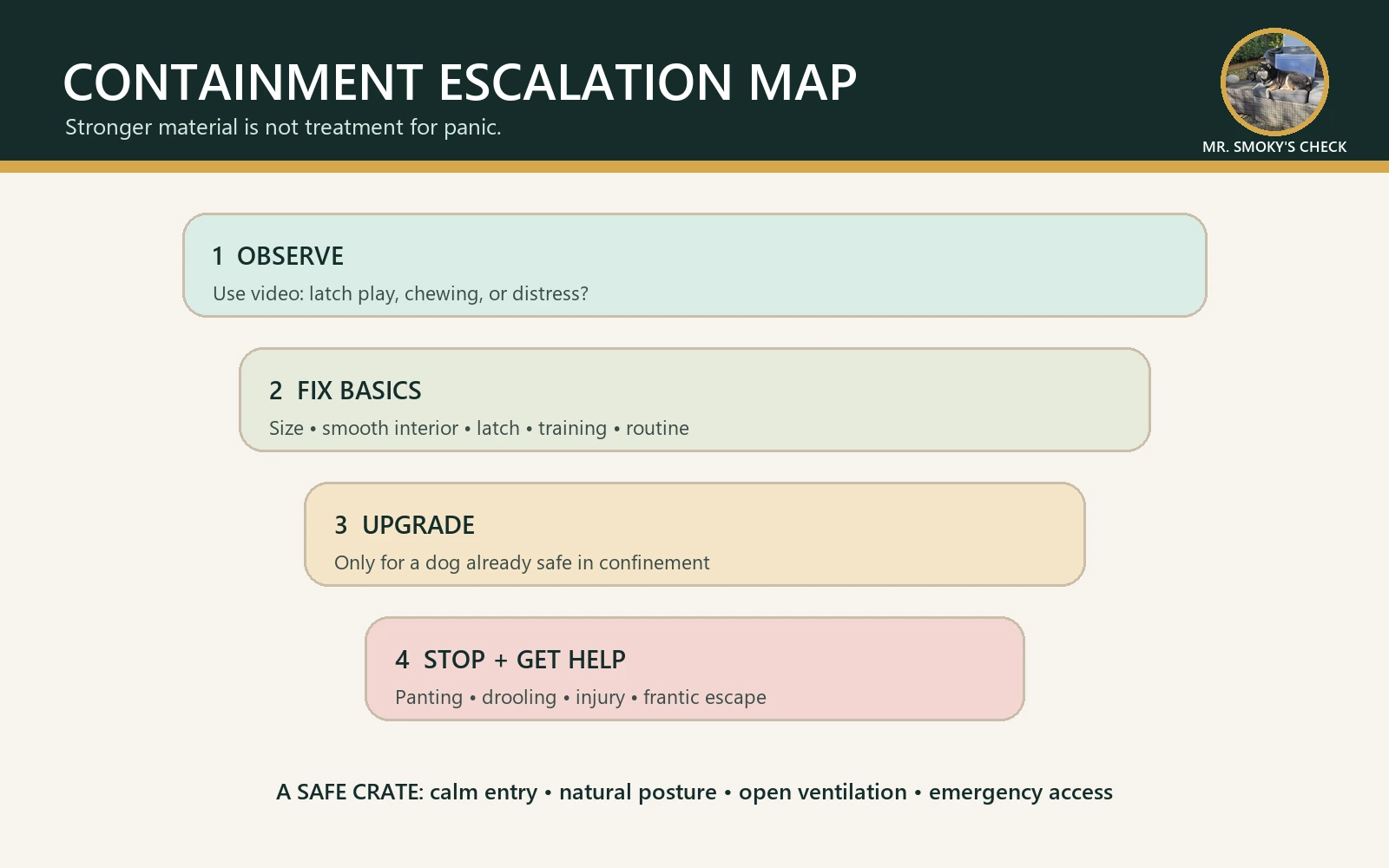
The containment escalation map
Share & embed
Calm dog opens latch
No panic; dog manipulates simple closure
- Look for
Protected multi-step latch plus training
- Avoid
Assuming stronger bars solve all behavior
Calm dog chews weak crate
Intermittent damage without distress pattern
- Look for
Smooth stronger construction and supervised introduction
- Avoid
Exposed mesh, sharp edges, reachable fasteners
Dog panics when alone
Panting, salivation, vocalizing, frantic escape or injury
- Look for
Veterinary/behavior assessment and safer temporary management
- Avoid
Locking the dog into a stronger crate and leaving
Unknown behavior
Damage discovered after absence
- Look for
Video observation and short supervised trials
- Avoid
Guessing from the damage alone
The ASPCA's separation-anxiety guidance and Cornell University veterinary guidance both warn that confinement can worsen distress for some dogs. Cornell advises against forcing highly stressed dogs to remain crated alone. The crate purchase should therefore follow the behavior assessment, not replace it.
| Containment type | Best for | Strength | Tradeoff | Verify before use |
|---|---|---|---|---|
Reinforced steel cage | Calm dogs that defeat light wire or simple latches | Strong frame, protected closures, removable tray, familiar open visibility | Heavy, noisy, multiple joints and bars to inspect | Check every dog-facing edge, latch reach, bar spacing, caster lock, and usable interior height |
Aluminum panel crate | Owners prioritizing smooth walls, lower weight than steel, and fewer bendable bars | Rigid panels and protected hardware can reduce tooth-catching points | Higher cost, different airflow and visibility, exact ventilation clearance required | Verify vent area, panel temperature, door overlap, floor grip, and emergency opening |
Standard wire crate | Calm crate-trained dogs needing folding storage and broad airflow | Widely available, visible, easy to move, divider options | Flexible wires and simple latches are not suitable for every escape pattern | Inspect welds, wire ends, door gaps, tray fit, and whether ordinary management already works |
Exercise pen or dog-safe room | Dogs safe with more space but unsuitable for closed-crate confinement | More movement and distance from a barrier | Not escape-proof; room hazards, doors, windows, and chewing still require management | Run a camera-monitored short trial and remove cords, toxic items, climb points, and ingestible material |
Use video to identify the failure mode
Record a short departure from a safe location. Observe when the behavior begins, whether it occurs while the handler is still home, what part of the crate the dog targets, and whether the dog can settle. A dog calmly nosing a latch needs a different solution from a dog injuring their mouth within minutes of departure.
Do not stage a long absence to collect evidence. Begin below the known problem duration, remain close enough to return, and stop at early distress. Share recordings with a veterinarian or board-certified veterinary behaviorist when separation or confinement anxiety is possible.
Medical problems, pain, cognitive change, noise events, and elimination needs can change crate behavior. Sudden escape attempts in a previously calm dog deserve veterinary assessment.
Construction details that matter
Interior surfaces
Look from the dog's side of the crate. Reachable bolts, sharp wire ends, pinch gaps, rough welds, and thin edges can injure paws or teeth. The floor should sit securely without a gap that traps nails.
Door and latch
A strong body with a flexible door is not a strong system. Check hinge play, door-frame overlap, latch engagement, secondary locks, and whether the dog can reach the mechanism. Every household adult must also be able to open it quickly in an emergency.
Ventilation and visibility
More solid panels may reduce bending points but also change airflow and visual exposure. Follow the manufacturer clearance requirements and never block vents with a cover, wall, luggage, or improvised padding. A crate is not a climate-controlled space.
Structural joints and wheels
Inspect corners, rivets, welds, panel joints, and caster locks. A crate on wheels needs all brakes engaged on a level surface. Never let a dog ride in a wheeled household crate as though it were a vehicle restraint.
Size the usable interior
The dog should be able to stand without crouching, turn around, lie on their side, and rest naturally. Measure standing height, nose-to-rump body length, and relaxed lying dimensions, then compare with interior measurements. Exterior dimensions and nominal size labels can be misleading with thick frames.
A crate that is much larger is not automatically safer: it may offer more run-up distance during panic. A crate that is too small restricts normal posture. For ordinary home sizing, compare the principles in Best Dog Crates for Home.
Heavy-duty home crates are not automatically airline compliant or crash-tested. For a vehicle, use the separate car-travel crate guide and verify the complete restraint system.
Introduce the crate without force
Place the crate in a comfortable, ventilated room with the door secured open. Reward voluntary investigation, feeding near the entrance, stepping inside, and settling. Add door movement only after the dog remains relaxed. Increase closed-door duration in seconds, not hours, and remain present initially.
Watch body language: relaxed muscles, normal breathing, choosing to re-enter, and taking food are useful signs. Freezing, frantic scratching, hard panting unrelated to heat, drooling, repeated yawning, refusal of high-value food, or sustained vocalization mean the step is too difficult.
Never use the crate as punishment. Do not leave collars, tags, loose straps, or gear that can catch unless the crate and behavior professional's guidance explicitly supports it.
Room fit, delivery, and return logistics
Measure the route into the room as carefully as the dog. Record the shipping package dimensions when available, exterior crate dimensions, doorway width and height, stair turns, hallway corners, elevator limits, and the open-door swing. A crate can fit its final wall space and still fail to pass a narrow landing or leave no room to remove the tray.
Plan the floor before assembly. Confirm that the finished weight is appropriate for the location, use manufacturer-compatible floor protection, lock all casters, and preserve ventilation and emergency access on every side that requires clearance. Do not place the crate where a door, heater, appliance, or heavy furniture can trap the person opening it.
Large-crate returns may involve disassembly, repacking, freight arrangements, or seller-specific conditions. Before ordering, check who pays return transport, whether the original packaging is required, and how damage must be documented. Keep the packaging until fit, assembly, latches, tray travel, and every dog-facing surface have passed inspection. These logistics are part of product suitability even when the purchase price looks attractive.
Emergency access, evacuation, and cleaning
Every adult in the household should be able to release every latch quickly without a key, app, or unusual strength. Practice opening the main and secondary closure with the crate empty, identify who moves the dog during an evacuation, and keep the path to an exterior door clear. A heavy household crate is not automatically a fire-evacuation carrier, airline kennel, or vehicle crash restraint; plan those functions separately.
Clean in a way that exposes damage. Remove the tray and approved bedding, wash according to the manufacturer instructions, rinse residue, and let all components dry before reassembly. Inspect beneath the tray, around urine contact points, under joint covers, and inside hollow-looking corners for corrosion, cracks, loosened coating, sharp edges, or trapped moisture.
Do not hide a rough bar with tape, pad a reachable latch with fabric, or improvise a repair that introduces glue, wire, loose fasteners, or new chew targets. Photograph changes, stop use when structural safety is uncertain, and ask the manufacturer whether an approved replacement part or retirement is required.
Current Amazon options to compare
We have not tested these crates against escape attempts. Verify current interior dimensions, door design, bar spacing, weight, assembly, seller, delivery, and return conditions. A large heavy crate can be expensive or difficult to return.
A weekly safety inspection
Remove the dog and check every interior edge by sight and touch. Look for bent bars, widened joints, loose fasteners, chipped coating, latch movement, sharp points, tray cracks, urine corrosion, and missing caster locks. Confirm vents and required wall clearances remain open.
After any escape attempt, stop using the crate until it is fully inspected. Damage that appears cosmetic outside may create a sharp or trapping surface inside.
FAQ
Is an indestructible dog crate real?
No crate should be treated as an absolute guarantee. Dog behavior, strength, wear, assembly, sizing, and construction all affect performance. “Indestructible” is marketing language, not permission to ignore inspection.
Is a heavy-duty crate good for separation anxiety?
Not by itself. Veterinary behavior sources warn that crating can worsen distress and cause injury for some dogs. Treat the underlying behavior with professional help and use confinement only when the dog is demonstrably safe.
Should I cover a heavy-duty crate?
Only if the manufacturer permits it and ventilation remains unobstructed. Some dogs relax with reduced visual input; others become more distressed. Observe the individual response.
Can I use it in the car?
Household containment and vehicle crash protection are different functions. Use only as the manufacturer specifies and secure an appropriate travel system.
My dog is bending bars or biting the door. Should I buy thicker steel?
Stop using the damaged setup and arrange a safer supervised space before shopping. ASPCA guidance describes broken teeth, damaged nails, and injured paws during escape attempts. Stronger bars do not remove that risk. Contact a veterinarian if injury is possible, and have the confinement behavior assessed. Our recommendation is to separate the equipment decision from the question of whether crating is suitable at all.
Can I add padlocks, zip ties, or extra clips to stop the door opening?
Our recommendation is to use only a manufacturer-approved latch accessory, with an adult still able to open the door promptly. Improvised locks or ties can complicate emergency access and create new chewing or snag points. Ask the crate maker to assess the actual latch and door alignment; do not treat a faulty door as a training problem. If the dog is forcing the door in distress, follow the behavior stop-use guidance above rather than adding more restraints.
Why is my dog calm in the crate while I am home but frantic when I leave?
Being comfortable with the crate and being comfortable alone are different skills. Dogs Trust explains that crate training alone cannot resolve worry about being left. A recording of a brief, safely managed absence may help your veterinary or behavior team understand the pattern, but do not prolong distress to collect footage. Arrange suitable supervision while you develop a gradual plan; changing crate material alone is not a treatment.
Bottom line
The strongest crate is not automatically the safest crate. Identify why the dog escapes, rule out panic, size the usable interior, inspect every dog-facing surface, and teach calm entry gradually. If confinement creates distress or injury, the right answer is professional behavior care and safer management—not a thicker door.