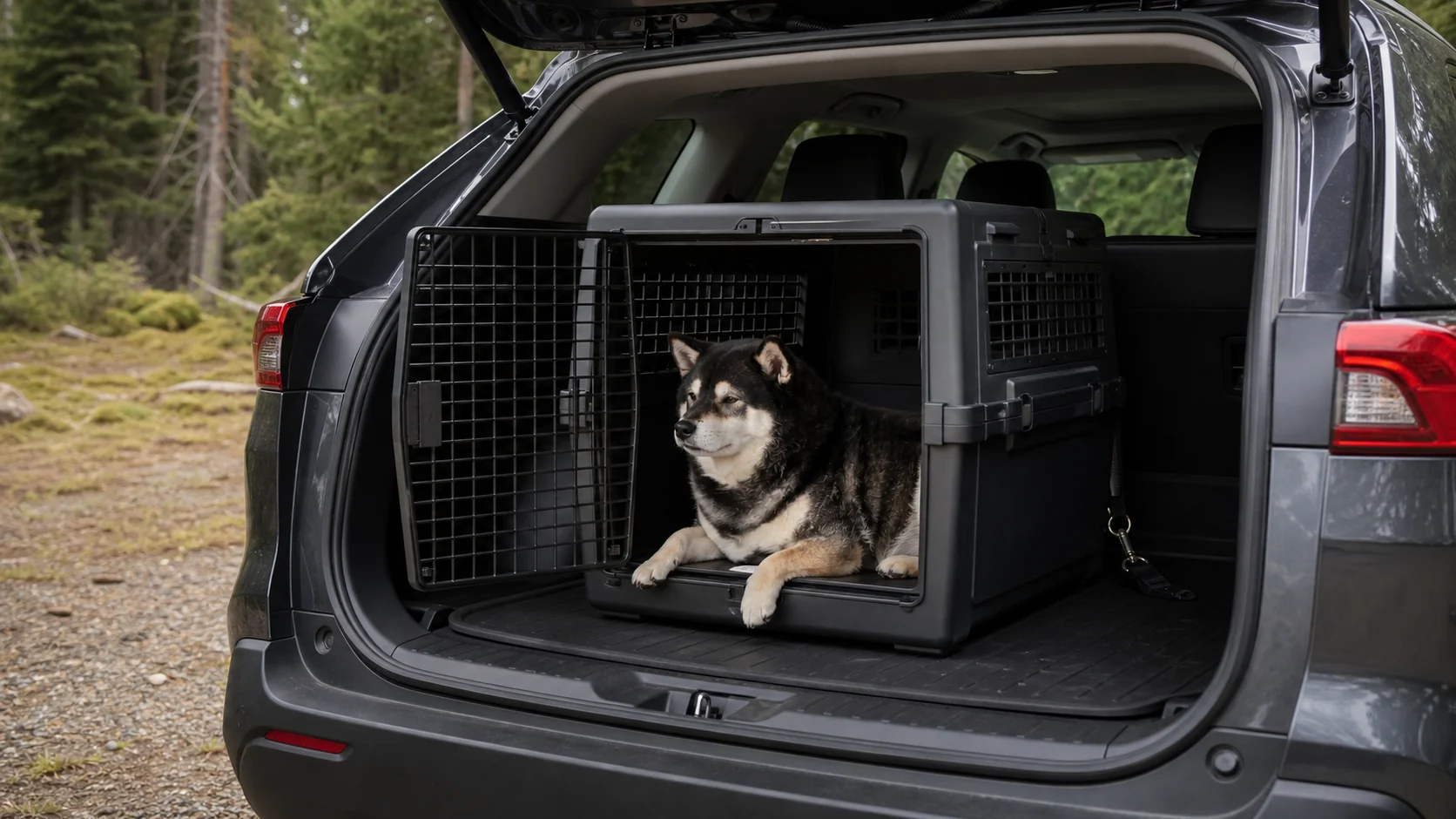
The best dog crate for car travel is one that fits the dog and vehicle, has current evidence for the exact model and size, and can be installed using the manufacturer’s approved anchor method. A convenient folding crate may prevent distraction, but it should not be assumed to provide crash protection.
This guide explains the decision without naming a permanent “best overall” product. Certifications, model names, approved sizes, straps, and instructions can change, so current evidence must be checked when buying.
Quick read
Quick answer
- Start with current independent evidence, not the phrase “crash tested.”
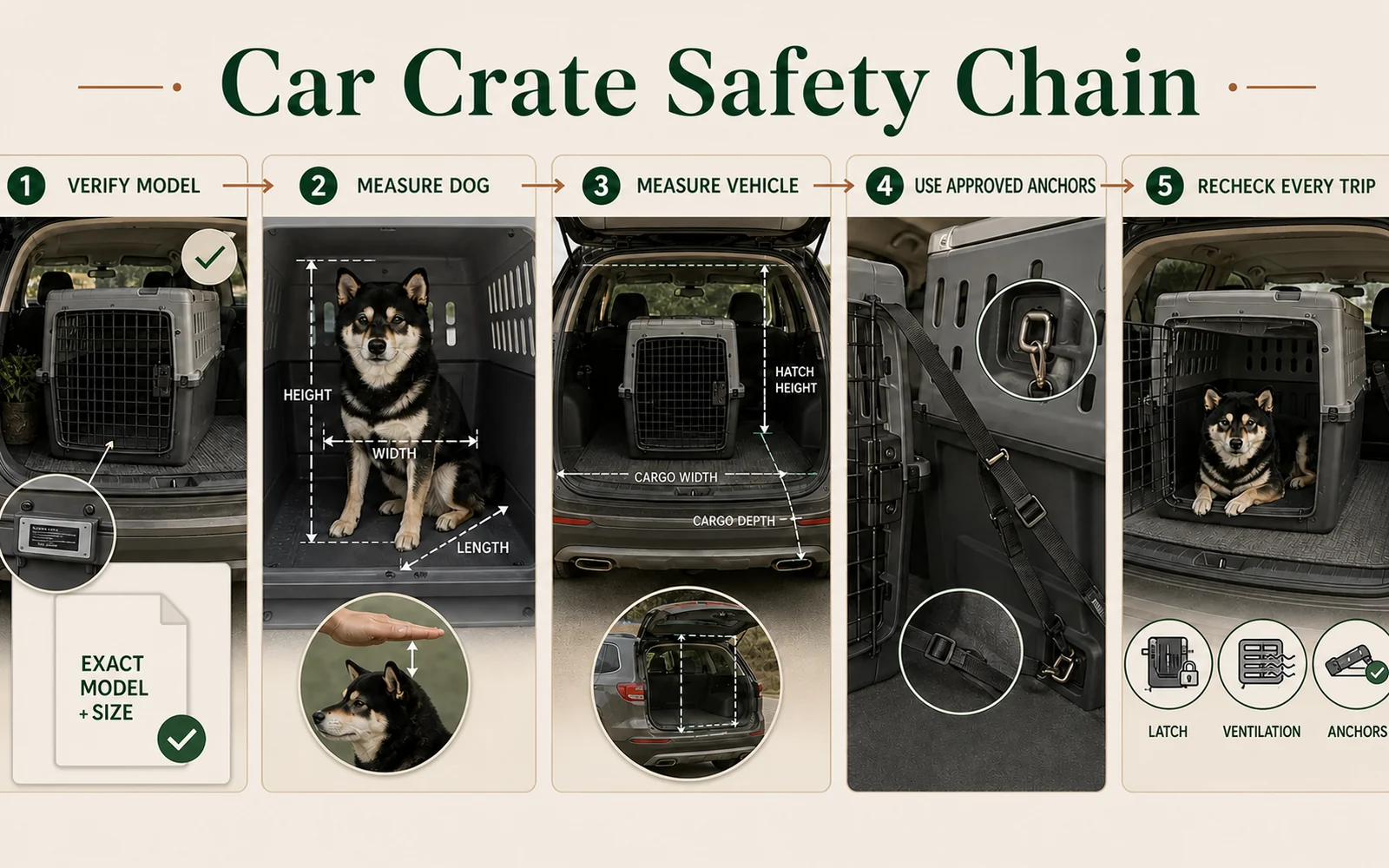
- Match the complete system: exact crate model, approved size, vehicle position, anchor straps, and installation instructions.
- Compare internal dimensions for the dog and external dimensions for the vehicle.
- Hard-sided travel crates and rear-seat carriers are different categories with different placements and connection methods.
- A soft or collapsible crate is useful for some calm-dog travel routines, but do not assume it is a crash-protection crate.
- Never block ventilation or leave a dog unattended in a vehicle.
What should you look for in a car dog crate?
Begin with evidence, placement, and fit. The Center for Pet Safety certified list identifies exact travel crates and carriers that have passed its independent certification program. Recheck that list and the manufacturer’s current instructions rather than relying on an old article, retailer badge, or broad brand claim.
Center for Pet Safety distinguishes between travel crates, which are typically hard-sided and anchored in a cargo area, and carriers, which are commonly designed for smaller pets and secured on a rear seat. Its crate and carrier FAQ explains that the test conditions and connection requirements differ.
Current certification covers exact model and size
Follow the certified system
- Look for
Approved size, placement, anchor straps, instructions
- Avoid
Substituting unapproved straps or sizes
Small dog rides on rear seat
Compare certified carriers
- Look for
Seat-belt or anchor routing, carrier limit, ventilation
- Avoid
Treating any soft carrier as crash protection
Crate sits in SUV cargo area
Compare certified hard-sided travel crates
- Look for
Cargo dimensions, anchor points, rated straps, door access
- Avoid
Leaving a heavy crate unsecured
Only a folding convenience crate fits
Treat it as containment, not proven crash protection
- Look for
Dog behavior, ventilation, stability, setup limits
- Avoid
Marketing it as crash safe without evidence
Share & embed
Build a pre-purchase evidence file
Do not rely on a badge visible on a retailer page. Before paying, save or print the current source that identifies the exact model and size, the installation instructions, the required accessories, and the product dimensions. Write the access date beside each item because lists and manuals can change.
Your file should answer six questions without guesswork:
- Who performed the test or certification?
- Is the exact product name listed, not only the brand?
- Is the exact size you plan to buy included?
- What vehicle position was evaluated or approved?
- Which straps, connectors, or base components are required?
- Are there limits involving dog weight, orientation, or vehicle anchors?
If one answer is missing, contact the manufacturer and keep the written response. A customer-service statement is not the same as independent evidence, but it can clarify current compatibility and installation. Reject any setup that requires you to improvise around unclear instructions.
This evidence file also helps later. If a strap is damaged or the crate is moved to another vehicle, you can verify the approved replacement instead of choosing a connector that merely looks similar.
Seven checks before buying
1. Exact certification scope
“Crash tested” can mean an internal demonstration, a test with no published pass criteria, or a test that covered only one size. Look for the exact model, exact approved size, test organization, current status, and required accessories.
Do not transfer certification from one model to the rest of a brand. Do not assume a larger or smaller version passed because the product name looks the same.
2. Approved anchor method
A travel crate is part of a restraint system. The crate, connectors, anchor straps, vehicle position, and instructions work together. Generic cargo straps, bungee cords, improvised tie-downs, or an unapproved connection create a different setup.
Check whether the vehicle has the required anchor points and whether they are accessible after the crate is positioned. Follow both the vehicle manual and crate instructions.
3. Dog fit
The dog needs enough internal space to stand naturally, turn, and lie down. Measure the dog, then compare the manufacturer’s internal dimensions and weight limits. The Dog Crate Size Calculator provides a home-sizing starting range, but car-travel fit must still follow the travel-crate manufacturer’s approved size guidance.
4. Vehicle fit
Measure the narrowest loading opening, cargo floor, roof angle, wheel-well intrusion, seatback angle, and space needed for the crate door. A crate can fit on the cargo floor yet fail to pass through the hatch.
Leave room for ventilation and for the door to open without forcing the dog into traffic. Do not place the crate where it blocks the driver’s view or interferes with vehicle controls.
Make a cardboard footprint before ordering
Mark the crate’s outside length and width on flattened cardboard or painter’s tape. Place that footprint in the intended position and check the hatch opening, rear-seat movement, wheel wells, sloping roof, and anchor access. Then add the door-swing area and the space your hands need to attach and inspect straps.
Height needs a separate check because a sloping hatch can reduce clearance toward the rear. Measure the narrowest point along the loading path, not only the tallest part of the cargo area. If the crate must be tilted to load, confirm the weight and handling are realistic for every person who will install it.
5. Door and emergency access
Check latch design, door orientation, and whether the dog can be reached if the main hatch cannot open. Some vehicle layouts benefit from an emergency-access door, but only when that feature is part of the manufacturer’s approved design.
6. Ventilation and temperature
Do not cover ventilation openings with luggage. Keep the crate away from exhaust intrusion and direct heat. The AVMA travel guidance advises acclimating pets to car travel and never leaving them unattended in a vehicle.
7. Daily usability
A safe system still needs to be used correctly every trip. Consider crate weight, loading height, dog entry, cleaning, bedding, and whether the approved anchors can be inspected easily. If installation is so difficult that it is routinely skipped, the real setup is weaker than the product specification.
Car crate types compared
| Option | Best for | Key features | Caveat | Merchant |
|---|---|---|---|---|
Certified hard-sided travel crate | Cargo area of a compatible SUV or van | Published certification for exact model and size, structural containment | Heavy, expensive, vehicle fit can be difficult | Use only approved anchors and straps |
Certified rear-seat carrier | Smaller dogs within listed limits | Designed for seat-belt or anchor routing on rear seat | Size range is limited | Follow the carrier’s exact routing |
Plastic travel kennel without current crash evidence | Routine containment and some non-vehicle uses | Enclosed shape, familiar kennel design | Do not assume crash protection | Evaluate as containment only |
Wire crate | Home use and stationary routines | Ventilation, visibility, folding convenience | Unsecured panels and doors are not proof of crash performance | Not a default crash-safety choice |
Soft or collapsible crate | Calm, crate-trained dogs at destinations | Lightweight, easy storage | Fabric and folding frames may not contain crash forces | Use only within stated limits |
Common car-crate setup failures
Buying by vehicle model alone
“Fits an SUV” is not a dimension. Trim level, folded seats, subwoofers, cargo covers, wheel wells, and hatch shape can change the usable area. Measure the actual vehicle.
Securing the crate but not nearby luggage
A correctly installed crate can still be surrounded by loose cargo. Water bottles, tools, folding chairs, and the dog’s gear bag should be secured separately and must not block vents, doors, or approved connections.
Adding thick bedding after the fit check
Bedding reduces usable height and can alter how the dog stands or how the door clears. Use only bedding compatible with the instructions, then repeat the dog-fit and latch checks with it installed.
Leaving straps installed without inspection
Sun, moisture, abrasion, cargo movement, and repeated tension can damage webbing and hardware. Look for fraying, deformation, corrosion, loose bolts, and changed routing. Replace parts only with approved components.
Moving the system between cars as if nothing changed
A second vehicle creates a new loading opening, anchor layout, floor angle, air path, and emergency-access problem. Re-run the complete measurement and installation process rather than copying the old strap positions.
Crate, carrier, or car harness?
The best category depends on dog size, vehicle layout, and current certified options. Smaller dogs may fit an approved rear-seat carrier. Some dogs and vehicles suit a hard-sided anchored crate. A purpose-built certified car harness may be the more practical route when an approved crate cannot fit.
Read the Dog Seat Belt and Car Harness Guide before treating a generic buckle tether or walking harness as equivalent. For broad home-versus-travel differences, use the Dog Crates hub.
Amazon option when a certified crate does not fit
If an independently certified crate or carrier cannot fit the dog and vehicle, a purpose-built certified car harness may be the more practical category. This is not a crate substitute by default: verify the exact product, approved size, current Center for Pet Safety record, seat-belt routing, and manufacturer instructions. What Dogs Like may earn from qualifying purchases.
Installation checklist
Before the first drive:
- confirm the exact model and size on the current certification source;
- read the crate and vehicle manuals;
- verify every required strap and connector;
- measure the vehicle opening and installed footprint;
- confirm ventilation around all sides;
- test door access while parked;
- remove loose objects around the crate;
- acclimate the dog with short stationary sessions and short drives; and
- recheck anchors, latches, panels, and damage before each trip.
First-week acclimation plan
Installation quality and dog comfort should be tested while the vehicle is parked before a longer drive. Let the dog inspect the crate voluntarily, then practice brief closed-door sessions with calm rewards. Start the engine only after the dog can settle in the stationary setup, and progress to a short familiar route before highway or multi-hour travel.
Watch for persistent panting unrelated to temperature, drooling, vocalizing, repeated turning, refusal to load, or attempts to escape. These may reflect motion sickness, fear, poor fit, heat, or another problem that equipment alone will not solve. Pause the progression and ask a veterinarian or qualified behavior professional for appropriate guidance.
Do not leave a dog in the parked vehicle during acclimation. Every practice session requires direct supervision and comfortable temperature control.
Inspection schedule after purchase
Use a short visual check before every trip: latch, door, anchors, straps, vents, bedding, and surrounding cargo. After a long or rough journey, inspect again before the next use. Follow the manufacturer’s replacement guidance and stop using the system after a collision until the manufacturer confirms the required next step; damage is not always visible.
Keep the purchase record, model and size, serial information if provided, manuals, approved-accessory list, and clear photos of the installed routing. These records make later replacement or support questions much easier to resolve.
Related guides
If the dog currently jumps into the cargo area, measure the vehicle and compare Dog Ramps for SUVs before choosing the crate entrance routine. The Dog Travel & Outdoor Gear hub connects vehicle access with trail, heat, water, and mobility decisions.
Use the Dog Crate Size Guide for body measurements, Soft vs Collapsible Dog Crates for Car Travel for convenience-crate tradeoffs, and the Dog Gear Bag Guide for organizing travel supplies separately from the restraint system.
Frequently asked questions
What is the best dog crate for car travel?
The best option is a crate or carrier with current evidence for the exact model and size that fits both the dog and vehicle and can be installed with the approved connection system.
Does crash tested mean independently certified?
No. Ask who tested it, what standard was used, which exact sizes passed, whether results are public, and what installation accessories are required.
Can a dog crate go in the back seat?
Only if the product is designed for that position and the manufacturer explains how to secure it there. Many larger travel crates are designed for a cargo area instead.
Is a soft dog crate safe in a car?
A soft crate may provide routine containment for a calm dog, but it should not be treated as crash protection unless the exact product and size have current evidence for that use.
How do I know whether a crate fits my car?
Measure the hatch or door opening, cargo floor, roof and seatback angles, wheel wells, anchor access, ventilation clearance, and door-opening space—not only the flat floor dimensions.
Can two dogs share one travel crate if they normally sleep together?
Our recommendation is a separate, appropriately installed restraint space for each dog. Sharing a bed at home does not establish that a crate's tested configuration covers two animals. Check the exact model's occupancy instructions and current certification evidence. Do not add the dogs' weights and assume that staying below a stated limit validates shared use. If both crates will not fit, compare a permitted individual harness setup rather than improvising shared containment.
If the right-size crate will not fit, should I buy a smaller one or use a harness?
Do not squeeze the dog into an unsuitable crate to make the vehicle layout work. Our recommendation is to compare a properly fitted vehicle harness with evidence for the exact size and installation, or change the transport arrangement. The Center for Pet Safety certification directory separates product categories and configurations. A walking harness plus a generic seatbelt clip is not automatically equivalent. Recheck rear-seat space, approved attachment, and the dog's ability to rest comfortably.
How can I tell whether the cargo area is too warm even with the air conditioning on?
PDSA recommends checking the temperature in the rear compartment: front-seat air conditioning does not establish comfortable conditions inside a carrier farther back. Our recommendation is to assess the crate's position before loading the dog and keep ventilation openings clear of luggage, bedding, and covers. Check again at regular safe stops. If you cannot maintain a comfortable environment throughout the journey, change the layout or trip. Never leave the dog alone in the vehicle.