
There is no dog bed that can be promised as indestructible for every dog. “Chew-proof” is a product-category claim; the safe purchase still depends on what the dog does with bedding. A dog that nibbles one corner before settling, a dog that digs and circles, and a dog that tears and swallows fabric need different decisions.
Quick read
Quick answer
- If the dog swallows foam, fabric, vinyl, thread, or metal fragments, remove the damaged bed and contact a veterinarian; product toughness is not the primary problem.
- For edge chewers, compare an all-metal perimeter that hides or shields fabric edges.
- For diggers, prioritize a taut replaceable surface and published scratch guidance, not only chew claims.
- Measure the complete resting surface and any crate door opening before ordering an assembled armored bed.
- Introduce every new bed under supervision and inspect it daily during the transition.
First identify the destruction pattern
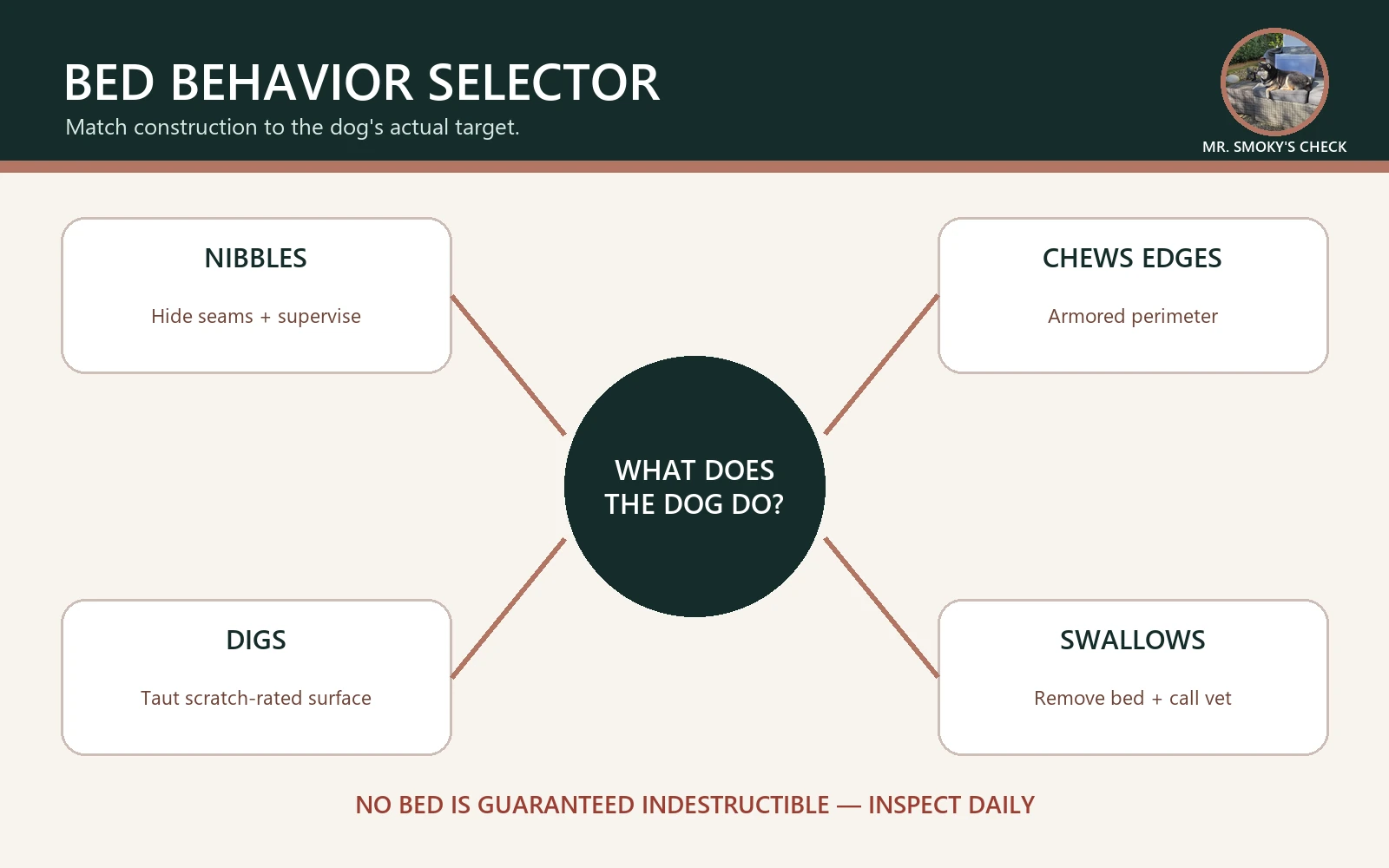
Share & embed
Occasional corner nibbling
Occurs briefly before settling; no missing material
- Look for
Reduce exposed edges and redirect to an appropriate chew
- Avoid
Leaving the new bed unsupervised immediately
Persistent edge chewing
Dog seeks seams, zippers, piping, or corners
- Look for
Armored perimeter with inaccessible fabric edge
- Avoid
A soft bed labeled “tough” with exposed seams
Digging and nesting
Repeated pawing and circling
- Look for
Taut surface, scratch guidance, replaceable center
- Avoid
Assuming chew resistance equals scratch resistance
Shredding and swallowing
Material is missing or ingested
- Look for
Remove bedding, veterinary advice, behavior and medical assessment
- Avoid
Buying progressively harder material without supervision
K9 Ballistics publishes separate chew and scratch scores for its Armored Mesh bed, which illustrates an important distinction: a product can resist teeth better than repeated claws. Its Armored Ripstop page also warns owners to measure heavy-duty or custom crate interiors and the diagonal door opening because a preassembled framed bed may not fit. Kuranda offers a separate aluminum format. These specifics are more useful than an “indestructible” headline.
Why “chew-proof” is not a universal standard
There is no independent pass-fail certification that makes one dog bed chew-proof for every dog. Manufacturers use the term for different designs: a tougher cover, a protected edge, a rigid aluminum perimeter, or a warranty with specific exclusions. Compare the construction and the warranty separately. A long warranty may improve purchase protection, but it does not make swallowed fabric safe or remove the need for supervision.
Before shopping, write one sentence that describes the actual failure mode: “She mouths the front corner for thirty seconds,” “He scratches the center before lying down,” or “He opens seams and swallows filling when left alone.” That sentence is a more useful product filter than breed, age, or a toughness label.
Why dogs destroy beds
Common contexts include puppy exploration, teething, boredom, under-stimulation, stress around departures, a learned shredding game, nesting behavior, and preference for a different sleep surface. Pain or sudden behavioral change can also alter resting and chewing. VCA's destructive-chewing guidance recommends keeping a diary of when and where chewing occurs and what happened immediately before it. Observe the pattern and record a short video rather than assuming stubbornness.
Provide appropriate legal chewing outlets and enrichment matched to the dog, but do not leave any item unsupervised merely because it is sold for chewing. If destruction happens only when the dog is alone and includes pacing, vocalizing, salivation, or escape attempts, consider separation-related distress and speak with a veterinarian or qualified behavior professional.
Repeated fabric or foam ingestion can cause an obstruction. VCA's foreign-body guidance explains that swallowed objects do not always pass and that an obstruction can become life-threatening. Loss of appetite, repeated vomiting or retching, abdominal pain, lethargy, or difficulty passing stool requires prompt veterinary attention. Do not wait for a tougher bed to solve an ingestion pattern.
Construction types compared
| Construction | Best use | Strength | Tradeoff |
|---|---|---|---|
Construction | Best use | Strength | Tradeoff |
Armored elevated frame | Persistent access to fabric edges | Metal perimeter can shield the sling edge | Hard surface, higher cost, exact size and doorway fit needed |
Taut mesh cot | Hot climates and light nesting | Airflow and little loose filling | Mesh may be vulnerable to digging or teeth depending on design |
Ripstop sling cot | Edge chewers that also scratch | Denser surface and protected perimeter | Less cushioning; inspect tension and frame gaps |
Tough fabric mattress | Light nibbling and dogs that need padding | More familiar padded rest | Seams, zipper, and foam remain potential targets |
Bare washable platform | Temporary management under professional plan | No soft filling to ingest | Comfort and pressure distribution need individual assessment |
Exposed edges decide more than fabric strength
Most dogs begin at an accessible seam, zipper, corner, or loose flap. Turn product photos mentally into a dog's-eye view: can teeth reach the fabric edge, is the sling captured inside a frame channel, are plastic caps exposed, and can a paw enter the gap between surface and rail?
An all-metal frame can protect edges, but inspect welds, fasteners, end caps, and coating. Metal is not harmless when bent or chewed. A replacement sling is valuable only if the dog cannot access its attachment under ordinary use.

For padded beds, hidden zippers and a removable cover improve maintenance but do not make foam safe to ingest. If cushioning is required for a medical or orthopedic reason, ask the veterinarian how to balance pressure relief against destruction risk. Our senior dog bed guide covers access and support questions; it is not a chewing guide.
Measure the dog, room, crate, and doorway
Measure the dog's longest relaxed position and add room to change position. Then record the proposed bed's full outer dimensions, not just the fabric area. For crate use, measure inside width, length, obstructions, and the diagonal clear door opening.
A rigid cot may fit the crate interior but not pass through its door. It may also reduce usable headroom. Never force or bend a frame into a crate, and do not block ventilation or door operation.
Use our dog bed size guide for posture measurements and the dog bed materials guide for washable-cover and moisture tradeoffs.
Build a product-page evidence sheet
Keep a short comparison table while shopping. For each candidate, record the full outer dimensions, usable sleep area, assembled or flat-pack format, frame material, fabric attachment method, exposed seams, replacement-part availability, care instructions, warranty exclusions, and return window. Save a screenshot or PDF of the exact variant because listings and bundled sizes can change.
Reject a product when the listing hides the information that controls your main risk. An edge chewer needs clear perimeter photos. A crate user needs complete assembled dimensions. A digger needs surface and replacement guidance. A dog that has swallowed material needs management and professional advice before another unsupervised bedding experiment—not a more dramatic marketing adjective.
A seven-day supervised introduction
Day one: place the bed in a shared room and reward calm investigation. Sessions last only a few minutes. Days two and three: reward lying down and provide an appropriate separate chew. Days four and five: extend calm supervised rest. Days six and seven: briefly increase distance while remaining able to observe.
End the session at the first persistent attempt to bite, dig through, or dismantle the bed. Redirect without punishment, inspect the exact target, and change the environment or product choice. Do not “wait and see” after material has been removed.
Document the return window without provoking damage
Photograph the four corners, center surface, underside, feet, fasteners, and seams on arrival. Repeat the same photos after the first supervised rest, day three, and day seven. Note whether the dog settles, repeatedly targets one point, avoids the surface, or makes the frame move during entry.
This is not a destructive challenge. Do not encourage biting, leave a known shredder alone to “see what happens,” or keep using a damaged bed to strengthen a warranty claim. The goal is to identify ordinary-use mismatch while the return or exchange window is still open.
Current Amazon options to compare
These three options illustrate two metal-frame approaches with different edge protection plus a lighter breathable cot. The K&H option is not presented as a chew-proof solution. We have not performed destructive testing; treat durability wording as a current manufacturer or listing claim, verify the exact variant, and supervise introduction.
Daily inspection under two minutes
Remove the dog. Run a hand around the entire perimeter. Check for lifted threads, punctures, tooth grooves, loose fabric, enlarged gaps, bent rails, missing caps, loose legs, sharp surfaces, and floor movement. Compare with a photo taken on day one.
Stop use if material is missing, the sling detaches, a frame bends, a sharp point appears, or the bed collapses under normal entry. Contact the manufacturer about approved replacement parts rather than improvising a repair that creates new edges.
A pre-purchase rejection checklist
Do not buy yet if any of these remain unclear:
- the fabric edge or zipper is directly reachable at the dog's usual target point;
- a rigid assembled frame will not pass through the room or crate door;
- the usable sleep surface is too small after subtracting the perimeter;
- the manufacturer does not explain compatible replacement surfaces or hardware;
- the dog currently swallows bedding material or has unexplained new destructive behavior;
- supervision is not possible during introduction; or
- the return terms exclude the exact type of damage you are trying to manage.
A less padded surface may be the safer temporary management choice for one dog, while another dog needs cushioning for a veterinary reason. When those needs conflict, bring the measurements, behavior log, and product construction to the veterinarian or behavior professional instead of guessing.
Frequently asked questions
Is any dog bed truly indestructible?
No universal guarantee is realistic. Durability depends on dog, behavior, access points, supervision, wear, and construction. Read product guarantees for exclusions and required evidence.
Are elevated beds better for chewers?
They remove loose filling and can shield fabric edges, but some designs still expose mesh, corners, caps, or fasteners. Match the specific construction to the dog's target behavior.
What if my dog eats the bed?
Remove access and contact a veterinarian for advice, especially if material is missing or symptoms develop. A stronger replacement should wait until ingestion risk and behavior are addressed.
Can a chew-proof bed go inside a crate?
Only if the manufacturer permits it and the complete rigid dimensions fit through the door and inside without blocking function or reducing safe space.
Should I leave a chew-resistant bed in the crate overnight?
Not until the dog has used that exact bed calmly under supervision and you have checked the manufacturer's crate guidance, fit, ventilation, and damage points. A tougher label does not justify unsupervised use for a dog that dismantles or swallows bedding.
Is a warranty proof that the bed is indestructible?
No. A warranty describes the seller's remedy and exclusions; it is not a safety certification. Read what damage is covered, whether photos or registration are required, whether replacement parts are supplied, and what happens after repeated claims.
What do real owner questions add to the decision?
A Reddit discussion about kennel bedding being destroyed and possibly swallowed and a separate discussion about a large dog eating beds despite pressure-sore concerns expose the tradeoff owners are actually trying to solve: ingestion risk versus a comfortable resting surface. Those anecdotes are useful question discovery, not proof that a named product is safe. Answer the tradeoff with veterinary input, observed behavior, protected construction, supervision, and a clear stop-use rule.
My dog digs holes before lying down but rarely bites the bed. What should I look for?
Our recommendation is to compare the sleep surface, seams, and exposed underside for repeated claw contact, not just protected edges. An edge shield does little if the dog starts damage in the middle. Ask the manufacturer whether its damage policy includes digging and whether the sleep panel is replaceable. VCA's chewing guidance supports identifying the behavior before managing it; a bed label cannot explain why your dog scratches.
Would a blanket over the bed stop my dog chewing the expensive cover?
Not reliably. It may simply provide another fabric edge to grab, and a dog that swallows bedding can swallow blanket pieces too. Our recommendation is to avoid adding loose layers to protect a bed from a known fabric eater. VCA explains the risks of swallowed foreign material. Choose resting arrangements with your veterinary team when ingestion risk and cushioning needs conflict; do not treat a sacrificial blanket as a safety measure.
Why does my dog destroy the bed only when left alone?
The timing is useful information, but it does not establish one diagnosis. ASPCA guidance describes destruction during separation alongside other signs of distress. Record when it happens and whether there is pacing, vocalizing, or an escape attempt, and discuss the pattern with a qualified professional. Our recommendation is to manage access to swallowable material while addressing the cause. A stronger bed may survive longer without making alone time comfortable.
Bottom line
Buy from the destruction pattern, not the adjective. Shield edges for edge chewers, compare scratch performance for diggers, measure rigid frames precisely, and remove any damaged product before pieces can be swallowed. Supervision and behavior assessment remain part of the bed system.