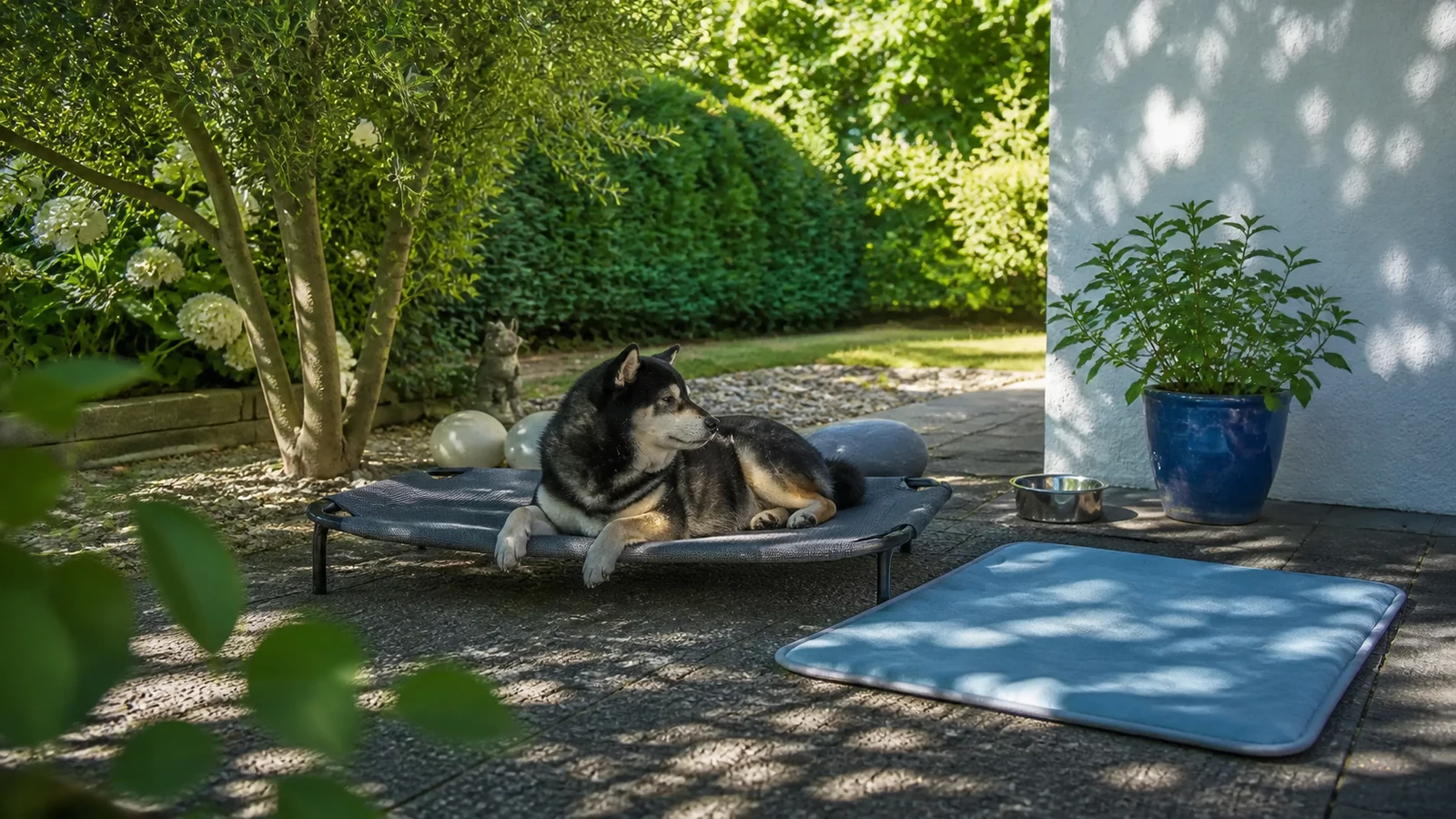
A cooling dog bed is a comfort surface, not protection from an unsafe environment. It works only within its mechanism and conditions: an elevated mesh cot improves airflow underneath, while a water-core or pressure-activated mat absorbs and redistributes heat for a period. Neither makes direct sun, a hot car, poor ventilation, or strenuous exercise safe.
Quick read
Quick answer
- Choose an elevated breathable cot for shade, airflow, wet outdoor use, and dogs that like a firm raised surface.
- If the bed is primarily for a patio, deck, or campsite, use Best Outdoor Dog Beds for frame, weather, storage, and clean-and-dry checks; this guide focuses on heat mechanisms.
- Choose a cooling mat for floor-level contact cooling, crates or rooms where the manufacturer allows it, and dogs that prefer a flat surface.
- Place either product in deep shade with fresh water and moving air; test the surface with your hand and a thermometer where useful.
- Give the dog a normal alternative bed and freedom to move away.
- Heavy panting, weakness, confusion, vomiting, collapse, or abnormal gum color is an emergency—not a bed-selection problem.
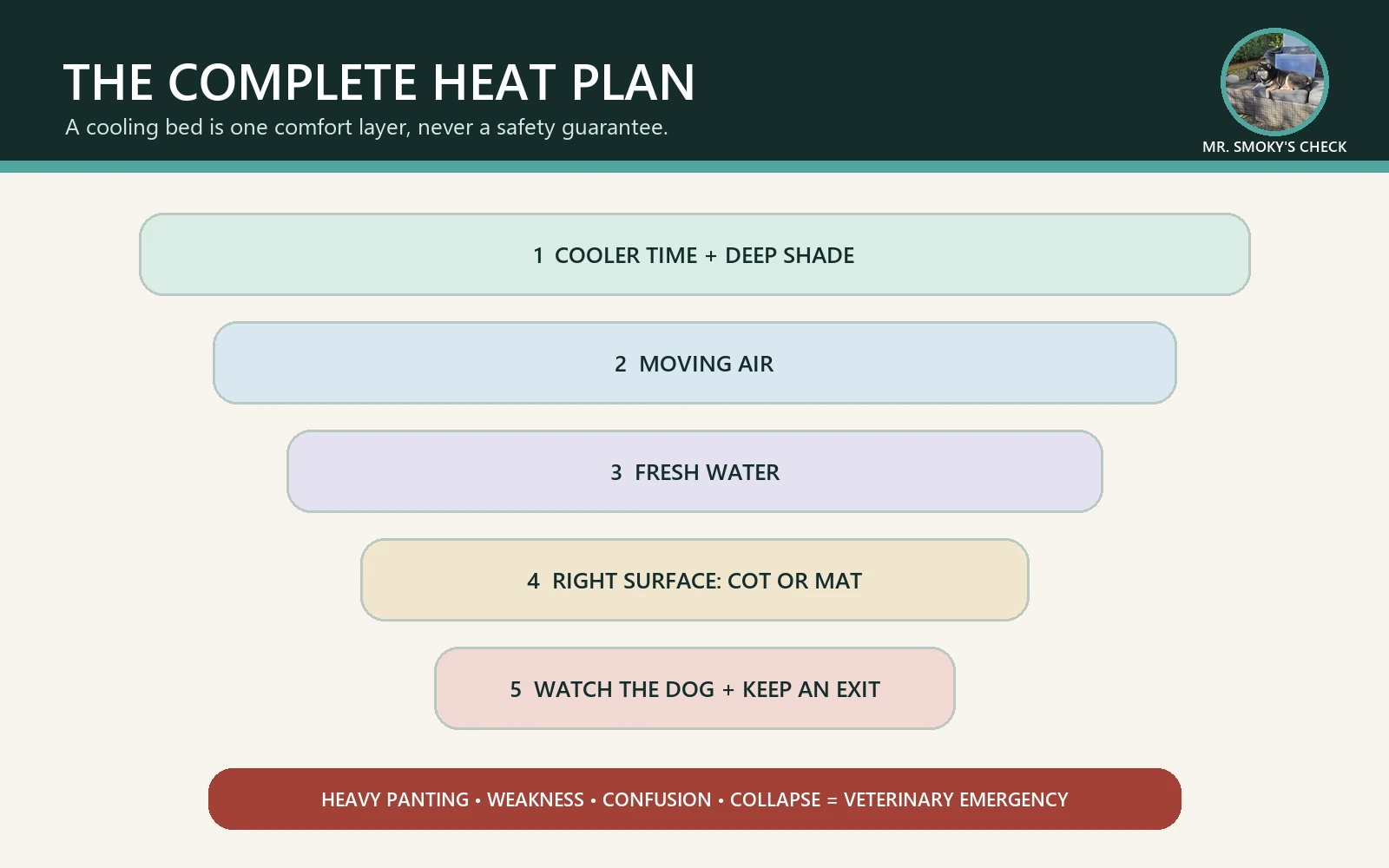
The complete heat plan
Share & embed
Elevated mesh cot
Shaded patio, camping setup, humid or damp areas
- Look for
Air moves above and below the dog; easy to hose
- Avoid
No direct contact cooling; frame stability and mesh condition matter
Water-core mat
Home, porch, or crate if permitted
- Look for
Large thermal mass without electricity
- Avoid
Heavy after filling; leaks and setup matter
Pressure-activated gel mat
Portable short rest and travel
- Look for
No filling or power on many designs
- Avoid
Cooling duration and recharge conditions vary
Ordinary thin mat on cool floor
Dog already seeks tile or concrete
- Look for
Simple washable option
- Avoid
Floor may warm; little cushioning
AAHA's current heatstroke-prevention guidance emphasizes water, shade, ventilation, cooler activity times, extra caution for higher-risk dogs, and immediate veterinary contact when heatstroke signs appear. A product page should never delay that response.
How each bed moves heat
An elevated cot creates an air gap under the body. It works best when air can actually circulate, so a tight corner, solid skirt, thick blanket, or blocked underside reduces the advantage. Mesh also drains and dries faster than thick foam.
A water-core mat absorbs body heat into a larger mass and releases it to the surrounding room or floor. K&H explains this mechanism for the Cool Bed III and specifies setup and environmental limits on its product instructions. Because a filled mat becomes heavy, fill it where it will be used and support the entire base when moving it.
Pressure-activated gel mats typically absorb heat for a limited period before needing time away from the dog to recover. The actual duration depends on model, room temperature, dog size, and contact. Compare the instructions rather than assuming the word “self-cooling” means continuous performance.
| Cooling surface | Best for | Strength | Tradeoff | Verify before use |
|---|---|---|---|---|
Water-core mat | Dogs that choose a flat stable surface and owners able to fill and inspect it | Large thermal mass, no electricity, full-body contact when correctly sized | Heavy when filled; valve care, leaks, environmental limits, and chewing matter | Check fill instructions, floor support, surface temperature, leaks, and permission for the intended location |
Pressure-activated gel mat | Portable rest periods where filling is impractical | Often ready without water or power and easy to relocate | Cooling and recovery periods vary; puncture or gel exposure ends use | Verify stated cooling cycle, recharge conditions, storage limits, folds, and cover integrity |
Elevated mesh cot | Shade, airflow, damp ground, and dogs that prefer a firm raised surface | Ventilation above and below, drainage, and simple cleaning | No conductive cold source; frame height, rocking, and mesh wear matter | Test entry, full-body fit, leg stability, shade movement, airflow, and surface condition |
Ordinary thin mat on a cool floor | Dogs that already seek tile and need a simple washable alternative | Low complexity, easy to move, no gel or fill | Floor warms over time and provides little pressure relief | Compare the floor and mat temperature, traction, dog preference, and freedom to move away |
Choose by dog preference and posture
Some dogs avoid unstable mesh, crinkly covers, cold initial contact, or raised edges. Others immediately leave a padded bed for tile. Offer the cooling surface beside the dog's familiar option and observe voluntary use.
Measure the dog's longest warm-weather posture—often fully stretched on the side or belly. A small mat under only the chest may provide some contact but does not offer a complete resting surface. Elevated cots need enough taut area for entry, turning, and lying down without legs landing on the frame.
Senior dogs may need a lower step-on height, non-slip feet, and a stable path. See Best Dog Beds for Senior Dogs for access and support tradeoffs.
Match the mechanism to the place
Start with the exact rest location rather than a generic “best cooling bed” ranking.
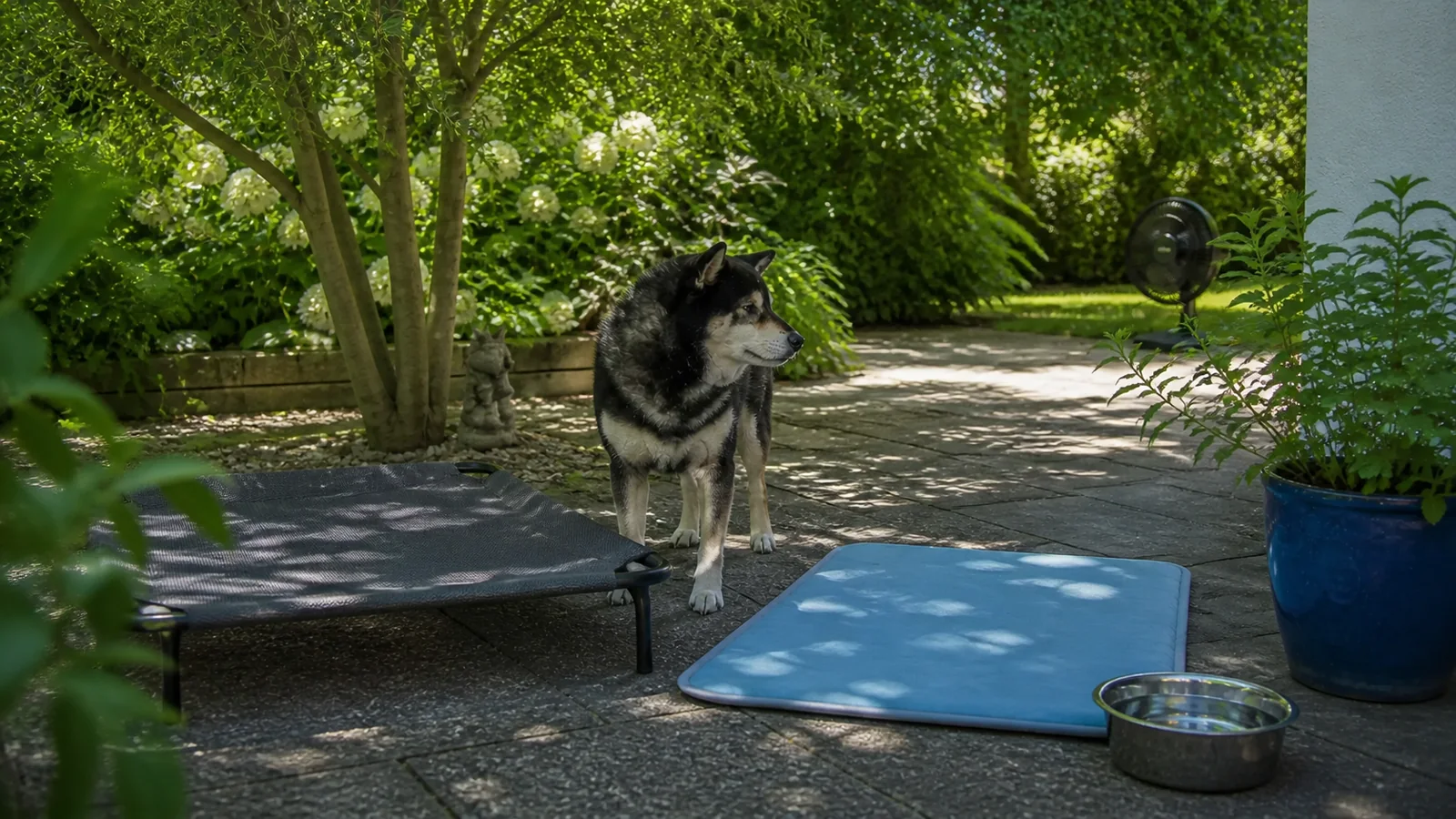
- Shaded patio with moving air: an elevated mesh cot can use the breeze above and below the dog. Confirm that shade remains at the hottest planned hour.
- Air-conditioned room with a cool floor: a flat water-core or gel mat may provide direct contact without adding step height. The dog still needs another resting option.
- Humid, still porch: elevation alone may offer less relief than expected because the surrounding air is warm and barely moving. Improve the environment before upgrading the bed.
- Crate or travel setup: only use a mat where the manufacturer permits it, without folding, blocking ventilation, leaking, or trapping the dog on one surface.
- Camping: choose a washable, inspectable surface and make the shade, airflow, water, weather, and exit plan before relying on the bed.
Humidity matters because panting is less effective when the air already holds more moisture. A cooling surface may make resting more comfortable, but it does not change the surrounding heat load or a dog's medical risk. Use local heat and humidity conditions to shorten or move the activity, not to justify longer exposure because a mat is packed.
Location is more important than color
Outdoor shade moves during the day. Check the proposed bed location at the hottest time, not only in the morning. Keep it away from hot walls, grills, vehicle exhaust, pool chemicals, and enclosed decks with still air.
Dark frames and fabric can become hot in sun; light colors can still heat. Measure the actual surface rather than guessing from color. Indoors, keep airflow around the bed and do not place it over a heating vent or in a closed crate without confirming the product's allowed use and full ventilation.
Never leave a dog in a parked vehicle with a cooling mat as a safety plan. Cabin temperature can rise rapidly and overpower any passive surface.
Check the dog-level microclimate
Stand where the bed will sit at the warmest planned time. Check for direct or reflected sun, heat radiating from masonry, still air behind a wall, hot decking, and whether the shade line moves. If you use a surface thermometer, treat it as one observation rather than a safety threshold; the dog's breathing, behavior, health, humidity, and exposure time still matter.
Keep the rest station out of narrow corners where a cot's underside is blocked. Do not drape a heavy blanket over breathable mesh. For a cooling mat, make sure the whole mat lies flat on a manufacturer-approved surface and that the dog can step off onto a normal-temperature alternative.
Setup and maintenance
For a water-filled mat, follow the exact fill amount, valve, conditioning, and leak-check instructions. Place it on a clean smooth surface, check under it daily, and protect it from chewing. Do not add ice, chemicals, or antifreeze.
For an elevated cot, tighten or assemble the cover as directed, confirm all legs sit flat, and test for rocking. Check mesh tension, frame joints, caps, and non-slip feet. Clean dirt from breathable openings; “mesh” that is packed with hair and mud moves less air.
For any cooling bed, read temperature, indoor/outdoor, washing, storage, and repair limits. Stop use after leakage, swelling, puncture, exposed gel, damaged fabric, bent frame, or loose parts.
Use the return window as a seven-day preference trial
Introduce the bed during mild conditions, not the first dangerous heat event. On day one, place it beside the familiar bed and allow voluntary investigation. Over the next week, note the room or outdoor temperature, shade, time, surface offered, whether the dog chose it, how long the dog stayed, and whether the dog could rise and leave normally.
Photograph the full surface, seams, valve, underside, frame joints, and feet on arrival and again after ordinary use. For water-core products, check for dampness beneath the mat. For gel products, inspect folds and puncture points. For cots, check rocking, mesh tension, corners, and floor grip.
Do not force the dog onto a surface, remove every alternative bed, or extend warm-weather exposure to prove that the product works. If the dog repeatedly avoids it, first change placement and presentation; then use the return terms rather than turning the trial into training pressure.
Current Amazon options to compare
These products represent two distinct mechanisms. We have not measured their cooling effect in your home. Verify the current size, instructions, material, seller, and return terms.
A safe summer rest-station test
- Set the bed in established deep shade with unrestricted airflow.
- Provide a stable bowl of fresh water several feet away.
- Add a familiar ordinary bed or cool floor option.
- Let the dog investigate voluntarily during mild weather.
- Observe entry, stability, full-body fit, breathing, and whether the dog can leave easily.
- Recheck shade position and surface condition at the warmest planned hour.
- End outdoor time based on weather and the dog's condition, not because the bed is present.
For hikes and camping, build the bed into a broader dog adventure gear checklist that covers water, route, weather, first aid, and exit planning.
A pre-purchase checklist
Before choosing between two listings, confirm:
- the usable surface fits the dog's full warm-weather resting posture;
- the mechanism is stated clearly rather than described only as “cooling”;
- the instructions cover setup, cooling or recharge cycle, storage, cleaning, and stop-use damage;
- the intended location is permitted, including crate or outdoor use;
- the dog can enter, turn, lie down, rise, and leave without being blocked;
- chewing, puncture, valve, fabric, frame, and leak risks match the dog's behavior; and
- the return period is long enough for a mild-weather preference trial.
Avoid volatile claims such as a fixed number of cooling hours unless the current manufacturer instructions define the test conditions. Room temperature, contact area, dog size, and recovery time can change the result substantially.
Warning signs override the shopping guide
Excessive or unusual panting, thick drool, weakness, wobbling, confusion, vomiting, diarrhea, collapse, seizures, or abnormal gum color can signal a heat emergency. Move to a cool area and contact a veterinary hospital immediately. Follow veterinary instructions for cooling; do not force the dog to stay on a mat or delay travel while comparing products.
Brachycephalic dogs, very young or senior dogs, overweight dogs, dogs with heart or respiratory disease, thick-coated dogs, and dogs exercising in heat may be at greater risk. Ask the veterinarian for an individual plan.
Frequently asked questions
Do cooling dog beds really work?
They can provide a cooler or better-ventilated resting surface within the product's conditions. They cannot reduce an unsafe ambient temperature enough to make heat exposure safe.
Is an elevated bed cooler than a mat?
It depends on airflow, floor temperature, humidity, dog preference, and the mat mechanism. Elevated cots emphasize ventilation; water or gel mats emphasize conductive contact.
Can I put a cooling mat in a crate?
Only if the manufacturer allows it, it fits without folding or blocking ventilation, and the dog does not chew it. A crate must never become the only place a dog can escape a warm surface.
Should I freeze a cooling mat?
Only if the product instructions explicitly say so. Extreme cold can damage some mats and is not automatically safer for the dog.
What if my dog refuses to use a cooling mat?
Do not force it. Put the mat beside the familiar bed in a cool, calm location, let the dog investigate voluntarily, and try a cover only if the manufacturer allows one without defeating the mechanism. A Reddit cooling-mat discussion raises the practical question of balancing floor comfort with heat sensitivity; the discussion identifies the question, not product-performance evidence.
How large should a cooling mat be?
Measure the dog's longest stretched warm-weather posture and choose enough usable surface for the trunk and comfortable repositioning. A Reddit question about cooling-mat size and a dog that would not lie on the product is a useful reminder that dimensions and voluntary use matter more than a small cold patch.
Can a cooling bed replace air conditioning, shade, or water?
No. It is a comfort layer within the environment. Deep shade, moving air, fresh water, cooler timing, freedom to move, and rapid response to warning signs remain the heat plan.
Why does a cooling mat feel warm after my dog has used it for a while?
Check the cooling mechanism and its reset instructions. For example, the Green Pet Shop Cool Pet Pad requires time without use to recover its cooling effect; that is not a universal schedule for every mat. Our recommendation is to give the dog another cool resting choice and keep the mat away from sun or hot air. A warm mat is not a reason to freeze it unless its own instructions allow freezing.
Can I cover a cooling mat with a blanket to protect it from nails?
Use only a layer the manufacturer allows. Green Pet Shop sells a cover specifically intended for its cooling pad; that does not establish that a thick blanket will work with another mat. Our recommendation is to avoid bulky layers that separate the dog from the cooling surface and to inspect for damage underneath. A cover is not chew-proofing, and a dog that scratches through the mat needs a different resting arrangement.
My dog punctured a gel cooling mat. Is it safe because the label says non-toxic?
Remove the damaged mat and prevent further licking or chewing. Non-toxic labeling does not make the cover or filling suitable to swallow. Green Pet Shop explicitly recommends veterinary advice after ingestion, even for its non-toxic gel. Keep the packaging and tell the veterinarian what may be missing. Do not patch a chewed mat and return it unattended; choose another cooling arrangement that the dog cannot dismantle.
Bottom line
Choose a mechanism the dog will actually use, then place it inside a complete heat plan: deep shade, moving air, fresh water, cooler timing, freedom to move, and fast recognition of warning signs. The bed is a comfort layer—not permission to extend unsafe heat exposure.