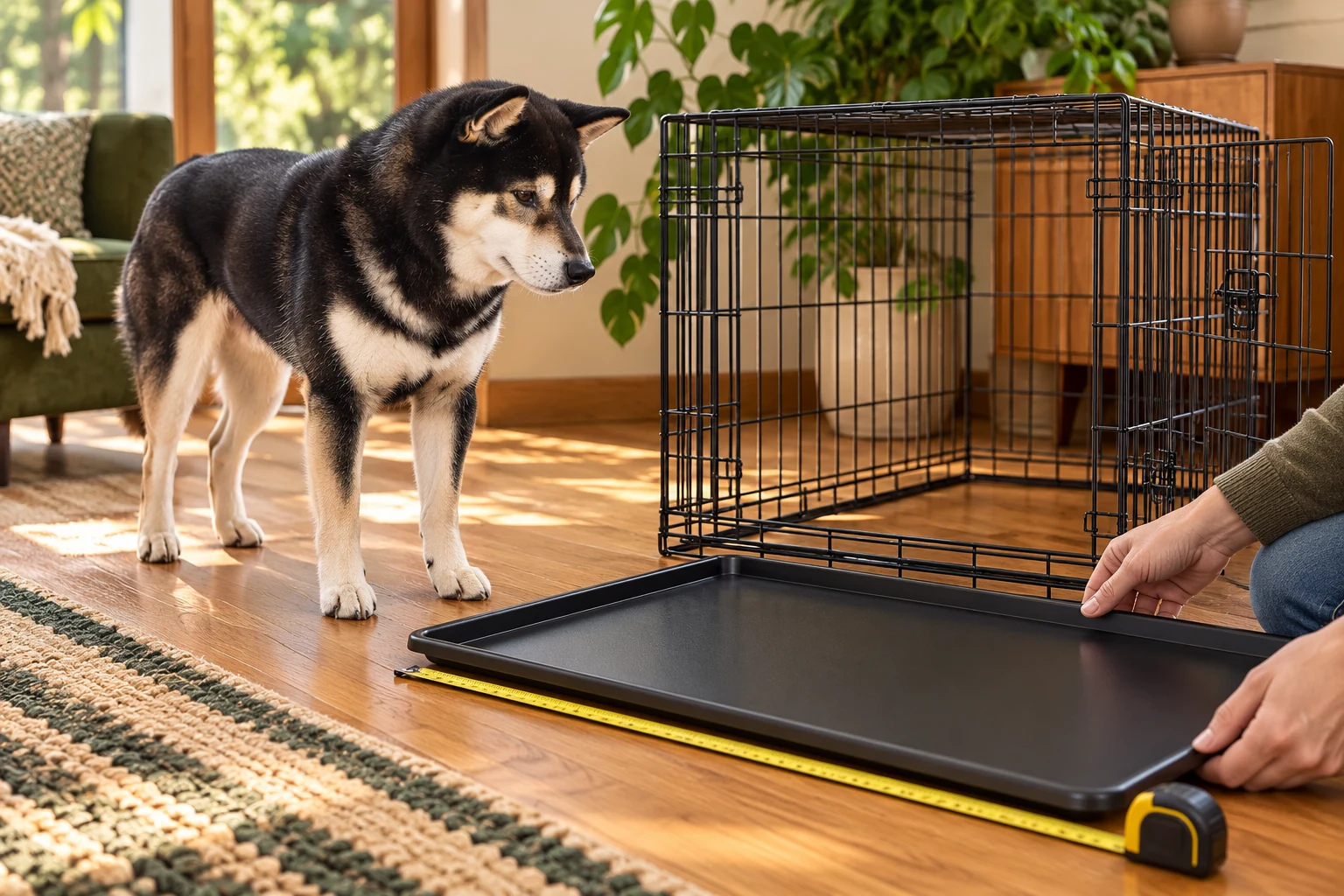
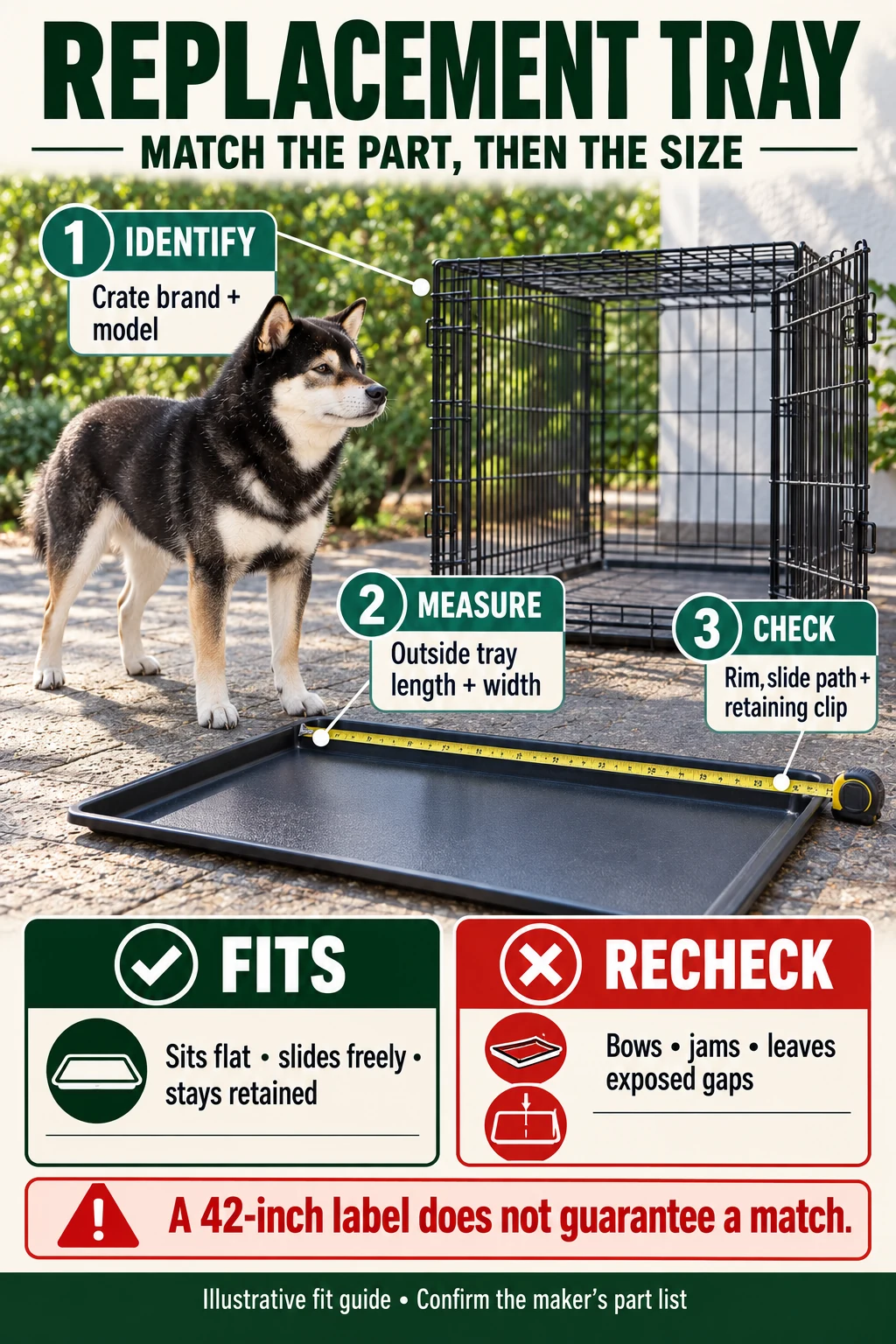
Choose a dog crate replacement tray by the crate's exact model and the pan's actual dimensions. A “42-inch crate tray” label alone does not establish a fit. You also need the right rim height and shape, a clear slide path and a retaining clip that works with the replacement.
If the old pan is cracked or chewed, move your dog to another suitable resting arrangement while you inspect the crate. A loose mat over a damaged base does not repair it. This guide explains how to identify the part, compare replacements and check the delivered pan before putting the crate back into use.
Quick read
Before you order
- Find the crate brand, model and, where available, production or purchase date.
- Measure the old tray's outside length and width, then record rim height and shape.
- Check the floor opening, tray rails and retaining clip with the dog elsewhere.
- Ask the maker about compatibility when model information or listing dimensions disagree.
- Treat a new tray as a replacement part. It does not solve chewing, escape attempts or a damaged frame.
Start with the crate model
Look for a label, purchase email, assembly instructions or a model number on the crate. Photograph the whole crate and the door latch. A manufacturer may need those details to distinguish similar-looking versions.
MidWest's customer-service guidance asks owners to include the product brand and item number when requesting help. Its FAQ also directs owners to replacement-pan support. If the crate is recent, check the warranty terms and purchase record before ordering a part yourself.
Keep the distinction between the crate and the tray in your notes. The crate may be sold under a nominal length, while the actual replacement part is shorter or narrower. A mat advertised for that crate size is a third item with its own dimensions. Our crate size guide covers the dog's usable space; the measurements here concern a component that must fit the frame.
Share & embed
Measure the pan without confusing the dimensions
Take the old tray out with the crate empty. If it is badly distorted, record that fact rather than treating its bent outline as an exact template. Measure at more than one point and compare with the maker's part information.
| Measurement | What to record | Why it changes the choice |
|---|---|---|
| Outside length | End to end, including the rim | The entire pan must pass into the frame |
| Outside width | Widest points, including flared edges | A few similar-looking listings may use different widths |
| Rim height | From the supporting underside to the top edge | A taller lip may catch at the tray opening |
| Corner shape | Rounded, squared or stepped | Corners must clear the frame and floor supports |
| Flat usable area | Interior base within the sloping edges | This is the space available for a flat mat |
| Retaining arrangement | Clip, stop or other specified part | The replacement must remain held in its intended position |
Photograph the tape against the pan so the supplier can see which edges you measured. If a listing gives only “42 x 28,” establish whether that means the crate's outside size, the pan's outside size or a rough product category. Do not silently subtract an inch and assume the result will fit.
Without the old pan, start with the model number. Measure the opening and available space, then ask the manufacturer which part belongs there. A cardboard outline can help you picture an advertised footprint, but it cannot prove rim clearance, rigidity or correct retention. It is a planning aid, not a temporary crate floor.
What 42 x 28 and 48 x 30 searches really tell you
Searches such as “42x28 dog crate tray” and “dog crate replacement tray 48 x 30” are useful for finding candidates. They are not compatibility standards. Before placing an order, compare the exact part against the crate series and its current documentation.
For example, the MidWest 42-inch option below lists an actual outside measurement of approximately 41.3 by 27.75 by 1 inch. That is a product-specific example, not a rule for all 42-inch crates. Carlson's medium replacement tray is a different part: its maker lists 29.5 by 18.5 inches and limits compatibility to the #6003 and #6022 crates.
These examples explain why a broad “medium,” “large” or “universal” label needs another check. The first question is whether the part belongs to your crate. Price, color and delivery convenience come after that.
Plastic, metal or a mat?
A plastic replacement pan can restore the wipe-clean floor supplied with many folding wire crates. Inspect the complete rim and underside on arrival. Reject cracks, warping or rough damage rather than hoping the frame will flatten the part into shape.
A metal pan is a separate compatibility decision. Check the specified crate models, edge finish, coating, weight and cleaning instructions. A harder material does not establish that it is suitable for a dog that bites the floor or tries to escape. It can also change how the pan sits on the supports and how manageable it is to remove.
A crate mat provides bedding on top of the appropriate base. It cannot replace a missing structural part unless the crate maker specifically provides that arrangement. Use the crate mats guide for flat floor fit, washing and thickness; it addresses a different buying question from replacement pans.
If you are comparing two listings, write down the reason for choosing each. “The manufacturer confirms this part for my model” is a useful reason. “It looks stronger in the photograph” leaves the key question unanswered.
Replacement options to check against your model
The options below serve different crates. They are not interchangeable recommendations, and neither has been tested by What Dogs Like. Amazon links may earn us a commission; the Carlson link goes directly to the manufacturer.
If your crate belongs to neither example, contact its maker or find its official parts list. Buying another whole crate may be unnecessary, but an inexpensive wrong part still creates another return and leaves the original problem unresolved.
Check the delivered tray with the dog elsewhere
Lay the new pan on a flat surface before installing it. Compare its label and dimensions with your order. Keep the packaging until you know the part is correct, and follow the seller's return conditions.
- Inspect the full rim, corners and underside for damage.
- Slide the empty pan into the crate using the intended route.
- Check that it sits flat on the specified supports without bowing.
- Fit the retaining clip or stop exactly as instructed.
- Operate every door and confirm that the pan does not obstruct it.
- Add the intended mat, then check that the mat lies flat and does not hide a fit problem.
Do not force the tray through the opening or bend the frame around it. A pan that jams can become difficult to remove after an accident. A pan that is too loose may shift or expose parts of the floor that were meant to be covered. Ask the manufacturer to resolve either issue.

When the old tray was chewed
Replace a damaged component and investigate why it was damaged. Those are separate jobs. An owner discussion about a chewed plastic pan asks whether a different material would help. Another describes a dog destroying a pan and the material underneath. These are reader questions, not evidence that a particular replacement will be safe or durable.
Check whether the dog could reach an exposed edge, whether the pan was retained and whether the whole confinement arrangement remains appropriate. If the dog is frantic, injures itself or repeatedly tries to escape, pause use and seek qualified help. The ASPCA's separation-anxiety guidance explains that crating can increase distress for some dogs. Our heavy-duty crate guide keeps that distinction separate from equipment strength.
If you suspect pieces were swallowed, contact your veterinarian. Do not wait for an upgraded pan to address a possible ingestion problem.
Cleaning and keeping the part usable
Follow the replacement pan's cleaning instructions. The CDC's pet-supply guidance recommends following product directions and describes washing hard pet items with soapy water, rinsing and drying. Check compatibility before using a disinfectant or putting a tray in a dishwasher.
Make removal part of the normal cleaning routine. Look underneath as well as on top: trapped moisture or debris can be missed when you only wipe the exposed surface. Recheck the retaining part after moving or folding the crate, and replace a damaged clip with the specified part.
Keep a short record of the crate model, pan part number and your actual measurements. A photograph of the correct tray in its packaging can save another identification exercise later. Use the crate setup checklist when reinstalling the complete arrangement.
Frequently asked questions
Will any 42-inch replacement pan fit my 42-inch crate?
No. The nominal crate length does not establish the tray width, rim profile or retaining arrangement. Match the crate model and compare the actual part dimensions. Ask the maker when the listing is unclear.
How do I find a replacement when the old tray is missing?
Identify the crate from its label, receipt or manual. Photograph the frame and latch, record the opening and available floor space, and ask the maker for the correct part. Avoid treating a generic size label as the complete specification.
Should I measure the inside or outside of the tray?
Record outside length and width for component fit, including the rim. Also record rim height and shape. Measure the interior flat base separately when choosing a mat to lie on top.
Can I put a bed over a broken tray?
A bed does not repair a cracked, missing or incorrectly retained base. Keep the dog elsewhere while the crate is repaired, then check the bedding on top of the correctly fitted part.
Is metal always better for a dog that chews plastic?
No. Material alone does not answer compatibility, edge safety or the reason for chewing. The pan-chewing discussions linked above inform this question; manufacturer instructions and an assessment of the dog's behavior should guide the next step.
Can I cut down an oversized tray or make a plywood floor?
Do not assume a home modification preserves the crate's intended floor and retention system. Ask the maker for an approved replacement. Cutting can change the rim, surface and way the part is held, even if the footprint appears closer.
Should I replace the whole crate?
Not necessarily. A confirmed replacement part can be appropriate when the frame, supports, doors and latches remain sound. If several components are damaged, parts are unavailable or confinement is no longer suitable, reassess the complete setup before spending more.
Related decisions and sources
Start with the Dog Crates hub for crate type and use. Use the size guide for body fit and the mat guide for bedding. For an attached drinking bowl, see crate water bowls.
Product identities, images and source information were checked on October 25, 2026. Measurements shown for named products are examples tied to those listings, not dimensions assigned to Mr. Smoky or universal crate standards. Prices and stock are not fixed in this guide.