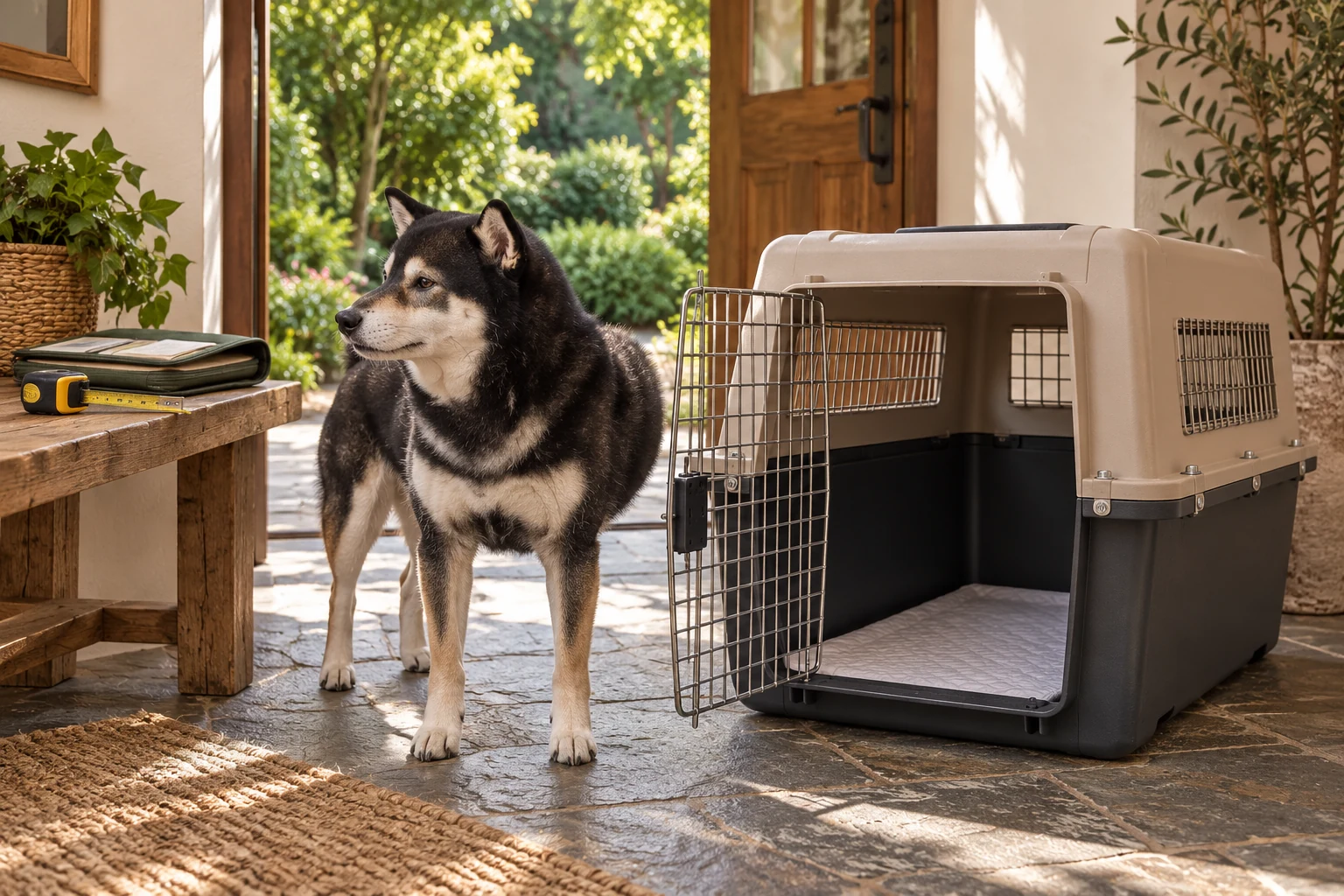
Choose a dog crate for air travel only after confirming how the airline will carry your dog. An under-seat cabin carrier and a rigid kennel for hold or cargo transport solve different problems. The right purchase must fit the dog, meet the operator's current requirements and work on the actual itinerary.
An “airline approved” label on a product page is not acceptance for your flight. Before buying, send the airline the exact container model and size, your dog's measurements and the route. Keep its answer with your booking and recheck any change of aircraft, connection or transport arrangement.
Quick read
Choose in this order
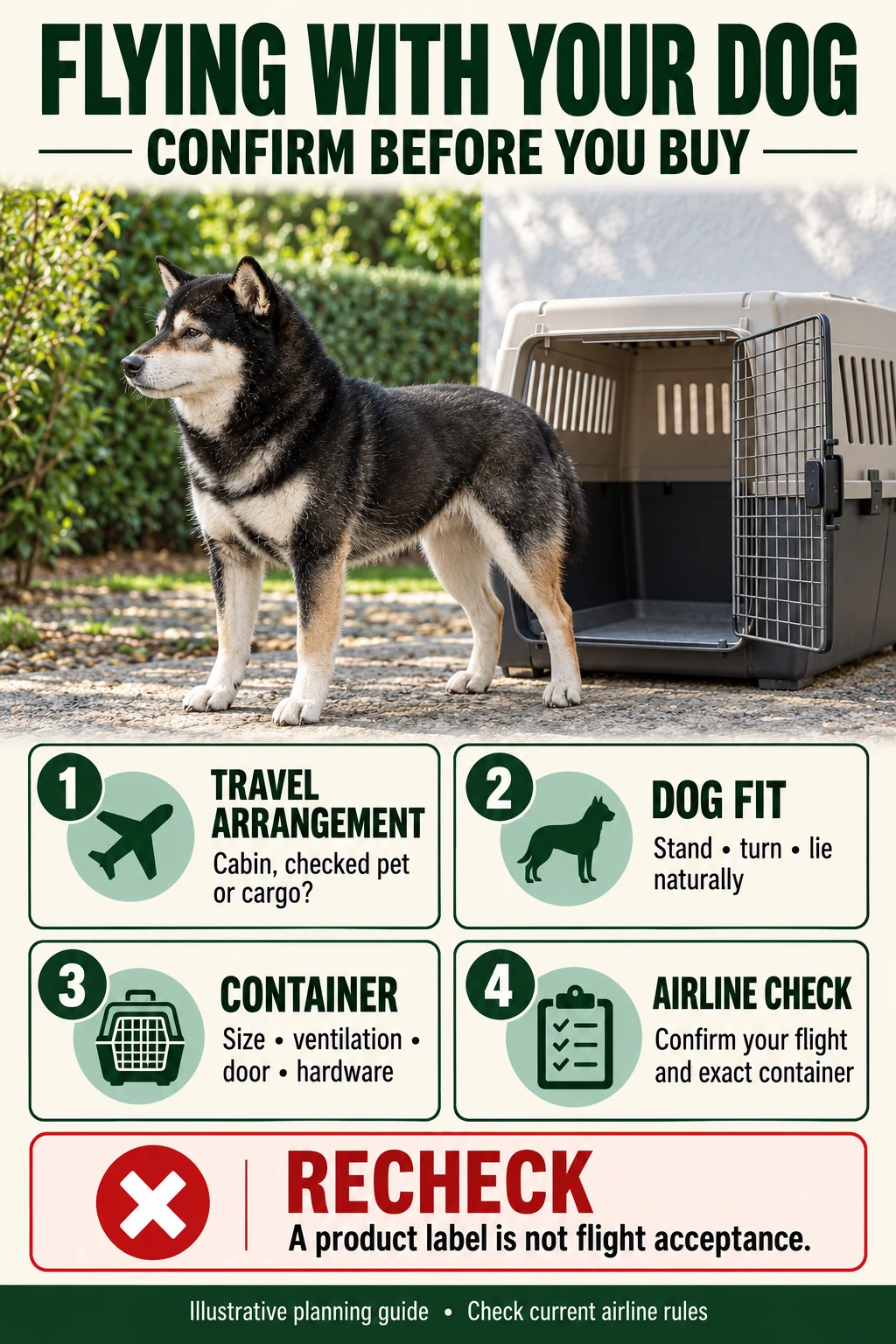
- Confirm whether the booking permits a cabin pet, checked pet or cargo shipment.
- Measure the dog and compare usable internal space; record exterior dimensions separately.
- Check the exact door, shell, hardware, ventilation, bedding and bowl arrangement.
- Verify route, aircraft, animal eligibility and document requirements with the operator.
- Introduce the accepted container at home before departure day.
Cabin carrier or travel kennel?
Start with the booking category. Do not assume that a dog too large for the cabin can automatically travel as a checked pet on the same flight. Ask which animal service is available, where the animal is accepted and collected, and which container rules apply.
The FAA's flying-with-pets guidance says that airlines decide whether pets may travel in the passenger cabin and can set additional policies. A permitted cabin container must fit under the seat and be stowed as required. A larger rigid kennel is not an alternative to that under-seat fit requirement.
| Arrangement | Container decision | Confirmation to obtain |
|---|---|---|
| Passenger cabin | Carrier that fits the permitted under-seat space and the animal | Flight-specific limits, animal eligibility and how the carrier must be used |
| Checked-pet service | Kennel meeting that operator's checked-animal rules | Whether the service is available for your booking and route |
| Cargo shipment | Kennel and preparation accepted by the animal-cargo operator | Booking, aircraft limits, check-in location and collection procedure |
Ask for the answer in a form you can save. A general customer-service assurance about “pets” may leave the transport category unclear. Put the service name, flight details and container information together so you can spot a mismatch early.
For the car journey to the airport, use a separate vehicle-crate assessment or appropriate restraint. Air-transport marketing does not establish crash protection in a car.
Share & embed
Measure the dog, then compare the container
Use the current measuring method required for the intended transport. The IATA Traveler's Pet Corner identifies four measurements for its approximate container calculation: nose to tail root (A), ground to elbow (B), greatest body width (C) and natural standing height to the top of the head or ears (D).
Its single-animal calculation uses internal length A + half of B, width twice C and height D plus bedding. This is a starting calculation to discuss with the operator, not a promise that a particular kennel will be accepted. Special circumstances and animal types can require different treatment.
Write down the units beside every measurement. If you measured in centimeters, keep the working sheet in centimeters or convert every value consistently. Photograph the dog in natural standing posture for your own checking; do not force a crouch to make an existing crate appear suitable.
Keep two sets of container numbers:
- Internal dimensions: the space the animal can actually use, including the effect of walls, corners, door structure, bedding and attached bowls.
- External dimensions: the complete footprint and height the operator must accommodate, including relevant protrusions.
A store's nominal “36-inch” label is insufficient for either job. Use the maker's current dimensions for the exact variant, then verify the physical container when it arrives. Our home crate size guide explains the difference between size labels and usable space; its home-use calculator is not an airline acceptance tool.
Prepare a container evidence sheet
Before contacting the operator, collect the information it needs in one place. This avoids a long exchange in which a photograph shows one size and a shopping link defaults to another.
| Record | Useful detail |
|---|---|
| Animal | Current measurements and any eligibility information requested by the operator |
| Container | Maker, full model name, chosen size and product link |
| Dimensions | Internal and external measurements, clearly labeled |
| Construction | Door, shell fasteners, ventilation and handling points |
| Accessories | Installed food and water containers and the intended bedding |
| Journey | Operating airline, flights, connections and transport category |
| Confirmation | Who confirmed the arrangement, when and any conditions |
Save the manufacturer instructions alongside the sheet. If you later change the bowl, add bedding or exchange the kennel, update the information instead of relying on the old confirmation. A screenshot of an advertisement does not show how the delivered setup has been assembled.
Check construction against the operator's rules
Read the rules for the service you are booking. For example, Alaska Air Cargo's kennel requirements reject broken parts, makeshift fasteners, collapsible kennels and certain opening designs. The same page specifies preparation, handling and animal-space requirements. Treat those as that operator's rules, not a universal checklist for every airline.
Inspect the shell joints, door operation and ventilation on the actual kennel. Ask the operator about fastener material, door locks, lifting or handling points, removable wheels and any accessory restrictions. Do not add a zip tie or tape as a substitute for required structural hardware.
For applicable hold-transport containers, IATA's current CR1 container document includes feeding and watering provisions. It specifies an affixed water container accessible for refilling from outside, and says a bottle must not replace the open container. Confirm the implementation with your operator.
This matters when shopping for a “no-spill” accessory. A convenient bottle for a home crate does not establish compliance for air transport. The crate water bowl guide separates mounting and cleaning decisions from flight requirements.
Two rigid kennel options to compare
These are starting points for a confirmed rigid-kennel requirement. They are different models and sizes, not a ranking or a statement that both fit your dog. What Dogs Like has not tested them. We may earn from qualifying Amazon purchases.
The Sky Kennel manufacturer page publishes size-specific interior dimensions and warns owners to check with the airline. The Ultra Vari manufacturer page is the corresponding source for that family. Compare the current instructions rather than transferring a feature from one size or generation to another.
Verify fit on arrival
Assemble the empty kennel according to its instructions. Inspect the delivered shell, hardware and door before introducing the dog. Put in the intended bedding and accepted bowl arrangement, then observe entry, standing, turning and natural rest while supervised.
If an accessory occupies space the dog needs, do not reduce the animal's usable room to keep the smaller kennel. Ask about a different accepted attachment or a larger suitable container. If the larger exterior will not work on the booked service, revisit the travel arrangement.
Keep the packaging while you complete these checks, subject to the seller's return conditions. Contact the maker promptly about a missing part or mismatched instructions. An exchange is easier to resolve before the trip than at the animal check-in desk.
Practice before departure
Introduce the accepted kennel at home with gradual, calm sessions that your dog can manage. Start with the open container and familiar surroundings. Build comfort with the door and the assembled accessories before expecting a long period inside.
American Airlines Cargo's preparation FAQs emphasize advance acclimation. Follow your operator's preparation instructions and ask your veterinarian about your individual dog's suitability for the journey. A purchased kennel does not resolve fear of confinement or establish fitness to fly.
Plan the practical handover too. Who handles luggage while you manage the dog? Can the empty kennel pass through your doorway and fit in the airport vehicle? Where must it be delivered? How will you manage a delay or a changed collection time? These are useful questions to settle during the rehearsal.
Documents and changes to the plan
Use USDA APHIS pet-travel guidance for the relevant journey and destination, and work with the appropriate veterinarian on required paperwork. Requirements can take preparation time. The operator can impose additional conditions, so keep the travel-document check separate from the container purchase.
Before leaving, recheck the booking, operating carrier, connection, weather restrictions and animal acceptance arrangements. Do not copy another owner's itinerary as evidence for yours. Save the current contact and collection details offline, along with the instructions for what to do if the schedule changes.
Frequently asked questions
Is there a universally airline-approved dog crate?
A listing phrase is not approval for a specific booking. Confirm the model, size, preparation and animal eligibility with the operating airline or cargo service. The FAA and IATA sources above explain why the operator is part of the decision.
Can an airline reject a crate that looks very large?
The container must accommodate the dog and fit the operator's service and aircraft limits. An owner discussion about a crate seeming too large illustrates the uncertainty; ask the operator using the actual internal and external measurements.
Should I choose the size from my dog's weight?
Use the required body measurements and the maker's current dimensions. Weight guidance does not show standing height, body width or room to turn. Record weight separately when the operator requests it.
Can I use a soft collapsible crate in the hold?
Do not assume so. The operator may require a rigid construction and reject collapsible designs. The linked Alaska cargo rules are one example. A soft carrier permitted under a cabin seat is a different arrangement.
Does the water bottle from my home crate work for a flight?
It does not establish compliance. For applicable hold containers, the linked IATA document calls for an attached open water container and says a bottle must not replace it. Confirm the exact bowl and refill arrangement with the operator.
Is a larger kennel always the answer if my dog is between sizes?
Compare the dog's required space with each actual interior, including accessories. Then confirm the exterior is accepted on the service. A cargo-crate shopping discussion surfaces this question; anecdotes do not resolve a different route or airline.
Does an air-travel kennel also provide car crash protection?
Airline acceptance and vehicle crash performance are separate questions. Check the exact vehicle installation and evidence in our car-crate guide. Do not treat a rigid shell or air-travel description as crash certification.
Related planning
Return to the Dog Crates hub for the broader category. Compare wire and plastic crates for material decisions and use the Travel & Outdoor hub for the road journey and destination.
Sources and exact linked product identities were checked on October 25, 2026. The two Reddit discussions inform questions only. This guide provides shopping and preparation help; it does not confirm a booking, certify equipment or claim hands-on flight testing.