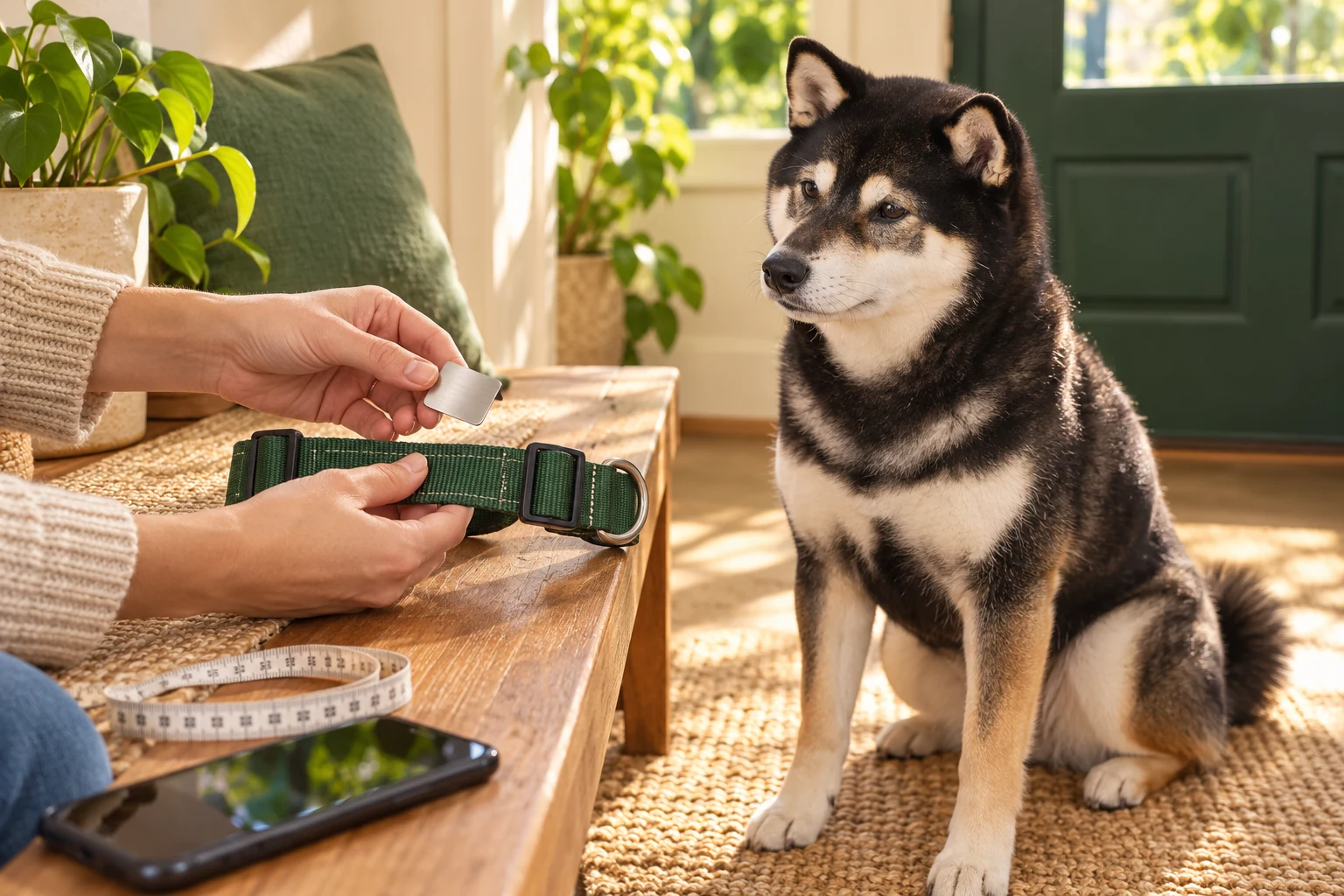
A personalized dog collar is useful when someone can read the contact information on the collar your dog actually wears. Start with a correctly fitted collar, then choose embroidery, an engraved plate or a compatible slide-on tag. Check where the text sits after adjustment: a clear product photograph does not show whether your dog's size setting will put a slider over the phone number.
This guide compares the identification formats and the checks to make before committing to customization. Use our collar size guide for neck measurements and our small-dog collar guide when hardware bulk is the harder decision. We have not tested the products below ourselves.
Quick read
Before you personalize
- Choose the collar's adjustment range and width before choosing lettering.
- Compare embroidery, an engraved plate and a separate tag against the collar you will use.
- Ask where the text will sit at the intended size setting.
- Proofread every contact detail, including spaces that count toward the seller's character limit.
- Check customization and return terms before ordering.
- Keep microchip registration current and check which official tags your local authority requires.
Choose the identification format
An embroidered collar puts lettering into the strap. An engraved buckle or plate puts it on a separate surface. A slide-on tag adds identification to an existing collar, provided its attachment fits the strap and closure. A hanging tag is another option when its size, attachment and movement suit the setup.
These formats solve different practical problems. If your dog's current collar fits well, a compatible tag may be the smaller change. If you want to remove a dangling contact tag, compare lettering on the collar or a flat plate. Neither choice removes every possible snag or makes the complete collar suitable for unsupervised wear.
| Format | Useful when | Check before ordering | Reason to reconsider |
|---|---|---|---|
Embroidered strap | You want contact details on the collar itself | Text position after adjustment, contrast and character limit | Slider or overlapping webbing covers the information |
Engraved plate or buckle | You want a compact hard surface for text | Readable lettering, attachment, edges and hardware bulk | Plate crowds the adjustment area or adds excessive weight |
Slide-on ID tag | You already have a suitable collar | Strap width, thickness and route past the buckle | Tag cannot be installed without forcing or modifying parts |
Hanging tag | You need a removable, transferable contact tag | Size, attachment and movement near other hardware | Tag strikes bowls, tangles or is repeatedly lost |
The GoTags embroidered collar illustrates the first format: its maker offers lettering on adjustable nylon webbing. The Boomerang CollarTags range illustrates why a separate tag needs a compatibility check: the maker distinguishes adjustable-collar, slide-on and thicker-collar designs.
Fit the collar before planning the text
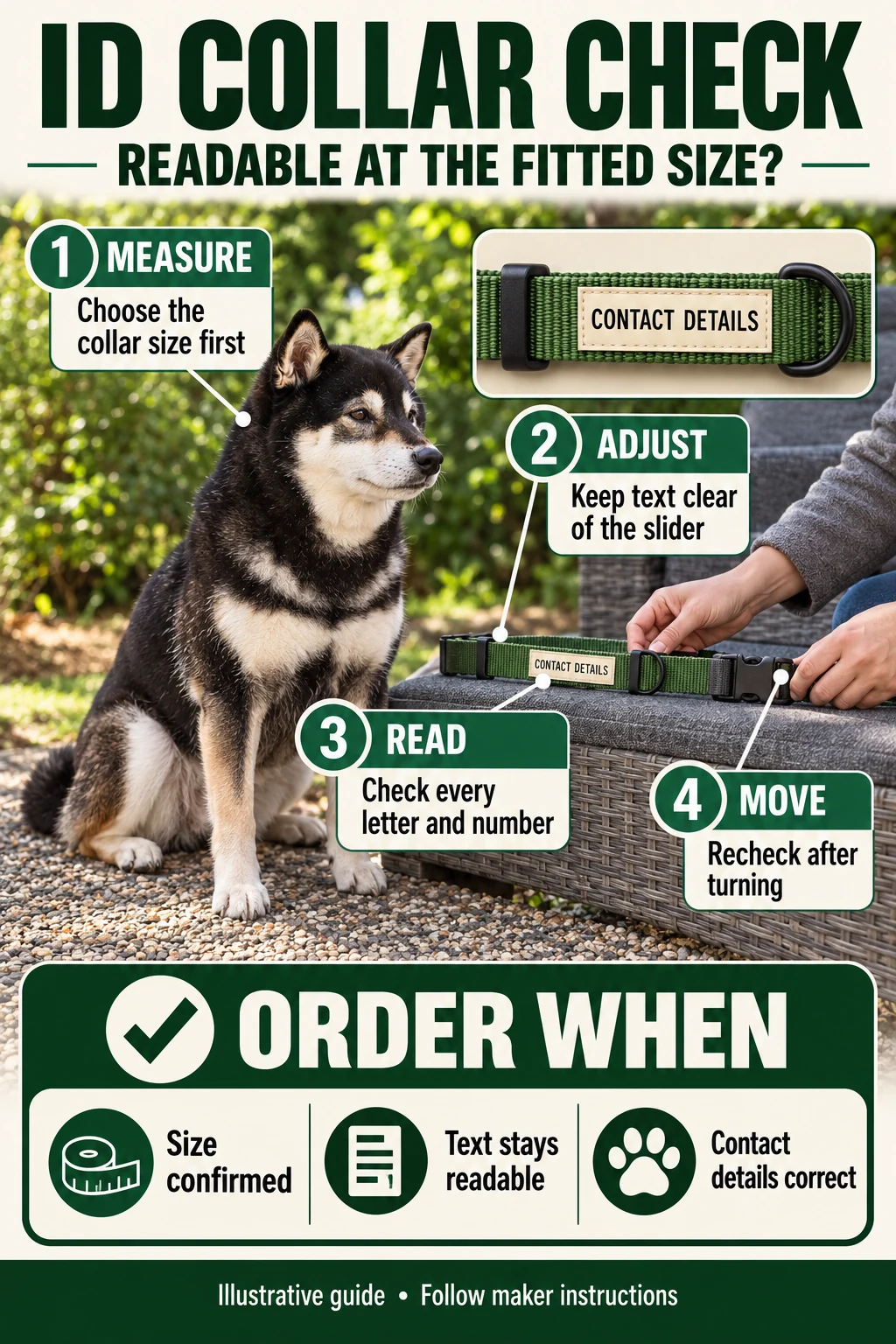
Measure the neck where the collar will sit and follow the exact maker's sizing instructions. Do not choose a larger collar just to obtain more room for embroidery. The extra adjustment or excess strap may make the lettering problem worse while leaving the collar unsuitable for the dog.
Use an existing correctly fitted collar to picture the available area. Record the neck setting, strap width and the positions of the buckle, slider and leash ring. If the new design is different, send the seller those measurements and ask how its text area changes at your setting. A neck circumference and a collar's total unfastened length are different measurements; establish which one the order form requests.
LupinePet's Basic Solids page warns that adjustment can move embroidery through the slider or cover it with webbing. That is a concrete reason to ask for a fitted-size example. A long name may look attractive on a fully extended collar and lose several letters when the collar is shortened.
For a growing puppy, consider how soon the collar may need replacing. A plain adjustable collar with a compatible removable ID tag may be easier to update. If you choose embroidery now, budget for another collar when the fit changes; extra wording space is not growing room.
Share & embed
Make the contact information easy to use
Decide what someone finding the dog would need to contact you. A current reachable phone number is more useful than a decorative phrase that uses the available space. If you add a second contact, make sure that person knows they may receive a call and that both numbers remain readable.
Write the proposed text in a note before entering the customization form. Read each digit from your actual contact record rather than from memory. Count spaces and punctuation when the seller includes them in the limit. Check the preview for automatic capitalization, line breaks or a smaller font caused by a long entry.
Draft separate fields for the dog's name and contact number, then enter the real details into the order form. Ask another adult to read the number back without being prompted. Keep the saved text with the order confirmation so you can compare it with the finished collar.
Think about readability as well as what fits. High contrast between thread and strap is easier to assess than a color combination chosen only to match the leash. A plate with many tightly packed lines may technically contain more information while requiring closer inspection. Request an example at the size and text length you are buying when the preview does not make that clear.
Slide-on tags: width alone is not enough
Measure the strap's actual width and inspect its thickness and fastening. Can the tag pass over an open belt-style end? Does a permanently attached snap buckle block that route? Is there a doubled section of webbing where you want the tag to sit?
Boomerang's instructions separate the ordinary slide-on design from the version intended for adjustable collars with clasp buckles. Its thicker-collar option is another design. These are product-specific distinctions, not a promise that every tag described as “slide-on” uses the same attachment.
Check the seller's installation diagram before buying. A photograph of a tag sitting on a strap does not explain how it gets there. Do not cut the collar, remove stitching or force a buckle through a slot to make an incompatible tag work. Ask the tag maker for the correct version or choose another format.
Keep the tag clear of the slider and moving closure parts. After fitting it, make sure the collar still adjusts and fastens as intended. Read the text with the collar closed and curved, because a flat tag held in your hand can give a different impression of visibility. For more about strap construction and care, use the collar materials guide.
Two options for different starting points
One option replaces the collar; the other adds identification to suitable existing equipment. The Amazon links may earn us a commission. Confirm the current variant and customization details on the destination page before ordering.
If either listing leaves a fit question unanswered, ask before placing a custom order. A contact tag that cannot be installed is not rescued by correct engraving, and an accurately embroidered number is not useful when a slider hides it.
Proof the delivered identification
Read the delivered text before putting the collar on the dog. Compare every character with your saved order. Check the edges, stitching and attachment, then fit the equipment according to its instructions in a secure indoor area.
Ask the dog for a few ordinary steps and a turn without using the collar to pull the head into view. Look again at the lettering. Has the strap rotated? Does fur cover the number? Has the tag moved into the slider? A photograph can help you compare the before-and-after position, but take care not to post your personal contact details publicly.
If you need to correct a spelling or fit problem, contact the seller with the order record. Do not assume all personalized items have the same return policy. LupinePet's embroidery page, for example, identifies custom embroidery as final sale. Check the terms of the actual seller you choose.
Keep the rest of the ID plan current
A readable collar and a registered microchip serve different stages of identification. The AVMA microchipping FAQ explains that a microchip contains an identification number and needs current registry information; it is not a GPS device. Visible contact information can let a finder reach you without first obtaining a scanner.
The AAHA identification guidance also recommends current collar identification alongside microchipping. Check local license and vaccination-tag requirements with the relevant authority rather than assuming personalized embroidery replaces official tags. For location tracking, our GPS dog collar guide explains cellular, radio and nearby-finding systems.
Recheck the text after washing and after any size adjustment. Update the collar and registry if a contact number changes. If a dog will stay with someone else, agree which number a finder should call and leave the sitter handover sheet with the caregiver.
Questions owners bring to this decision
An owner discussion about attaching dog tags raises the choice between hanging tags and identification on the collar. Another collar discussion asks about alternatives to dangling hardware. Those questions inform the FAQs below; community experiences do not establish a product's safety or durability.
Frequently asked questions
Is an embroidered collar better than an engraved tag?
Choose by the collar and the information you need to display. Embroidery avoids a separate contact tag but can be covered by adjustment hardware. An engraved tag can suit an existing collar if the attachment, size and lettering work with it.
Can a slide-on tag fit a collar with a plastic snap buckle?
Some designs can; others require an open strap end. Check the exact installation diagram. Boomerang distinguishes its adjustable-collar tag from its ordinary belt-buckle slide-on design, which shows why the product name alone is insufficient.
What if the slider covers the phone number?
Ask the seller about text placement before ordering, using the intended fitted size. After delivery, resolve the problem with the seller. Do not loosen an otherwise correctly fitted collar just to expose lettering.
Does personalization mean I can remove every other tag?
It can replace a separate contact-information tag in a suitable setup, but official license or vaccination-tag requirements are a separate question. Check your local authority's rules and keep required identification available as instructed.
Does a microchip replace visible identification?
No. The AVMA explains that a finder can use readable contact information directly, while a chip requires scanning and current registry details. Maintain both parts of the identification plan.
Is a quick-release collar automatically a breakaway collar?
No. A buckle opened by squeezing it is a different function from a closure designed to release under force. For example, KeepSafe's instructions describe separate quick-release and breakaway parts. Follow the exact collar's use and leash-attachment instructions.
Can I return a personalized collar if the size is wrong?
Check before ordering. Customization terms vary, and some makers identify personalized items as final sale. Confirm measurements, text and adjustment-area visibility before paying for embroidery or engraving.
How do I keep a small dog's ID setup manageable?
Compare the combined strap, buckle, tag and any tracker. A flat tag can remove dangling movement but still adds material and may crowd the adjustment area. Use the small-dog collar guide to compare the complete setup.
Sources and next steps
Product identity, images and source information were checked on October 25, 2026. Use the Dog Collars hub to choose the collar's role, the size guide for measurements and the material guide for care. The comparison table and proofreading sequence are editorial decision aids, not results from hands-on testing.