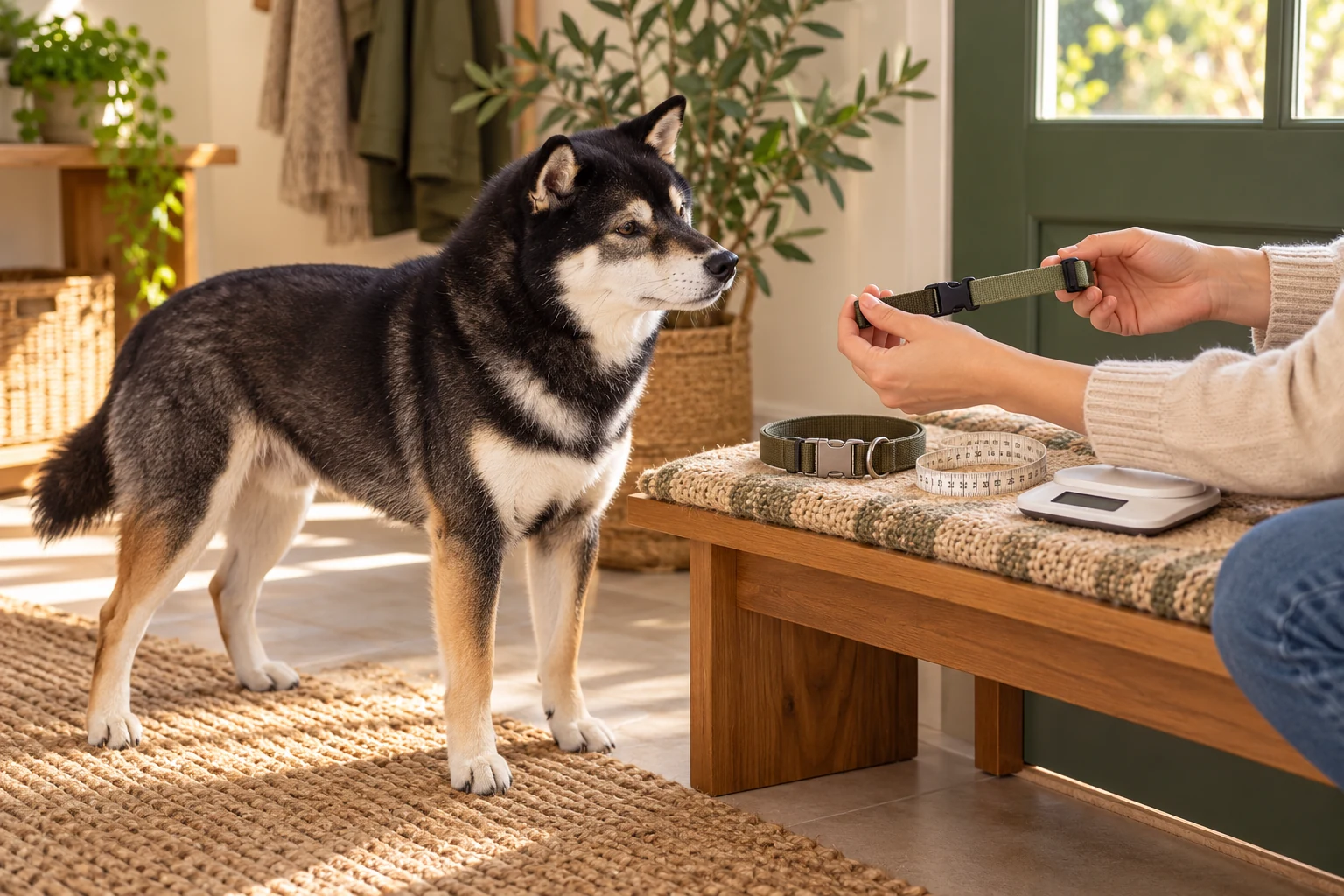
The best collar for a small dog fits the measured neck, stays correctly adjusted and carries the required identification without crowding the neck with hardware. Compare the buckle and tag as carefully as the strap. “XX-Small” describes a brand's size range; it does not tell you how bulky the fastening will feel or whether the collar suits your dog.
For many small dogs, the collar can carry ID while a correctly fitted harness takes the walking leash. The RSPCA's leash-equipment guidance emphasizes comfortable, correctly adjusted equipment and warns that large heavy leash clips can be unsuitable for small dogs. This guide focuses on buying the collar and arranging its hardware. Use our collar size guide for the measuring process.
Quick read
Compare the whole collar
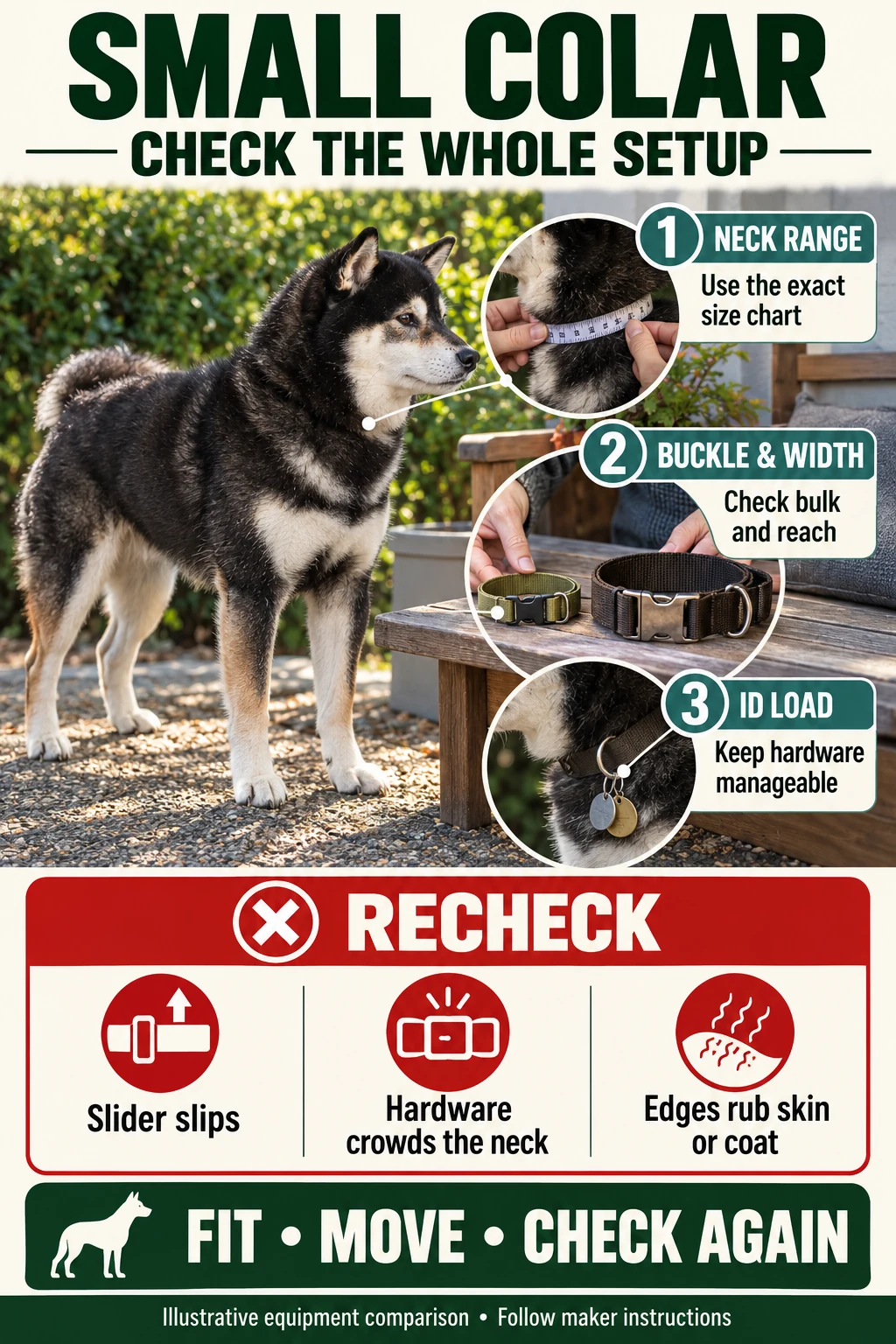
- Record neck circumference, then use the exact model's chart.
- Compare strap width, thickness, buckle bulk and adjustment space.
- Add the ID tag and any tracker to the comparison before deciding the collar is light enough.
- Keep the leash on suitable walking equipment; an ID ring or accessory holder is not automatically a leash point.
- Try normal movement in a secure place and recheck fit after adjustment or washing.
- Treat repeated rubbing, skin changes or distress as reasons to stop and reassess the setup.
Start with the adjustment range
A Chihuahua, Yorkie and small mixed-breed dog can have different neck measurements even at similar body weights. Breed names are useful search terms, but they cannot select the collar size. Measure where the collar will sit, note the units and follow the maker's instructions about allowance. Do not add several generic allowances on top of one another.
Look at where the neck falls within the usable adjustment range. A collar that only just reaches its longest setting offers little room to correct the fit. Another that needs nearly all its strap doubled back may create a bulky overlap. Neither problem is visible from an “XS” label alone.
For example, LupinePet's Basic Solids collar has several neck ranges within its half-inch-width collection. Selecting the width does not finish the size choice. Its smaller 6–9-inch option and its 8–12-inch option are different ranges, not interchangeable names for the same fit.
If the dog falls between sizes, ask the maker what the actual overlap and hardware arrangement will look like. Choosing an unsuitable collar and tightening it beyond its intended range is not a solution. For a dog that can reverse out of ordinary walking gear, use the escape-proof harness guide to assess body fit and handling instead of simply tightening the neck strap.
Check width and buckle bulk together
Lay the candidates beside one another if possible. A narrow strap can still carry a deep plastic buckle, a large D-ring or several layers of folded webbing. A wider strap may lie flatter but take up too much of a short neck. Check the assembled collar, including the stiff section around the fastening.
Ask whether you can reach the release tabs while the collar is correctly fitted. A miniature buckle that is difficult for the handler to open is an everyday usability problem. A large buckle chosen for easier handling may create a different fit problem. Photographing the candidate beside a ruler can help compare dimensions when a seller provides no hardware measurements.
Feel the edges and inspect the joins. Look for rough cut ends, protruding stitching and an adjustment slider that does not lie neatly. These are reasons to investigate a particular item, not proof that all plastic or all metal hardware is unsuitable. Material labels alone do not describe the finished collar.
The collar materials guide covers nylon, coated webbing, leather and padding. Start with a simple construction when it answers the need. A substantial decorative buckle, attached bow or broad padded lining needs a reason to be on this particular small dog's collar.
Share & embed
Compare weight without inventing a universal limit
The useful comparison is the complete setup your dog will wear. That includes the strap, buckle, adjustment hardware, ID tag, tag attachment and any tracker. Two collars of the same width can feel quite different once those items are added.
If you have a scale that can resolve small differences, weigh the assembled candidates and write down what each measurement includes. Treat that as a comparison between those items. We do not use a universal collar-weight percentage or a fixed gram limit for every small dog; the information here does not establish one.
Before adding another device, ask what it contributes. A readable contact tag and a tracker have different jobs. A large tracker may fit the strap while remaining awkward on the dog. A smaller tag may reduce bulk but provide less room for text. Check both the physical arrangement and whether the identification can actually be read.
For a dog whose collar rotates or crowds the neck, remove unnecessary accessories and reassess the fit. Do not add a second tight collar merely to distribute gadgets. Our GPS collar guide explains coverage, subscriptions and device attachment if tracking is part of the plan.
Identification on a small collar
A small tag should remain readable. Compare the text size, contrast and placement after the collar is curved and adjusted. A tiny plate filled with several lines can be difficult to inspect; embroidery can be covered by a slider or thick fur. Use the personalized collar guide to compare formats before ordering custom text.
An attachment also needs to suit the strap. Boomerang's CollarTags instructions distinguish designs for adjustable collars, belt-buckle collars and thicker materials. Its miniature options are tied to particular strap widths and constructions. “Small dog tag” is therefore not enough information to confirm compatibility.
Keep the ID hardware clear of the buckle and slider. Read the number again after a turn and a few steps. If a tag repeatedly strikes a bowl, shifts into the adjustment area or draws the dog's attention, change the arrangement rather than accepting the annoyance as unavoidable.
Keep the dog's microchip registration current too. The AAHA identification guidance recommends visible current contact information alongside microchipping. A smaller collar is not a reason to leave the recovery plan dependent on a single device.
Two nylon collars to compare
These are options to check against measurements, not a ranking based on hands-on testing. Neither is automatically right for every toy breed or puppy. Confirm the current neck range, width and buckle on the linked variant; Amazon links may earn us a commission.
If both candidates fit the measured range, compare what happens at the intended adjustment. Which leaves the slider accessible? Which holds the tag clear of the buckle? Can the handler open either fastening without struggling? Those observations help choose between two plausible collars more than a broad “best for Chihuahuas” label.
Puppies and gaps between sizes
Buy for the puppy's current fit. A collar that will be useful later may be loose enough to slip now. Check the range and repeat the fit assessment as the puppy grows; keep a note of the current setting so a change is easier to notice.
The RSPCA guidance recommends checking growing puppies' collar and harness fit several times a week. Growth can require a different collar rather than another turn of the same slider. Stop using a collar that has reached its limit or no longer fastens and adjusts properly.
If the next size feels bulky, compare another design's range and construction. A lower-profile fastening may solve the problem, but a collar should still perform its intended function. A cat collar that happens to fit may have a release mechanism intended for another use; do not assume it is suitable for leash attachment.
Use our puppy collar-versus-harness guide for the first walking setup and the puppy walking checklist to coordinate ID, harness and leash checks.
A short check at home
Keep the dog in a secure area while you inspect and fit the new collar. Follow the manufacturer's instructions and let the dog move normally. Do not perform forceful pull tests on the neck or deliberately startle the dog to see whether the collar stays on.
- Check the webbing, stitching, buckle and rings before fitting.
- Adjust the collar and confirm that it cannot simply slip over the head during an ordinary fit check.
- Check access to the release and make sure no fur is caught in it.
- Add identification, then ask for a few steps, a turn and a relaxed settle.
- Inspect the collar position and the skin and coat beneath it.
- Recheck the adjustment after removing and refitting the collar.
Persistent scratching, repeated head shaking, redness, hair loss or scabs call for reassessment and veterinary guidance where appropriate. Padding is not a diagnosis or a guaranteed cure. Avoid working through an irritation by tightening the collar or trying several materials against already affected skin.
Keep walking equipment separate from ID choices
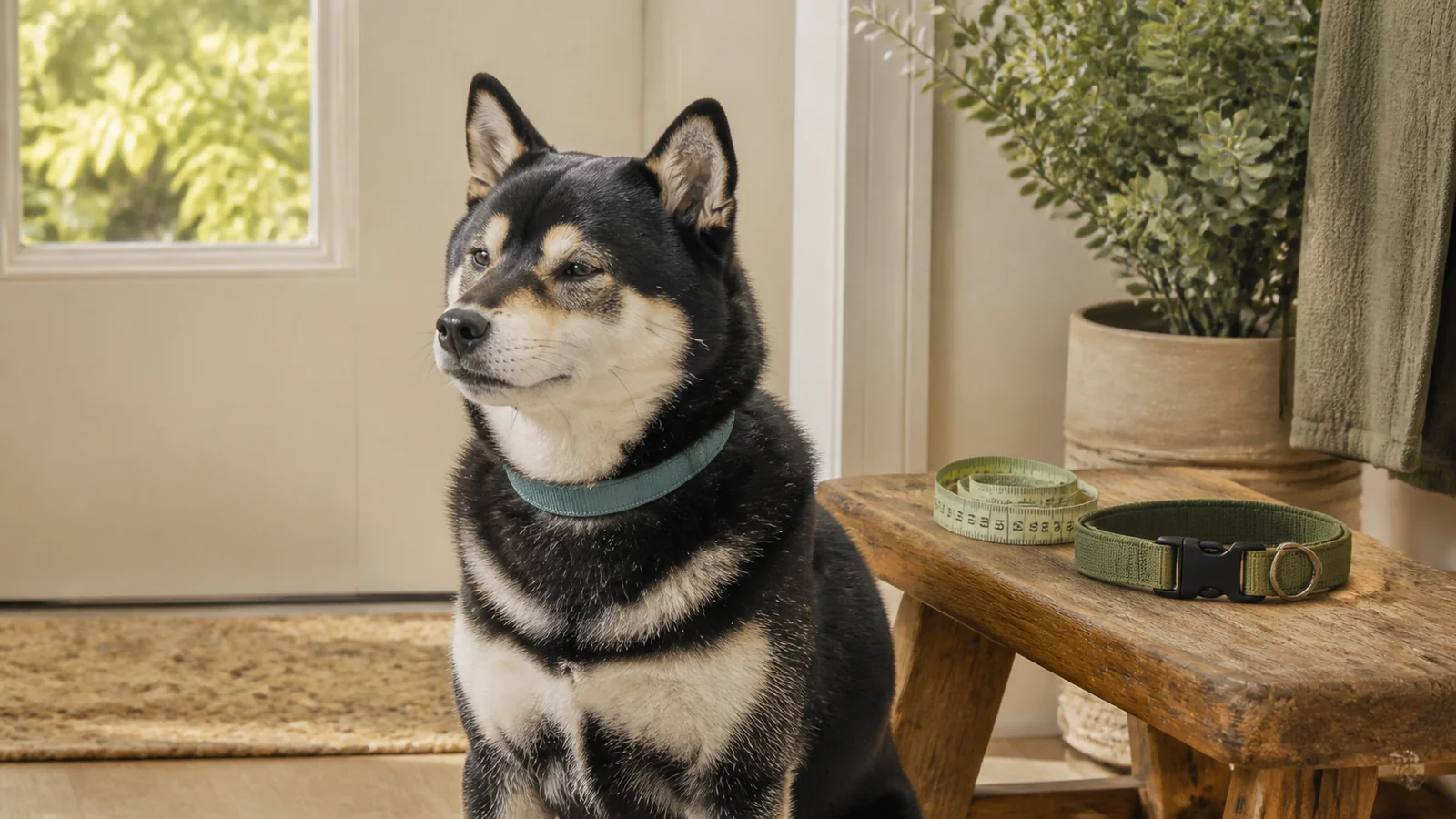
A lightweight ID collar does not have to be the leash attachment for every walk. Compare the collar and harness roles when pulling or neck pressure is part of the decision. Fit the harness to the dog rather than relying on a collar to compensate for loose body straps.
Check the leash clip as well. A suitable collar can be overwhelmed by an unnecessarily large clip hanging from it. Use a fixed leash with hardware appropriate to the dog and the intended attachment, and consult the leash materials guide for handling and cleaning tradeoffs.
For evening walks, assess the full visibility setup. A separate accessory light on a permitted harness mount may be easier to place than several devices on a small neck strap. Preserve access to the proper leash point and make sure any outer layer does not hide the light.
Questions from small-dog owners
An owner looking for a small collar raises questions about tiny buckles and using cat collars. Another describes rubbing despite apparently soft materials. These discussions identify reader problems. They do not establish safe equipment, a cause of skin changes or an effective treatment.
Frequently asked questions
Is XX-Small the same size across collar brands?
No. Compare the current neck range and width for the exact model. Also inspect the buckle and overlap at the intended setting. The size name alone cannot establish a fit.
Is the narrowest collar always best for a Chihuahua?
No. Compare the complete collar, including its edges, stiffness, fastening and intended use. A narrow strap with bulky hardware may be less practical than another well-fitted design. Breed names cannot select the size.
How light should a small-dog collar be?
We do not have a universal weight limit for every small dog. Compare complete setups, including tags and trackers, then assess fit and movement. Ask your veterinarian about individual concerns rather than treating a generic percentage as a safety rule.
Can I use a cat collar because it fits my small dog?
Check its intended use and closure mechanism first. A breakaway design can release under force, so fitting around the neck does not establish that it is suitable for attaching a walking leash. Choose equipment whose instructions support the intended use.
Should a small dog walk on a collar or a harness?
For many small dogs, a correctly fitted harness can take the leash while the collar carries ID. RSPCA guidance supports harness use to avoid pulling on the neck. Fit and handling still need checking; equipment alone does not teach loose-leash walking.
Will a padded collar solve rubbing or sensitive skin?
Not necessarily. Fit, edges, moisture, movement and an underlying problem can all require attention. Stop using equipment that is causing irritation and seek veterinary guidance for persistent skin changes. Do not treat a padded-material claim as a treatment promise.
Can a slide-on tag make the setup smaller?
It can reduce hanging movement, but it still adds a surface and attachment. Match it to the collar's construction and check that it does not crowd the slider or buckle. Confirm the lettering remains readable at the fitted size.
Should I buy a puppy collar with lots of growing room?
Buy a collar that fits now and has a useful adjustment range. Recheck it frequently during growth and replace it when necessary. A loose adult-size collar is not a substitute for a current secure fit.
Sources and related decisions
Product identity, images and source information were checked on October 25, 2026. Return to the Dog Collars hub for the wider equipment choice. Use the size calculator as a starting aid, then follow the specific maker's instructions. The comparison questions and home check are editorial guidance; no hands-on product testing or measured Mr. Smoky specifications are claimed.