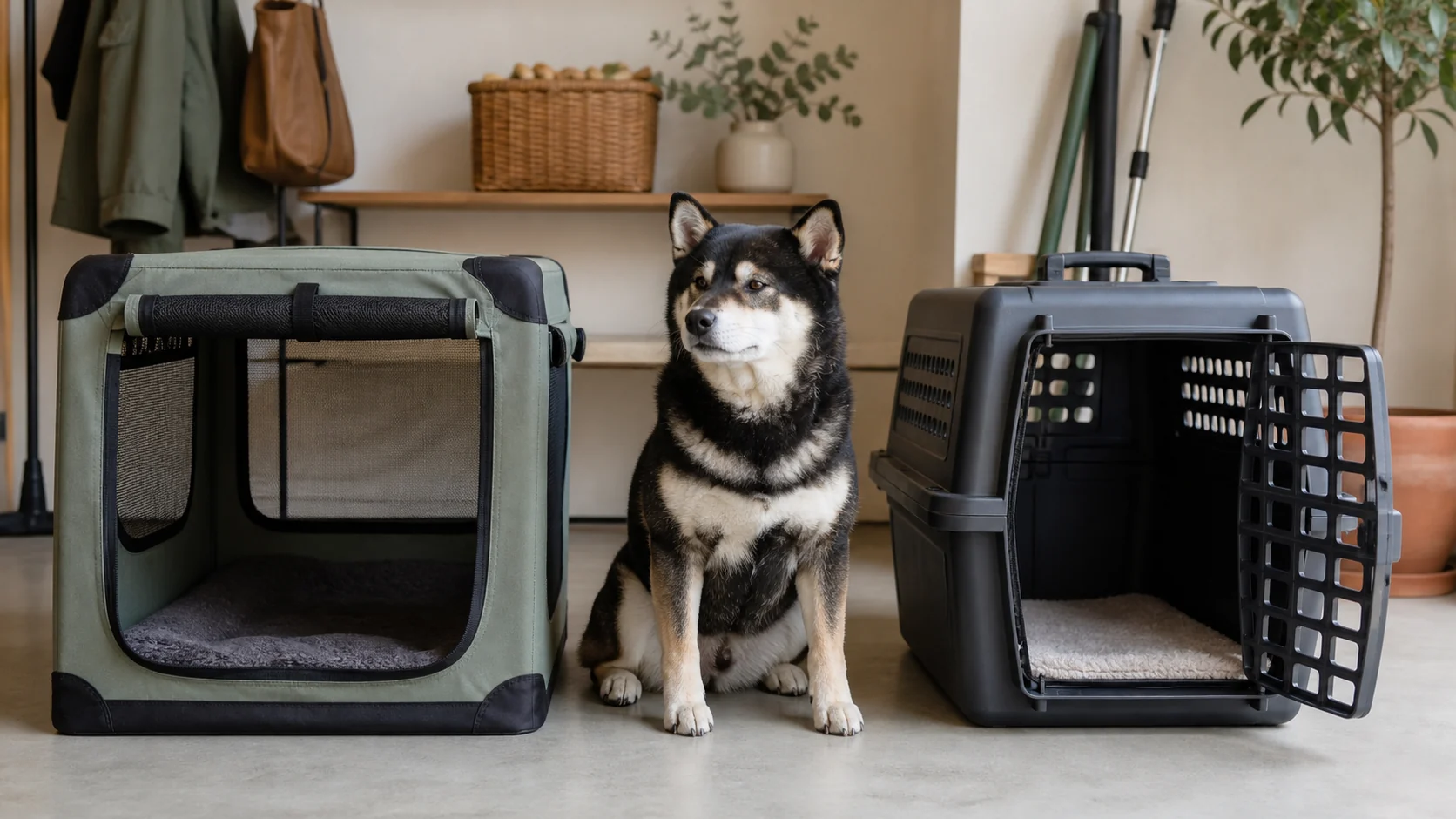
A soft or collapsible dog crate can be useful when storage, carrying weight, and quick setup matter. It is not automatically a crash-protection crate, and it is a poor match for dogs that chew fabric, push doors, scratch panels, panic, or try to escape.
Use this comparison after reading the car travel crate safety guide. That guide covers current independent evidence and vehicle installation; this page focuses on portable convenience crates and their limits.
Quick answer
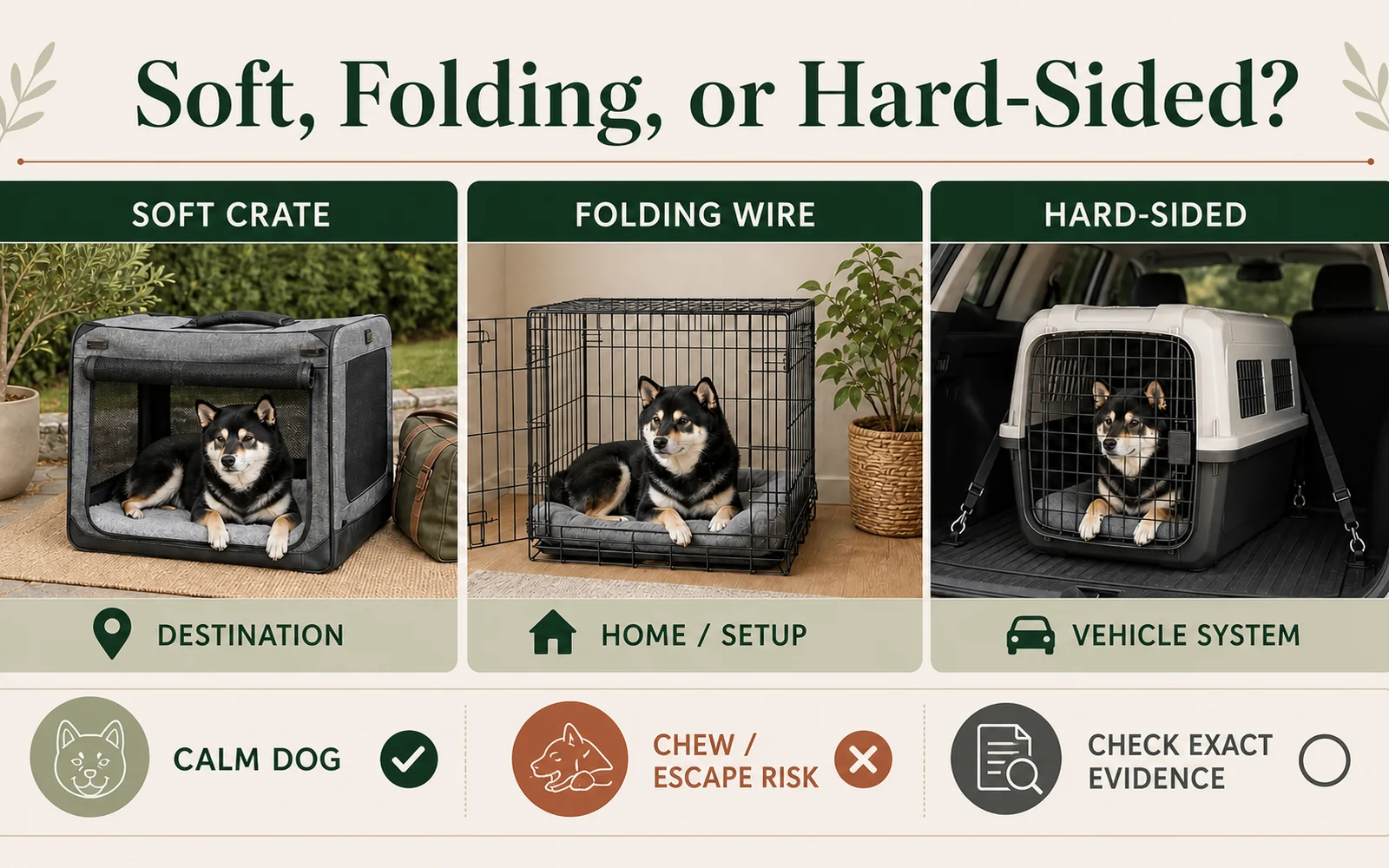
- Choose a soft crate for a calm, crate-trained dog when light weight and destination setup matter most.
- Choose a collapsible hard-sided or purpose-built travel crate when stronger containment and a defined vehicle installation are required.
- Choose a folding wire crate mainly for home or destination use, not because it folds flat for the car.
- Do not assume portability equals vehicle safety. Check evidence for the exact model, size, position, and anchor method.
- Measure the packed crate and the opened crate before deciding it fits the trip.
Soft, collapsible, foldable, and portable are not the same
Retail listings mix these words freely:
- Soft crate: fabric panels over a light folding frame.
- Collapsible crate: any crate designed to break down or fold, including soft, wire, and some rigid systems.
- Foldable crate: usually emphasizes storage rather than safety or material.
- Portable crate: simply means it is easier to move; it does not describe construction or crash evidence.
- Travel crate: may mean airline, vehicle, hotel, campsite, or general transport use.
Read the material, structure, intended use, and instructions instead of shopping by one label.
Calm dog at hotel or rental
Soft folding crate
- Look for
- Light frame, washable panels, secure zippers, familiar setup
- Avoid
- Using it for a chewer or escape attempts
Need compact storage at destination
Collapsible crate
- Look for
- Packed dimensions, setup method, pinch points, carry weight
- Avoid
- Assuming folded size proves car fit
Need home crate at destination
Folding wire crate
- Look for
- Tray, door, stable floor, familiar mat
- Avoid
- Leaving it loose in the vehicle
Need verified vehicle protection
Certified travel crate or carrier
- Look for
- Exact model, approved size, anchors, current instructions
- Avoid
- Treating a generic portable crate as certified
Decide which job the crate must do
Write one primary job at the top of the shopping list. “Travel” is too broad. A hotel rest space, a folding home crate carried in the trunk, a rear-seat carrier, and an anchored cargo-area crate solve different problems.
Use this sequence:
- define how the dog will be protected while the vehicle moves;
- define where the dog will rest after arrival;
- decide whether one product genuinely meets both sets of instructions; and
- if not, choose two simpler systems with clearly separated roles.
For example, a small dog may travel in an approved rear-seat carrier and sleep in the same carrier if the manufacturer permits stationary use. A larger calm dog may travel in a hard-sided vehicle crate and use a soft crate in a hotel room. Another dog may use an approved car harness in transit and a familiar folding wire crate at a rental house.
The two-system approach takes more planning, but it prevents a portable destination crate from being treated as vehicle protection simply because it is easy to load.
Comparison by real use case
| Option | Best for | Key features | Caveat | Merchant |
|---|---|---|---|---|
| Soft folding crate | Hotels, visits, calm supervised use | Light, compact, quiet fabric panels | Poor match for chewing, pushing, scratching, or escape behavior | Containment evidence varies |
| Folding wire crate | Home and destination routines | Ventilation, divider options, removable tray | Heavy, noisy, exposed joints and panels | Folding does not prove crashworthiness |
| Collapsible rigid crate | Travel where storage and structure both matter | Stronger shell than fabric, reusable installation on some models | Weight, setup complexity, higher cost | Verify exact evidence and approved anchors |
| Plastic kennel | General transport and enclosed rest | Enclosed sides, familiar shape, wipe-clean shell | Bulky; ordinary models may lack vehicle crash evidence | Do not generalize from airline language |
| Certified travel crate or carrier | Vehicle restraint within approved limits | Defined test evidence and installation method | Specific sizes, vehicles, and accessories; often expensive | Strongest evidence-led starting point |
When a soft crate makes sense
A soft crate can work for a dog that already relaxes in a crate and does not mouth fabric, paw doors, lean hard against panels, or panic when enclosed. It can be useful at a hotel, training class, family visit, office, campsite, or other supervised destination.
Check mesh strength, zipper closures, frame locks, floor construction, washable panels, carry handles, and whether the crate stays stable when the dog turns. Practice setup at home before relying on it away from home.
When to avoid a soft crate
Avoid a soft crate when the dog:
- chews fabric, mesh, zippers, or seams;
- has bent or damaged previous crates;
- scratches or pushes doors;
- is not yet comfortable being confined;
- becomes distressed when left alone;
- needs a manufacturer-defined crash-restraint system; or
- must be protected from luggage or heavy objects in a cargo area.
Crate-related panic or repeated escape attempts are behavior and welfare concerns, not reasons to keep buying stronger fabric. Ask a veterinarian or qualified behavior professional for help.
Behavior suitability test
Test suitability at home while you can stop immediately. Set up the crate in a familiar room with the door open. Reward voluntary entry and allow the dog to leave. Progress only when the dog settles without biting mesh, pawing seams, pushing the frame, or becoming distressed.
During a short supervised closed-door session, watch the parts of the crate as well as the dog. Does the frame rack sideways when the dog turns? Does a zipper gap appear under pressure? Can a nose or claw reach the zipper pull? Does the floor bunch or slide? A calm five-minute session does not guarantee unattended suitability, but visible stress or structural movement is an immediate reason to stop.
Never use the crate as a test of whether a distressed dog can eventually “give up.” Confinement training should remain gradual and positive, and separation-related distress needs an appropriate behavior plan rather than a more restrictive enclosure.
Car use versus destination use
Separate these two questions:
- How will the dog be restrained or contained while the vehicle moves?
- What rest space will the dog use after arrival?
The same product does not have to solve both jobs. A dog may travel using a current approved crate, carrier, or car harness and use a lightweight soft crate at the destination.
This separation often creates a safer and more practical setup than choosing one compromise product because it is advertised for “home and car.”
Fit, ventilation, and packing checks
Measure the dog’s standing height and body length, then compare internal dimensions. Measure the vehicle opening and planned storage area separately. Do not let luggage press against mesh panels or block airflow.
Pack bedding thin enough that it does not reduce headroom or interfere with the door. Keep loose bowls, toys, tools, and luggage outside the crate while the vehicle moves unless the manufacturer specifically permits an accessory.
Use a separate dog gear bag for food, water, cleanup supplies, documents, and spare walking gear.
Construction details that matter
Frame and locking points
Check how the frame reaches its full shape and what prevents accidental folding. Hinges and joints should be shielded from the dog and from fingers during setup. The crate should sit squarely without rocking on a flat surface.
Mesh and seam placement
Large mesh panels improve visibility and airflow but provide more material for claws and teeth to reach. Inspect stitching at corners, door edges, and handle attachments. A second mesh door is useful only if it can be secured and does not create another weak point for the individual dog.
Zippers and latches
Two zipper pulls are convenient, yet they should meet in a position the dog cannot easily manipulate. Some designs provide clips that join the pulls. Confirm how the manufacturer expects every opening to be secured rather than adding improvised clips that could create snag hazards.
Floor and cleaning access
A removable floor panel or mat simplifies cleanup, but it should lie flat and should not expose hook-and-loop strips, plastic edges, or absorbent foam. Ask whether the fabric shell can be removed, how it must be washed, and whether the frame can dry fully after rain or a spill.
Carry handles
Handles are often intended for moving the empty crate, not for carrying the dog inside. Follow the stated carrying limits. Lifting an occupied soft crate can distort the frame and shift the dog unexpectedly.
Five-minute setup test
Before the first trip:
- open and lock the crate without the dog;
- check every joint, zipper, latch, and frame sleeve;
- press gently on each side to find weak or collapsing panels;
- let the dog enter voluntarily and reward calm behavior;
- watch a short supervised rest session;
- fold and repack the crate; and
- confirm the crate, dog restraint, luggage, and ventilation do not interfere with one another.
Pack-down and storage routine
Photograph the correct frame and fabric arrangement the first time. Before folding, remove bedding, crumbs, moisture, and loose accessories. Close or position zippers as instructed so they do not catch in the frame. Do not force a damp fabric shell into a closed bag; trapped moisture can cause odor, mildew, and hardware corrosion.
At the destination, place the opened crate on a level surface away from door swings, heaters, cooking areas, cords, and busy walkways. Press each corner to confirm it is fully locked before inviting the dog in. Keep luggage away from mesh and make sure the dog can be reached without moving furniture.
After the trip, inspect the underside and every seam in bright light. Small pulled threads, bent joints, or a zipper that no longer closes evenly are early warnings. Retire or repair the crate according to the manufacturer’s guidance before the weakness becomes an escape route.
Four buying mistakes to avoid
- Choosing by folded size only: the opened footprint, door swing, and ventilation space still have to fit.
- Using weight as the only size input: standing height, body length, turning room, and door opening matter.
- Assuming “airline approved” means car tested: airline, vehicle, and destination requirements are separate.
- Ignoring return and replacement parts: a difficult-to-clean shell or unavailable floor insert can make a convenient crate short-lived.
Direct Amazon comparison options
These examples represent three different construction categories. They are not interchangeable vehicle-safety recommendations. Check the exact product’s intended use, internal size, current evidence, dog behavior fit, seller, and return policy. What Dogs Like may earn from qualifying purchases.
Related guides
Read Best Dog Crates for Car Travel for evidence-led vehicle setup, Soft vs Wire Dog Crates for broader home-use differences, and the Dog Crate Size Guide before comparing dimensions.
Frequently asked questions
Are collapsible dog crates safe for car travel?
Collapsible construction alone does not prove crash protection. Check the exact product’s current evidence, approved size, vehicle position, and connection method.
Is a soft dog crate good for a long car trip?
It may be useful as a destination crate for a calm, trained dog. For the moving vehicle, use a restraint or containment system supported by current evidence and exact installation instructions.
Can a wire dog crate be used in a car?
Fitting in a car is not the same as having crash evidence. Do not leave a folding wire crate unsecured or assume its home-use strength transfers to a collision.
What is the best portable crate for a dog that chews?
A fabric crate is usually a poor choice. Compare more durable designs, but address chewing, distress, and confinement behavior rather than relying only on stronger materials.
Can one dog crate work for car and home?
Sometimes, but verify both jobs separately. A practical approach is often a defined vehicle restraint system plus a lighter destination crate.