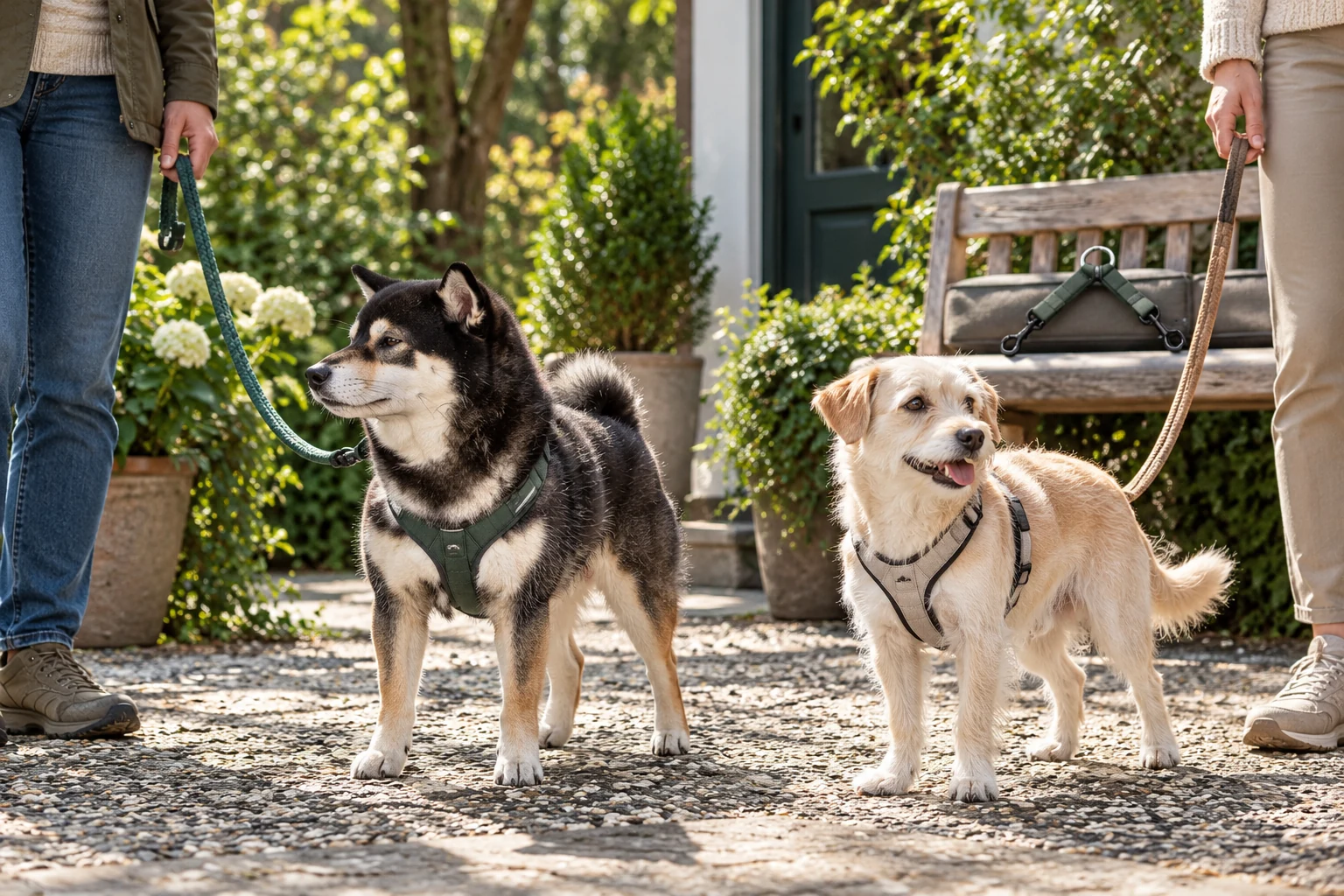
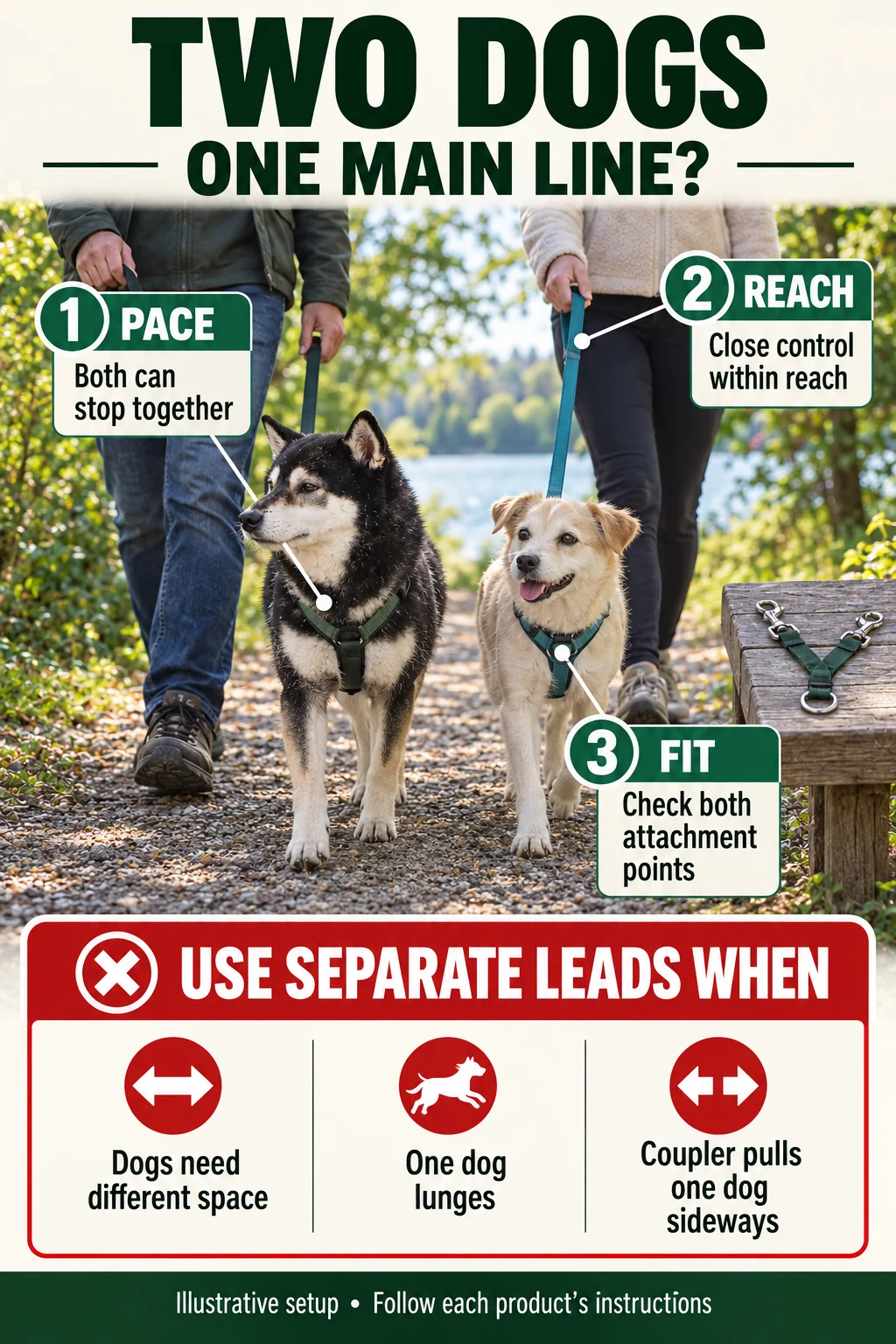
Choose leashes for two dogs by the control each dog needs. Separate leads let you change one dog's distance without changing the other's. A coupler joins two branches to one main leash, which can simplify a compatible pair's arrangement but also connects their movements. Check both dogs' pace, stopping habits, size and response to distractions before buying one.
A double-handle leash is different: it gives a handler two grip positions on one dog's leash. It does not normally provide a second dog connection. Our leash length guide explains close handles; this guide compares actual two-dog setups. We have not tested the products below ourselves.
Quick read
Start with both dogs
- Check each dog's walking setup separately before combining the pair.
- Keep separate leads when one dog needs different space or individual handling.
- For a coupler, measure the complete main-leash and branch arrangement.
- Check every clip against its intended attachment point and the main ring.
- Do not treat a swivel or “no tangle” label as a guarantee.
- Practice stops and turns with another adult in a secure, quiet place before choosing a route.
Separate leads or one shared main line?
Separate leashes preserve independent length and attachment choices. You can keep one dog close while allowing the other a little more room, provided you can manage both lines. Two handlers can also maintain more separation than one person trying to hold both dogs together.
A coupler has two dog-end branches and a shared connection for the main leash. An integrated double leash builds a similar arrangement into a complete product. Either can bring the dogs into a narrower shared space. If one stops to sniff, changes sides or accelerates, that movement can affect the other dog as well as the handler.
| Arrangement | Useful comparison | Check first | Reason to choose another setup |
|---|---|---|---|
Separate fixed leads | Independent distance and handling | Can the handler manage both lines without tangling? | One person cannot reliably control both dogs |
Coupler plus main leash | Shared connection with replaceable components | Branch lengths, central ring, clips and total reach | One dog pulls the other sideways or needs more space |
Integrated two-dog leash | One complete walking product | Individual controls and adjustment on each side | A damaged branch cannot be replaced as intended |
Two handlers | More separation and individual attention | Both handlers can communicate and keep a suitable distance | The route or dogs need a different plan |
The Canine and Feline Sector Group's dog-walking guide advises assessing each dog's suitability for group walking and ensuring dogs remain under control. It is UK professional-walking guidance; its local regulatory context does not establish rules for a US household. The useful planning question here is whether both dogs remain comfortable and manageable together.
Check pace and space before equipment
Walk each dog on the proposed route first. Notice ordinary events: stopping at a gate, turning away from a distraction, passing a person and waiting while you pick up waste. A pair that walks at the same speed on an empty path may still need very different amounts of room when something happens.
Use another adult for an initial combined assessment. Each person can keep a separate line and enough distance for their dog to remain relaxed. Bath Cats & Dogs Home's parallel-walking guidance emphasizes working at a distance the dogs can cope with rather than rushing them together. It is particularly relevant when introducing unfamiliar dogs; a coupler is not an introduction method.
If one dog repeatedly lunges, freezes, crowds the other or becomes distressed, keep the arrangements separate and seek qualified help with the underlying handling problem. A stronger shared clip does not give the dogs more personal space. A short separate walk can be more workable than a combined outing that requires constant correction.
Share & embed
Measure the complete arrangement
The distance from your hand to either dog includes the main leash, the coupler branch and the connectors between them. Adding a coupler to an everyday leash increases the working reach. Check whether you can still bring the dogs close before a doorway or crossing without reaching down into their path.
Record each branch's unstretched length and, if elastic, the maker's stated extension. Check whether either branch adjusts independently. A longer advertised branch can give a dog more room, but it can also create spare line near a smaller dog's legs when the pair is standing close.
The current Ruffwear Double Track Coupler lists a per-side length of 12–19 inches and uses stretch webbing. That is a specification for that product, not a universal two-dog distance. Compare the actual geometry with your dog's harness attachment height and normal position beside the other dog.
Mock up the proposed reach with the equipment disconnected from the dogs. Lay it out on a clear floor and identify where the main clip, central ring and dog clips would sit. This helps reveal whether a close handle will be too far away. It does not prove how the dogs will respond once connected.
Different-sized dogs need more than an adjustable branch
Compare attachment heights as well as body sizes. A small dog beside a much taller dog may have a different branch angle, even when both branches have the same length. Check that no section runs across either dog's face, back or legs during a calm turn.
Independent adjustment can help arrange the space, but it cannot prevent a stronger dog from moving a smaller dog through the shared connection. If one dog's ordinary change of pace repeatedly displaces the other, return to separate leads. Do not use the smaller dog as an anchor for the larger one or expect them to exercise each other against the coupler.
Two owner discussions raise these questions directly: one asks about a coupler for very different-sized dogs, and another asks for tips on walking two dogs together. They inform this comparison, but the replies are not evidence that a particular arrangement is safe for another pair.
Swivels, bungee and close handles
A swivel permits rotation at one connection. It does not untangle branches that pass around a dog, a person's legs or a post. Check that it turns freely and that the clips can close without webbing or hair in the gates. A rotating ring that becomes stiff after grit or mud still needs inspection and care.
Elastic branches change the geometry under tension. Compare the resting and extended reach before deciding whether the arrangement suits a narrow route. A bungee section is not a reason to combine dogs whose pulling already exceeds the handler's control. The maker's “shock absorbing” description does not establish that a sudden two-dog lunge will be manageable.
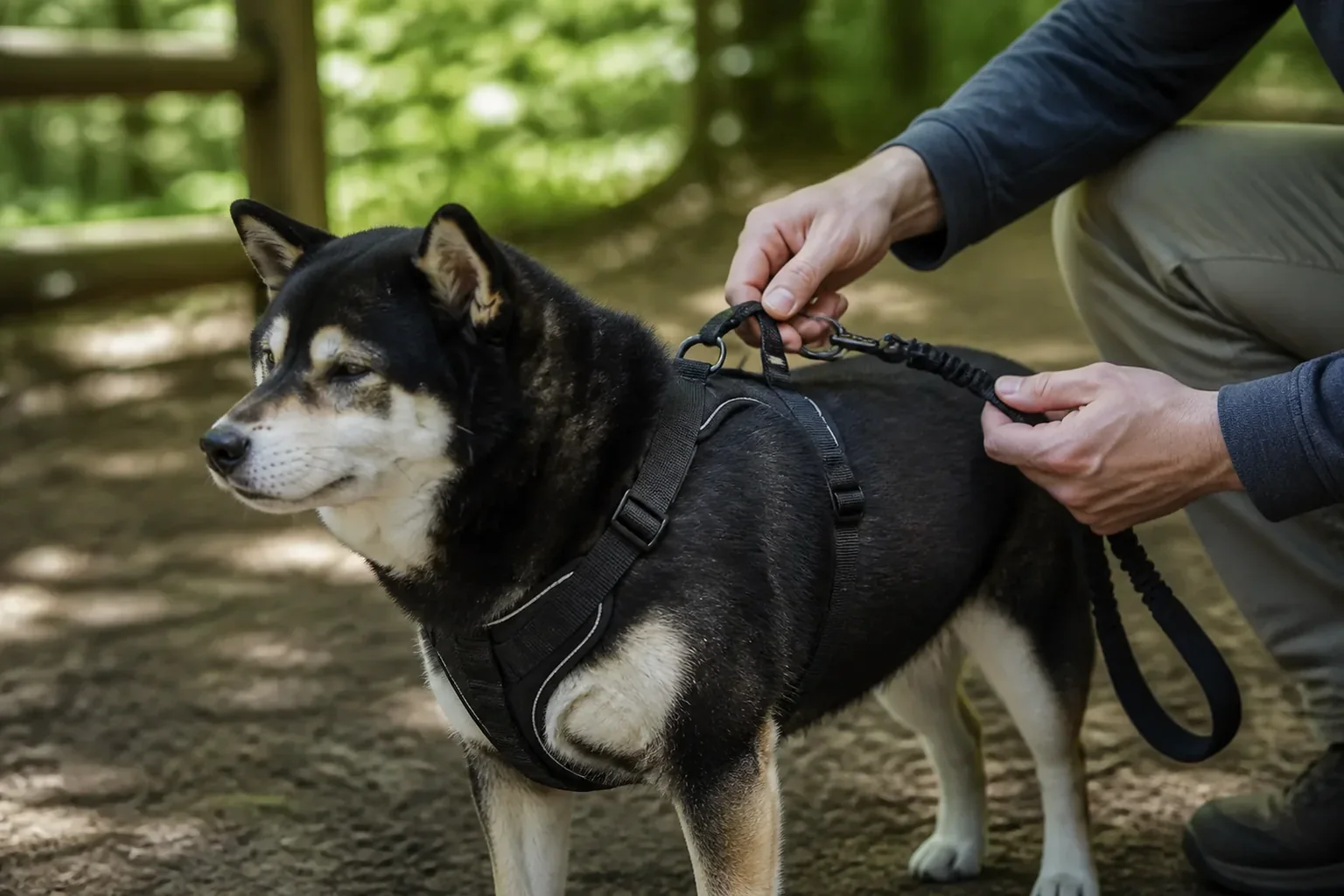
Check close handles in the position you would actually use. A handle near one dog's clip may be reachable on a tall dog and awkward on a small dog. Keep unused loops clear of legs and snag points. If the product has no way to manage each side separately, consider whether that limitation matters for your normal stops.
Two coupler designs to inspect
Both examples require a suitable main leash. They are not automatic recommendations for reactive dogs, large size differences or every route. The EzyDog link is an Amazon affiliate link; the Ruffwear link goes directly to its manufacturer.
The EzyDog product page identifies its Zero Shock construction and traffic handles. Check the instructions supplied for your regional model. Product names and generations can persist while clips or other details change; compare what you receive with the order and current maker information.
A short trial before the shared walk
Begin in a secure quiet place with another adult available. Check each harness and clip separately. Start with separate leads and confirm that both dogs can stop, turn and wait calmly. If you try a coupler, follow its instructions and keep another suitable lead available for each dog.
Watch the pair from the side as well as from behind. Does one branch tighten whenever the smaller dog stops? Does the central connection hang where a dog can step through it? Can the handler shorten the arrangement before approaching a gate? End the trial if either dog is repeatedly displaced or you cannot keep the lines clear.
Rehearse a normal waste pickup, turn and return indoors. These small tasks can expose awkward equipment before a longer outing. Keep the dogs calm and the main leash held throughout. If the arrangement makes it difficult to bend, stop or change direction, resolve that before extending the walk.
Route changes can change the answer
A quiet shared walk does not establish suitability for a busy market, narrow trail or crowded clinic. Check the destination's current dog and leash rules. Bring separate fixed leads when you may need individual space or when another handler will take one dog.
For waist systems, use the hands-free leash guide, which treats two-dog load and emergency transitions separately. Our hiking leash guide covers passing and snag points. Do not connect two dogs to a single retractable leash: flexi's US precautions explicitly prohibit attaching more than one dog to that product.
After the walk, inspect every branch, seam and moving part. Follow the maker's cleaning instructions and replace damaged components as specified. A short main leash and two coupler branches create more connections to inspect than one ordinary leash, so include the full arrangement in the check.
Frequently asked questions
Is a double-handle leash the same as a leash for two dogs?
No. Two handles usually provide two grip positions for one dog's leash. A two-dog coupler or integrated double leash has separate dog-end connections. Check the construction rather than the word “double.”
Does a no-tangle swivel prevent all tangles?
No. Rotation at a connector cannot clear a branch wrapped around a leg or obstacle. Check line paths during ordinary turns, and change the arrangement if tangling continues.
Can a large and small dog share a coupler?
Only consider it after assessing the individual pair and product. Compare attachment heights, branch angles and how each dog's movement affects the other. Keep separate leads if the smaller dog is displaced or needs different space.
Is a coupler suitable when one dog lunges?
A shared connection can transfer that movement to the other dog. Use separate handling and qualified support when a dog needs individual distance or cannot remain manageable. A stronger coupler is not behavior treatment.
How long should the branches be?
There is no universal length. Compare the main leash plus each branch, the dogs' normal positions and your ability to reach close control. Include the maker's stated extension if branches are elastic.
Can I use one retractable leash with a splitter?
Do not assume compatibility. Flexi's linked US precautions prohibit attaching more than one dog. Follow the exact leash instructions; use an arrangement expressly intended for the planned number of dogs.
Should I start with a hands-free two-dog setup?
Assess each dog and the combined pair on separate hand-held leads first. A waist system introduces different load and transition questions. Use the linked hands-free guide before considering it, and keep separate walks when control is uncertain.
What if one dog wants to sniff while the other keeps walking?
Separate leads give more independent adjustment. If a shared branch keeps pulling one dog away from its preferred position, change the setup rather than expecting the dogs to work it out against the coupler.
Sources and related guidance
Product identity, images and source information were checked on October 25, 2026. Use the Dog Leashes hub for the wider choice, the material guide for grip and care and the harness fit guide for each dog's attachment.