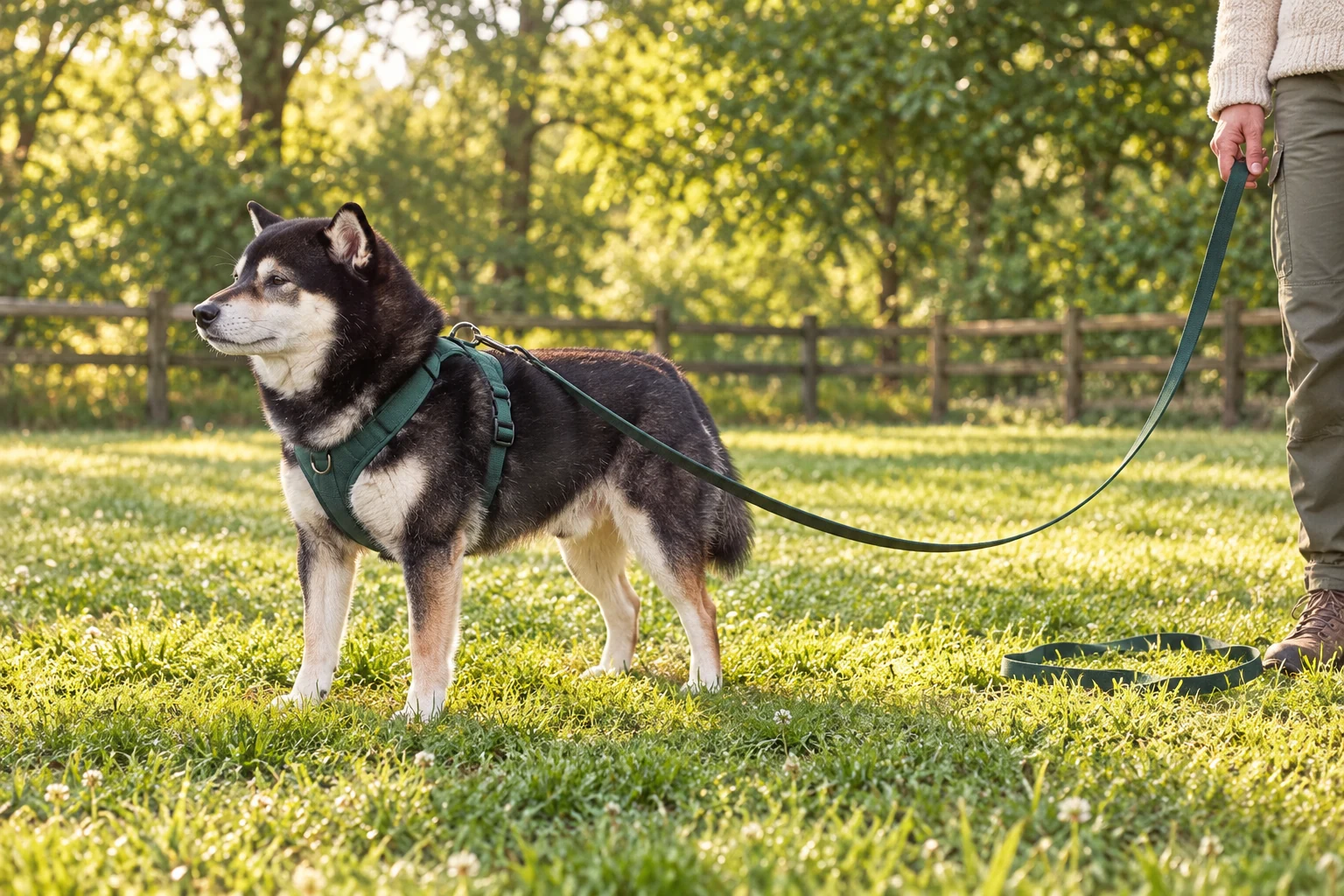
A dog training long line gives you a longer connection for suitable open-space practice. Choose the length you can manage in the actual location, then compare material, clip weight, handle design and care. A longer line does not create better recall or make a crowded place suitable for distance work.
Our leash length guide covers everyday four-, six- and ten-foot choices. This guide focuses on longer training lines, including the 20-, 30-, 50- and 100-foot labels you will see while shopping. The products and illustrations are comparison aids; we have not tested them ourselves.
Quick read
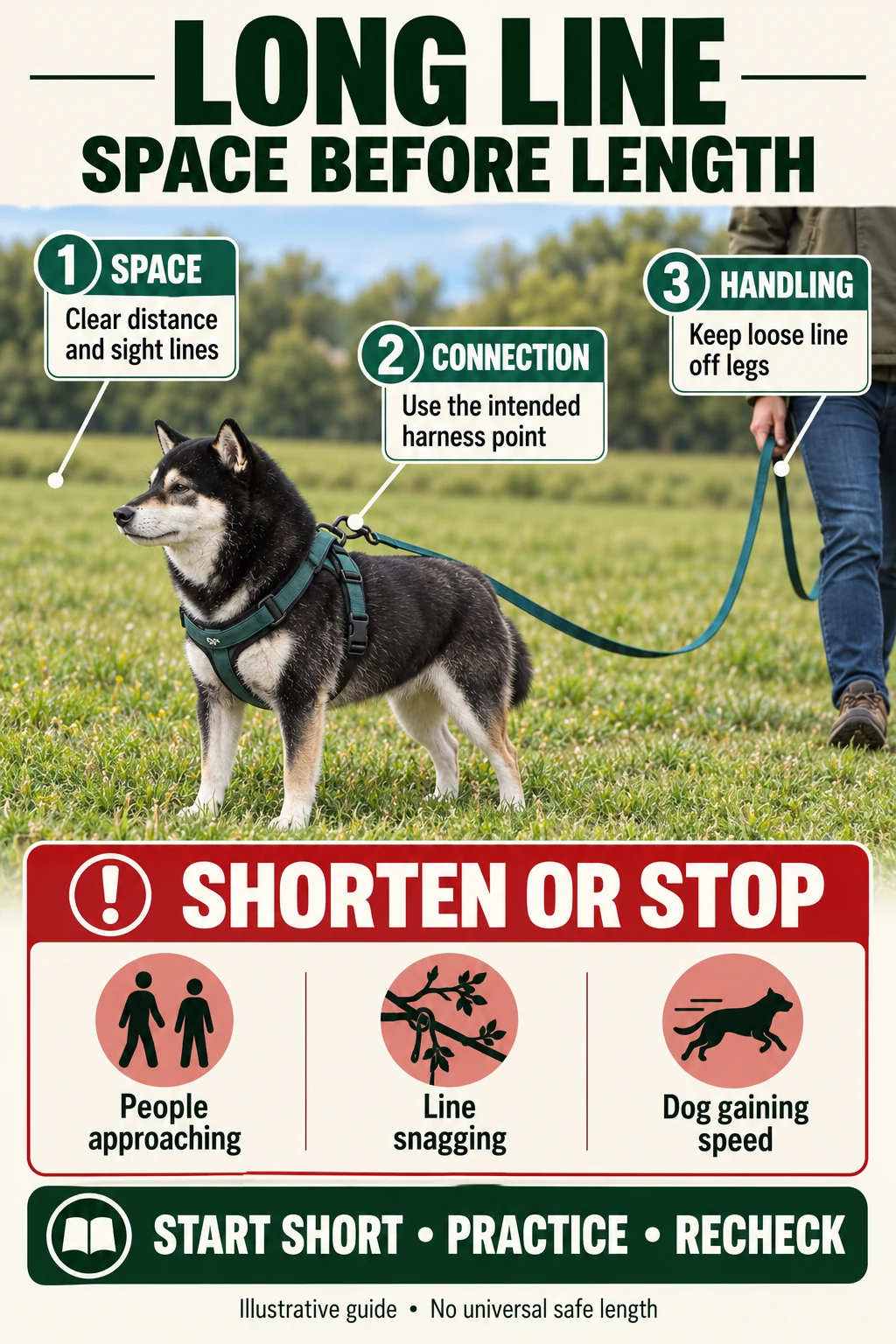
Space before length
- Identify a clear working area before deciding how much line to buy.
- Compare the full line, clip and handle, including how you will manage spare length.
- Use the intended attachment on a correctly fitted harness and follow the line maker's instructions.
- Shorten the working distance before people, obstacles or a change in the dog's pace create a problem.
- Practice managing the line before increasing distance.
- Keep a normal fixed leash for the journey to and from the training area.
What makes a long line different?
A fixed long line is a length of webbing, rope or coated material with an attachment for the dog. Some have a handle, while others are designed without one. Unlike a retractable leash, it has no housing that takes up spare length. The handler needs a plan for that material as the dog moves closer or farther away.
A training line, a walking leash and a tie-out can look similar in a search result while having different intended uses. Read the product instructions. A clip on each end, a stake included in a bundle or a padded handle does not establish suitability for every activity. Do not substitute a tie-out cable for a training line because the advertised length matches.
Company of Animals' Recall Line guidance distinguishes its training aid from a normal walking lead and explains why that particular design has no handle. Check the specific product you are buying rather than applying that detail to every long line.
Choose the working area first
Look for clear ground, usable sight lines and enough distance from roads, other dogs, people and places where the line could catch. Consider the whole path the line may take, not only where the dog is standing. A tree behind you or a bench between you and the dog can change the arrangement quickly.
Plan how you will shorten the line when somebody approaches. If you cannot do that comfortably without tangling or losing attention to the dog, start with less working distance or choose a different location. The line's full purchased length does not need to be in use throughout the session.
Battersea's long-line guide emphasizes managing spare line and watching the environment. It describes two-handed handling and notes the trip and snagging problems created by excess slack. Use that guidance with the maker's instructions and practical help from a qualified trainer if line management is unfamiliar.
This article's checks concern buying equipment and beginning supervised handling. They do not establish that a particular dog is ready for off-leash activity. A line gives you a connection; recall, awareness of the surroundings and suitable handling still need their own work.
Share & embed
Compare 20, 30, 50 and 100 feet
These are shopping labels, not training stages every dog should progress through. A larger number gives you more material to manage and lets the dog cover more ground before reaching the end. Consider your location, current handling and purpose before moving to another length.
| Length label | Approximate metric length | Question before buying |
|---|---|---|
20 feet | 6.1 metres | Can I manage this working distance and spare line in the chosen space? |
30 feet | 9.1 metres | Does the extra reach serve a specific exercise or sniffing area? |
50 feet | 15.2 metres | Can I retrieve the additional line promptly when the situation changes? |
100 feet | 30.5 metres | Do I have a clear purpose, suitable space and the handling experience for this much line? |
The metric figures are rounded unit conversions. They are not measurements of named products or recommendations for how far a dog should roam. A product sold as ten metres is approximately 33 feet, so do not assume it is exactly the same length as a 30-foot option.
If your 30-foot line repeatedly snags or gets underfoot, a 50-foot version adds material to the same problem. Resolve the handling or location issue first. If the current line stays manageable but a planned exercise needs more distance, compare the next option with that specific use in mind.
Nylon, rope and coated lines
Nylon webbing is a common starting comparison. Check its width, surface and how much space it occupies when gathered. Inspect the edges and stitching rather than assuming that every flat webbing line feels the same. Ask how the maker says to clean and dry it after wet or muddy use.
A coated line can be easier to wipe down, but coating does not establish a universal grip, weight or flexibility. Coachi's waterproof-line page identifies a non-absorbent outer surface on that particular product. Compare the actual construction and instructions instead of assigning the same properties to everything called waterproof.
Rope creates a rounder grip and can occupy a different amount of space in your hand or bag. Inspect its diameter, joins and clip as well as the rope itself. Any line moving quickly through a hand can create a handling problem; a soft-looking surface is not a guarantee against friction or injury.
Use the leash materials guide for the broader material comparison. For a long line, also ask how it will feel after an ordinary wet session, how you will transport it without covering other equipment in mud and whether you can inspect the full length easily.
Match the clip and handle to the job
A large metal clip may be awkward on a small dog's harness even when the line itself looks light. Check the clip's dimensions, gate action and the intended harness ring. It should close fully without trapping webbing, and its swivel should move as designed.
Choose the harness using its own size and fitting instructions. Dogs Trust's equipment guidance states that long lines should attach to a harness. A correctly selected attachment does not justify letting the dog accelerate into the end of the line. Our harness fit guide covers adjustment and ordinary movement checks.
A handle may help with a held-line arrangement, but a loop also needs to stay clear of snag points. A handle-free line may be intended for a particular training method. Check the instructions and get practical guidance before trailing equipment. Do not cut a handle off or make other modifications simply because a different design is recommended for another activity.
Keep line material away from fingers, wrists and legs; do not wind it around yourself to store excess. Start with a short working section and practice taking in and releasing spare length while the dog remains calm. If managing the line needs all your attention, shorten the task and seek instruction before adding distance.
Two long-line formats to inspect
These options differ in material and handle arrangement. Confirm the exact length and instructions on the linked listing. Both links are Amazon affiliate links, and neither product has been tested by What Dogs Like.
Total Pet's nylon-line page describes its control handle and length-adjustment arrangement. The linked US listing identifies a 30-foot option; the manufacturer's UK page uses metric variants. Check the exact supplied length and instructions. Neither the brand's hand-burn claims nor a control handle remove the need for careful line management.
Begin with a manageable rehearsal
Inspect the line with no dog attached first. Run your eyes over the full length for damage, check the handle or end finish and operate the clip. Lay out only the length needed for a short initial exercise. Keep the rest arranged so it cannot wrap around the handler or become a loop for a leg.
In a secure clear area, fit the harness and attach the line as instructed. Practice ordinary changes of distance at a walk. Take in spare line as the dog returns rather than leaving a large pile between you. Shorten early when the route or activity changes; do not wait until the dog is sprinting away or somebody has stepped into the line.
Stop if either of you gets tangled, the line catches or you cannot manage the dog's ordinary movement. Do not use a hard jerk or deliberate run to the end as a product test. A trainer can demonstrate the handling with your specific line and dog before you extend the working area.
Clean, dry and store the complete line
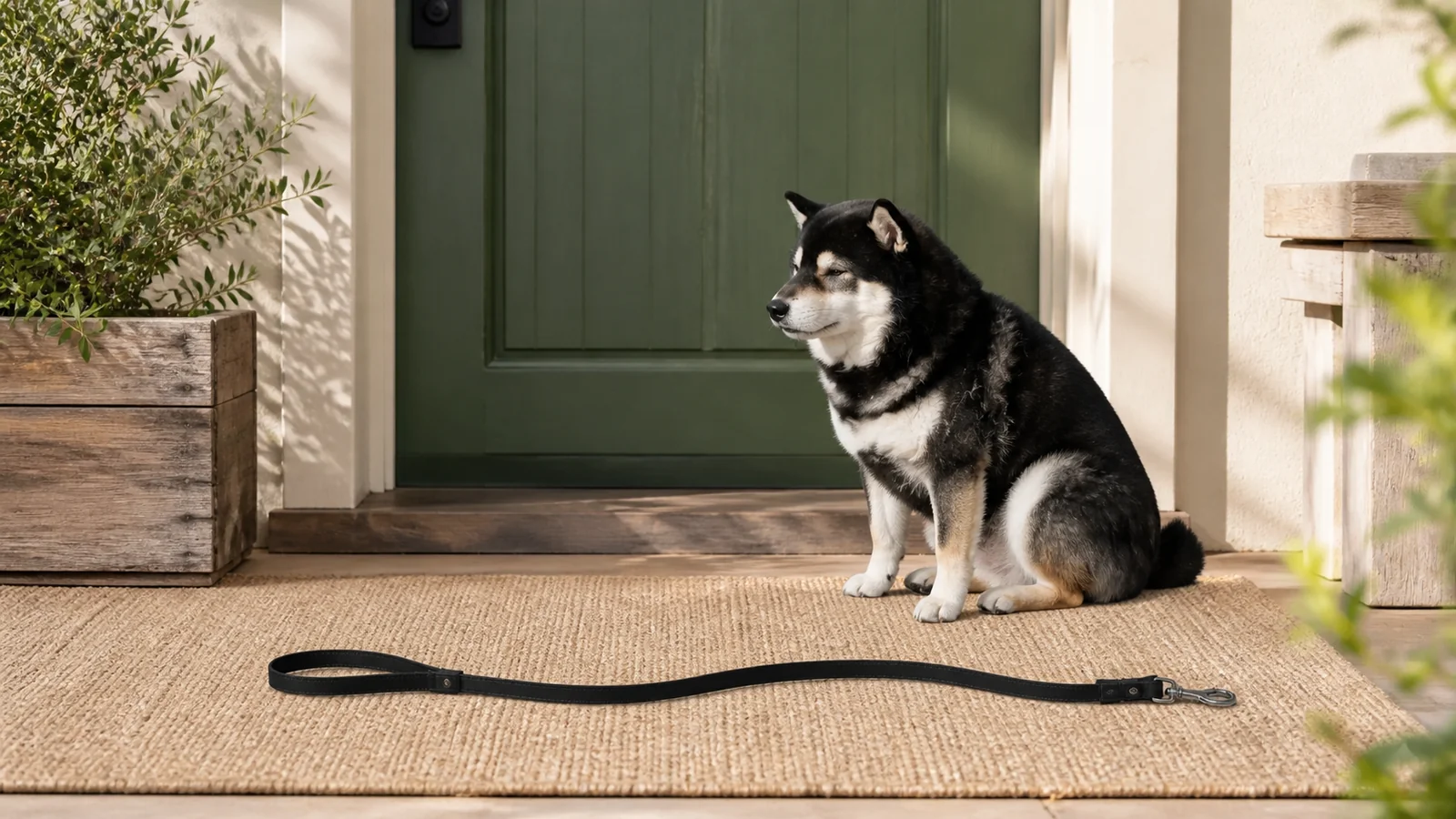
Follow the maker's care instructions for the strap or rope, clip and any padded section. Inspect joins and the full surface after muddy use. A clean-looking first few feet do not show the condition of the section that dragged behind the dog.
Store the line dry as instructed and keep its clip easy to find. Separate wet equipment from food, paperwork and clean bedding in your dog gear bag. Before the next session, check the clip movement again; grit or dried mud can make a previously smooth part awkward.
Two owner discussions ask about moving from 30 to 50 feet and managing a long lead without wrapping hands. Those are useful buying questions. Community handling suggestions do not establish safety; use the linked welfare and manufacturer guidance for the practical decisions.
Frequently asked questions
Is 30 feet the best long-line length for every dog?
No. Choose by the space, exercise and distance you can manage. A shorter working section can be useful even when you own a longer line. The label does not establish a universal training stage.
Should I buy 50 feet instead of 30 feet for more freedom?
First check whether the current distance remains manageable. More line adds reach and spare material; it does not fix snagging, poor line handling or recall. Increase distance only for a specific suitable use.
Is a ten-metre line the same as a 30-foot leash?
No. Ten metres is approximately 33 feet. Check the actual product length, units and variant rather than treating the labels as identical.
Should a long line attach to a collar or harness?
Use a correctly fitted harness and its intended attachment, following product instructions. Dogs Trust specifies harness attachment for long lines. Do not let the dog build speed and hit the end simply because the connection is on a harness.
Does waterproof mean the line will be easy to grip?
No. Compare the actual surface, width, stiffness and hardware. A wipe-clean outer can help with care, but it does not establish how every handler will manage that line when wet.
Should I choose a line with a handle?
Check the intended use. A held line and a line intended for an advanced trailing exercise can have different designs. Get practical guidance before changing methods, and do not modify equipment to imitate another product.
Can a long line replace recall training?
No. It maintains a connection during suitable supervised work. Recall and line-handling skills still need training, and the location must provide room to manage the dog and equipment.
Can I use the full line on a busy shared path?
Choose the working distance for the available space and other users. Keep a normal fixed leash for close transitions. If there is no room to prevent interference or tangling, use another location or arrangement.
Sources and next steps
Product identity, images and source information were checked on October 25, 2026. Return to the Dog Leashes hub for other formats. Compare a retractable leash as a different mechanism, and use the hiking guide for narrow routes and passing.