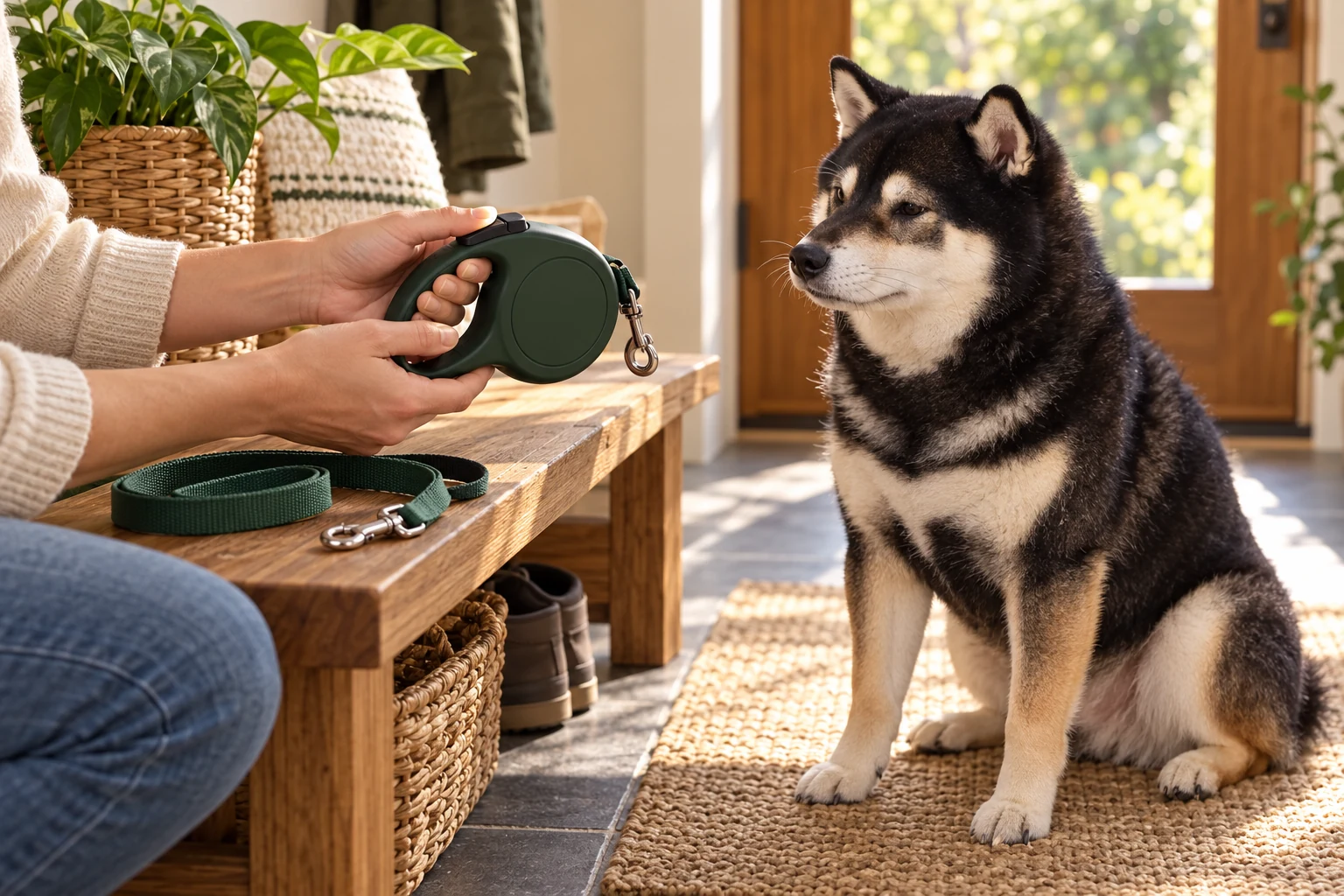
A retractable dog leash can provide variable working distance for a manageable dog in a suitable open space. Choose it by the dog, the route and the handler's ability to hold the casing and operate the brake. The longest advertised tape is not automatically the most useful option.
Keep a fixed leash for places where the dog needs predictable close control. Our leash length guide covers ordinary four- and six-foot choices, while the long-line guide compares a longer fixed connection without a retracting mechanism. This guide explains the buying checks for retractable equipment; we have not tested the products below ourselves.
Quick read
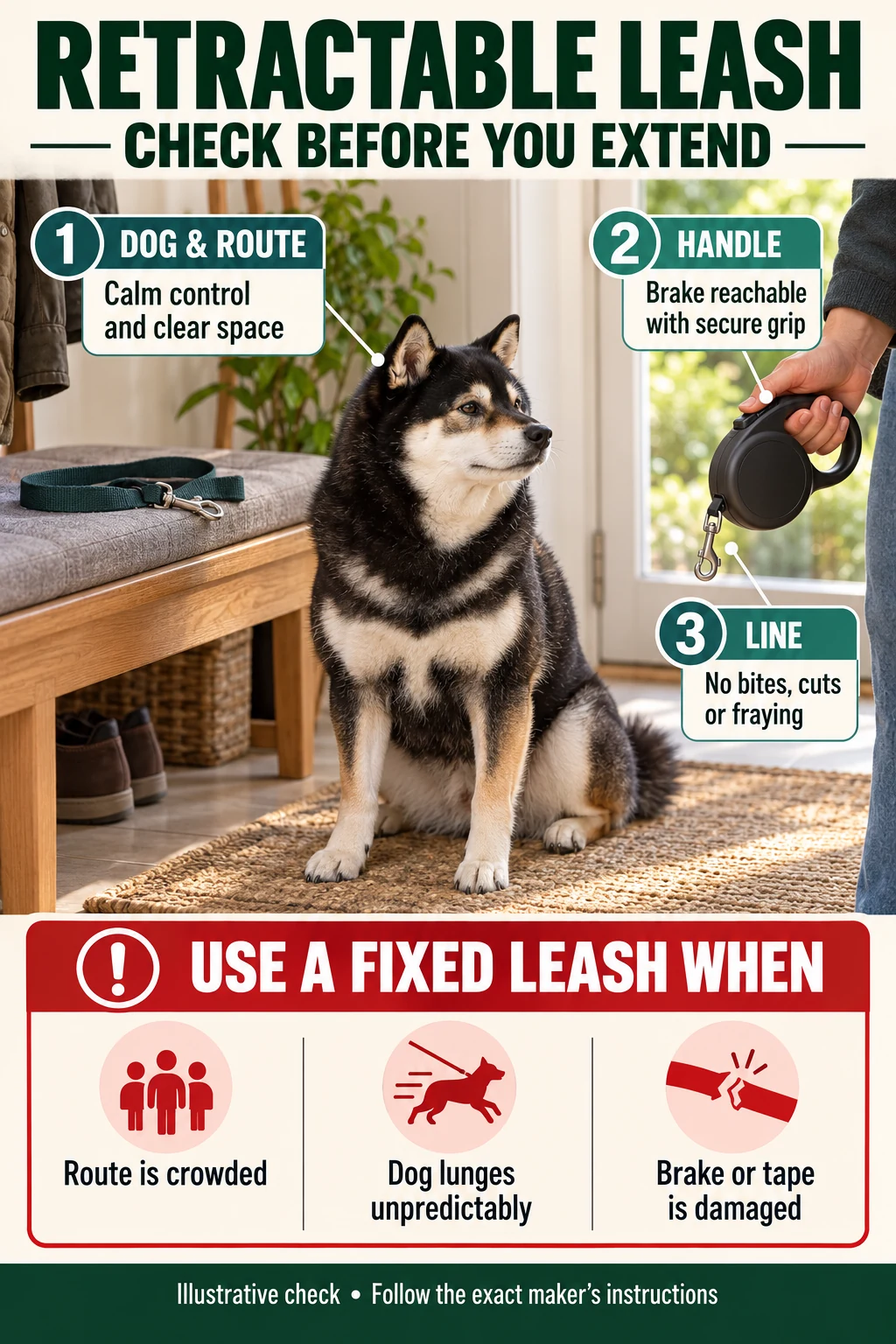
Check before extending
- Confirm the exact model's dog-weight limit and intended use.
- Try the grip and brake with the people who will actually walk the dog.
- Compare tape and cord by the whole product, not a blanket safety claim.
- Keep the line short where other people, animals or obstacles reduce usable space.
- Never grab the tape or cord to pull the dog back.
- Stop using equipment with a damaged line, unreliable brake or other defect.
Decide whether the format fits the outing
A retractable leash stores its spare tape or cord in a hand-held housing. The mechanism takes up slack as the dog comes closer, while the brake controls whether more line can leave the casing. This changes the handler's task compared with gathering a fixed leash or long line.
Assess the whole route. An open patch of grass reached through a busy parking lot still involves a close-control transition. Check whether you can manage the dog and the handle during gates, waste pickup and passing. If attention or grip is already stretched with a normal leash, extra distance and a brake do not resolve that problem.
Flexi's US precautions warn against using its leash with an uncontrollable dog and explain that crowded settings may call for a regular non-retractable leash. The instructions also make clear that a small dog still needs careful handling. Read the leaflet supplied with your exact product before deciding it fits the routine.
Dogs that lunge unpredictably or repeatedly try to escape need a suitable handling and training plan. Dogs Trust's guidance discusses well-fitted equipment, quieter locations and space from triggers. A larger retractable casing is not a substitute for that work.
Tape versus cord
Tape is a flatter strip, while cord has a rounder, narrower profile. Products in either category can have different lengths, clips, housings and braking arrangements. Check the current model instead of assuming that one format shares all the features of another.
| Feature | Tape option | Cord option | What to verify |
|---|---|---|---|
Line shape | Flat strip | Rounder cord | Actual width or diameter and condition |
Stored length | Model-specific | Model-specific | Useful working room on the route |
Housing and brake | Vary by model | Vary by model | Grip, button reach and maker instructions |
Care and inspection | Full strip needs checking | Full cord needs checking | Wear, bite damage, cleaning and drying |
Both formats require keeping the moving line away from hands and other body parts. Flexi's handling and care instructions explicitly warn against grabbing the line or winding it around the body. A broad tape is not permission to hold it like an ordinary leash, and a thin cord is not a solution for crowded space.
Think about what you can inspect. Unspool the line only as the maker directs, with no dog attached, and check the entire working surface. A clean casing can hide a damaged section farther along the line. Retire a damaged product as instructed rather than covering fraying with tape or tying a knot into it.
Share & embed
Size for the dog and the hand
Use the exact listing and maker chart to establish the supported dog-weight range. Size names are not standardized across brands. A product called Medium can differ in line construction, handle space and intended dog range from another Medium.
Then check the hand that holds it. Can the handler close their fingers comfortably around the grip and reach the brake without shifting into an unstable position? Would gloves change that? In a household with several walkers, each person needs to be able to use the casing and control the dog.
TUG's sizing guidance treats the handle as part of size selection and distinguishes its product ranges. It also shows why longer reach and a higher dog-weight limit are different specifications. Do not infer either one from the casing's size or from an “XL” label.
Do not buy a model beyond your dog's control needs merely to obtain a grip that fits. Ask the maker which model satisfies both requirements, or choose a different leash format. A comfortable hand opening does not establish that the spring, clip and line suit a particular small dog.
Understand the brake before the dog is attached
Read which control provides a momentary stop and how the product locks and releases. Names and button arrangements vary. Practice those operations with the dog securely elsewhere, following the instructions rather than improvising a force test.
The retraction mechanism takes up available slack; it is not a winch for dragging the dog toward you. Learn the maker's procedure for shortening the working distance and practice ordinary changes in a quiet suitable place. If you need to grab the line to manage the dog, return to a different arrangement and obtain practical guidance.
Check that your thumb can find the intended control without looking away from the surroundings for an extended time. A button that is awkward under gloves, a lock you cannot identify reliably or a casing that slips in your hand is a reason to reconsider the product before an outing.
Do not test braking by letting the dog accelerate and then stopping it abruptly. A successful stop in one staged event would not establish safety or durability. The useful initial check is whether the equipment operates as described and the handler can use it calmly and consistently.
Two tape-leash options to compare
These examples have similar advertised reach, so compare grip, controls and current model specifications rather than choosing by distance alone. Both links are Amazon affiliate links. Confirm the exact size and color on the destination page before ordering.
Check the delivered label against the order before trying it. If a listing combines several sizes or generations, the description beside a photograph may not establish the specification of every option. Ask the seller or maker to resolve a conflict; do not assume the largest number on the page applies to your variant.
Extra length needs a specific reason
Look at the area where the dog would use the extra reach. Can you see the whole path of the tape? Can somebody approach from a side path? Are there posts, bicycles or other dogs that could cross the line? Keep usable distance within what the surroundings and handling permit.
A longer version does not make an unsuitable route suitable. For planned distance exercises in a clear training area, compare a fixed long line and get instruction in managing it. It is a different mechanism, with its own spare-line and attachment questions; neither option removes the need for control.
For trails with frequent passing, roots and narrow sections, use the hiking leash guide to compare fixed length and close-control options. Check the destination's current leash rules. A line remaining physically attached does not by itself answer whether its working length is permitted or practical there.
One dog and the intended hand-held use
Read the maker's restrictions on accessories and attachments. Flexi's linked precautions prohibit attaching more than one dog, using more than one of its retractable leashes at a time and adding unapproved accessories to the housing. Do not turn that product into a two-dog system with a splitter.
Its current general instructions also specify hand-held use and prohibit using the leash to tie the dog. A carabiner clipped to the casing does not establish waist-leash compatibility. Use equipment expressly intended for hands-free walking if that is the decision, and assess the separate load and transition requirements.
If a route becomes crowded, change to your suitable fixed arrangement in a secure place while maintaining control of the dog. Avoid detaching the only connection at a busy entrance. Plan the transition before leaving home so it does not depend on juggling a loose dog and two unfamiliar clips.
Care and the next pre-walk check
Follow the maker's cleaning and drying directions. Flexi explains how to extend and lock a wet line for drying and remove dirt before it returns to the casing. That is a product-specific routine; inspect the supplied instructions rather than washing the complete mechanism like ordinary webbing.
Check the clip, housing, controls and full tape or cord before the next walk. Stop using the product if it is damaged or operates unreliably, and contact the maker about the appropriate next step. Do not open a spring-loaded housing or attempt a repair unless the manufacturer expressly provides for it.
Owner discussions about a small dog's leash with an awkward hand opening and replacing a long line with a retractable inform the questions below. They identify reader needs; the comments do not prove product safety or comparative performance.
Frequently asked questions
Is tape always safer than cord?
Do not make that assumption. Compare the exact product and follow its instructions. Both moving tape and cord need to stay away from hands and other body parts, and neither format fixes an unsuitable route or handling problem.
Should I choose the longest retractable leash?
Choose usable working room rather than maximum distance. Extra reach needs clear space and manageable control. It does not make a crowded route appropriate for extension.
What if the dog needs a small size but the handle is too small for me?
Ask the manufacturer which option meets both the dog specification and the handler's grip needs. Compare another design or format if necessary. Do not select by dog weight alone or assume a larger casing suits every small dog.
Can I grab the tape to bring my dog back?
No. Flexi expressly warns against grabbing its tape or cord. Learn the exact shortening procedure and use another arrangement if you cannot manage the dog without reaching for the moving line.
Does the reel pull the dog back automatically?
No. It takes up available slack as the dog comes closer. It is not a winch for retrieving a dog. Follow the maker's handling instructions and practice before using the equipment in a distracting place.
Can I attach a splitter for two dogs?
Do not assume that is permitted. Flexi's cited US precautions prohibit attaching more than one dog to its leash. Use the two-dog guide to compare arrangements actually intended for two dogs.
Can I clip a retractable leash to my waist?
Follow the exact product instructions. Flexi specifies hand-held use, so a clip or belt does not make that model a hands-free system. Compare equipment designed for the intended activity.
What should I do if the brake or tape is damaged?
Stop using it and contact the maker for the appropriate replacement or support route. Use other suitable undamaged equipment for the dog. Do not rely on a knot, tape patch or improvised housing repair.
Sources and next steps
Product identity, images and source information were checked on October 25, 2026. Return to the Dog Leashes hub for other formats or use the everyday walking guide for a basic fixed setup.