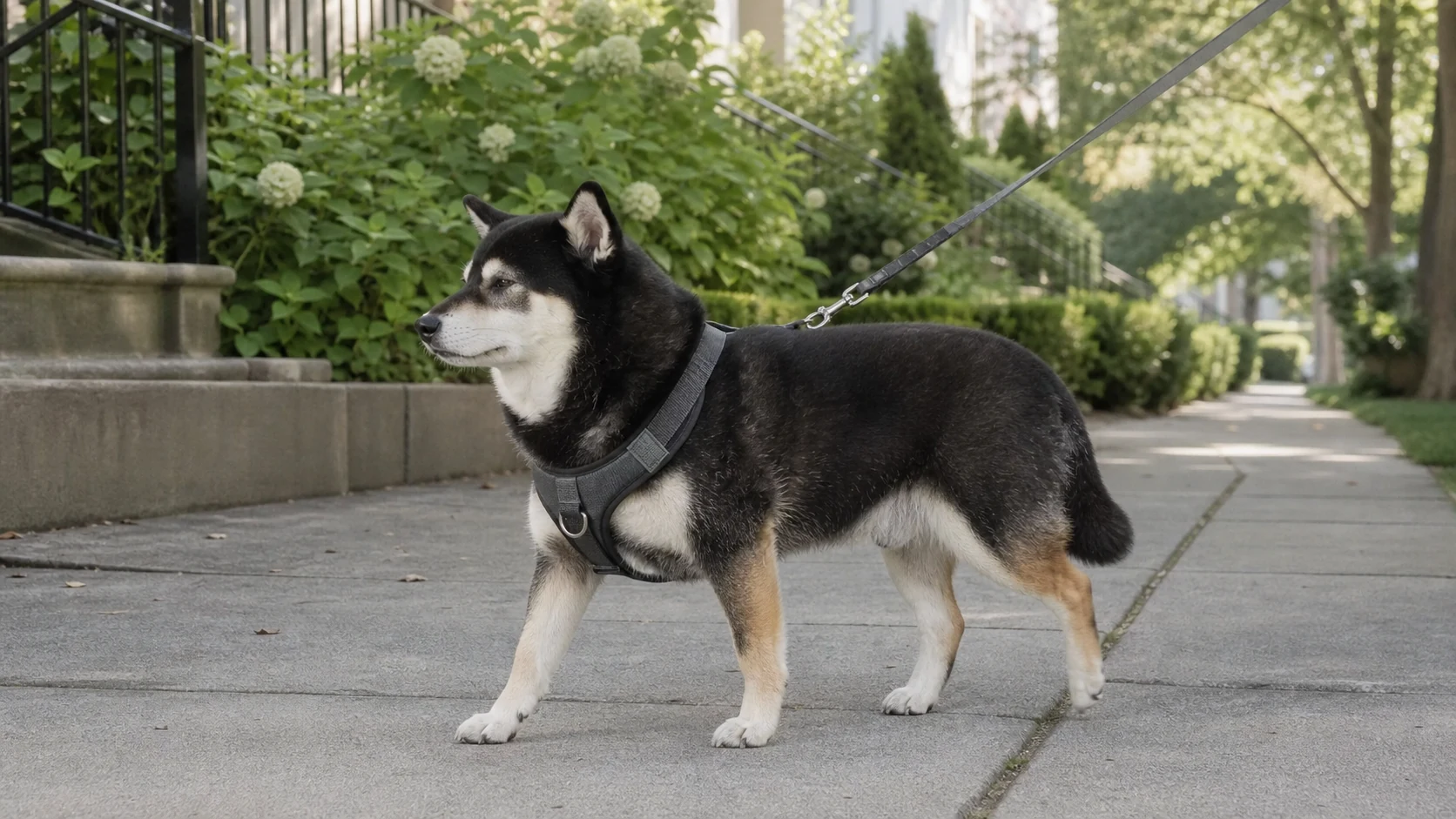
A no-pull dog harness can change leverage and make some walks easier to manage, but it does not teach loose-leash walking by itself. The useful question is not whether a harness can "stop pulling." It is whether the shape, attachment point, and fit give the handler better control without rubbing, restricting movement, or creating a new escape risk.
Start with the Dog Harnesses hub and the Dog Harness Fit Guide. If you are mainly deciding between attachment points, use Front Clip vs Back Clip Harnesses.
Quick read
Quick answer
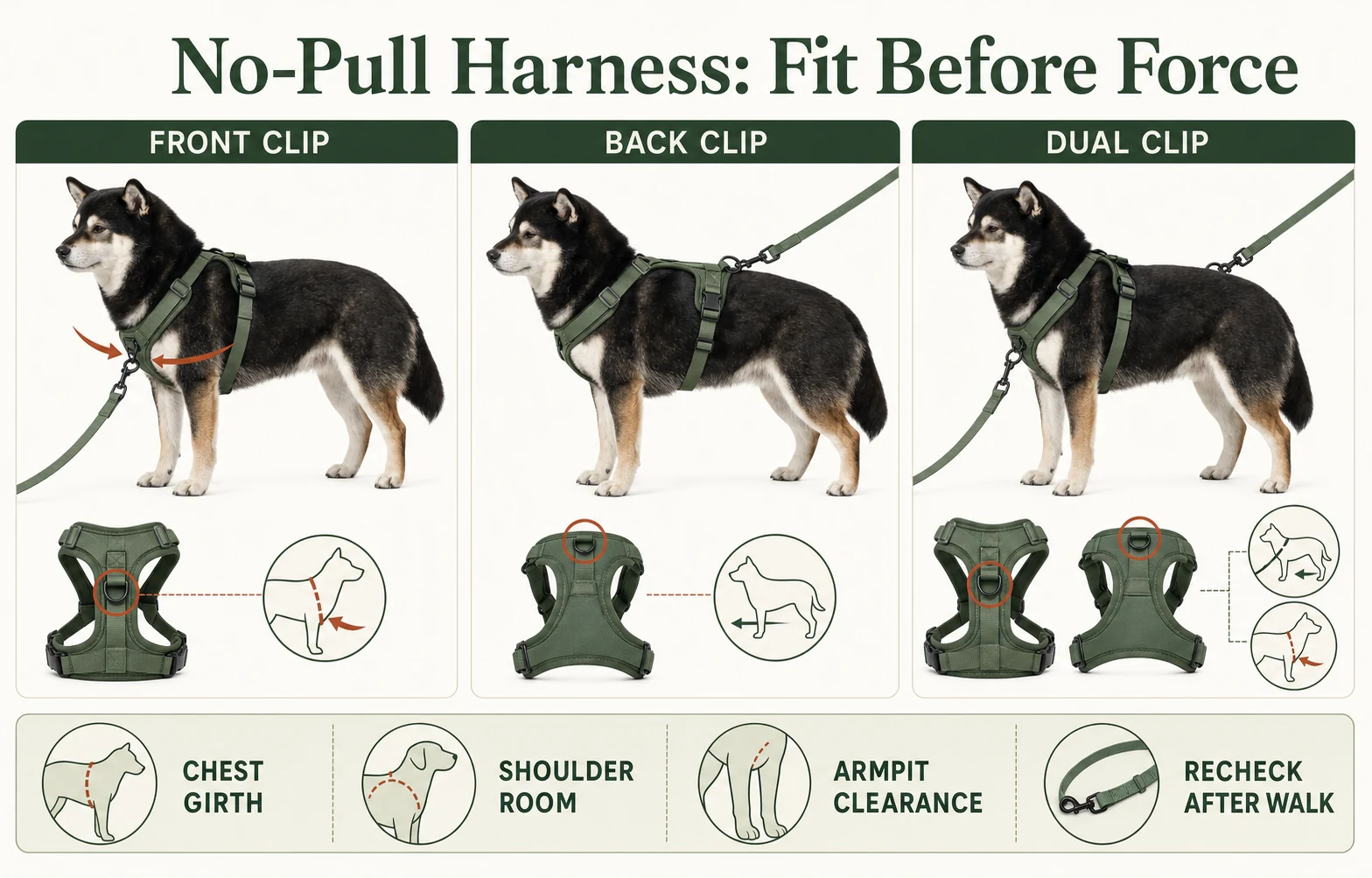
- Front clips can reduce forward leverage for some dogs by turning the chest when the leash tightens.
- Dual-clip harnesses offer more handling options, but both leash points must work with the dog's movement and the handler's setup.
- Fit matters more than the no-pull label: check chest girth, neck opening, strap path, armpit clearance, and rotation.
- A harness is management equipment, not a training result. Pair it with reward-based loose-leash practice.
- Stop and reassess if the harness causes rubbing, altered gait, freezing, panic, or repeated backing out.
Share & embed
What no-pull actually means
"No-pull" is a product category, not a guaranteed outcome. Most designs use one or more of these approaches:
- a front chest leash ring that changes the direction of tension;
- a dual-clip layout that allows front and back attachment;
- a strap pattern intended to reduce forward leverage;
- a tightening or martingale-style chest loop that changes tension under pulling.
None of these designs replaces timing, reinforcement, route planning, or professional help when pulling is severe. A dog can also continue pulling in a front-clip harness if the motivation is strong enough or the fit allows the harness to rotate.
Front clip, back clip, or dual clip
Dog pulls steadily forward
Front-clip harness
- Look for
Stable chest ring, no throat pressure, limited rotation
- Avoid
Expecting the clip to teach leash skills
Dog walks calmly most of the time
Back-clip harness
- Look for
Simple setup, shoulder freedom, secure fit
- Avoid
Assuming a back clip will reduce leverage
Handler wants two options
Dual-clip harness
- Look for
Both rings reinforced, optional double-ended leash, clear setup
- Avoid
Using extra straps without practicing handling
Dog backs out of gear
Multi-point adjustable design
- Look for
Secure neck opening, torso strap, backup connector
- Avoid
Calling any design escape-proof
Dog lunges or is hard to control
Professional fit and training support
- Look for
Hardware strength, handler plan, lower-distraction practice
- Avoid
Escalating to painful equipment without guidance
A front clip can help redirect the dog's chest, but the leash should not pull the harness sideways across the body. If the harness rotates dramatically or the front strap slides into the armpit, adjust it or try a different shape.
A back clip is easy to use and can be comfortable for relaxed walkers. It may give a strong dog more forward leverage, which is why it is not automatically the best choice for pulling management.
A dual-clip harness can support a front-only, back-only, or two-point setup. Two-point handling requires practice so the lines do not tangle and the dog is not pulled unevenly.
Fit checks before the first walk
Measure chest girth around the widest part of the rib cage. Compare that measurement with the current brand chart rather than relying only on weight or breed. Check the neck opening because some dogs have a narrow head, thick neck, deep chest, or long body that does not match a standard size label.
The harness should sit away from the throat and avoid pressing into the armpits. Watch the shoulder blade and front leg move through a normal stride. A Y-shaped front often creates more room for forward movement, but the actual strap position matters more than the product label.
Use the Dog Harness Fit Calculator for a cautious starting range and print the Harness Fit Checklist for the first several walks.
Shoulder movement and rubbing
No-pull designs sometimes use horizontal chest straps or close-fitting loops. If a strap sits directly across the moving shoulder or slides behind the front leg, it may change gait or cause rubbing. Look for flattened fur, heat, redness, or sensitivity after the walk.
Padding can reduce edge pressure, but bulky padding can also hold moisture and move the strap closer to the armpit. Clean and dry the harness according to its care instructions, especially after rain, mud, or swimming.
If the dog limps, shows pain, resists movement, or has a sudden gait change, stop using the equipment and seek veterinary guidance. Equipment selection should not be used to diagnose a movement problem.
Pulling management plus training
Use the harness to create a safer, more manageable learning environment. Practice in a quiet area, reward slack in the leash, change direction before tension becomes constant, and keep early sessions short enough that both dog and handler can succeed.
Strong lunging, fear, reactivity, or a handler who cannot safely hold the dog calls for qualified training or behavior support. The answer may involve distance, environment, handling skills, and a backup connection rather than simply a stronger harness.
Direct product CTAs
These are direct Amazon comparison points, not universal winners. Check the current size chart, strap path, materials, return policy, and fit on your dog before keeping any harness.
What Dogs Like may earn from qualifying purchases. Affiliate links do not change the fit, movement, and training checks in this guide.
Common mistakes
✓ Better buying habits
- Measure chest girth and neck opening.
- Check the harness under light leash tension.
- Watch shoulder movement from the side.
- Recheck fit after the first several walks.
- Pair equipment with reward-based practice.
- Use a backup connection when escape risk is real.
× Mistakes to avoid
- Buying only by weight or breed label.
- Treating "no-pull" as a guaranteed result.
- Tightening straps until movement is restricted.
- Ignoring rotation, armpit rubbing, or throat pressure.
- Leaving a wet harness on after the walk.
- Using stronger equipment instead of addressing fear or reactivity.
Related guidance
Use the Dog Harnesses hub for the complete harness path. Compare Front Clip vs Back Clip Harnesses, review Everyday Dog Harnesses, and use Best Escape-Proof Dog Harnesses when reversing out is the main risk. The Dog Leash Length Guide keeps the walking setup predictable; for puppy growth, use the Puppy Harness Size Guide.
Frequently asked questions
Do no-pull harnesses stop pulling?
No. They can change leverage and improve handling for some dogs, but loose-leash walking still requires practice, reinforcement, and an environment the dog can manage.
Is a front-clip harness better than a back-clip harness?
It depends on the dog and purpose. Front clips can help with pulling management; back clips are simple for relaxed walkers. Fit and movement matter in either design.
Can a no-pull harness hurt a dog's shoulders?
Any poorly fitted harness can rub or restrict movement. Check the actual strap path, shoulder motion, rotation, and post-walk skin rather than relying on the label.
How tight should the harness be?
It should remain secure without pressing continuously, shifting into the armpits, or blocking movement. Follow the manufacturer chart and inspect fit during a real walk.