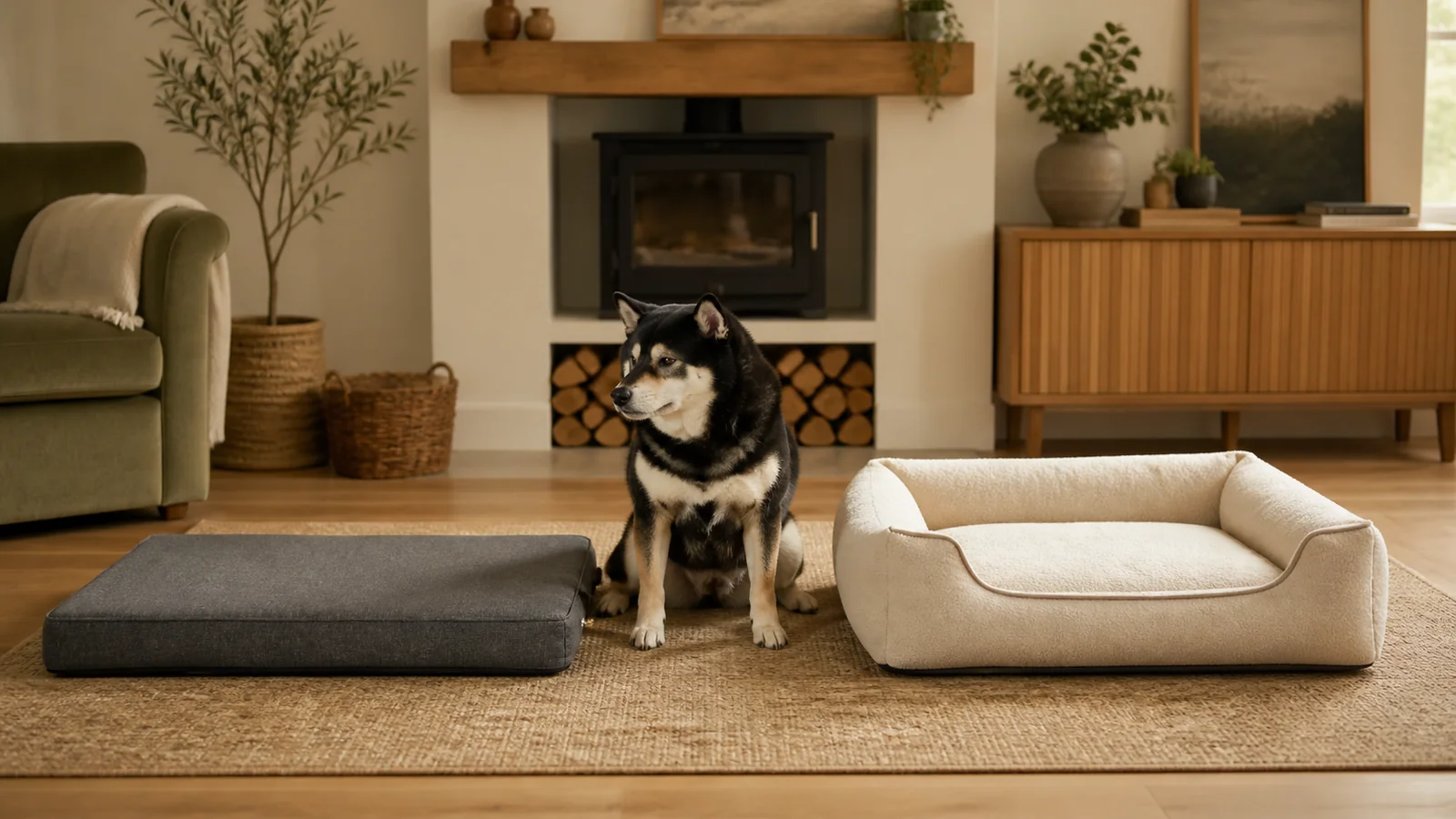
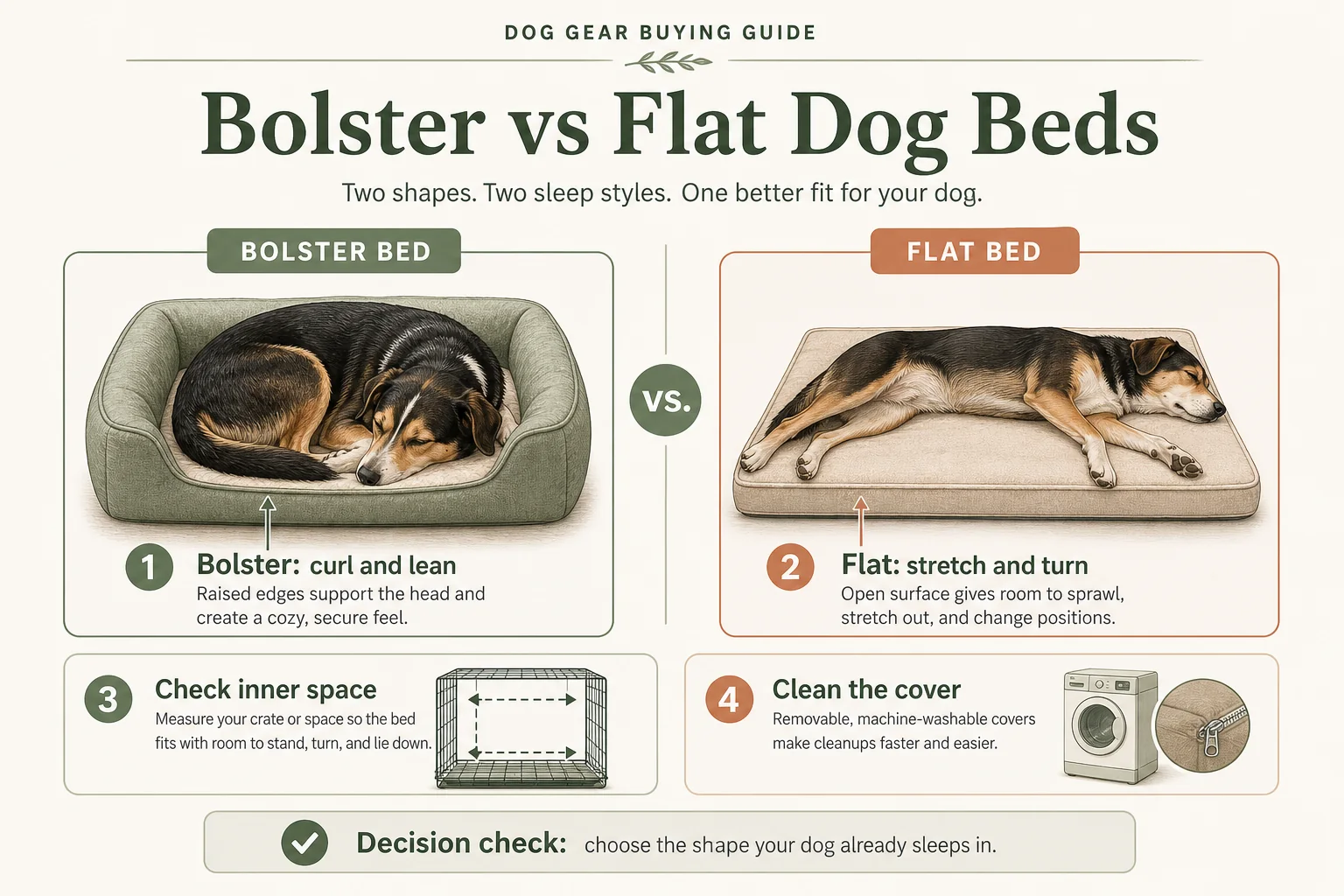
Bolster beds and flat beds solve different comfort problems. A bolster bed gives some dogs an edge to lean against, while a flat bed gives sprawlers and senior dogs more open surface area.
Use the Dog Beds pillar for the full buying framework. This guide helps you decide whether raised sides are useful or whether they simply take away sleep space. If room flow, door swings, or senior-dog access are part of the decision, pair it with the Dog Bed Placement Guide.
Quick read
TL;DR
- Choose flat beds for sprawlers, large dogs, warm sleepers, and dogs that need easy entry.
- Choose bolster beds for dogs that curl, lean, nest, or rest their head on an edge.
- Check inner dimensions on bolster beds because raised sides reduce usable space.
- Flat beds are often easier to clean and easier to place in tight rooms.
- Bolsters can be harder for stiff dogs if the sides are tall or the entry is narrow.
- Sleep style should decide the shape, not room decor alone.
Quick answer
If your dog stretches out, sleeps on their side, overheats easily, or changes positions often, start with a flat rectangular bed. If your dog curls tightly, leans against furniture, or uses pillows as a headrest, a bolster bed may fit better.
The safest choice when you are unsure is usually a larger flat bed. It leaves more usable surface area and does not force a dog into one posture.
Share & embed
Dog sprawls
Flat rectangular bed
- Look for
Open surface, easier entry, room to shift
- Avoid
Tight round or high-sided beds
Dog curls or leans
Bolster bed
- Look for
Raised side, secure feel, headrest support
- Avoid
Small inner dimensions
Senior or stiff dog
Flat or low-entry bolster bed
- Look for
Easy step-on access, stable surface
- Avoid
Tall sides and deep nests
Small room
Flat bed or low-profile mat
- Look for
Fits walls and corners, easier movement
- Avoid
Oversized bolsters blocking walkways
What bolster beds do well
Bolsters can make a bed feel more defined. Dogs that curl or press into sofa corners often enjoy a raised edge. The bolster can work as a headrest, backrest, or boundary.
If the dog also chooses to go under blankets, compare the supported opening and easy exit of a cave dog bed rather than assuming every raised edge needs a hood. For compact dogs, the small dog bed guide shows how to compare that edge with the usable center.
The tradeoff is space. A thick bolster can make the bed look large while leaving a smaller center. For medium and large dogs, that inner space is often the deciding detail.
What flat beds do well
Flat beds give dogs more freedom to stretch, turn, and enter from any side. They are easier to measure and often easier to clean because there are fewer seams and corners.
Flat beds are strong choices for orthopedic foam designs. They let support work across the whole sleep surface and avoid raised edges that may get in the way.
Support, warmth, and cleaning
Bolsters can trap warmth and hair along the edges. Flat beds may be cooler and simpler to vacuum or wash. If cleaning is a priority, compare removable cover design, zipper placement, and drying instructions.
For support-focused needs, use Best Orthopedic Dog Beds for Support. If the support question overlaps with memory foam, read Orthopedic vs Memory Foam Dog Bed. For cover and liner details, use Washable Dog Beds for Easier Cleanup. For fabric, foam, fill, liner, and warmth tradeoffs, read the Dog Bed Materials Guide.
| Option | Best for | Key features | Caveat | Merchant |
|---|---|---|---|---|
Flat orthopedic bed | Sprawlers, large dogs, seniors | Open surface, low entry, strong support baseline | Less cozy for curlers | |
Bolster dog bed | Curlers, leaners, head-resters | Raised edge, secure feel, nesting support | Less usable center space | |
Low-entry bolster bed | Dogs that like edges but need easy access | One open side, headrest, easier entry | Still needs inner measurement checks | |
Washable flat bed | Messy dogs and frequent cleaning | Simpler cover shape, easier drying | Less structured edge |
Category picks
These are category-level recommendations, not fixed single-product winners.
Common mistakes
✓ Better buying habits
- Watch how your dog sleeps before choosing shape.
- Measure inner dimensions on bolsters.
- Choose low entry for stiff or senior dogs.
- Prioritize flat beds for sprawlers.
- Check cover removal and edge seams for cleaning.
× Mistakes to avoid
- Buying a bolster because it looks cozy without checking usable area.
- Choosing a flat bed for a dog that always leans into edges.
- Ignoring heat retention in deep plush bolsters.
- Buying by outside dimensions only.
- Putting a bulky bolster where it blocks room flow.
Related guides
Use the Dog Bed Size Guide to measure shape and sleep position. Read Best Dog Beds for Large Dogs if surface area and support are major concerns. Use Orthopedic vs Memory Foam Dog Bed when foam support and contouring feel are part of the shape decision. Use the Dog Bed Materials Guide when material, liner, and cover feel matter as much as shape. Use the Dog Bed Placement Guide if a bulky bolster or flat mat needs to fit a bedroom, living room, office, or small apartment. Return to the Dog Beds pillar for the full bed framework.
Frequently asked questions
Are bolster beds better than flat beds?
Not universally. Bolsters help dogs that curl or lean; flat beds are often better for sprawlers and dogs that need easy entry.
Do bolster beds have less space?
Often yes. Raised sides reduce the usable center, so check inner dimensions.
Are flat beds better for senior dogs?
Often, because they are easier to step onto and allow movement from any side. Some seniors still like a low bolster.
Which bed is easier to clean?
Flat beds are often simpler, but cover design matters more than shape alone.
Can large dogs use bolster beds?
Yes, if the inner sleep area is large enough and the entry is not difficult.