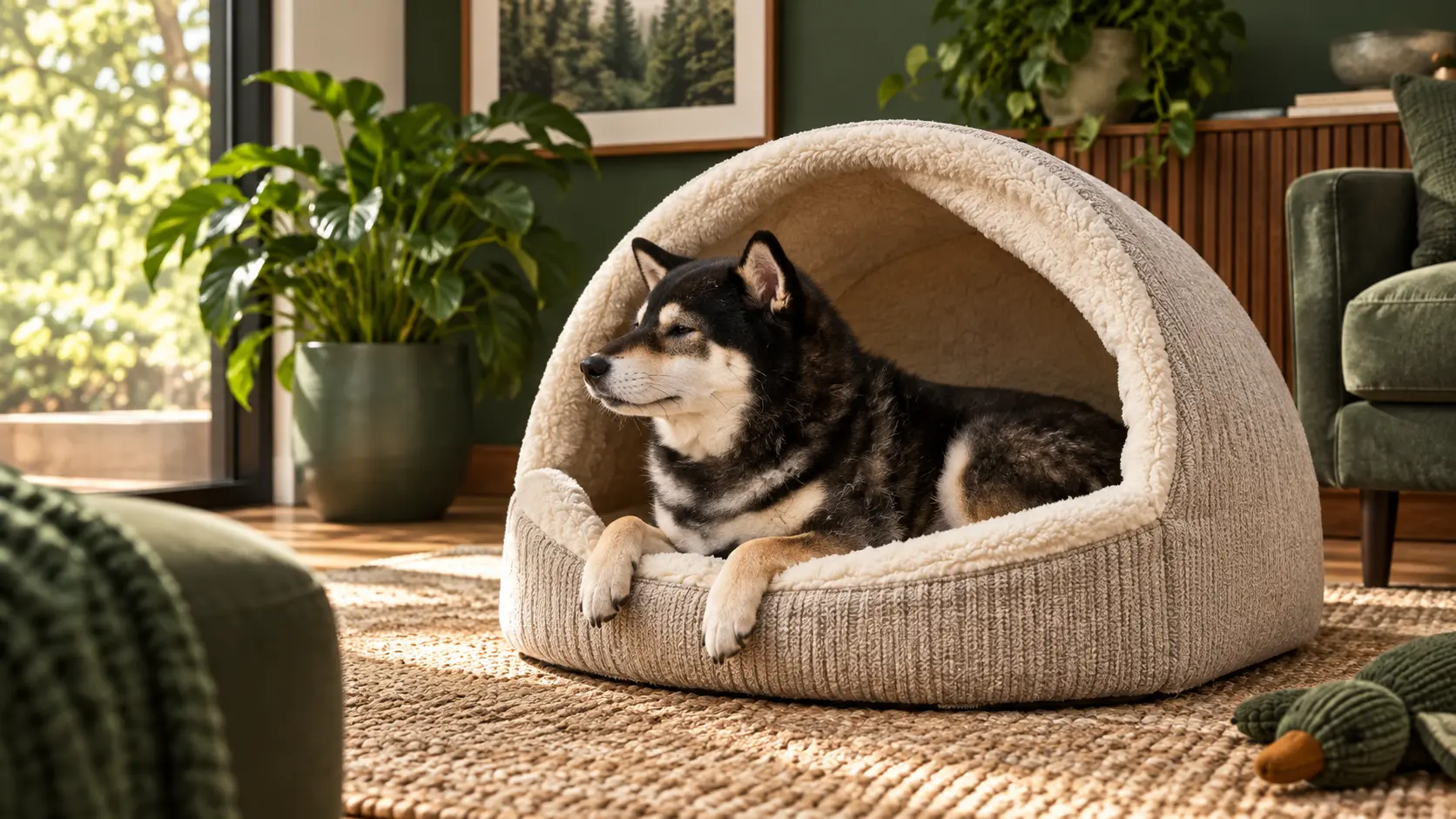
A cave dog bed can be a good match for a dog that already chooses to burrow under blankets. It is not the right choice just because the dog is small, anxious, or cold-looking in a photo. The hood changes the actual buying decision: the opening must invite voluntary entry, the inner surface must permit turning and resting, the dog must be able to leave easily, and the fabric must be cleaned and dried without trapping moisture. A dog that avoids enclosed spaces, runs warm, or shreds bedding may do better on an open bed.
The two exact Amazon comparisons below are a rectangular Snoozer Cozy Cave and a round Furhaven Snuggery. They illustrate meaningful shape and filling differences, not a claim that either brand has been personally tested. The pictures of Mr. Smoky are editorial illustrations, not proof of ownership or product use. We use manufacturer information for construction details and exact Reddit discussions only to identify questions people ask.
Quick read
Quick answer
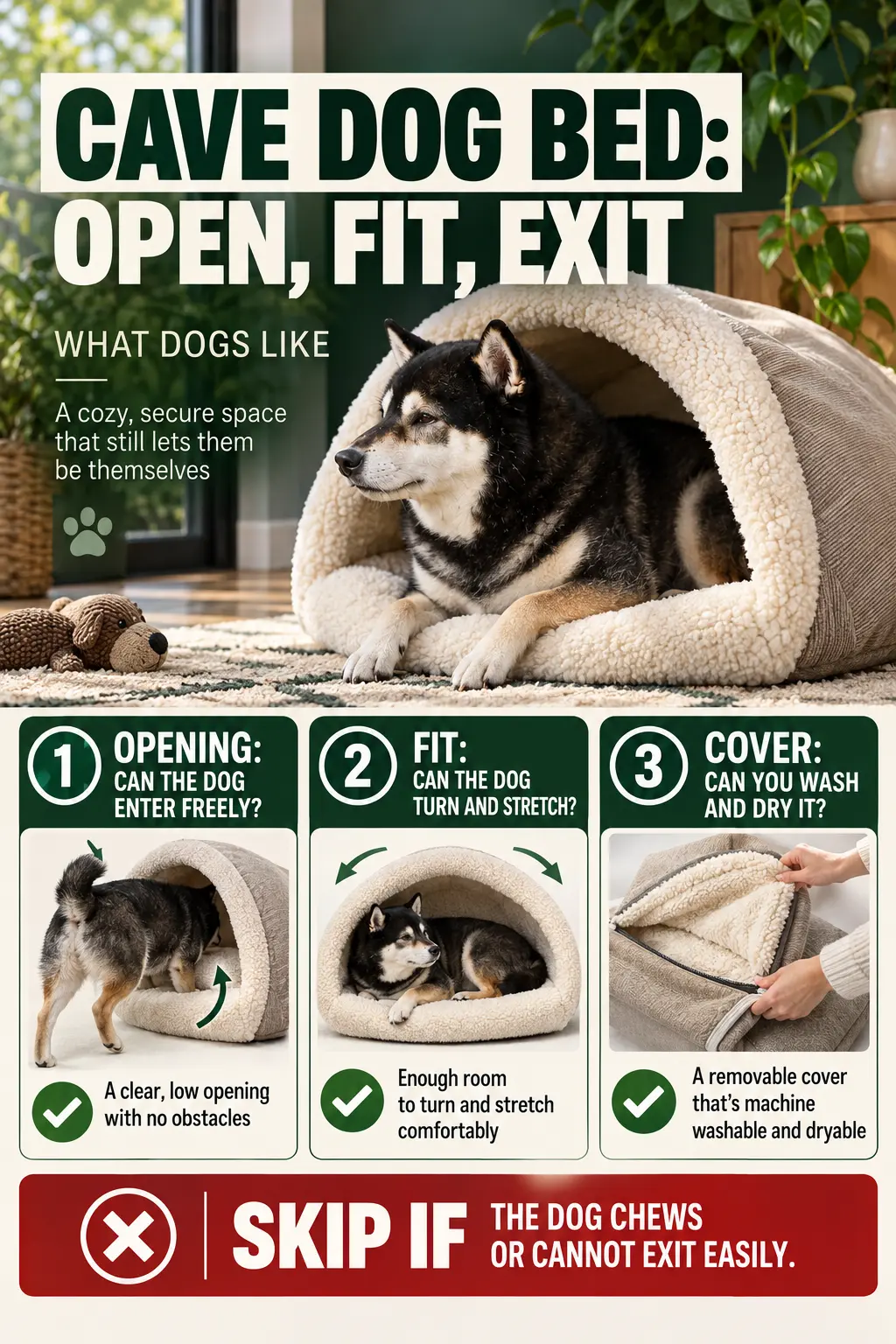
- Observed burrower: compare a hooded bed with an opening that stays accessible and a removable washable cover.
- Curler: a round cave can make sense if the inner circle fits the whole dog.
- Sprawler or long-bodied dog: compare a rectangular cave with enough usable length, or an open bed.
- Stiff, visually impaired, or hesitant dog: choose a low clear entrance and test an easy exit; an open bed may be preferable.
- Chewer or fabric swallower: skip loose hoods and exposed seams until that risk is managed.
Share & embed
First decide whether your dog wants a cave
Look at behavior before product photos. Does your dog regularly push under a blanket, settle under a table, or sleep with the head covered while retaining a clear route out? That suggests a hood may match an existing preference. Does the dog pull a blanket off, rest on cool tile, avoid enclosed crates, or choose a position with a view of the room? That points toward an open bed. A Reddit discussion asking whether a burrowing bed helps an anxious dog captures a common shopping question, but owner anecdotes cannot establish that a cave bed treats anxiety. Distress, sleep changes, or fear need a separate behavioral or veterinary assessment.
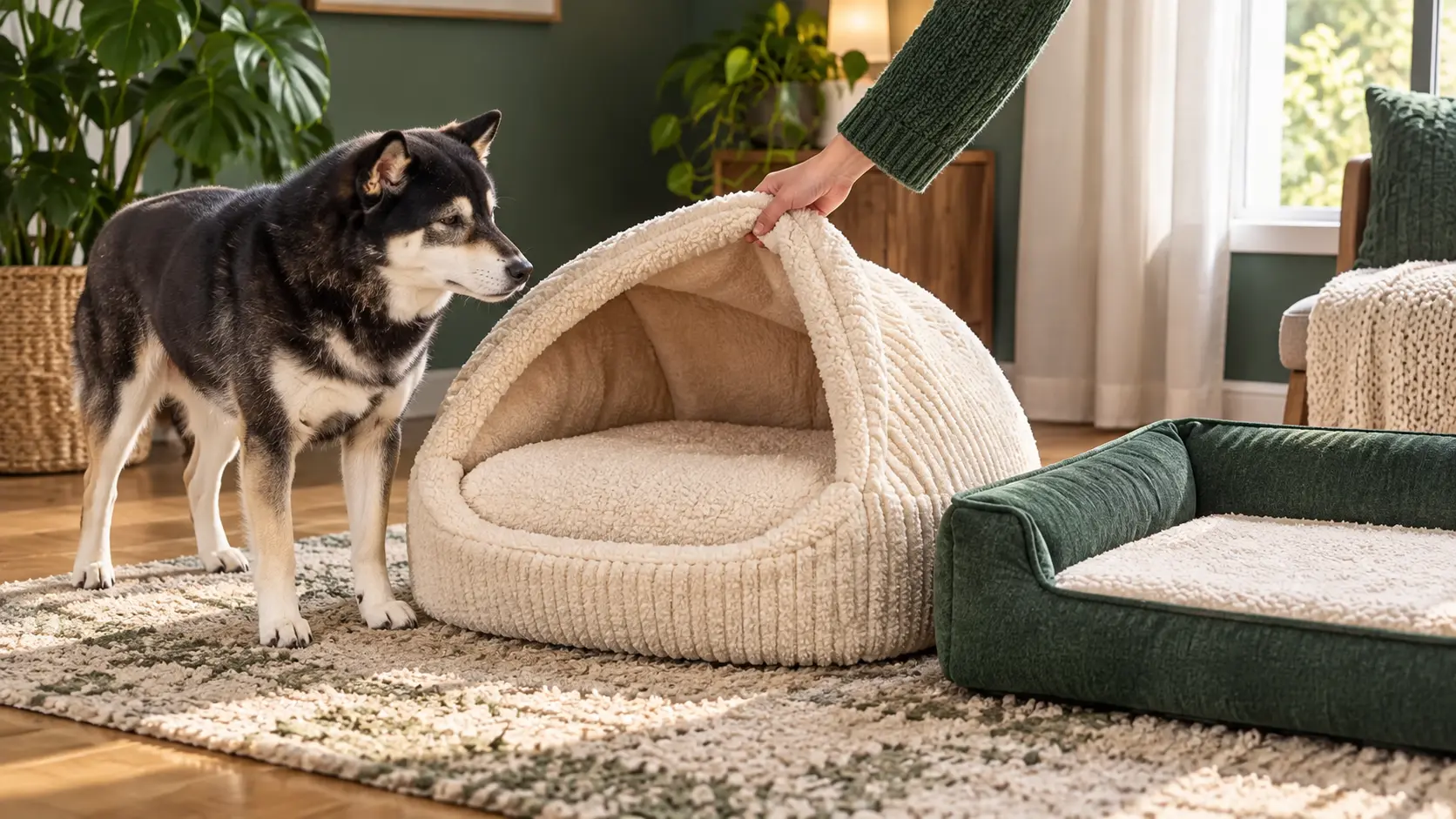
Offer a low-stakes trial before buying an expensive cave: put a light, breathable blanket partly over a familiar bed while you are present, leaving a broad open side. Watch whether the dog chooses to enter and exit. Do not trap the dog under a heavy blanket or force them into a covered space. This trial cannot predict response to every hood construction, but it can reveal obvious aversion. If the dog ignores the cover and loves the familiar bed, it may be better to keep that setup.
Burrower who curls
Round hooded bed
- Look for
Clear opening and enough inner diameter
- Avoid
High outer diameter with cramped inside
Long-bodied burrower or sprawler
Rectangular hooded bed
- Look for
Usable interior length, width, and turning room
- Avoid
Narrow entrance or low roof over the whole dog
Dog likes an edge but not a roof
Open bolster bed
- Look for
Lower front entry and visible room
- Avoid
Paying for a hood the dog avoids
Dog is stiff, runs warm, or chews fabric
Open low-entry bed
- Look for
Easy exit, breathable cover, safer inspection
- Avoid
Heavy plush, trapped heat, or loose material
How the hood works changes the experience
Some cave beds use a flexible tube or hoop to prop the entrance open. Others use an attached blanket that lies partly over the dog. The Snoozer Cozy Cave installation guide shows a removable hood tube. The manufacturer also describes its round Cozy Cave and rectangular Cozy Cave with a Sherpa lining, poly-cotton exterior, and removable washable cover for the classic versions. Check the exact variant because orthopedic, microsuede, waterproof-style, and fully washable versions may differ.
Furhaven's Faux Sheepskin Snuggery uses an attached blanket and optional plastic tubing to shape its entry. The maker describes a removable washable cover and several foam options, which is a reason to verify the linked orthopedic-foam variant rather than assuming every Snuggery has the same core. The maker also warns against use by destructive chewers. A product photo cannot tell you how the hood behaves after repeated use; assembly instructions and the dog's observed entry are more useful.
A propped opening is useful for a dog that wants cover but does not want to lift fabric with the nose. A draped hood can feel more blanket-like to a practiced burrower. Neither is automatically safer. Check that the tube stays in place, is removed for washing as instructed, and does not become exposed after chewing or wear. The entrance must not collapse onto a dog that struggles to push out. If the dog is old, unsteady, visually impaired, or frightened by moving fabric, compare an open bolster instead.
In a Reddit question about cave-bed entry and the hoop, owners discuss exactly this distinction. That discussion is useful for question discovery, not proof that one hood design is best. Our recommendation is to verify the manufacturer's assembly instructions, observe voluntary entry and exit, and return the bed if the mechanism prevents normal movement.
Round versus rectangular is a fit decision
The round shape suits a dog that curls and likes a continuous border. Its listed diameter, however, includes the hood and raised outer edge; it does not equal the sleeping circle. A long-bodied dog can be cramped in a large-looking round bed. The rectangle can provide more usable length and may fit against a wall without projecting as far into the room. It may suit a dog that stretches partly under cover, but only if the entrance width and roof height permit a comfortable turn.
Measure your dog in the longest relaxed posture and add turning space. Compare that measurement with the interior mattress or pillow dimensions and the clear opening—not only the outside footprint. If the listing does not provide those, ask the maker or retailer. The Dog Bed Size Guide covers body measurement and interior-versus-exterior area. For a small dog, the Small Dog Beds Guide compares round nests with low-entry rectangular beds more generally.
Use the bed in the planned room when judging size. A large cave can block a walkway, door, or heat vent. A cave wedged behind furniture may make the exit less obvious. The Dog Bed Placement Guide helps find a calm location where the dog can see and leave without being stepped over.
| Construction | Best for | Fit check | Care check | Reason to choose open bed instead |
|---|---|---|---|---|
Round supported-hood cave | Compact curler that voluntarily burrows | Inner circle and entrance height | Cover removal, tube removal, full dry | Dog sprawls or repeatedly hits rim |
Rectangular supported-hood cave | Longer burrower or dog that partly stretches | Interior length and turning width | Cover/liner separation and drying | Entrance feels narrow or roof collapses |
Draped blanket hood | Experienced nose-first burrower | Can dog lift and leave freely? | Attached fabric and seam care | Dog is hesitant, stiff, or grabs fabric |
Open bolster or flat bed | Dog wants edge or easy access without roof | Low entry and usable surface | Removable cover and protected core | No reason to add a hood |
Warmth, ventilation, and room temperature
A hood and plush lining reduce the movement of air around the dog. That can feel attractive in a cool room, yet be uncomfortable in a warm bedroom or summer apartment. Do not present a cave bed as “cool in summer” merely because a listing says so. Watch whether your dog stays under the cover, moves out, pants, or seeks tile. Always leave a normal-temperature alternative resting place. The dog needs freedom to leave the hood at any time.
Do not put a cave bed in direct sun, over a heating vent, or beside a space heater. If you use an electric heating product, follow its exact safety instructions and ask a veterinarian about medically vulnerable dogs. A plush hood is not a substitute for safe ambient temperature. Our Cooling Dog Beds Guide covers warm-weather surface choices and the limits of any cooling accessory.
Washability is more than a zipper
The outer cover, hood lining, inner pillow, and optional foam core may have different care rules. Confirm exactly which pieces come off and which may enter a washing machine. The Snoozer classic versions list a machine-washable removable cover; that does not mean every filling and hood component should be washed together. Remove tubing where directed, wash according to the exact label, and dry the hood and seams fully before reassembly. Trapped moisture inside a folded hood can produce odor even when the visible surface seems dry.
If your dog has accidents, drools heavily, or returns from wet walks, ask whether an inner liner protects the pillow or foam. “Washable cover” is not the same as “protected core.” The Washable Dog Beds Guide explains cover, liner, and fill separately, while the Waterproof Dog Bed Guide focuses on seams and moisture routes. A replacement cover can extend the life of a bed, but only if it fits the exact shape and size; check the current manufacturer's parts catalog before treating that as guaranteed.
For a dog that digs at the entrance, inspect the underside of the hood, seams, and zipper after each early use. If fabric is missing, remove the bed and contact a veterinarian about possible ingestion. No “durable” claim makes swallowed material safe. The Chew-Proof Dog Beds Guide provides a behavior-first framework; a cave with an attached hood is especially poor for a dog that targets loose fabric edges.
Two exact Amazon comparison points
These are two different shapes and constructions, not a performance ranking. The linked ASINs identify a small olive rectangular Snoozer and a 26-inch gray round Furhaven with an orthopedic-style foam base; their fallback images were matched to those exact variants through the Amazon catalog. Confirm the current size, color, filling, seller, availability, and returns before buying. As an Amazon Associate, What Dogs Like earns from qualifying purchases.
If the dog does not voluntarily seek a roof, neither card is the best pick. Consider a Bolster vs Flat Dog Beds comparison instead. The cave category is worth buying only when it solves a real preference while preserving easy entry, exit, cleaning, and room comfort.
A safe introduction and return-window test
Assemble the hood exactly as instructed. Feel inside for sharp or exposed tube ends, hard seams, loose hardware, or packaging material. Set the cave beside the dog's familiar bed in a comfortable room. Leave both available. Do not lure the dog so far under the hood that it must struggle to back out. If the dog chooses to enter, observe a full turn, rest, rise, and exit. Check that the bed does not tip or slide when the dog pushes through the opening.
Repeat the observation at different room temperatures and after the first cover wash. If the dog chooses the open bed, pants under the hood, drags the cover apart, or cannot turn without compressing against the rim, choose a different size or an open construction. Keep packaging and review return conditions before washing or removing tags. Product preference is individual, and a longer trial is useful only while the bed remains safe and returnable.
Frequently asked questions
Are cave dog beds good for anxiety?
They may match a dog that already likes covered resting places, but they are not evidence-based treatment for anxiety. Observe voluntary use and address persistent fear or separation distress with a veterinarian or qualified behavior professional. Do not infer an emotional diagnosis from a bed preference.
What is the difference between a cave bed and a donut bed?
A donut offers a raised perimeter while keeping the top open. A cave adds a hood or attached blanket that changes entrance, warmth, visibility, and cleaning. If the dog likes an edge but avoids cover, a donut or bolster may be a better fit.
Should the hood stay propped open?
Follow the exact manufacturer's instructions. A removable tube can hold some hoods open; leaving it out creates a different draped-blanket feel. Choose the configuration the dog can enter and exit without struggle, and remove the tube for washing where directed.
How do I size a Cozy Cave bed?
Measure the dog's longest relaxed posture and turning width, then compare with the interior surface and clear opening of the exact shape and size. Do not treat the round outside diameter or rectangle outer footprint as usable sleeping room. Long-bodied dogs may need more length than weight charts suggest.
Are cave beds too hot for dogs?
They can be too warm in a hot room, direct sun, or for a dog that already seeks cooler surfaces. Keep an open alternative and watch the dog's behavior. Move the bed or choose breathable open construction if the dog leaves, pants, or looks uncomfortable.
Can a senior dog use a cave bed?
Possibly, if the entrance is low and clear, the surface supports easy movement, and the dog can turn and exit normally. A stiff or unstable dog may do better on a low open bed. Ask a veterinarian about persistent mobility changes rather than relying on a bed label.
Can I wash the whole cave bed?
Do not assume so. Many designs have a removable cover, separate inner pillow or foam, and hood tubing with different care rules. Follow the exact variant's label and dry the hood, seams, and core fully. AKC's bed-cleaning guidance emphasizes material- and instruction-specific care.
What if my dog will not go inside?
Leave the bed near the familiar resting place and allow voluntary investigation; do not push the dog under the hood. Try the manufacturer-permitted open-hood configuration. If the dog repeatedly chooses an open bed, that is a useful answer—return or replace the cave within the policy.
Is a cave bed safe for a dog that digs or chews blankets?
Digging and swallowing are different risks. Inspect fabric, seams, and tube access during supervised use. If the dog tears pieces loose or swallows material, remove the bed and seek veterinary advice. A hood creates more fabric to grab, so an open durable surface may be more appropriate.
Bottom line
Buy a cave bed for a proven burrower, not for a keyword or a promise of calm. Decide between round and rectangular by measured usable space, then verify the hood opening, easy exit, wash-and-dry workflow, and chewing risk. Keep an open alternative available so the dog—not the product label—can show whether the cave is a good fit.