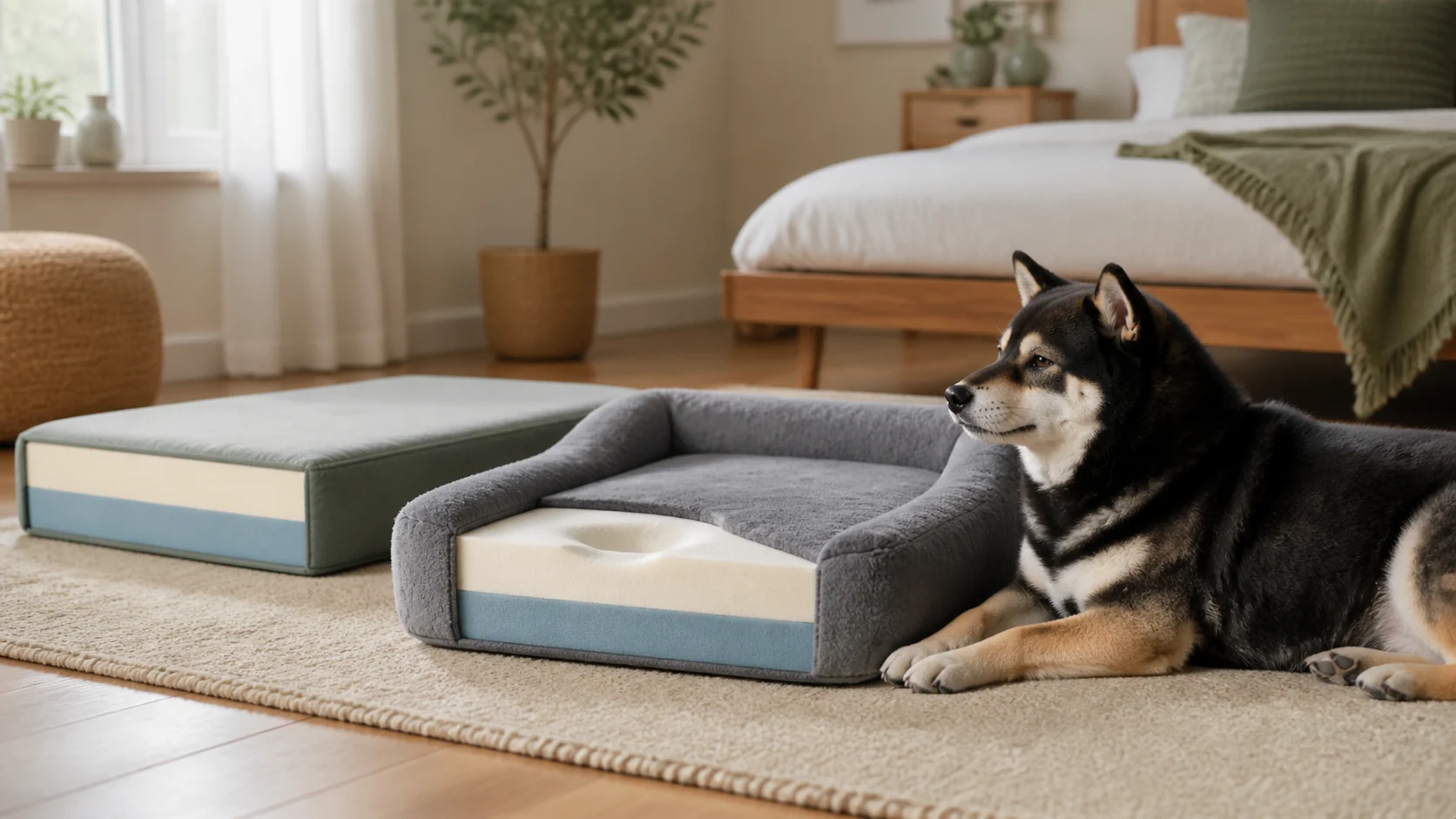
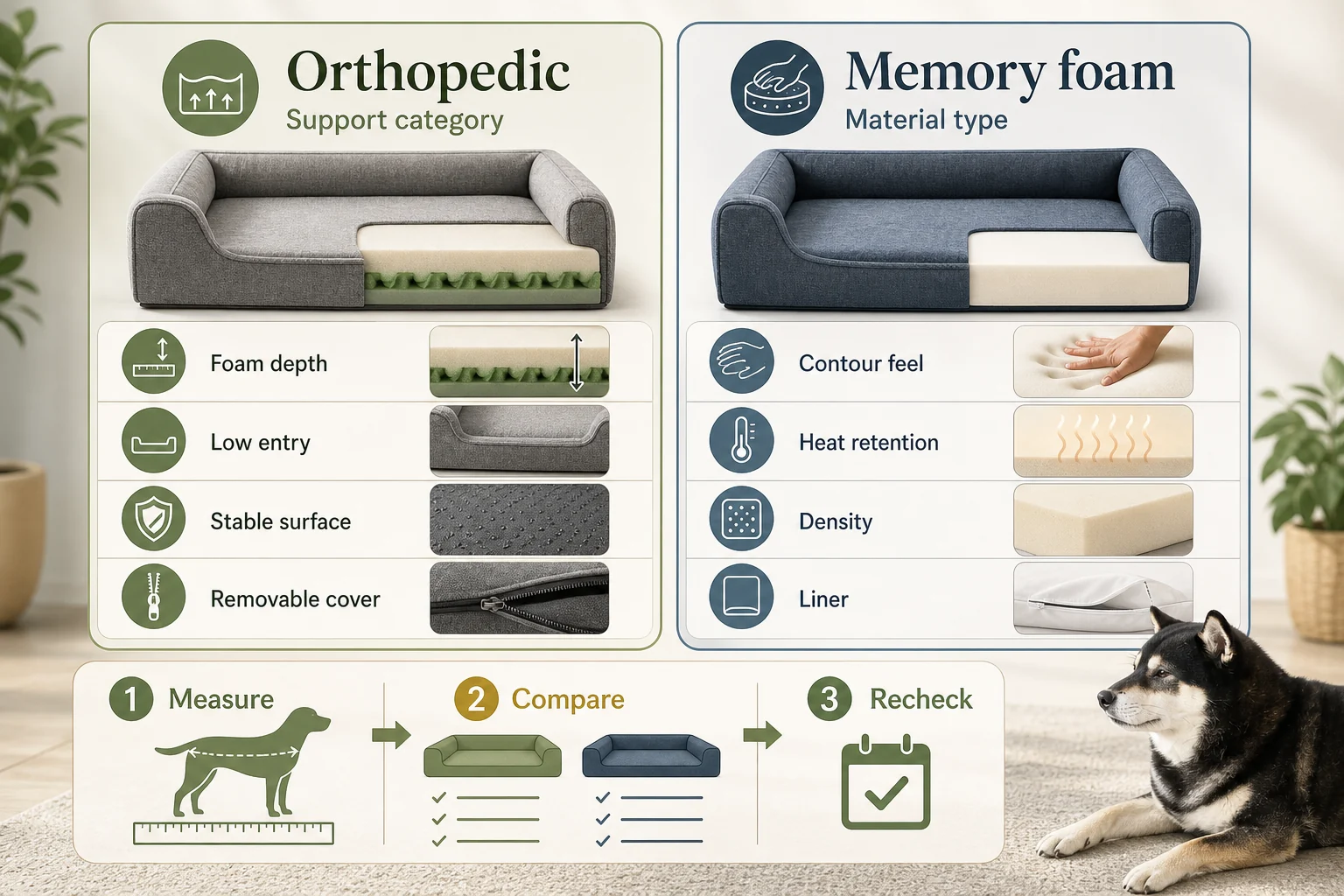
Orthopedic and memory foam are not the same kind of label. Orthopedic usually describes the support goal of the bed. Memory foam describes one material that may be used inside the bed. A dog bed can be orthopedic without being all memory foam, and a memory foam bed is not automatically supportive enough for every dog.
Start with the Dog Beds pillar for the full bed framework. Use this guide when the confusing part is whether to prioritize a support-focused orthopedic bed, a contouring memory foam bed, or a layered foam design with washable cover and liner checks.
Quick read
Quick answer
- Choose orthopedic first when the main problem is support, foam depth, low entry, and a stable sleep surface.
- Choose memory foam carefully when you want contouring comfort, but still need to check heat retention, density, and whether the bed bottoms out.
- For large or senior dogs, support usually matters more than a soft first touch.
- For warm sleepers, compare breathable covers, airflow layers, and whether dense foam feels too warm.
- Do not treat either label as medical advice. Ask a veterinarian about pain, limping, stiffness, recovery, or sudden mobility changes.
Share & embed
Orthopedic vs memory foam at a glance
| Decision point | Orthopedic dog bed | Memory foam dog bed |
|---|---|---|
| What the label means | Support-focused category | Foam material type |
| Main buying question | Does the bed keep the dog supported? | Does the foam contour without trapping too much heat or compressing too far? |
| Best for | Large dogs, senior dogs, heavy dogs, long rest periods | Dogs that like a contouring feel and need a softer top layer |
| Key checks | Foam depth, stable surface, low entry, usable size | Density, heat retention, contour feel, support layer below |
| Cleaning checks | Removable cover, liner, zipper access | Removable cover, liner, whether foam stays protected |
| Caution | The term is not proof of quality | Memory foam is not always firm enough by itself |
What orthopedic usually means
Orthopedic usually means the bed is designed around support. In practice, that may mean solid foam, layered foam, thicker foam, a flatter sleep surface, or a low-entry shape that helps the dog step on and off more easily. The word itself is not a regulated guarantee, so it should start your checklist rather than end it.
Look for:
- Foam thickness and whether the core is solid, layered, or loose fill.
- A flat sleep surface that does not collapse under normal body weight.
- Enough usable sleep area for the dog to change positions.
- Low entry for senior, stiff, short-legged, or tired dogs.
- A removable washable cover and liner if moisture or odor is realistic.
- A return policy that lets you reassess fit after delivery.
The Best Orthopedic Dog Beds for Support guide goes deeper into support-focused choices. If the dog is large, pair it with Best Dog Beds for Large Dogs before choosing a final size.
What memory foam actually tells you
Memory foam is a foam material that contours under pressure. That can feel comfortable, but it does not automatically mean the bed is firm, cool, supportive, washable, or appropriate for a large dog. A thin memory foam layer on top of weak support can still bottom out.
Compare:
- Whether the bed uses memory foam alone or memory foam over a support layer.
- Foam thickness and density details when available.
- Owner feedback about heat, sagging, odor, and compression.
- Whether the cover comes off without damaging the foam.
- Whether a liner protects the foam from accidents, drool, or damp paws.
CertiPUR-US notes that many pet beds use flexible polyurethane foam, including conventional and memory foam, and recommends checking foam certification, fit, washability, support, and outside materials before buying. Use certification claims as comparison signals, not as proof that a bed will fit your dog or solve a health issue.
Which should you choose?
Large or heavy dog
Orthopedic support bed
- Look for
Stable foam, wide surface, low entry, removable cover
- Avoid
Thin memory foam layers that compress too far
Senior or stiff dog
Low-entry orthopedic bed
- Look for
Easy step-on height, flat support, protected foam
- Avoid
Tall bolsters, slippery covers, vague support claims
Dog likes contouring softness
Layered memory foam bed
- Look for
Comfort layer plus support layer, washable cover, liner
- Avoid
Soft foam with no support details
Warm sleeper
Orthopedic or breathable foam bed
- Look for
Flatter surface, less plush, airflow or cooler cover
- Avoid
Dense memory foam plus deep plush top
Messy dog
Foam bed with cover and liner
- Look for
Removable cover, protected core, clear drying instructions
- Avoid
Unprotected memory foam that holds odor
Heat, density, and bottoming out
Memory foam can retain warmth. That does not make it wrong, but warm sleepers may move off the bed if the top feels too dense or plush. Orthopedic beds can also feel warm when they use dense foam, waterproof liners, or thick covers, so compare the whole build.
Use a simple delivery check before keeping a bed:
- Press into the sleep area and check whether you easily feel the floor underneath.
- Watch whether the dog changes positions normally or avoids the surface.
- Recheck for a permanent dip after several days.
- Remove and reinstall the cover once before the return window closes.
- Check whether the liner or cover feels noisy, stiff, or warm.
This is not a clinical test. It is a practical owner check for compression, heat, cover fit, and whether the bed still looks usable after normal handling.
Cover, liner, and cleaning
The foam core is only useful if the bed can stay clean. Most foam beds should not be washed as one whole piece. The practical setup is usually a removable cover, protected foam, and clear drying instructions.
For everyday homes, check:
- Cover zipper quality and whether the cover is easy to remove.
- Machine-wash instructions for the cover.
- Whether the foam has a waterproof or water-resistant liner.
- Whether replacement covers are available.
- Whether the cover traps hair, dries slowly, or shrinks after washing.
Use Washable Dog Beds for Easier Cleanup and the printable Dog Bed Cleaning Schedule if cleaning, odor, accidents, or muddy paws are part of the decision.
Commercial comparison points
What Dogs Like may earn from qualifying purchases. Affiliate links do not change the buying checks in this guide: compare current dimensions, foam details, cover design, liner wording, return policy, and recent owner feedback before buying.
Common mistakes
✓ Better buying habits
- Treat orthopedic as a support checklist, not a guarantee.
- Treat memory foam as one material, not proof of quality.
- Check foam depth, density language, support layers, and usable sleep area.
- Choose low entry for senior, stiff, or short-legged dogs.
- Prioritize removable covers and protected foam cores.
- Recheck compression, heat, and cover fit before the return window closes.
× Mistakes to avoid
- Assuming memory foam is always cooler, firmer, or better.
- Buying an orthopedic bed without checking foam construction.
- Choosing thick foam that is hard for the dog to step onto.
- Ignoring washable cover and liner details.
- Buying a bolster memory foam bed without checking inner dimensions.
- Treating any bed as a medical treatment or behavior solution.
Related guides
Use the Dog Bed Materials Guide before comparing foam, fill, liners, covers, warmth, odor, and hair release. Use Best Orthopedic Dog Beds for Support when the main question is support. Use Best Dog Beds for Large Dogs if surface area and foam compression matter most.
For fit, use the Dog Bed Size Guide and Dog Bed Size Calculator. For shape, compare Bolster vs Flat Dog Beds. For room setup and entry route, read the Dog Bed Placement Guide. For cleanup, read Washable Dog Beds for Easier Cleanup and print the Dog Bed Cleaning Schedule.
Return to the Dog Beds pillar for the full bed framework.
Helpful authority resources
For foam and material claims, CertiPUR-US has a practical overview on choosing dog beds, including foam type, certification, cover material, washability, and support. For senior dogs, mobility changes, or discomfort after rest, use the AAHA senior care guidelines for dogs and cats as broader veterinary context and ask a veterinarian when pain, limping, stiffness, or recovery is part of the decision.
Frequently asked questions
Is orthopedic the same as memory foam?
No. Orthopedic usually describes the support goal of the bed. Memory foam is a material that may be used in an orthopedic-style bed.
Is memory foam good for dog beds?
It can be, especially when it is part of a stable layered foam design. Check heat retention, density, support layers, cover design, and whether the bed bottoms out under your dog.
Are orthopedic dog beds better than memory foam beds?
Not automatically. A well-built orthopedic bed may use memory foam, conventional foam, egg-crate foam, or layers. The better choice is the bed that fits your dog's size, support needs, sleep style, and cleaning routine.
Do senior dogs need orthopedic or memory foam beds?
Many senior dogs do better with stable support, low entry, and enough room to change positions. That may include memory foam, but pain, limping, or sudden mobility changes should be discussed with a veterinarian.
Does memory foam get hot for dogs?
It can feel warm for some dogs, especially with dense foam, plush covers, or waterproof liners. Warm sleepers may prefer flatter surfaces, breathable covers, or foam designs with better airflow.
What should I check before keeping a foam dog bed?
Check usable sleep area, foam compression, entry height, cover removal, liner protection, heat feel, odor, and whether your dog actually rests naturally on it after normal use.