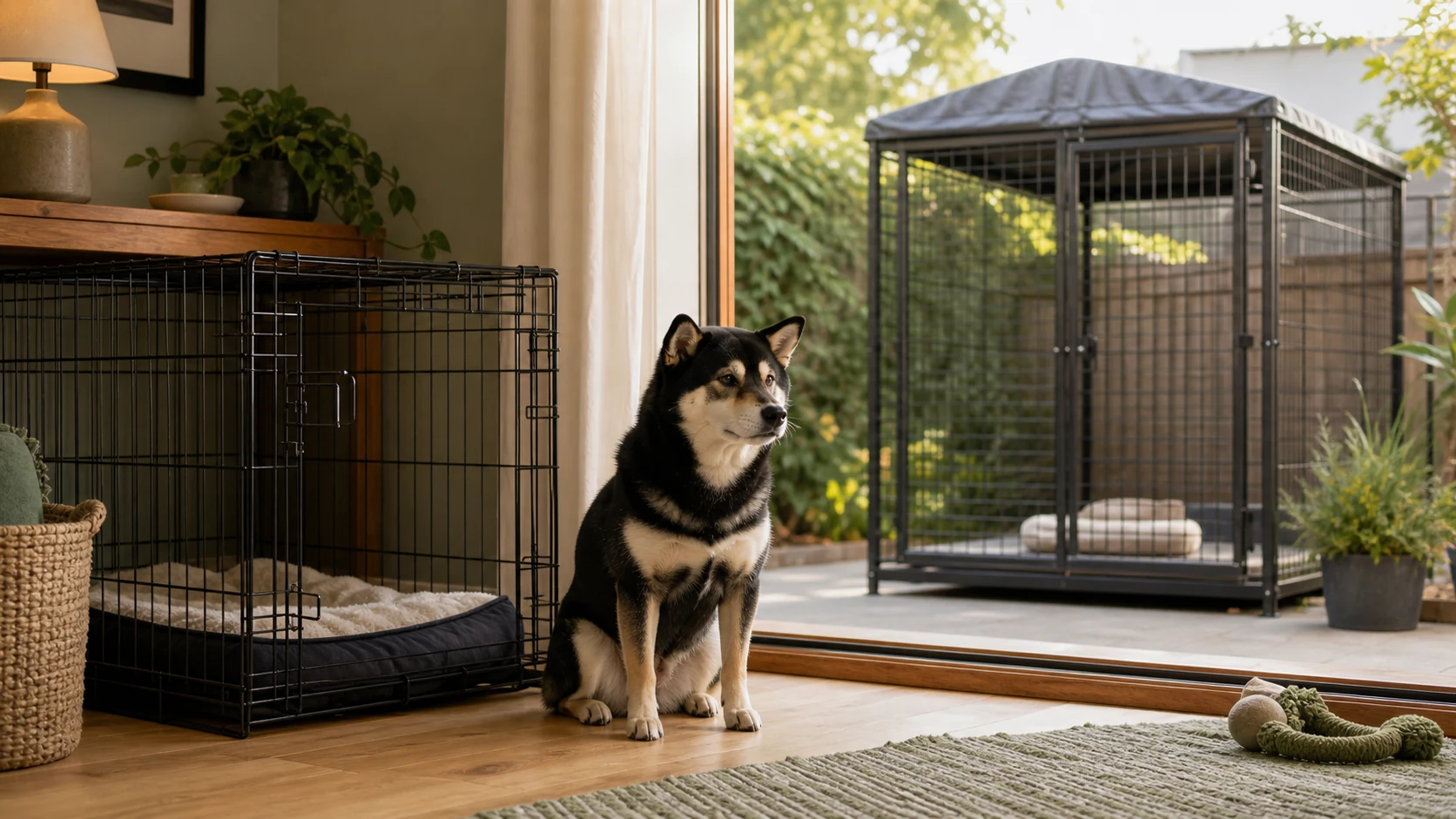
Dog kennel and dog crate are often used as if they mean the same thing, but shoppers can land on very different products. A "dog kennel" may mean an indoor crate, a rigid travel carrier, an outdoor run, or even a boarding facility. A "dog cage" is also common in listings, but it is less precise than crate or kennel.
Use this guide when the search term is broad and you need to decide what type of containment gear actually fits your dog, your home, and the way the space will be supervised.
Quick read
TL;DR
- Indoor dog crate: best starting point for many home routines, puppy dividers, and easy cleaning.
- Travel kennel: compare only when the product is meant for the trip type, carrier rules, and transport setup.
- Outdoor kennel or dog run: a larger supervised yard setup, not a replacement for housing, exercise, shade, water, or training.
- Dog cage: usually a search or listing term; check whether the product is actually a crate, carrier, playpen, or outdoor kennel.
- Measure internal space, not only outside dimensions or breed labels.
- Do not use stronger containment as a behavior shortcut for panic, escape attempts, or destructive barrier behavior.
Quick answer
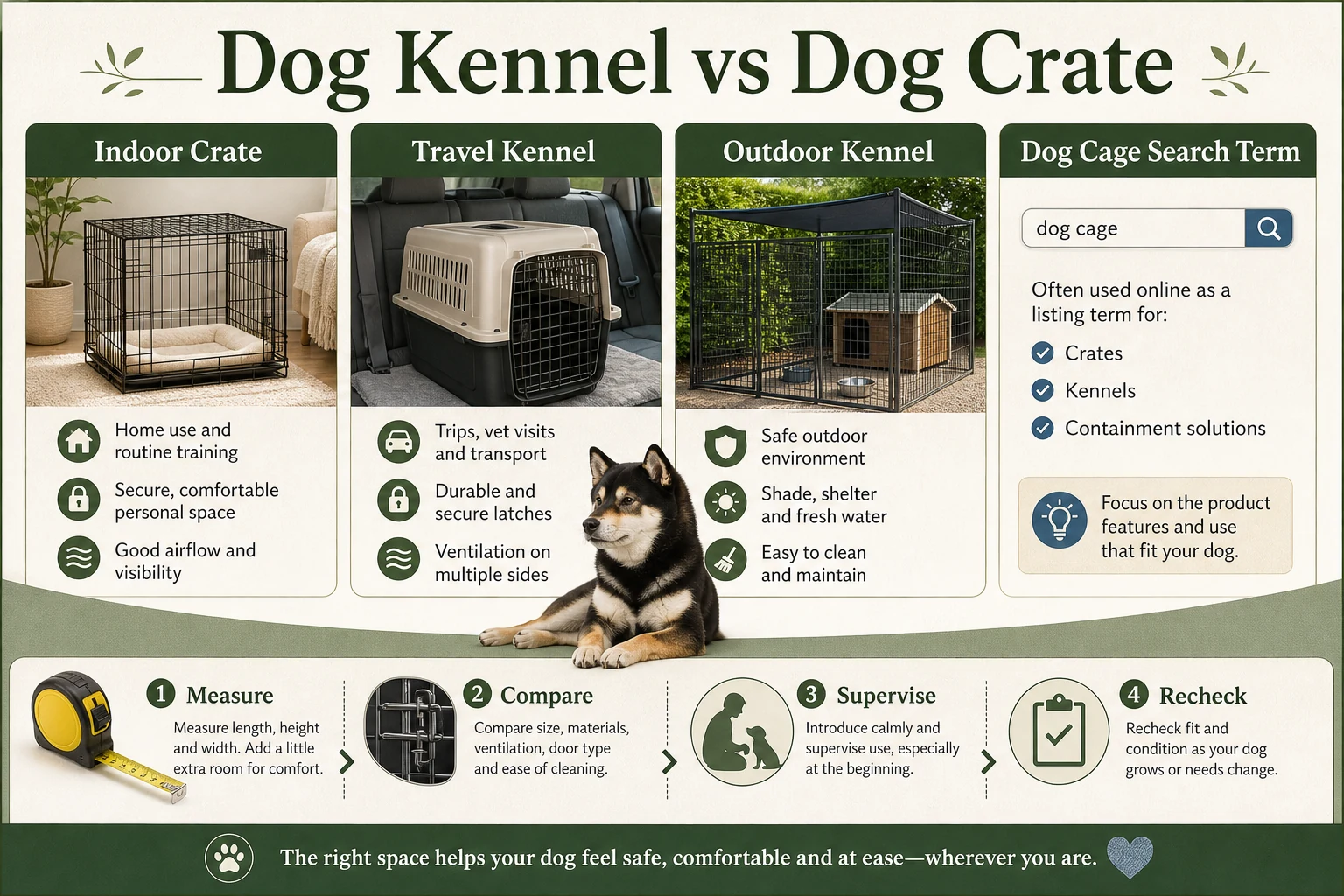
Choose a dog crate when you need a supervised indoor rest space, puppy divider setup, or practical home routine. Choose a travel kennel only when the exact product matches the trip, carrier rules, ventilation, hardware, and size requirements. Choose an outdoor kennel when you need a fenced yard enclosure for supervised outdoor time, with shade, water, weather planning, floor safety, and secure placement.
If a listing says dog cage, slow down and inspect the actual product. Some "dog cage" results are ordinary wire crates, some are heavy-duty crates, some are playpens, and some are outdoor kennel panels.
Share & embed
Indoor home routine
Dog crate
- Look for
Internal size, latch design, divider options, tray access, airflow
- Avoid
Buying by outside dimensions or decor alone
Trip or carrier use
Travel kennel
- Look for
Purpose-specific shell, ventilation, secure door, rule compatibility
- Avoid
Assuming portable means travel-safe
Supervised outdoor time
Outdoor kennel or dog run
- Look for
Shade, water, stable panels, weather planning, floor safety
- Avoid
Using it as all-day housing or unsupervised behavior control
Broad listing search
Dog cage search term
- Look for
Clarify whether it is a crate, kennel, playpen, or carrier
- Avoid
Trusting vague category names instead of product details
What "dog kennel" can mean
The word kennel creates confusion because it can describe both gear and services. On What Dogs Like, this guide focuses on gear: home crates, travel kennels, outdoor kennel panels, and large dog enclosures. It does not cover boarding kennels, daycare kennels, or local service searches.
When you search for dog kennel, identify the real intent before comparing products:
- Indoor crate: a crate used inside the home for rest, puppy routines, short managed breaks, or recovery guidance from a veterinarian.
- Travel kennel: a rigid carrier or travel-style crate meant for transport, vet visits, or specific travel rules.
- Outdoor kennel: a larger fenced enclosure or dog run used outside with supervision, shade, water, weather planning, and secure installation.
- Boarding kennel: a service business, not a gear purchase.
If the product is for daily home setup, use the Dog Crates pillar and Best Dog Crates for Home Setup after this guide. If the listing is a decorative end-table crate or wooden indoor kennel, use the Dog Crate Furniture Guide before buying by room appearance.
Dog crate vs dog kennel vs dog cage
An indoor dog crate is usually smaller than an outdoor kennel and is sized around standing, turning, lying down, cleaning, door swing, and room placement. It may be wire, plastic, furniture-style, soft, or heavy-duty metal.
A travel kennel is usually more enclosed and must be matched to the exact trip. Do not assume a home crate, folding wire crate, or plastic carrier is appropriate for airline, car, cargo, or long-distance travel. Check the manufacturer guidance, carrier rules, veterinary requirements, route limits, and current travel policies.
An outdoor kennel or dog run is usually a larger fenced structure. It can give a dog a defined outside area, but it does not replace walks, household time, supervision, shade, water, secure flooring, or behavior support.
"Dog cage" is a search term, not a buying standard. If a listing uses that wording, inspect the actual product type, internal dimensions, hardware, bar spacing, floor, tray, ventilation, and intended use.
| Option | Best for | Key features | Caveat | Merchant |
|---|---|---|---|---|
Indoor crate | Home rest, puppy divider routines, short supervised breaks | Internal dimensions, latches, removable tray, mat fit, room placement | Not a substitute for training, exercise, or behavior care | |
Travel kennel | Vet visits, specific travel plans, transport needs | Purpose-built shell, ventilation, secure door, carrier rules, usable interior | Rules vary by airline, route, car setup, and destination | |
Outdoor kennel | Supervised yard time and larger enclosed outdoor space | Panel stability, shade, water, gate latch, weather, floor safety | Not all-day housing or an escape-risk fix | |
Heavy-duty crate | Dogs that have damaged ordinary crates, with behavior review | Stronger frame, latch design, tray access, wheel locks, room fit | Stronger gear does not fix panic or barrier distress |
When an indoor dog crate makes more sense
An indoor crate usually makes sense when the decision is about room setup, puppy growth, bedding, cleaning, and daily rest. For many owners, a folding wire crate with a divider is the easiest starting point because it is visible, ventilated, washable, and easy to compare by internal dimensions.
Choose by checks rather than by label:
- The dog can stand, turn, and lie down comfortably.
- The crate fits the room without blocking walkways, drawers, doors, or vents.
- The latch closes cleanly and is not easy to bump open.
- The tray or floor can be cleaned after accidents.
- A mat fits without blocking the door or stealing too much height.
- The crate matches the dog's behavior, not only the room decor.
Use the Dog Crate Size Guide or Dog Crate Size Calculator before comparing current listings.
When a travel kennel makes more sense
A travel kennel can be the better term when the product is a rigid carrier or transport-style crate. This does not mean every plastic kennel is travel-safe for every trip. Travel use depends on the exact product, airline or carrier rules, ventilation, door hardware, fasteners, destination paperwork, and your dog's size and condition.
For travel-style shopping, check:
- Internal dimensions and the dog's natural standing and resting posture.
- Ventilation on multiple sides.
- Door security and fastener type.
- Handle strength and assembly method.
- Carrier, airline, or destination rules when applicable.
- Whether bedding changes usable height.
- Whether the dog is already calm in the carrier.
If the trip involves flights, destination rules, or health paperwork, start with official travel guidance and your veterinarian rather than a product listing alone.
When an outdoor kennel makes more sense
An outdoor kennel or dog run is a different decision from a home crate. It is larger, exposed to weather, and depends on the yard surface, shade, water, gate security, panel stability, local rules, and supervision.
Outdoor kennel checks include:
- Stable panels and a gate latch that cannot be bumped open.
- Shade and weather protection appropriate for the climate.
- Fresh water and a clean, comfortable floor surface.
- Protection from direct heat, cold, mud, sharp edges, and pooling water.
- Secure placement so panels cannot tip, shift, or lift.
- Local regulations, rental rules, HOA rules, and neighbor considerations.
- A plan for supervision and normal household time.
Do not use an outdoor kennel as all-day isolation, punishment, or a way to ignore anxiety, barking, escaping, overheating, or destructive behavior. Those situations need a routine and support review, not only a bigger enclosure.
Large dog kennel checks
Large dog kennel searches can point to indoor extra-large crates, heavy-duty crates, or outdoor kennels. Separate the use case before comparing size.
For an extra-large indoor crate, focus on internal height, internal length, door opening, tray strength, latch quality, room placement, and whether the crate rattles or flexes. For an outdoor kennel, focus on panel height, panel gauge, gate security, roof or shade, ground anchoring, drainage, cleaning, and whether the dog can climb, dig, or push.
Large dogs also change handling. A big crate may be hard to return, move, assemble, or clean. A big outdoor kennel may need two people, level ground, and stronger installation than the listing photos suggest.
Cleaning, airflow, and bedding
Cleaning is a practical buying filter for every crate or kennel type. Indoor crates should have tray access, washable mats, smooth edges, and a room location that lets you clean the floor. Travel kennels should have corners and ventilation openings you can actually wipe. Outdoor kennels should not trap mud, waste, water, or loose bedding.
Bedding changes usable space. A thick crate mat can reduce standing height. Outdoor pads can hold moisture if they do not dry well. Puppies and chewers may need simpler mats until habits are clearer.
Use the Dog Crate Mats Guide before choosing crate pads, kennel mats, waterproof liners, or thick bedding.
Direct product CTAs
These are direct Amazon product examples for comparison, not universal winners. Product details, size variants, prices, images, and availability can change. Check current internal dimensions, intended use, hardware, return policy, and your dog's behavior fit before buying.
What Dogs Like may earn from qualifying purchases. Affiliate links do not change the checks in this guide.
Common mistakes
✓ Better buying habits
- Decide whether you need an indoor crate, travel kennel, outdoor kennel, or service business.
- Measure the dog and compare internal dimensions.
- Check latch design, airflow, cleaning access, and bedding fit.
- Treat outdoor kennels as supervised yard gear with shade and water.
- Read current travel rules before buying a travel kennel.
- Recheck fit and condition after normal use.
× Mistakes to avoid
- Assuming dog kennel always means one product type.
- Buying a large dog kennel before checking room or yard placement.
- Treating dog cage wording as a reliable product standard.
- Assuming plastic always means airline-ready.
- Using outdoor kennels for all-day isolation.
- Buying stronger containment instead of addressing panic, climbing, digging, or escape behavior.
Related guides
For the full crate framework, start with the Dog Crates pillar. Use Best Dog Crates for Home Setup for indoor room placement, latches, trays, furniture-style crates, and cleaning. Use the Dog Crate Size Guide or Dog Crate Size Calculator before choosing internal dimensions.
For material choices, compare Wire vs Plastic Dog Crates and Soft Dog Crates vs Wire Dog Crates. For decorative room setups, read the Dog Crate Furniture Guide before comparing crate end tables, crate covers, and convertible crate gates. For bedding, read the Dog Crate Mats Guide. For puppy setup, read Best Dog Crates for Puppies, then use the Dog Crate Setup Checklist and Puppy Crate Training Schedule before comparing listings.
Frequently asked questions
Is a dog kennel the same as a dog crate?
Not always. A dog kennel can mean an indoor crate, travel carrier, outdoor dog run, or boarding service. A dog crate usually means a home or travel containment product.
What does dog cage mean on Amazon?
Dog cage is often a broad listing term. Inspect whether the product is actually a wire crate, heavy-duty crate, plastic kennel, playpen, or outdoor kennel.
Should I buy a dog kennel or a dog crate for home?
For normal indoor home routines, start with a well-sized dog crate. Outdoor kennels are different yard enclosures and need shade, water, secure setup, and supervision.
Are outdoor dog kennels safe?
They can be useful in the right supervised setup, but they are not automatically safe. Check weather, shade, water, floor, gate, panel stability, local rules, and behavior fit.
What is a large dog kennel?
It may mean an extra-large indoor crate or an outdoor enclosure. Check the product type first, then compare internal dimensions, gate access, panel height, and cleaning.
Can a travel kennel be used as a home crate?
Sometimes, but it depends on airflow, visibility, door access, cleaning, and whether your dog rests comfortably inside. Do not assume travel suitability works both ways.
Is a stronger kennel better for escape behavior?
Not by itself. Repeated escape attempts, panic, climbing, chewing, or barrier damage need behavior and routine review, not only stronger equipment.