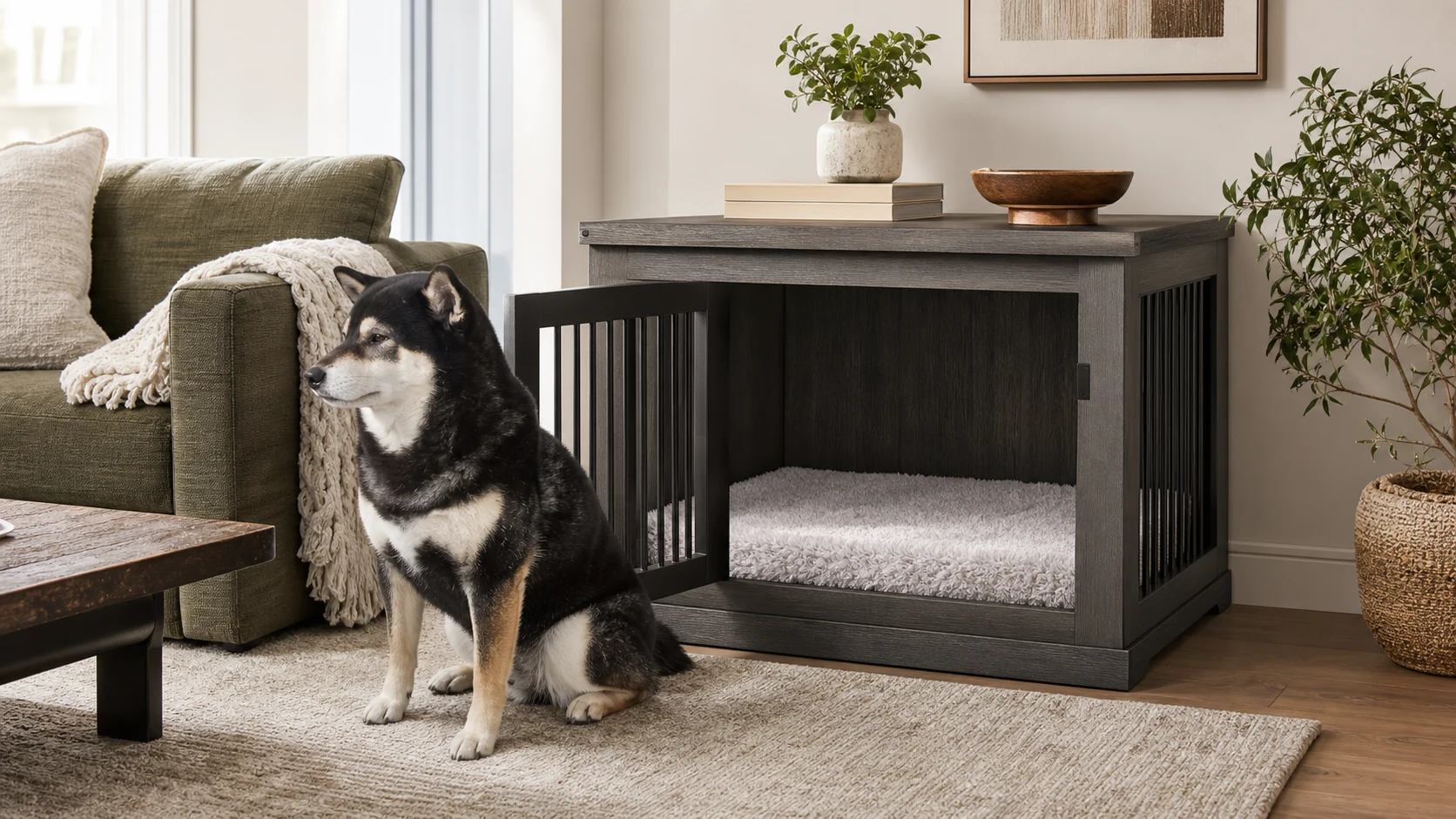
Dog crate furniture can make a crate easier to live with in a bedroom, office, or living room, but it should still be judged like dog gear first. The finish, tabletop, and side-table shape matter only after the crate fits the dog, ventilates well, opens safely, cleans easily, and matches the dog's behavior.
Use this guide when you are comparing furniture-style dog crates, dog crate end tables, wooden dog kennels, decorative dog cages, or crate covers that turn a wire crate into a table. If you are still deciding whether a cover is enough or a full furniture crate makes sense, start with Dog Crate Cover vs Furniture Crate.
Quick read
TL;DR
- Best fit: calm, crate-trained dogs that already rest comfortably in a crate.
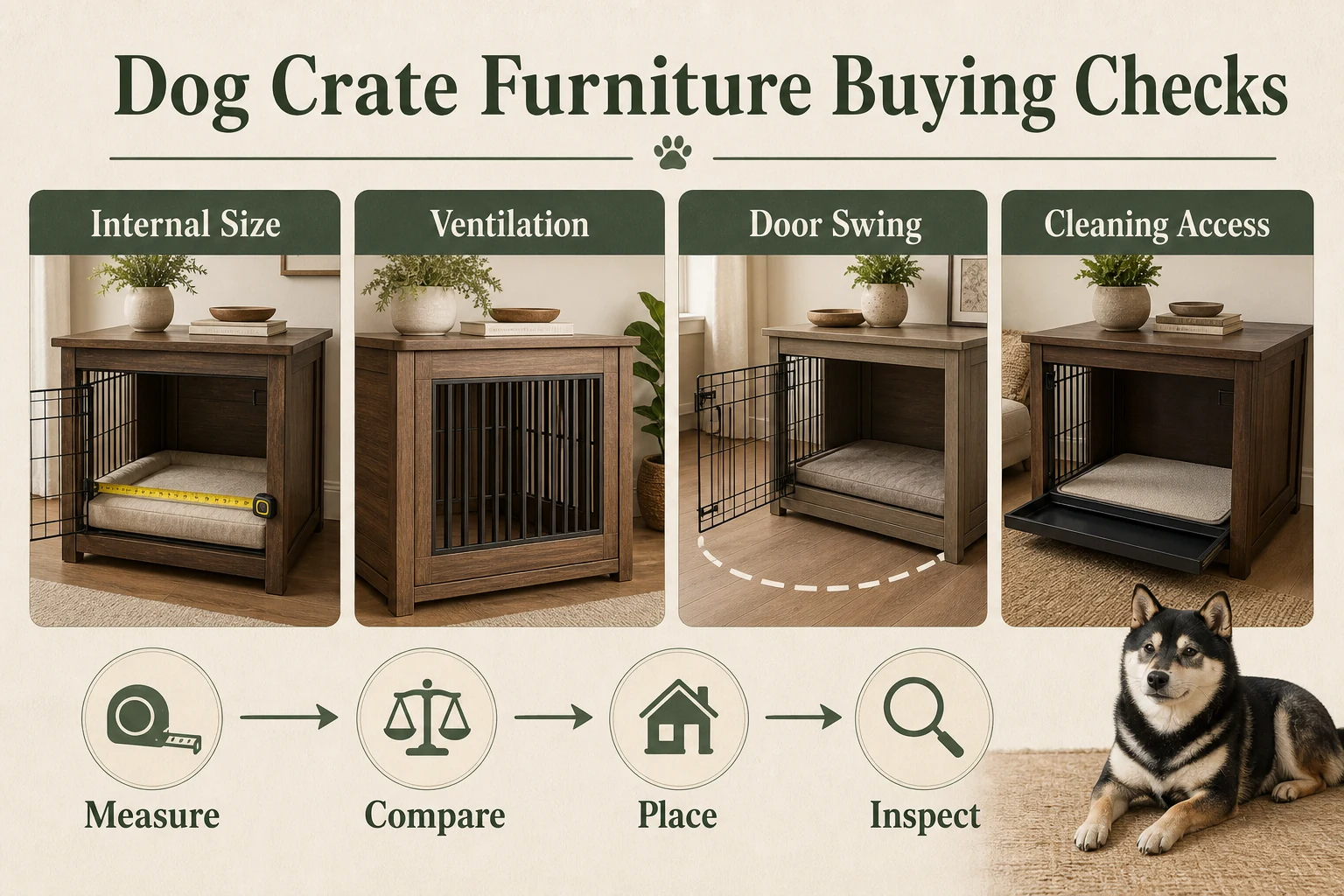
- Main checks: internal dimensions, ventilation, door swing, latch design, cleaning access, and top-surface stability.
- Be cautious with puppies and chewers. Furniture-style crates usually expose more edges, panels, seams, or wood-like materials than basic wire crates.
- Do not buy by decor first. A good-looking crate can still be too small, too warm, hard to clean, or wrong for the dog's behavior.
- Measure the room too. End-table crates need door clearance, drawer clearance, airflow, and a sensible walking path.
- Compare current listings carefully. Size variants, interior dimensions, materials, trays, and return policies can change.
Quick answer
Choose dog crate furniture only after your dog is already comfortable with crate rest and you have measured both the dog and the room. A furniture-style crate can work well beside a sofa, bed, or desk when it has enough usable interior space, clear ventilation, a door that opens without blocking traffic, safe latches, and cleaning access.
For puppies, heavy chewers, dogs that paw at doors, or dogs that panic in confinement, start with crate training, supervision, and safer basic setups before upgrading to a furniture crate. A better-looking crate is not a behavior solution.
Share & embed
Calm adult dog
Furniture-style crate or crate end table
- Look for
Room fit, internal size, airflow, latch design, tray access
- Avoid
Buying for looks before measuring
Dog still learning crate comfort
Wire crate first
- Look for
Visibility, divider options, tray cleanup, easier supervision
- Avoid
Moving too early into decorative furniture
Chewer or scratcher
Avoid weak wood-like panels
- Look for
Protected seams, metal bars, behavior review
- Avoid
Assuming furniture crates are stronger
Small living room
Compact end-table crate
- Look for
Door swing, walkway clearance, top use, airflow
- Avoid
Blocking paths, vents, drawers, or outlets
What counts as dog crate furniture?
Dog crate furniture is any crate designed to blend into a room as furniture. It may be sold as a dog crate end table, side-table crate, nightstand crate, wooden dog kennel, decorative dog cage, or furniture-style crate.
The category usually includes three different designs:
- Integrated furniture-style crates: crate and furniture frame are one product, often with wood, composite, metal spindles, or steel bars.
- Crate covers with a table top: a standard metal crate sits inside or under a furniture-style cover.
- Convertible crate-and-gate designs: panels form a crate, then unfold into a room gate.
These designs solve different problems. A crate cover can preserve the practical wire crate inside. An integrated furniture crate may look cleaner, but it can be harder to clean or less forgiving for chewing. A convertible crate-and-gate can be flexible, but panel joints and gate mode need careful setup.
When furniture-style crates make sense
Furniture-style dog crates are most useful when the crate has a permanent room location and the dog is calm enough for that material. They can reduce visual clutter, create a stable rest corner, and use the top surface for a lamp, books, remote, or decor.
Good use cases include:
- A crate-trained adult dog that already rests calmly.
- A living room where a wire crate dominates the space visually.
- A bedroom nightstand location with enough airflow and door clearance.
- A home office where the dog likes to settle near people.
- A small apartment where one piece of gear needs to do more than one job.
If the crate is still a training tool for a puppy, or if accidents and chewing are likely, a basic wire crate with a divider and removable tray is usually easier to manage. Use the Best Dog Crates for Puppies guide first.
When to avoid dog crate furniture
Avoid most dog crate furniture when the dog chews wood, claws doors, bends bars, panics, barks frantically, or tries to escape. Furniture crates can create more bite points than a simple wire crate, and decorative panels can hide weak ventilation, awkward cleaning access, or limited usable interior space.
Also be cautious if:
- Your dog is still house-training and has frequent accidents.
- The room is warm or has poor airflow.
- The crate would sit against a heat vent, radiator, or direct sun.
- The crate door would block a walkway or drawer.
- You cannot remove the mat, tray, or floor panel without moving the whole unit.
- The listing does not give usable interior dimensions.
Internal size comes first
Furniture crates often lead with exterior dimensions because buyers are thinking about room fit. The dog still needs internal space. Measure your dog, then compare usable interior length, width, height, door opening, and floor shape.
Use the Dog Crate Size Guide or Dog Crate Size Calculator before buying. Do not assume that a furniture crate with the same outside footprint as a wire crate gives the same interior space. Thick side panels, raised floors, rounded corners, and decorative frames can reduce usable room.
Check these size details:
- Internal length: enough for normal lying and turning.
- Internal height: enough for standing without crouching after the mat is added.
- Internal width: enough for turning and side-lying.
- Door opening: large enough for easy entry and exit.
- Mat thickness: does not reduce standing height too much.
- Top height: works as a side table without tempting unsafe climbing or clutter.
Ventilation and visibility
Furniture-style crates can feel more enclosed than wire crates. That can help some calm dogs settle, but it can also reduce airflow and visibility. Check ventilation on more than one side, especially if the crate sits near a wall, couch, bed, curtain, or cabinet.
Look for open side bars, back airflow, and enough space around the crate. Avoid placing the crate flush against vents, curtains, radiators, or direct sun. A stylish enclosed crate in a warm corner can become uncomfortable quickly.
For broader material tradeoffs, compare Wire vs Plastic Dog Crates and Soft Dog Crates vs Wire Dog Crates.
Door swing, room placement, and top use
Furniture crates are usually placed where normal furniture would go. That makes door swing more important. Before buying, tape out the footprint and door arc on the floor.
Check whether the open door blocks:
- Walkways.
- Sofa paths.
- Closet doors.
- Desk chairs.
- Nightstand drawers.
- Floor vents.
- Electrical outlets.
- Robot vacuum paths.
Top-surface use also needs limits. A crate top may hold a lamp or books, but heavy plants, drinks, candles, clutter, cords, and fragile decor can create practical risk. Keep the top stable and easy to clear if you need fast access to the crate.
Cleaning access
Cleaning is where many decorative crates disappoint. A furniture crate should still let you remove the mat, wipe corners, reach the latch area, clean the floor around it, and deal with shedding or accidents without taking the room apart.
Before keeping a crate, check:
- Can the tray or floor panel be removed?
- Can the mat come out without folding awkwardly?
- Are corners and seams reachable?
- Does the interior wipe clean?
- Does hair collect behind bars or decorative panels?
- Can you move the crate if the floor underneath needs cleaning?
Use the Dog Crate Mats Guide before choosing a thick mat, washable crate pad, or waterproof liner for a furniture crate.
Materials and construction
Common materials include engineered wood, composite panels, metal bars, stainless spindles, MDF, veneer, particleboard, and plastic trays. The exact material matters less than how it behaves in daily use.
Compare:
- Panel edges: no rough corners, lifted veneer, or chewable lips.
- Bars or spindles: secure spacing and no sharp edges.
- Latch design: closes cleanly and does not rattle open.
- Hinges: door stays aligned after assembly.
- Floor: flat, stable, and easy to clean.
- Top: stable enough for normal light use.
- Assembly: hardware tightens securely without wobble.
If the listing uses terms like heavy-duty, kennel, cage, or furniture, still inspect the product details. Marketing wording is not a safety standard.
Furniture crate types compared
| Option | Best for | Key features | Caveat | Merchant |
|---|---|---|---|---|
End-table crate | Living rooms, bedrooms, offices | Cleaner appearance, stable location, useful top surface | Can be harder to clean and less flexible than wire | |
Crate cover with wire crate | Owners who want wire-crate function with a furniture look | Keeps ventilation, tray, and divider benefits of the inner crate | Cover must fit exactly and not block airflow | |
Convertible crate and gate | Rooms needing flexible barriers | Can switch between crate and gate layout | Panel joints, stability, and gate mode need careful checking | |
Large furniture crate | Large calm dogs in permanent room setups | Can reduce visual bulk versus a large wire crate | Heavy, harder to return, more room-planning needed |
Direct product CTAs
These are direct Amazon product examples for comparison, not universal winners. Product details, size variants, prices, images, and availability can change. Check current internal dimensions, materials, ventilation, tray access, return policy, and your dog's behavior fit before buying.
What Dogs Like may earn from qualifying purchases. Affiliate links do not change the checks in this guide.
Common mistakes
✓ Better buying habits
- Measure the dog and the room before shopping.
- Compare internal dimensions, not only outside furniture size.
- Check airflow on more than one side.
- Tape out door swing and walking paths.
- Confirm cleaning access before assembly.
- Keep the top surface simple and stable.
- Use furniture crates for calm crate-trained dogs.
× Mistakes to avoid
- Buying a crate because it matches the sofa before checking fit.
- Choosing enclosed panels in a warm room with poor airflow.
- Using wood-like crates for dogs that chew or claw barriers.
- Blocking drawers, vents, walkways, or outlets.
- Assuming a furniture crate is stronger than a wire crate.
- Treating a nicer-looking crate as a fix for panic, barking, or escape behavior.
Related guides
Start with the Dog Crates pillar for the full category framework. If you are unsure whether a listing is a crate, kennel, dog cage, or furniture-style kennel, read Dog Kennel vs Dog Crate first.
Use Best Dog Crates for Home Setup for room placement, latch design, cleaning, and daily use. If you are choosing between a cover for a wire crate and a full furniture crate, read Dog Crate Cover vs Furniture Crate first. Use the Dog Crate Size Guide or Dog Crate Size Calculator before choosing internal dimensions. For bedding, mats, tray fit, and moisture control, read the Dog Crate Mats Guide. For material choices, compare Wire vs Plastic Dog Crates and Soft Dog Crates vs Wire Dog Crates. For a printable setup pass, use the Dog Crate Setup Checklist.
Frequently asked questions
Is dog crate furniture worth it?
It can be worth comparing when your dog is already crate-trained and the crate will stay in a visible room. Fit, ventilation, cleaning, and behavior still matter more than appearance.
Are furniture-style dog crates good for puppies?
Usually not as a first crate. Puppies often need dividers, easy cleanup, simple surfaces, and close supervision. A basic wire crate is often easier during early routines.
Can a dog crate be used as an end table?
Some furniture-style crates are designed for light top-surface use. Keep the top simple and stable, and avoid candles, heavy plants, drinks, cords, or fragile items.
Are wooden dog crates safe?
They can work for calm crate-trained dogs, but they are not a good match for dogs that chew, claw, panic, or push barriers. Check edges, bars, latches, ventilation, and cleaning access.
What size furniture crate should I buy?
Use internal crate dimensions, not only the outside furniture footprint. The dog should be able to stand, turn, and lie down comfortably after the mat is inside.
Where should dog crate furniture go?
Choose a calm room location near normal household life, away from direct heat, drafts, vents, direct sun, and traffic bottlenecks. Confirm the door opens fully before buying.
Is a furniture crate better than a wire crate?
Not automatically. A wire crate is often more practical for puppies, cleaning, dividers, and visibility. A furniture crate is mostly a room-fit upgrade for dogs that already do well in crates.