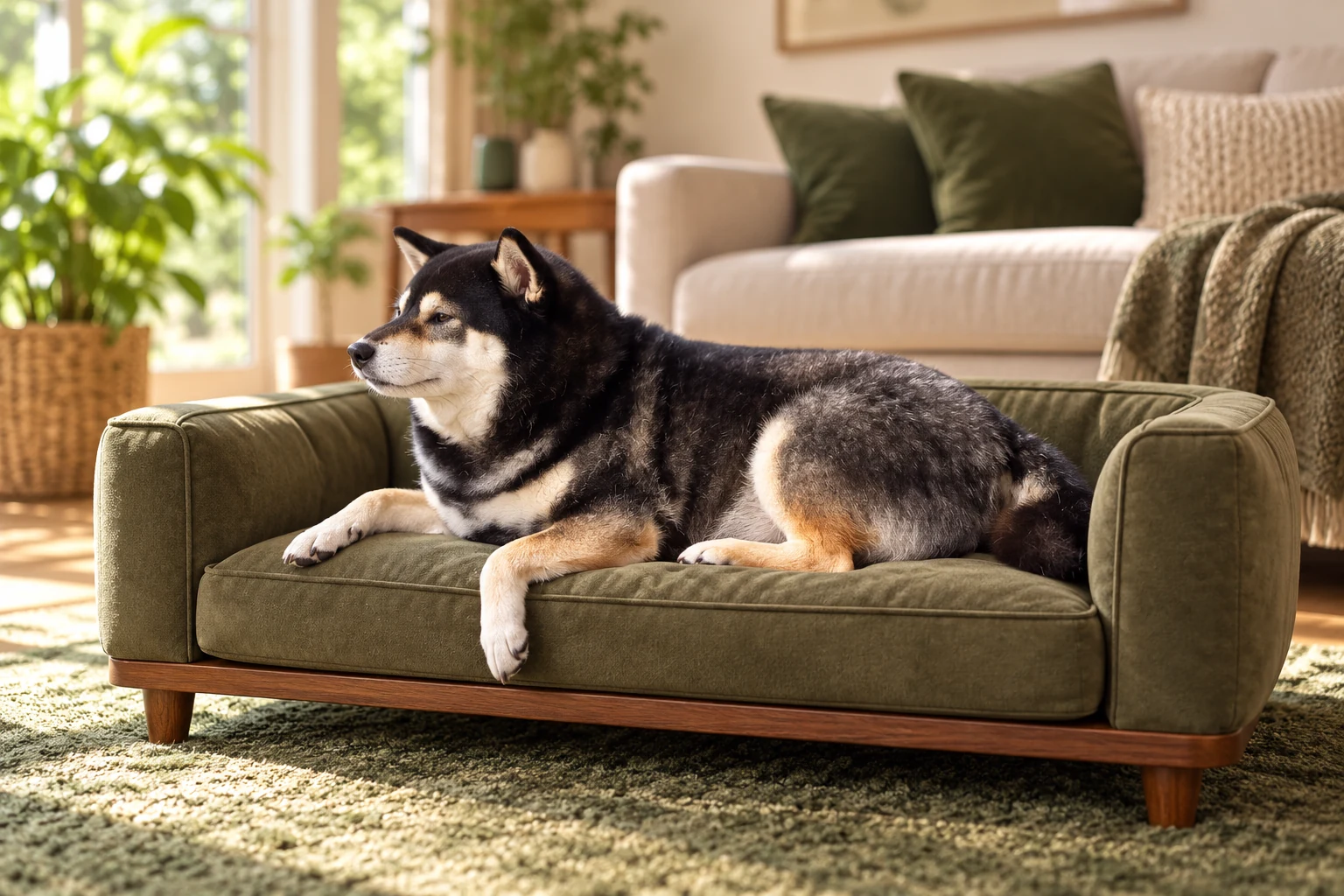
A dog sofa bed needs enough room inside its arms for your dog to sleep, with a stable entrance the dog can use comfortably. Measure the usable seat and the space available in your room before choosing a miniature couch to match your furniture.
Quick read
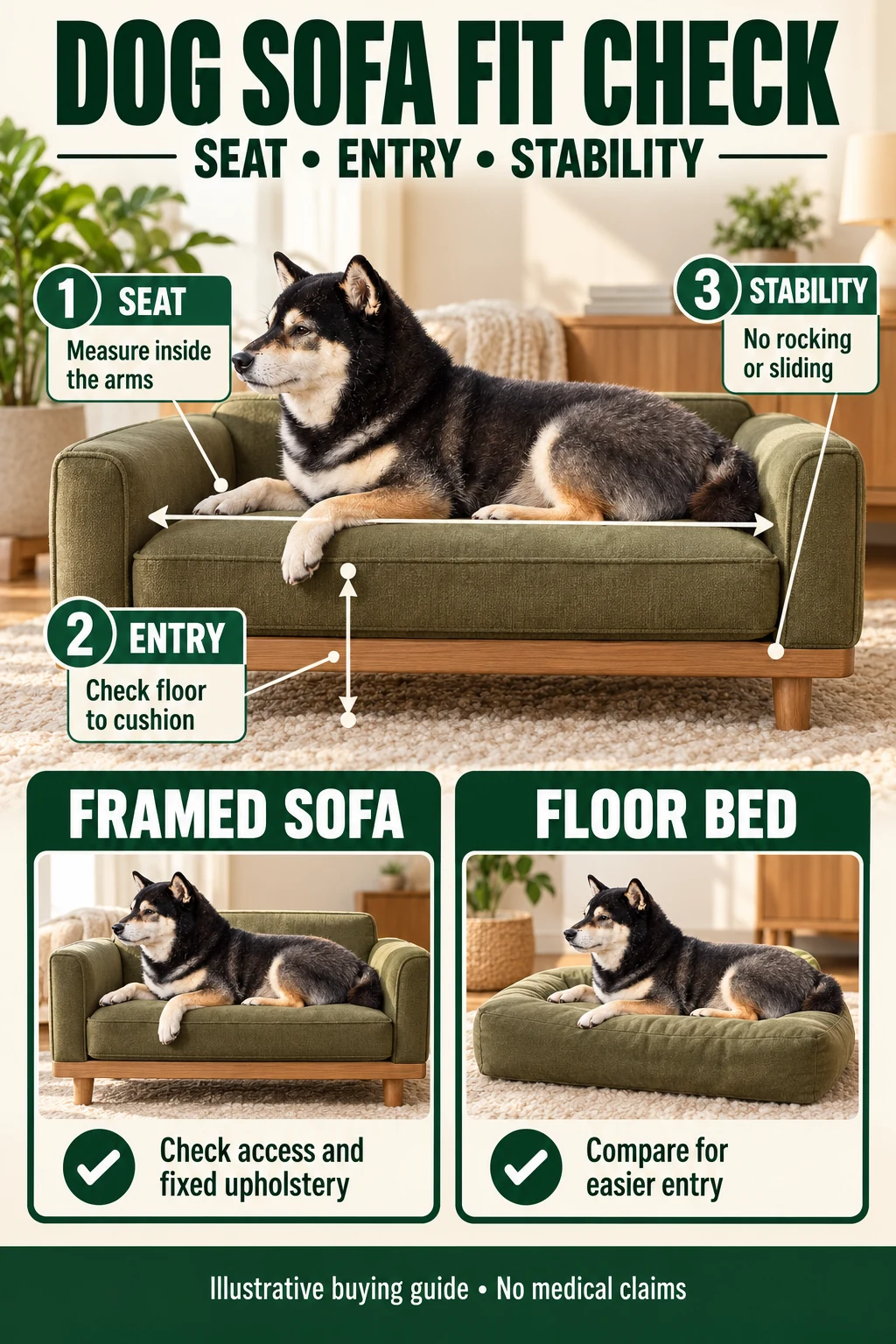
Check the seat before the style
- A framed dog sofa has a rigid structure and often legs. A sofa-shaped bolster bed may sit directly on the floor.
- Compare the usable cushion between the arms with your dog's relaxed sleeping outline.
- Measure entry from floor to the top of the cushion, not just the legs.
- Check rocking, sliding, cushion movement and exposed hardware after assembly.
- Find out which parts are removable, washable and replaceable. Fixed upholstered arms may require spot cleaning.
Framed sofa or floor-level bolster bed?
Product listings use “sofa,” “couch” and “lounger” for different constructions. Some are miniature furniture with a rigid deck, legs and a separate seat cushion. Others are foam or filled beds with raised sides. A picture of a dog leaning on an arm does not tell you which structure is underneath.
A framed sofa gives the dog a raised place beside the family seating. You will need to check its entry step and frame, and some upholstery may be fixed in place. A floor-level bolster bed gives a similar boundary with easier access for some dogs. Check that its filling stays supportive and does not shift awkwardly.
The bolster versus flat bed guide covers the sleeping shape. This guide focuses on the additional furniture decisions: inside dimensions, entry height, assembly, legs and cleaning around a fixed frame.
| Construction | Useful when | What to inspect | Cleaning question | Reason to choose another design |
|---|---|---|---|---|
Framed upholstered dog sofa | A defined furniture-style resting place suits the dog and room | Usable seat, entry height, legs and rigid support deck | Can arms and cushion covers be cleaned separately? | Dog struggles with the step or frame is unstable |
Floor-level bolster bed | Dog likes an edge without a raised furniture platform | Inner area, front opening and fill movement | Can all soiled sections be removed for washing? | Bolsters take too much sleeping space |
Flat supportive bed | Dog needs open access or likes to stretch | Loaded support, entry and floor grip | Are cover and liner removable? | Dog consistently seeks a headrest or enclosed edge |
Human furniture with a cover | Household permits shared seating | Access, cleaning and household rules | Does the cover protect the actual wear areas? | It does not provide the separate resting place you need |
Measure the dog in the position used for sleep
Watch a longer rest before measuring. A curled dog may need more room later when lying on its side. Measure relaxed length and width, including the normal position of legs and head. Keep those notes beside the available room footprint. The Dog Bed Size Guide gives a more detailed measuring method.
Look for “seat,” “sleeping area” or “inside dimensions” in a listing. Subtracting the apparent thickness of the arms from a photograph is unreliable. If the seller gives only the overall size, ask for the inner seat length, depth and cushion thickness before ordering. A dog's weight can meet the advertised limit while its body is too long for the seat.
For example, Aosom's specification for PawHut model D04-262V00GY separates a 38.6-inch outside width from a 33.9-inch seat width. That difference is occupied by the surrounding structure. Compare your dog with the seat figure and the maker's body-length guidance, then check the full footprint against the room.
Also leave space for turning and getting on and off. A sofa wedged neatly between a wall and a table may leave the dog only one awkward approach. Avoid a placement that makes the dog squeeze around a sharp corner or jump sideways over an arm.
Share & embed
Entry height includes the cushion and platform
Short legs do not necessarily mean a low entrance. The frame deck and cushion also raise the sleeping surface. Look for the floor-to-seat measurement, and ask whether it includes the cushion. Then consider how much the cushion compresses when the dog steps onto its edge.
An easy entrance has enough clear approach space and a surface that does not move away under the dog's front paws. Watch how the dog currently steps onto a similar height. Hesitation, scrambling or jumping from a standstill calls for a closer look at access.
VCA's guidance for a mobility-compromised dog's home recommends non-slip paths and bedding that is easy to access. If your dog has pain, weakness or a change in movement, ask a veterinarian about the appropriate setup. A floor-level supportive bed may avoid the access problem entirely.
Do not assume that adding steps solves every sofa fit issue. Steps take floor space, need their own stability check and create repeated transitions. If a veterinarian has approved raised furniture access, the dog steps guide explains the dimensions to check. The simpler choice may still be a lower bed.
Inspect the frame and assembled stability
Unpack and assemble according to the supplied instructions before introducing the dog. Check that all legs reach the floor, screws seat correctly and protective caps are present. Keep small hardware and packaging out of reach. A loose foot or protruding fastener should be resolved before use.
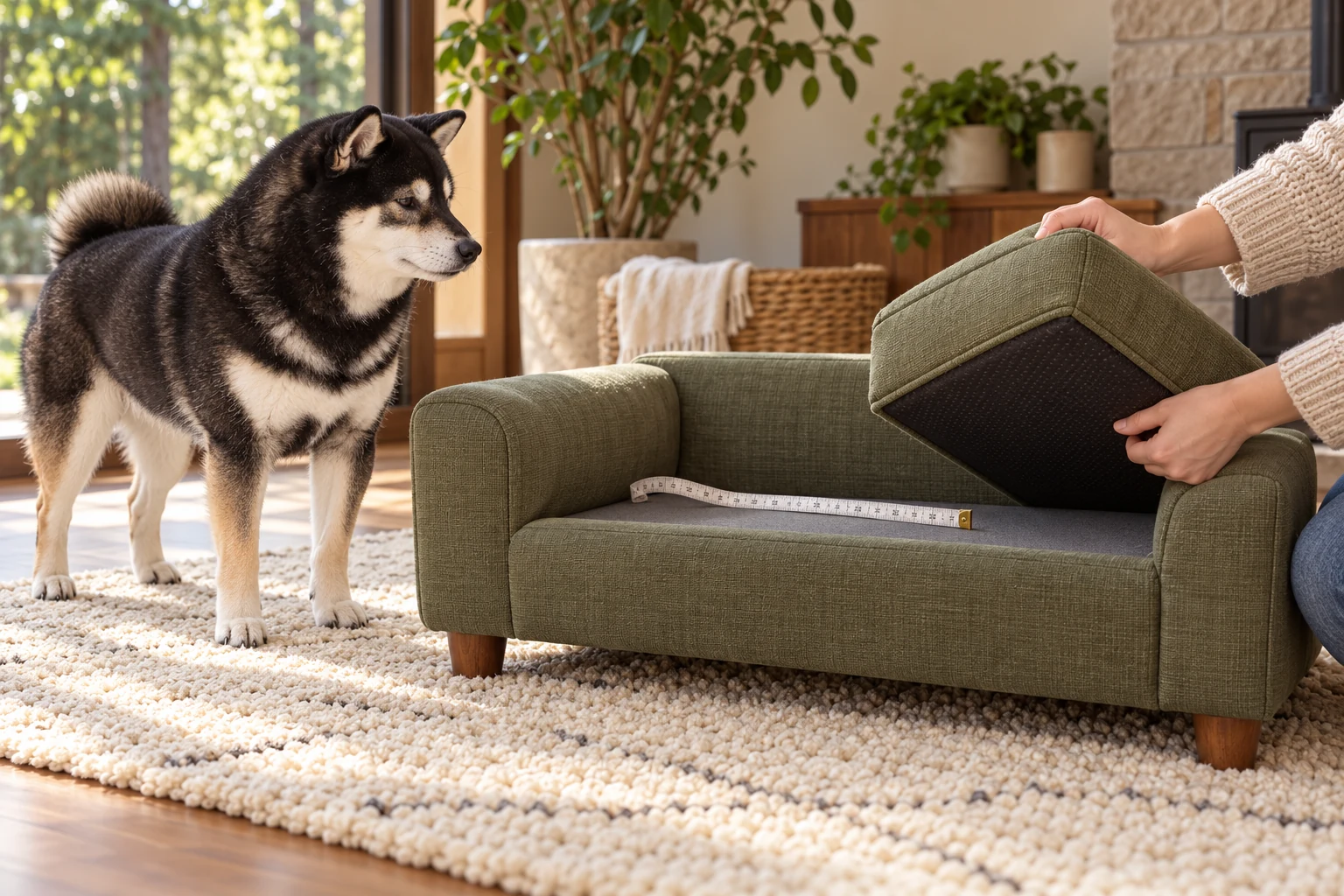
Press on the front edge, each corner and the middle of the support deck by hand. The sofa should not rock, twist or slide across its intended floor. This is a basic household inspection, not a load certification. Stay within the manufacturer's instructions and weight guidance, and do not test pet furniture by standing or sitting on it yourself.
Check the cushion separately. It should lie flat and remain reasonably positioned as the dog steps on and turns. A smooth underside on a slick support deck can let it shift even when the frame stays still. Use only a retaining method permitted by the maker; avoid loose strings, exposed hooks or makeshift ties the dog can chew.
Two exact Amazon examples for different dog sizes
These products show why “dog sofa” is not one interchangeable size category. One is a framed design with a larger rectangular seat; the other is a miniature raised sofa marketed for very small pets. We have not tested them ourselves. Confirm each selected model's dimensions, instructions and suitability before ordering.
PawHut framed sofa: check the inner seat and low entrance
The gray PawHut D04-262V00GY specification describes an MDF structure, pine legs and a removable cushion. It lists a 33.9 by 23.2-inch seat and a 5.5-inch seat height. Check those against the exact listing and your dog's resting footprint; the word “large” is not enough to establish fit.
Enchanted Home Pet Coco: a tiny-pet comparison
The linked Coco Pink version is a miniature raised sofa. Its listing describes a removable washable cushion cover and a rear storage pocket, with pet-size guidance up to 10 pounds. Compare the inside area carefully. This example is for very small pets, and its miniature proportions should not be read as suitable for a medium dog.
Separate cushion care from frame care
“Washable dog sofa” can refer only to the cushion cover. Check the back, arms, under-cushion deck and seams too. If the dog rests its chin on an arm every day, that fixed fabric will need cleaning even when the seat cover is fresh.
Ask how to remove the cover without damaging a zipper or pulling hard against the foam. Confirm the wash temperature, drying method and whether the cushion insert itself can be cleaned. Do not transfer one model's care routine to another because the fabrics look similar. The Dog Bed Materials Guide explains why cover fabric, foam and liners need separate inspection.
For a dog that has accidents, inspect the path liquid could take from the cushion into the deck and frame. A removable cover is not proof of a waterproof barrier. If the construction cannot be cleaned and fully dried in the areas likely to get wet, compare a waterproof bed arrangement or an easier-to-strip washable bed.
Check replacement parts before buying. A sofa with an unusual cushion shape can be difficult to refit when the original cover wears out. Record the exact model, inner dimensions and care label. Keep the bed cleaning schedule handy for routine inspection, including the legs and underside.
Choose a place where the dog can settle
The RSPCA's home-care guidance calls for a comfortable, clean and quiet resting area, with enough bed space for the dog to turn before settling. Place the sofa where the dog can approach it without crossing a busy doorway or being trapped between furniture.
A position near the household seating can be useful if the dog seeks company, but leave an alternative quiet resting place. Buying a separate sofa does not guarantee the dog will stop choosing the human couch. Teach and reward the resting arrangement consistently and avoid repeatedly lifting an unwilling dog onto the furniture.
Keep the sofa away from direct heater output, trailing cables and furniture with sharp corners. On a smooth floor, check both the feet and the approach area for grip. Look under the sofa during cleaning so dropped toys, loose trim or damaged fittings do not remain hidden.
A return-window trial worth doing
Keep the first trial indoors and clean. Compare the assembled sofa with the seller's dimensions, including entry height and usable seat. Let the dog investigate voluntarily, then observe a few ordinary rests instead of judging by one posed photograph.
Look for room to stretch, turn and lower the head. Check whether the dog lies partly on an arm because it prefers a headrest or because the cushion is too short. Watch getting off as carefully as getting on. A bed can look comfortable once the dog is settled and still be awkward to leave.
Remove and refit the cover according to the instructions before the return period ends, if the seller permits that handling. Check return shipping and packaging requirements before discarding the box. A bulky frame is more difficult to return than a compressed floor bed, so clarify missing measurements early.
Dog sofa questions
An owner looking for a couch-like bed that fits a large dog's stretched body needs both a usable seat and furniture that fits the room. Another bed discussion focuses on removable parts and cleaning. These are useful questions to bring to a seller. The anecdotes do not establish support, safety or durability.
Frequently asked questions
Is a dog sofa bed different from a bolster bed?
Sometimes. A framed sofa has a rigid furniture structure and may stand on legs. A bolster bed can look like a sofa while resting on the floor. Check the support deck, entry height and parts list to identify the construction before comparing fit and cleaning.
Should I choose by the dog's weight or the seat size?
Check both. Stay within the manufacturer's weight guidance, then compare the usable seat with the dog's relaxed body outline. A long dog can fit the weight category while having too little room to stretch. Overall furniture width includes arms and is not the sleeping width.
How do I measure the sofa's entry height?
Measure from the floor to the top of the cushion at the front entrance. Include the frame and cushion, not only the legs. Check how stable that edge remains when the dog places its front paws on it, and watch the dog's ordinary entry and exit.
Are raised dog sofas better for older dogs?
A raised shape is not evidence of a health benefit. Older dogs may need a lower entrance, dependable support and better floor grip. Ask a veterinarian when movement or pain affects the choice. A floor-level supportive bed may be easier than a framed sofa with an extra step.
Can I machine-wash the whole dog sofa?
Follow the exact care label. Many framed sofas have only a removable cushion cover, with fixed upholstery and a rigid frame that require separate care. Confirm the cushion insert, arms and deck instructions before choosing the bed for a dog that gets muddy or has accidents.
What should I do if the frame rocks or the cushion slides?
Stop using it until you have checked assembly, floor level and the manufacturer's instructions. Do not hide a loose leg with improvised padding or add chewable ties to the cushion. Contact the seller about faulty or unsuitable parts, or choose another construction if normal use remains unstable.
Will a dog sofa keep my dog off the human couch?
Furniture alone cannot guarantee that. The dog may be seeking company, a familiar location or a particular surface. Provide a suitable separate resting place and teach the household routine consistently. Observe whether the dog actually uses the new sofa during the trial period.
Is faux leather easier to maintain than fabric?
It may allow surface wiping, but check seams, cushion covers, coatings and the maker's cleaning instructions. Fabric may have a removable washable cover while a coated sofa has fixed upholstery. The complete care routine and wear areas matter as much as the material name.
Can two dogs share one framed sofa?
Only consider it if the maker's total weight guidance, usable space and both dogs' behavior suit sharing. Each needs room to change position and leave without crowding the other. Separate beds are the better starting point when one dog guards space or the seat becomes cramped.
Return to the Dog Beds hub to compare other constructions. For a long dog that needs more open space, use the large-dog bed guide to compare less enclosed sleeping surfaces.