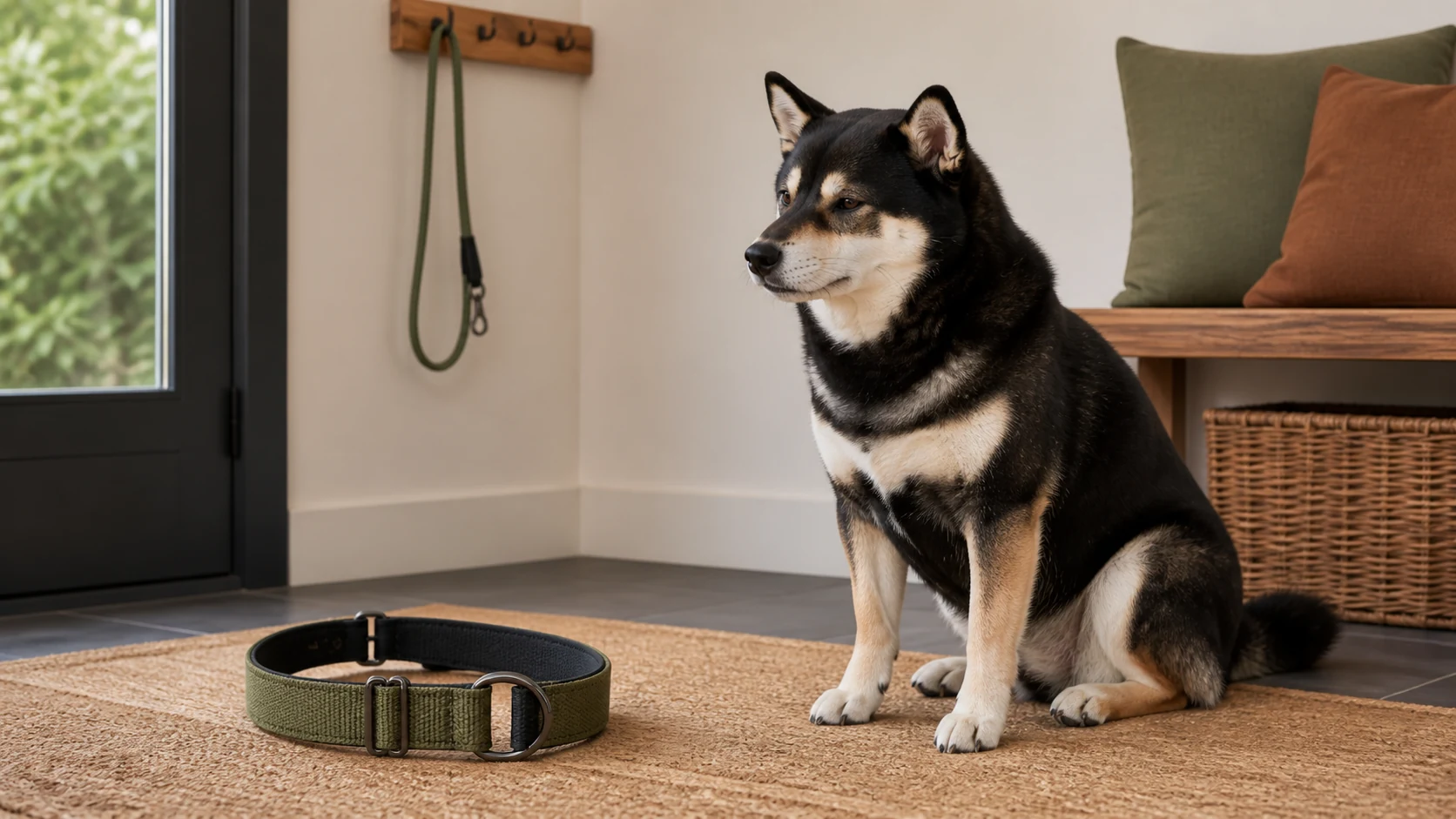
A martingale collar is a limited-slip collar. When leash tension is applied, a smaller control loop shortens the main collar. Correctly adjusted, the collar tightens only to a defined limit rather than continuing to close without restriction.
Martingale collars are often considered for dogs with narrow heads, thick necks, or a history of backing out of flat collars. They are not a shortcut for pulling, a punishment device, or an all-day collar for unsupervised use.
Start with the Dog Collars hub, then use the Dog Collar Size Guide and Dog Collar Size Calculator for the basic measurement framework.
Quick read
Quick answer
- Use a martingale for a specific fit problem, especially backing out of a flat collar, not as a universal training collar.
- Measure both the neck and widest part of the head when the collar has no buckle and must slide over the head.
- Set a clear closure limit: the collar should not continue tightening without restriction.
- Remove it when unsupervised or where the control loop could catch on a crate, branch, furniture, or another dog.
- Use a harness for hard pulling when neck pressure is a concern, with professional guidance where needed.
Share & embed
How a martingale collar works
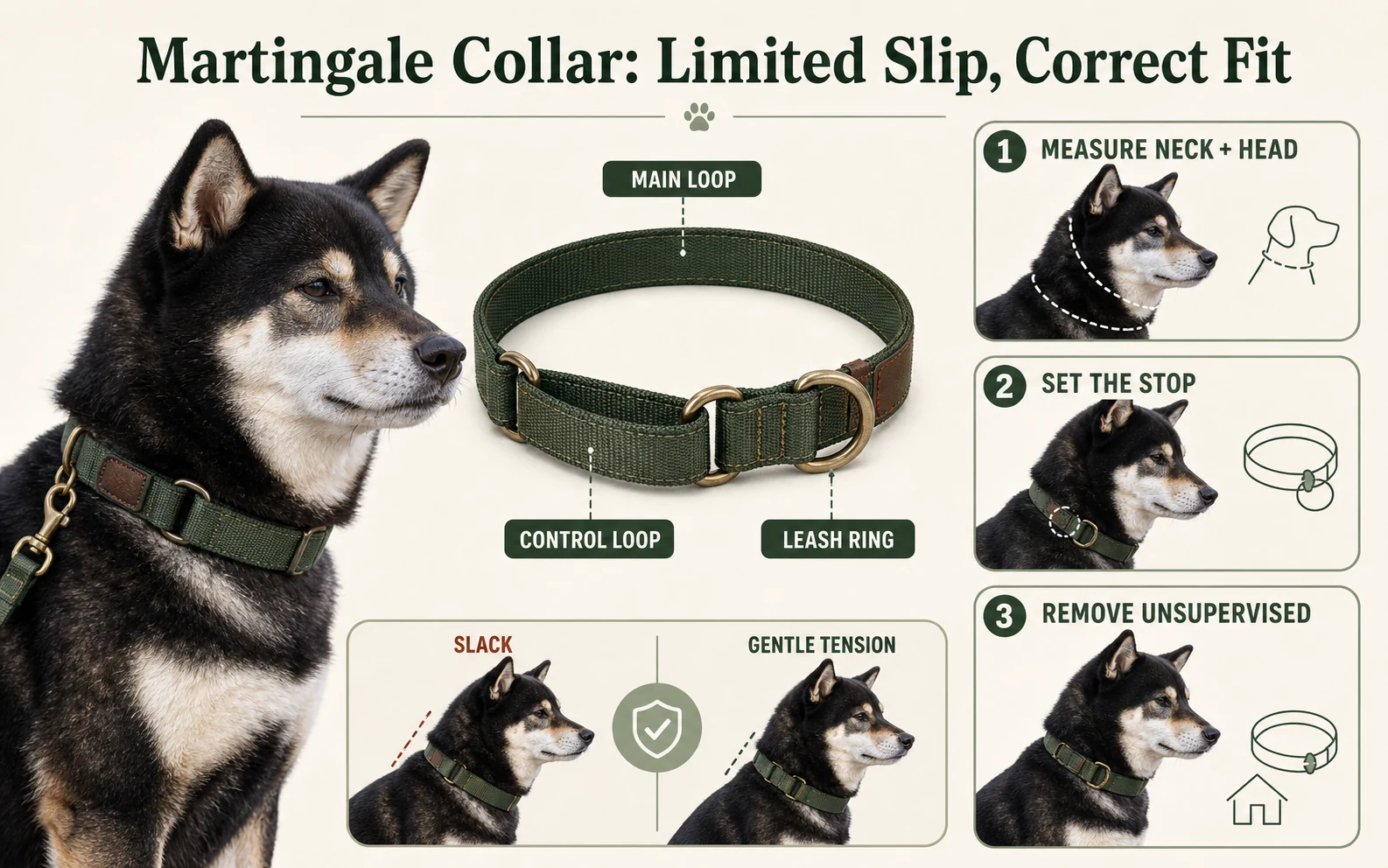
A fabric martingale usually has a main neck loop and a smaller control loop with the leash ring. Chain-loop versions use a short chain section instead of fabric. When the leash is slack, the collar relaxes. When tension is applied, the control loop shortens the main loop until the adjustment stops further closure.
The design can reduce the chance that a dog reverses out of the collar. It should not be adjusted so tightly that the collar keeps pressing into the neck or functions like an unlimited slip collar.
Who may benefit
Narrow head and wider neck
Properly fitted martingale collar
- Look for
Head measurement, limited closure, smooth release
- Avoid
Assuming breed label guarantees fit
Dog has backed out of a flat collar
Martingale plus handling review
- Look for
Neck and head fit, leash angle, backup plan
- Avoid
Relying on the collar without addressing panic
Calm everyday ID use
Flat buckle collar may be simpler
- Look for
Secure buckle, ID ring, comfortable width
- Avoid
Adding a control loop without a need
Hard pulling or lunging
Harness and qualified training support
- Look for
Body-based attachment, handling plan, safe environment
- Avoid
Using neck tightening as the main solution
Unsupervised crate or home time
Remove martingale collar
- Look for
Entanglement prevention, separate ID plan if needed
- Avoid
Leaving the loop where it can catch
Measure the neck and head
Measure the neck where the collar will sit without compressing the coat. For a buckle-free martingale, also measure the widest part of the head because the collar must pass over it. Compare both measurements with the manufacturer's current size chart.
Choose a range that leaves room to adjust in both directions. A size that places the dog at the extreme end of the chart gives little room for coat changes, growth, or fit correction.
For a buckle martingale, the collar opens around the neck, so head circumference may be less important for putting it on. Head shape still matters because preventing escape is the reason many owners choose the design.
Set the limited closure
Follow the manufacturer's instructions because loop proportions vary. In general, test the collar while the dog is calm and supervised. Apply gentle tension to the leash ring and confirm that the collar stops closing before it becomes an unlimited choke loop.
When tension releases, the control loop should relax smoothly. Fabric bunching, twisted webbing, a jammed chain loop, or hardware that does not move freely can change how the collar functions.
Fabric loop versus chain loop
Fabric-loop martingales are quiet and often lighter. They may be easier for daily handling but can hold water, dirt, and odor. Inspect stitching, D-rings, sliders, and loop wear.
Chain-loop martingales can release with a distinct sound and may move smoothly when clean. They add weight and require checks for corrosion, bent links, rough edges, and hair catching. The chain sound is not a training result and should not be used to startle or punish the dog.
The Dog Collar Materials Guide covers nylon, leather, coated webbing, reflectivity, hardware, and cleaning in more detail.
Buckle versus slip-over design
A buckle martingale is easier to put on without passing over the head, which can help dogs sensitive to over-head handling. The buckle becomes another hardware point to inspect.
A slip-over martingale has fewer opening parts but must be large enough to pass over the widest point of the head. That creates a narrower acceptable adjustment window: it must go on comfortably while still closing enough to reduce escape risk.
Walking, pulling, and escape behavior
A martingale can address collar escape risk, but it does not teach a dog to walk without pulling. For dogs that pull hard, attach the leash to a well-fitted harness when appropriate and keep the martingale for identification or backup security.
Dogs that panic, thrash, freeze, or repeatedly try to escape need a slower handling plan and qualified behavior support. Tightening the collar more can increase distress and injury risk.
Direct product CTAs
These are direct Amazon comparison points, not universal choices. Verify the current size chart, closure instructions, material, buckle design, and supervision guidance before use.
What Dogs Like may earn from qualifying purchases. Affiliate links do not change the fit, supervision, and limited-closure checks in this guide.
Common mistakes
✓ Better buying habits
- Measure the neck and, when needed, the head.
- Follow the exact manufacturer's adjustment instructions.
- Confirm that closure stops at a safe limit.
- Watch the loop relax when tension ends.
- Remove the collar during unsupervised time.
- Use a harness when walking control should not rely on the neck.
× Mistakes to avoid
- Treating a martingale like an unlimited slip collar.
- Buying only by breed or weight.
- Leaving the control loop on in a crate.
- Jerking the leash for correction.
- Ignoring worn webbing, rough chain links, or bent rings.
- Tightening equipment instead of addressing panic or escape behavior.
Related guidance
Return to the Dog Collars hub for the complete collar path. Use the Dog Collar Size Guide for measurement and the Dog Harness vs Collar guide when choosing the walking attachment point. For a puppy, read Dog Collar vs Harness for Puppy.
Helpful authority resources
The American Kennel Club permits properly fitted martingales in several activities while emphasizing that collars and harnesses should fit correctly and not be used as correction devices. Use current event rules only for the relevant activity; they are not a substitute for individualized fit guidance.
Frequently asked questions
What is a martingale collar used for?
It is mainly used to reduce backing-out risk for dogs whose head and neck shape makes a flat collar less secure. It has a limited section that tightens under tension.
Can a dog wear a martingale collar all day?
It is safer to remove it during unsupervised time, crate use, and play where the control loop could catch on objects or another dog.
Should a martingale collar be tight?
No. It should relax when the leash is slack and close only to a safe, predefined limit under gentle tension. Follow the manufacturer's fit instructions.
Does a martingale collar stop pulling?
No. It can improve collar security but does not teach loose-leash walking. A well-fitted harness and qualified training support may be more appropriate for strong pulling.