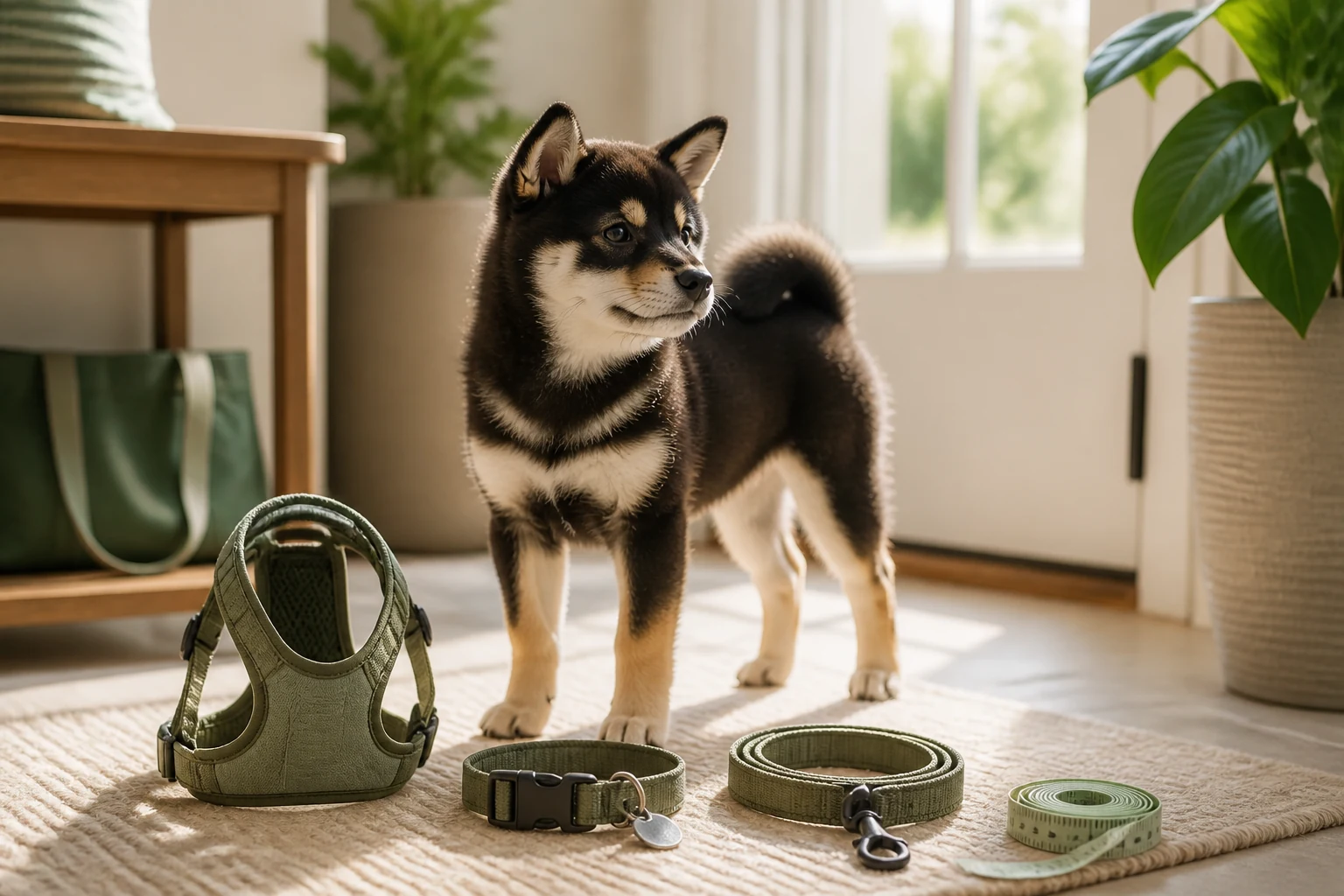
Most puppies do best when you think of a collar and harness as different tools, not as a single winner-takes-all decision. A flat collar is useful for ID tags and short supervised collar practice. A lightweight, well-fitted harness is often the better leash attachment for many puppy walks because it moves leash pressure away from the neck and gives you chest-girth fit checks.
Start with the Harnesses, Collars & Leashes pillar if you are building the whole walking setup. Use this puppy guide alongside Dog Harness vs Collar, the Dog Collar Size Guide, Dog Collar Materials Guide, the Puppy Harness Size Guide, Best Leash for Puppy, the Dog Harness Fit Guide, and the printable Puppy Walking Gear Checklist.
Quick read
Quick answer
- Use a collar for ID tags and calm supervised collar introduction.
- Use a harness for many puppy walks when leash pressure on the neck is a concern.
- Measure both neck and chest girth, then compare the brand's size chart before buying.
- Recheck fit often during growth. A puppy can outgrow a collar or harness quickly.
- Use a light, predictable leash for early walks. Avoid making gear more complicated than the puppy can handle.
- Gear does not replace training. If panic, coughing, gagging, limping, escape attempts, or strong pulling appears, slow down and get professional help where needed.
Share & embed
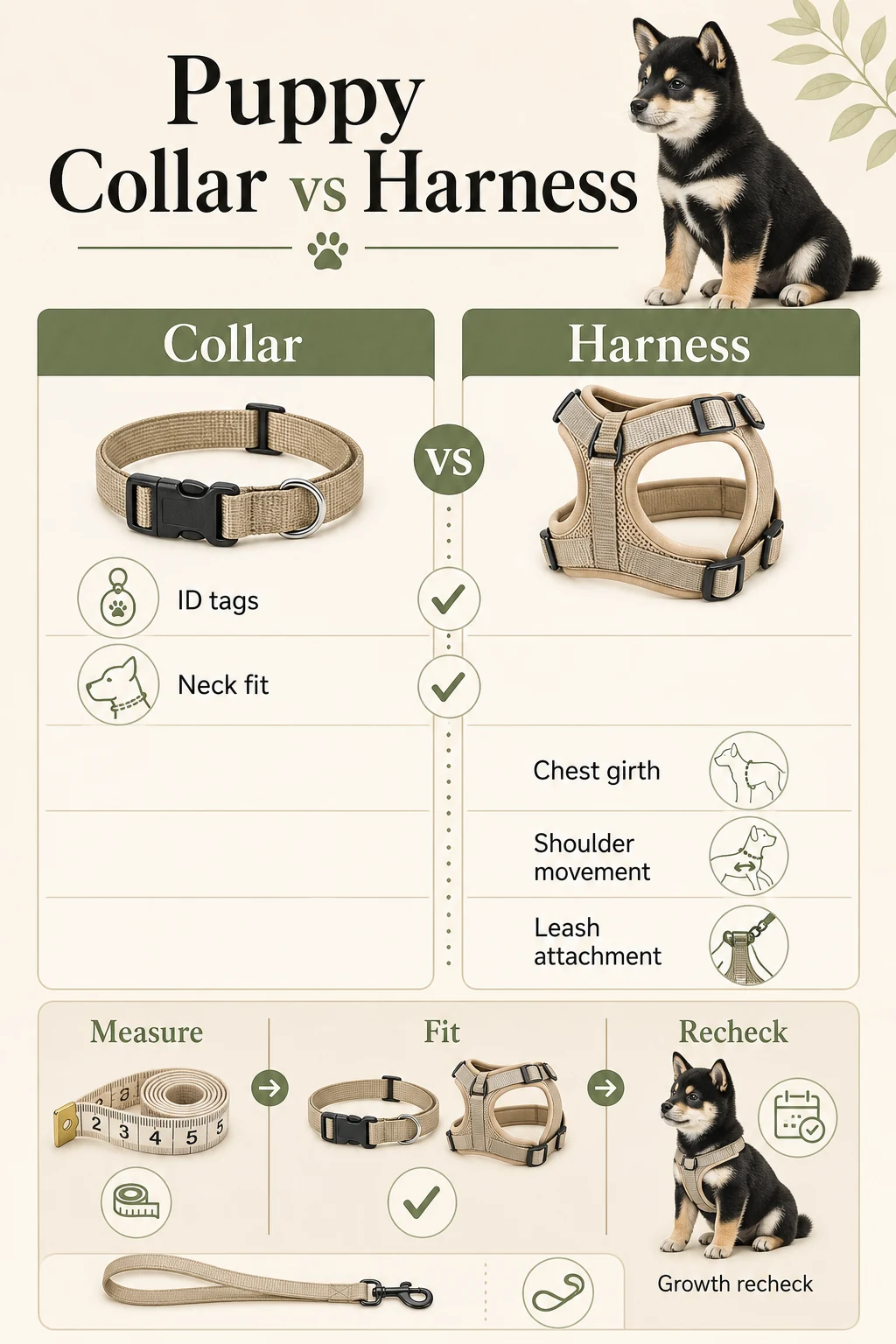
Puppy collar vs harness at a glance
| Decision point | Puppy collar | Puppy harness |
|---|---|---|
| Best role | ID tags, short supervised collar practice, calm handling | Leash attachment for many walks and body-based fit checks |
| Main measurement | Neck measurement in inches | Chest girth in inches |
| Main comfort risk | Too tight, too loose, throat pressure, heavy hardware | Armpit rubbing, shoulder restriction, slipping, twisting |
| Growth issue | Can become tight quickly | Chest and neck openings can become tight quickly |
| Leash use | Better for calm, controlled moments than pulling | Often more forgiving when the puppy moves unpredictably |
| Buying check | Adjustment range, width, buckle, tag ring | Chest-girth range, strap position, shoulder movement |
When a collar makes sense for a puppy
A flat puppy collar makes sense when you need a simple place for ID tags and when you are teaching the puppy to feel comfortable wearing something around the neck. Keep it light, adjustable, and easy to inspect.
Check:
- Neck measurement in inches.
- Adjustment range, not just the size label.
- Lightweight buckle and tag ring.
- Collar width that matches the puppy's neck.
- Whether tags hang safely without irritating the puppy.
- Whether the collar still fits after a week of growth.
Do not leave a tight collar on a growing puppy. Do not use a collar to force leash control if the puppy is lunging, freezing, coughing, gagging, or fighting the leash.
When a harness makes sense for a puppy
A harness makes sense for many puppy walks because it can move leash pressure from the neck to the body. It also gives you more fit checkpoints: chest girth, strap position, shoulder clearance, buckle placement, and whether the harness stays centered when the puppy turns.
Check:
- Chest girth around the widest part of the rib cage.
- Neck opening if the harness goes over the head.
- Strap clearance behind the front legs.
- Shoulder movement from the side while the puppy walks.
- Whether the leash ring twists the harness.
- Whether the puppy can sit, stand, turn, and take a few steps naturally.
Use the Puppy Harness Size Guide and Dog Harness Fit Calculator for a cautious starting range, then use the Harness Fit Checklist after the first short walk.
The best setup is often both
For many puppies, the cleanest setup is:
- Collar for ID tags.
- Harness for leash attachment during walks.
- Short, light leash for predictable handling.
- Frequent rechecks because growth changes everything.
This separates identification from walking pressure. It also gives you a backup way to keep ID on the puppy even when the harness comes off after the walk.
Growth checks for puppies
Puppies change fast. A collar or harness that looked fine last week may rub, pinch, or sit too tight this week. Recheck fit often, especially during fast growth, after grooming, after coat changes, or when the puppy starts moving more confidently on leash.
Use this quick routine:
- Measure the neck.
- Measure chest girth.
- Compare both numbers with the current brand chart.
- Fit indoors before a walk.
- Walk for a short, easy session.
- Inspect neck, armpits, chest, shoulders, buckles, and fur after use.
If the puppy avoids the gear, freezes, scratches at it, rubs after walks, or tries to back out, slow down and reassess fit before buying another item.
Leash training limits
Gear can make puppy walks easier to manage, but it does not teach loose-leash walking by itself. A harness can change where pressure lands. A front attachment can change leash angle. A collar can carry ID. None of those replace calm practice, short sessions, positive association, and safe supervision.
If the puppy panics, repeatedly escapes gear, coughs, gags, limps, shows pain, or becomes hard to handle, stop treating the gear as the main fix. Ask a veterinarian about health concerns and use a qualified trainer or behavior professional for serious walking or fear issues.
For leash pairing, read Dog Leash Length Guide and Dog Leash Materials Guide. For a broader collar and leash setup, use Collars and Leashes for Everyday Walks.
Commercial comparison points
These are direct Amazon product CTAs for comparison, not fixed universal winners. What Dogs Like may earn from qualifying purchases. Affiliate links do not change the buying checks in this guide: measure first, compare current brand size charts, inspect fit after short use, and avoid gear claims that promise behavior outcomes.
Common mistakes
✓ Better buying habits
Better puppy gear habits
- Use a collar for ID and a harness for many leash walks.
- Measure neck and chest girth before buying.
- Recheck fit often during growth.
- Keep hardware light enough for the puppy's body.
- Let the puppy build a positive association with gear indoors.
- Inspect neck, armpits, shoulders, and fur after short walks.
- Use a simple leash before adding specialized walking gear.
× Mistakes to avoid
- Buying only by breed or expected adult size.
- Leaving a puppy collar unchecked during fast growth.
- Clipping the leash to a collar when the puppy is lunging or coughing.
- Keeping a harness that rubs behind the front legs.
- Assuming a front attachment replaces training.
- Using heavy clips, bulky buckles, or retractable length too early.
- Treating avoidance, panic, or escape attempts as normal resistance.
Related guides
Read Dog Harness vs Collar for the adult-version comparison between leash attachment and ID use. Use the Dog Collar Size Guide, Dog Collar Materials Guide, and Dog Collar Size Calculator before choosing a flat collar. Use the Puppy Harness Size Guide, Dog Harness Fit Guide, Dog Harness Fit Calculator, Harness Fit Checklist, and Puppy Walking Gear Checklist before deciding a puppy harness fits well enough to keep.
For leash setup, begin with the curated Dog Leashes hub, then read Best Leash for Puppy, Collars and Leashes for Everyday Walks, Dog Leash Length Guide, and Dog Leash Materials Guide. For harness clip style, compare Front Clip vs Back Clip Harnesses. For a broader category view, read Best Dog Harnesses for Everyday Walks. Return to the Harnesses, Collars & Leashes pillar for the full walking gear framework.
If you are planning puppy gear more broadly, pair this with Best Dog Crates for Puppies and the Puppy Crate Training Schedule so walking, potty breaks, rest, and supervision stay realistic.
Helpful authority resources
The AKC collar-vs-harness overview notes that many trainers start puppies with a short leash and flat collar for early leash practice, while the AKC harness guide emphasizes fit, harness type, and cleaning checks. The RSPCA leash-equipment guidance keeps the focus on suitable, comfortable, correctly adjusted collars or harnesses. ASPCApro's leash-handling guide is useful context for walking without relying on leash pressure as the training method.
Frequently asked questions
Is a collar or harness better for a puppy?
Many puppies use both. A collar is useful for ID tags and supervised collar practice. A harness is often better for leash attachment because it moves pressure away from the neck.
Should a puppy wear a collar all day?
That depends on supervision, fit, household risk, and the collar design. A collar should never be tight, rubbing, damaged, or left unchecked during growth.
Can a puppy walk on a collar?
Some calm, supervised puppy practice may use a flat collar, but a harness is often a better walking attachment when the puppy pulls, lunges, coughs, gags, or moves unpredictably.
How often should I check puppy collar or harness fit?
During fast growth, check at least weekly and after any visible growth, grooming, coat change, or change in walking behavior.
What measurements matter most?
For a collar, measure the neck. For a harness, measure chest girth and check the neck opening, strap position, armpit clearance, and shoulder movement.
Does a puppy harness teach loose-leash walking?
No. A harness can change pressure distribution and handling, but loose-leash walking still depends on practice, rewards, safe supervision, and professional support when behavior problems are serious.