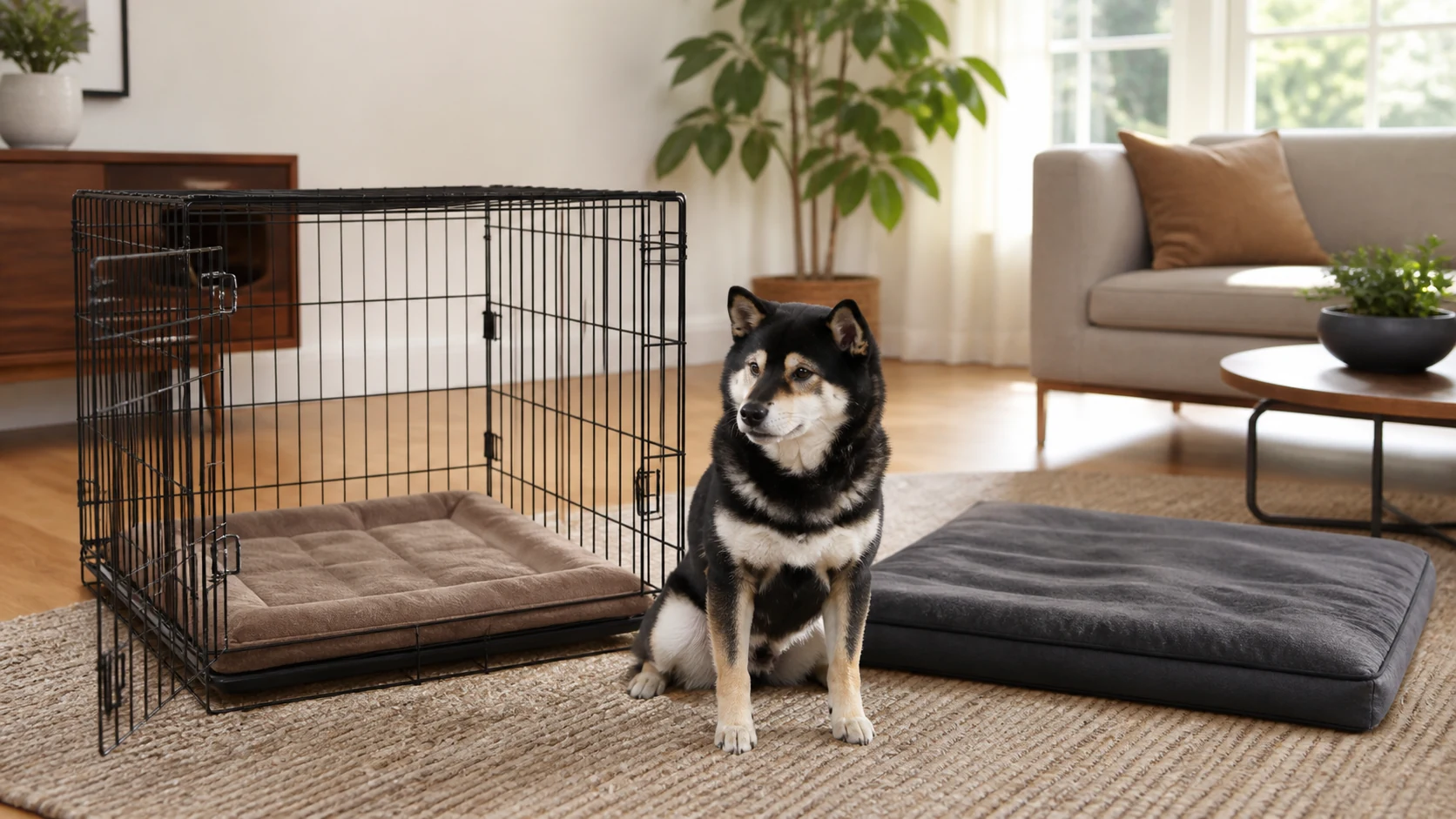
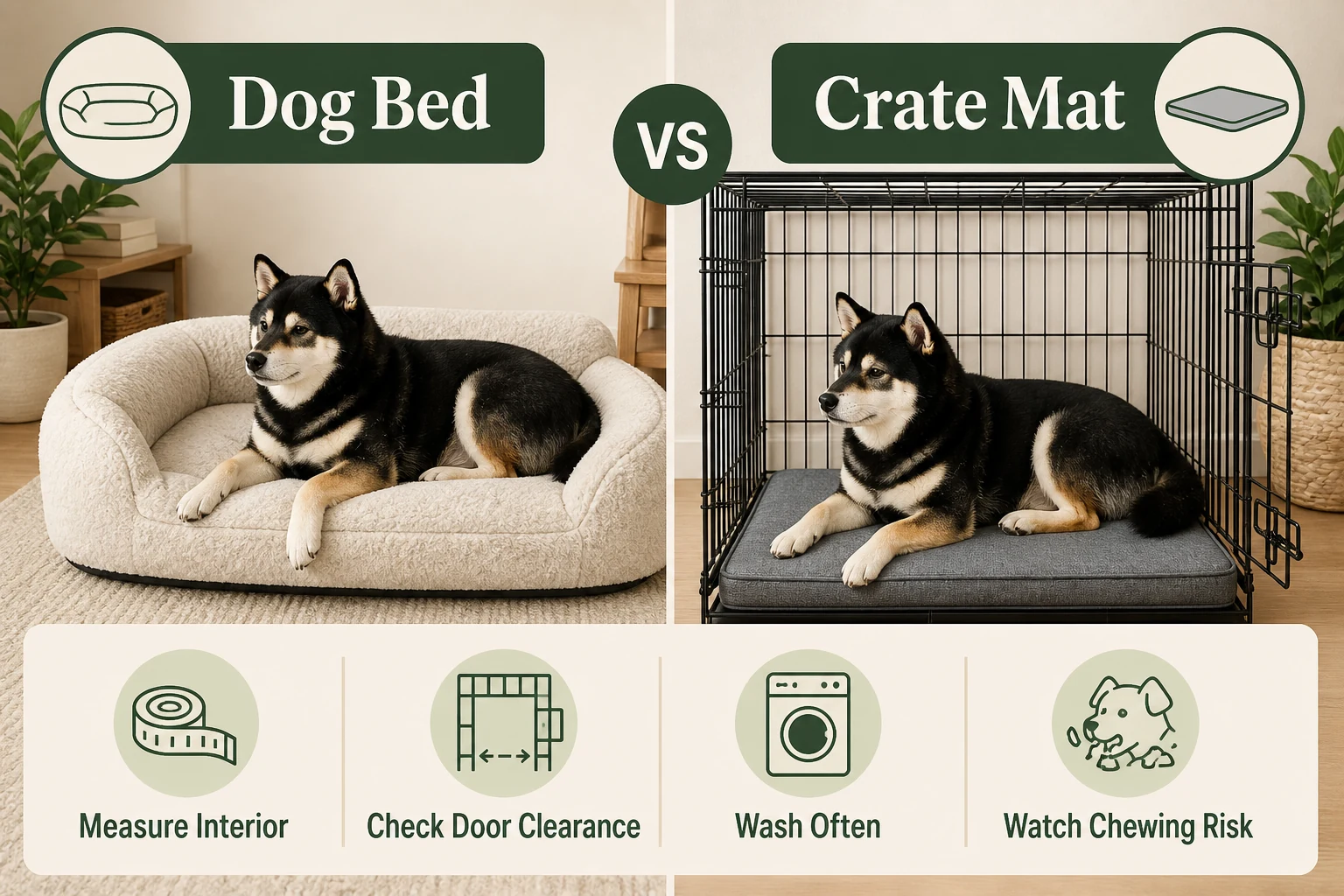
A dog bed is usually better for open room rest. A crate mat is usually better inside a crate because it is lower, easier to fit, and less likely to block the door or reduce usable height. The right choice depends on where the dog rests, how much interior crate space remains, how often accidents or muddy paws happen, and whether the dog chews bedding.
Use the Dog Beds pillar for the full bed framework and the Dog Crates pillar for crate setup. If you are choosing bedding for a crate, read the Dog Crate Mats Guide and check size with the Dog Crate Size Guide or Dog Crate Size Calculator before buying.
Quick read
Quick answer
- Use a crate mat inside most crates when door clearance, divider fit, washable cleanup, and usable height matter.
- Use a dog bed outside the crate when your dog needs a larger open rest space, more surface area, or a room-specific sleep spot.
- Avoid thick beds inside tight crates if they block the door, raise the dog too high, bunch near the latch, or trap moisture.
- Measure the inside floor, not the product title. A 36-inch crate mat is not useful if the actual crate floor or tray is smaller.
- Watch chewing risk: soft beds and mats can both become unsafe if the dog tears fabric or eats fill.
Share & embed
Dog bed vs crate mat at a glance
| Decision point | Dog bed | Crate mat |
|---|---|---|
| Best location | Bedroom, living room, office, crate-adjacent rest area | Inside a crate or carrier |
| Fit priority | Usable sleep area and room placement | Interior floor size, tray shape, divider position |
| Thickness | Can be thicker if the dog can step on easily | Should stay low enough for door and height clearance |
| Cleaning | Cover removal and drying space matter | Fast removal, washing, and accident cleanup matter |
| Support | Better for larger open rest surfaces | Better when support must fit a tight footprint |
| Chewing risk | Plush sides, seams, foam, and fill can attract chewing | Corners and fabric edges can still attract chewing |
| Puppy use | Useful outside crate under supervision | Often more practical inside a divided crate |
When a crate mat is the better choice
Choose a crate mat when the bedding must fit inside a defined interior. The mat should lie flat, stay clear of the door track, avoid bunching near the latch, and leave enough usable height for the dog to stand, turn, and rest normally.
Before buying, check:
- Internal floor length and width.
- Tray lip, rounded corners, or divider overlap.
- Door swing and latch clearance.
- Mat thickness after washing and drying.
- Whether the mat slides when the dog enters.
- Whether the dog can pull corners or straps into chewing range.
Use the Dog Crate Mats Guide when mat thickness, non-slip backing, washable covers, puppy accidents, and travel use are the main questions.
When a full dog bed is the better choice
A full dog bed makes more sense outside the crate, especially when the dog needs room to stretch, change position, or rest near people without being inside a crate. Beds can also be easier to match to sleep style, support needs, room placement, and cover-removal access.
Use a full bed when:
- Your dog sleeps sprawled out or changes positions often.
- The crate is only one rest area, not the main bed.
- A senior or stiff dog needs easier entry and exit.
- You need a larger washable cover or liner system.
- The bed will sit in a bedroom, office, or living room.
For size, use the Dog Bed Size Guide or Dog Bed Size Calculator. For fabric, foam, fill, and liners, read the Dog Bed Materials Guide.
Door clearance and usable crate height
This is where thick beds often fail. A bed can look comfortable outside the crate and still be a poor crate fit if it pushes the dog too high, blocks the door, catches under the divider, or bunches against the latch.
Inside a crate, compare:
- Interior crate height with the mat installed.
- Door opening height after bedding is added.
- Whether the dog can turn without hitting the top.
- Whether bolsters or raised sides reduce usable floor area.
- Whether the mat can be removed without disassembling the crate.
For home setup and placement, pair this with Best Dog Crates for Home Setup and the Dog Crate Setup Checklist.
Washing, accidents, and drying
Crate bedding usually needs more frequent cleaning than a normal room bed because it sits in a tighter space and may be used during puppy routines, muddy returns, shedding, or overnight rest. Washability is not just whether something can go in the washer; drying time and foam protection matter too.
Look for:
- A removable cover if the mat has foam.
- A simple shape that dries evenly.
- A surface that releases hair.
- A non-slip bottom that does not trap moisture.
- Clear care instructions from the manufacturer.
Use Washable Dog Beds for Easier Cleanup and the printable Dog Bed Cleaning Schedule after choosing the setup.
Chewing and puppy risk
Neither a dog bed nor a crate mat should be treated as resistant to chewing. If the dog tears fabric, opens seams, eats foam, or pulls corners through crate bars, remove the item and reassess the setup. For puppies, simple washable mats are often easier to manage than thick plush beds.
If chewing is the main decision, use Best Chew-Proof Dog Beds to compare armored edges, elevated frames, and ingestion limits.
If panic, repeated escape attempts, destructive chewing, or sudden behavior changes appear, do not solve the problem by buying thicker bedding. Use supervision and professional support where needed.
Commercial comparison points
What Dogs Like may earn from qualifying purchases. Affiliate links do not change the buying checks in this guide: measure the actual interior, compare current listing dimensions, check washing instructions, and inspect fit after use.
Related guides
Use the Dog Crate Mats Guide before choosing crate bedding thickness. Use the Dog Crate Size Guide or Dog Crate Size Calculator before comparing internal crate dimensions. Use the Dog Bed Size Guide, Dog Bed Materials Guide, and Dog Bed Placement Guide when the bed will sit outside the crate. For cleanup, read Washable Dog Beds for Easier Cleanup and print the Dog Bed Cleaning Schedule. Return to the Dog Beds pillar and Dog Crates pillar for the broader frameworks.
Frequently asked questions
Can I put a normal dog bed in a crate?
Sometimes, but only if it fits the interior floor, does not block the door, leaves enough usable height, and can be removed for cleaning. Many full beds are too bulky for crates.
Is a crate mat enough comfort?
For many calm crate users, yes. The goal is not maximum plushness; it is a flat, washable surface that fits the crate without reducing safe movement.
Should puppies use a dog bed or crate mat?
Many puppies are easier to manage with a simple washable crate mat because accidents, divider changes, and chewing risk are common. Use thicker beds later if the puppy is reliable with bedding.
Is an orthopedic bed better than a crate mat?
Not automatically. Support only helps if the item fits the actual space and the dog can use it comfortably. If pain, stiffness, limping, or mobility changes are present, ask a veterinarian before treating bedding as the solution.