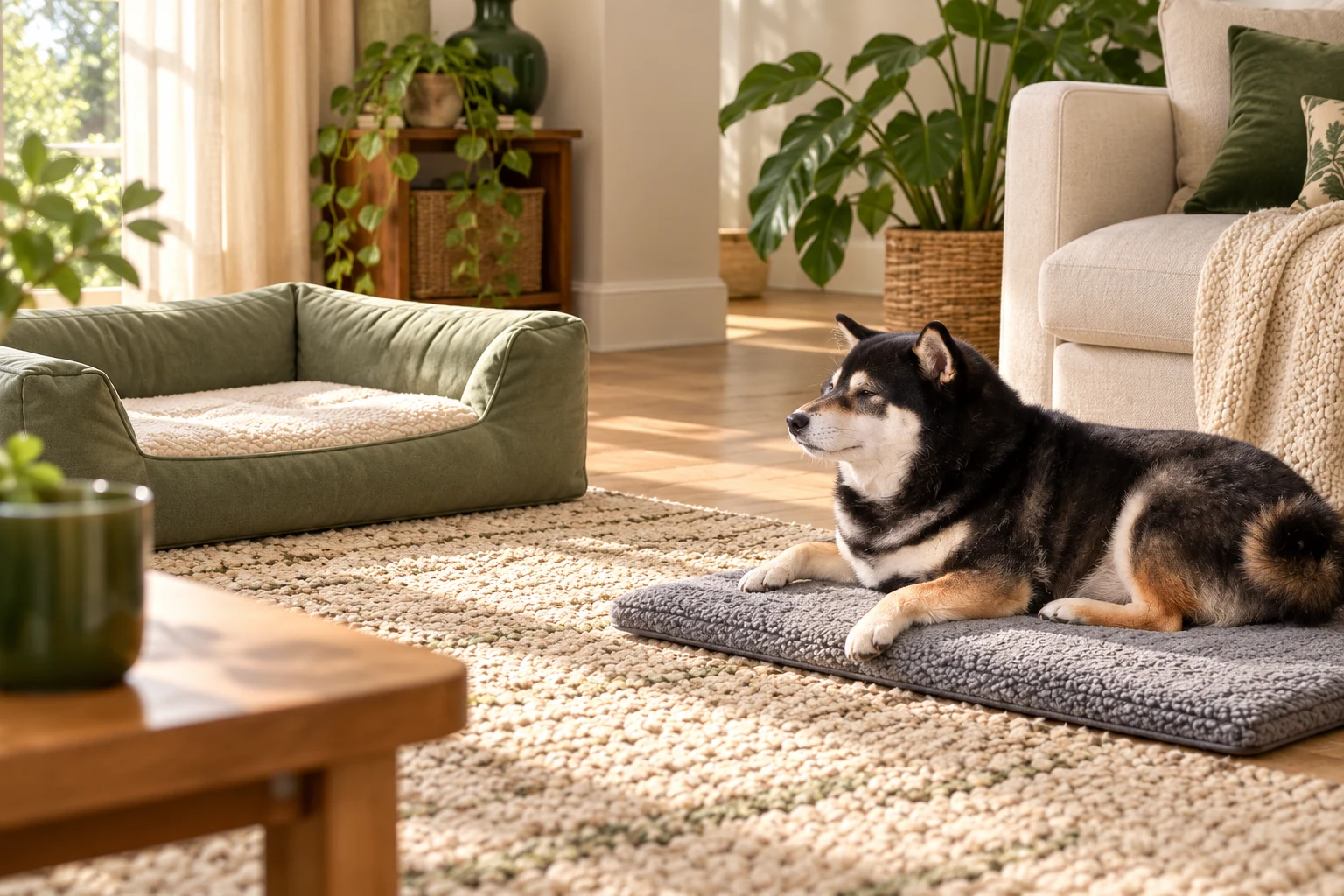
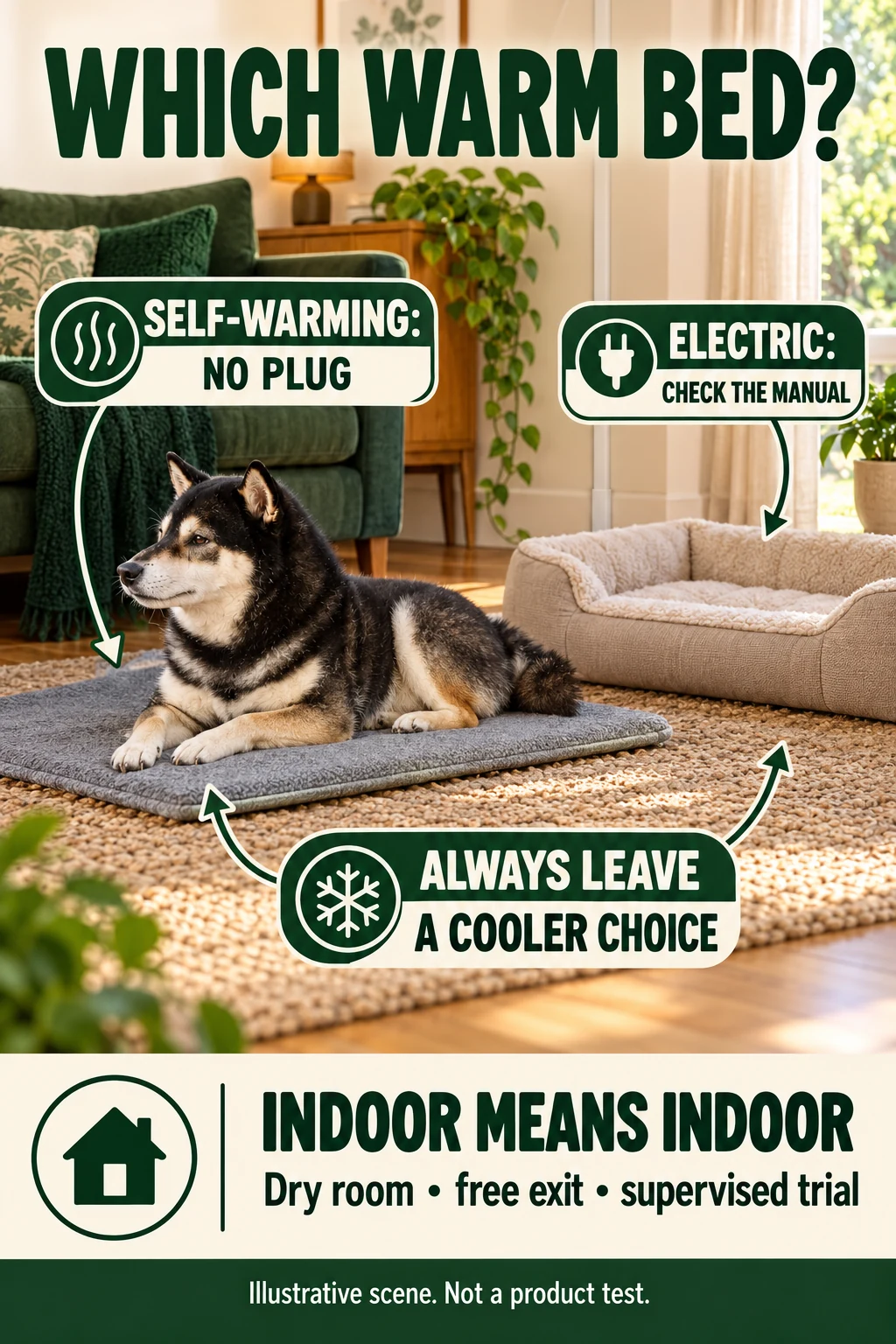
A self-warming dog bed retains or reflects some of the dog's own warmth without electricity. An electric heated bed adds heat through a powered element and needs model-specific installation, inspection and care. Start with a warm, dry, draught-free sleeping area. Choose a powered bed only when you can follow its instructions, supervise its use and give the dog an easy way to rest elsewhere.
Quick read
Choose the simplest suitable warmth
- For an ordinary room, compare a passive mat when you want no plug, heater or cord.
- For an electric bed, check the exact indoor or outdoor designation, voltage, manual and placement before buying.
- Keep a comfortable alternative resting place available. A dog must be able to leave the warmed surface.
- A damaged cord, chewing, wet electrical parts or an unsuitable location is a reason to stop use.
- Ask your veterinarian before adding heat for a dog with limited mobility, altered sensation or a health condition. A bed is not a treatment plan.
How the two categories differ
Passive warmth depends on the dog and surroundings. A reflective layer can reduce heat loss at the resting surface, but it does not create an independent supply of heat. If the room is unsuitable or the bedding is wet, choosing a product called “self-warming” does not fix the environment. K&H's Self-Warming Crate Pad guidance explicitly describes its passive products as intended to lift the comfort of a bed already near room temperature, not to provide sufficient warmth outdoors in winter.
A powered bed has an electrical element. Some models have adjustable controls; others use a fixed thermostatic design. A timer, pressure switch or automatic shutoff should never be assumed from the word “heated.” Read what the exact model does when it is plugged in, empty, occupied and left between uses. That determines both the setup and the daily routine.
| Decision | Self-warming mat or bed | Electric heated pet bed | Check before buying |
|---|---|---|---|
Heat source | Dog's existing body warmth | Powered heating element | The actual mechanism, not the product nickname |
Location | The model's stated conditions | Specific indoor or outdoor designation | Room, moisture exposure and the supplied manual |
Daily handling | Inspect fabric, fit and preference | Inspect bed, cord, heater position and connection | Whether you can manage that routine consistently |
Care | Often simpler, but label still governs | Electrical component usually needs separating | Exactly which parts may be washed |
Dog's choice | Must remain comfortable and able to leave | Easy access to an unheated area is essential | Mobility, exit route and freedom to change position |
Chewing | Fabric and filling can still be swallowed | Chewing also creates an electrical concern | Do not describe either type as chew-proof |
Try moving the current bed away from draughts before buying extra warmth. A suitable ordinary bed may already do the job there. If it does not, compare a passive mat, then consider whether your home can accommodate the cord, cleaning and supervision an electric bed needs.
Give the dog a real choice of resting places
Share & embed
Place the bed where the dog can get up and leave without climbing over a high edge or passing another animal guarding the exit. An empty strip at the side of a crate may not be a usable alternative for a dog that cannot stand and turn there. A separate normal bed outside the warmed area makes the choice clearer in an open room.
The Missouri Veterinary Medical Association's cold-weather guidance recommends providing different sleeping options so pets can adjust to their needs. For powered beds, the AKC's veterinary guidance also emphasizes supervision and warns about dogs that cannot get up easily. If a dog cannot leave independently, ask the veterinarian how to manage warmth before buying the bed.
Measure the usable inner surface and entrance height, and check floor grip. A low passive pad may be easy to step onto but provide little cushioning. A heated bolster bed can have a smaller sleeping area than its outside dimensions suggest. Compare the bed-size guide and senior-dog bed guide when access or support is part of the decision. Evaluate the mattress support separately from its warming feature.
Two Amazon options for different routines
These are research-based examples of two mechanisms, not a ranking from hands-on testing. Choose the exact size from your dog's resting measurements and the current listing. What Dogs Like earns from qualifying purchases as an Amazon Associate.
K&H Self-Warming Crate Pad: a passive surface without a cord
K&H describes this self-warming pad as a microfleece surface with a reflective layer, a non-slip base and corner slits. Compare it for a dry indoor resting spot when a thin mat suits the dog. The corner slits do not make every size suitable for every crate, and the pad is not a thick support mattress.
Try the feel and sound before deciding to keep it. A dog may dislike a new texture or any rustling from a reflective layer and avoid the mat even if its warming layer works as intended. Let the dog investigate voluntarily and retain the familiar bed during the trial.
K&H Thermo-Snuggly Sleeper: an indoor powered bed
The Thermo-Snuggly Sleeper page identifies it as an indoor household product for 110/120-volt current. The Medium variant pictured below has a removable heater and a bolstered shape. Compare its usable inner space, entrance and cord route before treating the outside measurements as the sleeping area.
K&H states that this bed is not pressure sensitive. It emits heat while plugged in; the pet's insulating effect changes the occupied surface conditions. Do not treat an empty bed as switched off, or assume it has a timer because another product does. The exact model's operating instructions matter more than a marketplace headline that suggests it only turns on under a dog.
Read the supplied manual before the first use
The Thermo-Snuggly instruction sheet requires a correctly positioned heater, a liner separating it from stuffing and a cord exiting the back away from the pet's usual path. It also says to unplug the appliance when not in use. K&H's web Q&A describes continuous operation; if your supplied instructions differ from website wording, follow the supplied safety instructions and ask the manufacturer to clarify before extending use.
Check the voltage and plug against the place where you will use it. The US model in this guide is not a universal-voltage travel accessory. Do not make an unsuitable socket convenient with a casual adapter, damaged extension lead or cord run across a doorway. The product page says not to use an extension cord. Choose another location or a different non-powered bed if you cannot provide the specified connection.
Keep the manual, model number and order record together. They help when asking about a replacement heater, cleaning method or conflicting instruction. A visually similar replacement pad is not enough: it must be the part the manufacturer approves for that bed. Do not open, puncture or repair the heater yourself.
Inspect the cord and the dog during use
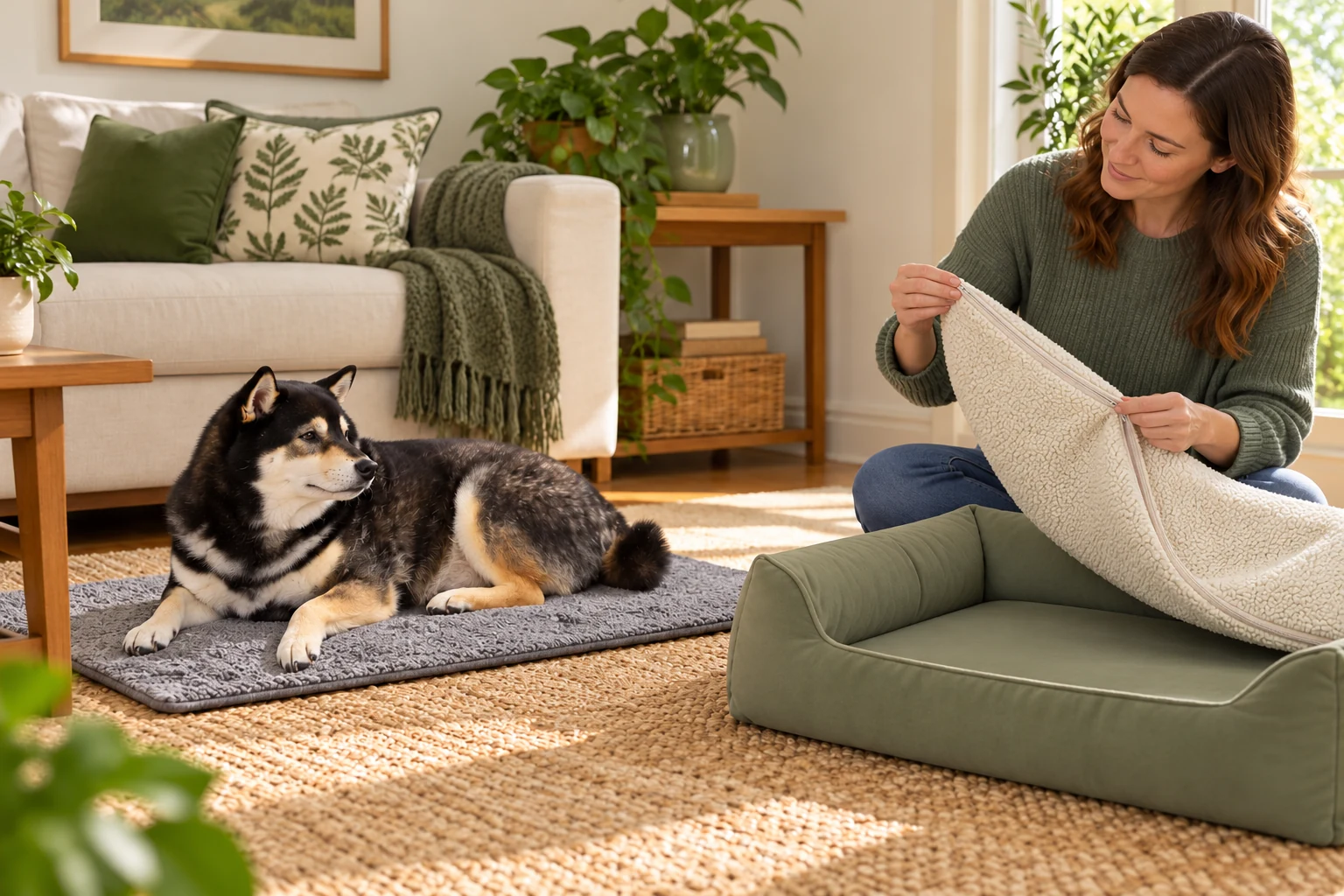
Look at the entire accessible cord, plug and the point where the lead exits the bed before use. Check for tooth marks, crushed insulation, fraying or loose parts. Route the lead according to the manual without trapping it under a rocking chair or door, and keep it away from the dog's normal movement. A protective-looking sleeve is not evidence that chewing is safe.
If a dog chews cords, digs into heater pockets or dismantles bedding, stop and choose an arrangement that avoids that access. A passive bed removes the electrical cord but still has fabric and filling to inspect. Use the chew-resistant bed guide to think about the behavior and supervision, without assuming any soft bed can withstand persistent destruction.
Watch the dog settle, change position and leave during the first supervised trials. Repeated avoidance, panting in a comfortable room or difficulty rising is a reason to stop use and assess what is happening. For a dog recovering from illness or surgery, or with reduced mobility or sensation, obtain veterinary guidance before adding heat. Do not increase warmth to address a medical concern on your own.
Keep indoor, garage and outdoor uses separate
The two products shown here are not a winter doghouse plan. K&H says its passive warming products are not designed to return enough body heat for cold outdoor winter conditions, while the Thermo-Snuggly is specified for indoor household use. A roof over a porch or an unheated garage does not automatically make it an appropriate indoor environment.
Some manufacturers sell separately designed outdoor heated products. Those have their own surface, shelter, electrical and accessory instructions, and cannot be evaluated from an indoor model's listing. Check the exact manual before considering one, and resolve whether the dog should be outside at all. The Missouri veterinary guidance cautions that heated pet mats can still cause burns and emphasizes appropriate shelter and dry bedding.
Keep a companion dog's ordinary resting area indoors with several comfortable choices. For walks, use the separate cold-weather gear guide to consider clothing and conditions. Neither an electric bed at home nor a passive mat in a crate establishes protection for an outdoor trip.
Washing and reassembly are part of the purchase
Before buying, identify exactly which parts can be washed and how they dry. On the passive K&H pad, the current care directions specify cold gentle washing and line drying. A large reflective pad that your household cannot dry between accidents may be less practical than a different washable surface.
For the Thermo-Snuggly, unplug and remove the heater before washing the permitted bedding components. Keep electrical parts out of water and cleaners. Follow the part-specific care instructions and let everything dry completely before reassembly. Check that the heater returns to its proper pocket and the cord exits in the intended direction. Do not fold the heater into a corner to make the bed look neater.
Avoid adding thick blankets, plastic liners, straw or another pad over a heating element without explicit manufacturer permission. An extra layer changes the arrangement the product was designed to use. The K&H heated-product FAQ specifically warns against combustible bedding such as straw over its heated products. Use only covers and components allowed for your exact model.
If accidents are frequent, choose the cleaning system before the warming feature. The washable-bed guide and waterproof-bed guide explain cover and liner tradeoffs. A waterproof description on a heater or cover does not mean a plug, cord or whole assembled bed may be soaked.
Check fit and routine before keeping the bed
- Confirm the sleeping location is dry and suitable for the exact model.
- Compare the inner resting area with the dog's usual posture, not only a weight label.
- Check access to an ordinary bed or another comfortable unheated surface.
- For an electric model, read the manual, inspect the lead and verify the outlet and heater position.
- Follow its specified test procedure. Remove any test pillow when the instructions say to, and do not invent a higher setting to make the bed feel hot.
- Supervise short initial sessions, then inspect the bed and dog before using it again.
- Confirm that washing, drying, storage and reassembly are manageable in your home.
The best outcome may be keeping the existing mattress and moving it to a warmer spot. If you do keep a new bed, check the setup again after rearranging furniture or changing covers. A practical bed-placement plan leaves warmth, access, cleaning and the cord route working together.
Questions owners ask about warming beds
These questions address issues raised in discussions about electric blankets for a senior dog and heated beds versus clothing on a porch. Those threads contain conflicting equipment and safety suggestions. They identify buying concerns; the answers here follow primary product instructions and veterinary guidance.
Frequently asked questions
Does a self-warming dog bed generate heat?
It uses the dog's existing warmth through insulation or a reflective layer, without a powered heater. It cannot be expected to provide the same heat supply as an electric product or compensate for unsuitable cold surroundings. Check the model's stated use because passive beds differ in construction.
Is a heated bed better for a senior dog?
Age alone does not decide the choice. Check the dog's movement, ability to leave the surface, comfort and medical needs with your veterinarian. A supportive ordinary bed in a suitable room may be the more practical option. Do not treat warmth as a remedy for pain or a replacement for prescribed care.
Does the Thermo-Snuggly switch on when my dog lies down?
No. K&H says this model is not pressure sensitive and emits heat while plugged in. Do not assume it is off because it feels only mildly warm when empty. Use the exact manual's operating and unplugging instructions.
Can I use an indoor heated bed in a garage or on a covered porch?
Do not infer permission from the presence of a roof. Follow the exact indoor or outdoor designation and manual. The Thermo-Snuggly shown here is for indoor household use, and the passive pad is not intended as winter outdoor warmth. A different environment requires a separate decision.
Can my dog sleep on an electric bed overnight?
Use a normal comfortable bed as the overnight default unless your veterinarian and exact product instructions establish an appropriate alternative. The AKC's veterinary guidance recommends supervised use and ordinary beds for overnight sleeping. A claim of continuous appliance operation does not establish that every dog should use it unattended.
Is a passive warming mat suitable for a dog that chews?
It removes the electrical cord, but fabric, reflective layers and filling can still be damaged or swallowed. Inspect it and supervise according to the dog's behavior. Stop use if the dog dismantles it. No warming label makes a mat chew-proof.
Can I put a blanket or another bed over the heated pad?
Only if the exact product instructions allow that arrangement. Do not transfer a blanket recommendation from a human heating pad or another pet model. Use approved covers and the intended heater pocket, and avoid improvised layers that change how heat is retained.
Which parts of an electric dog bed can I wash?
Check the individual care instructions. For the Thermo-Snuggly, unplug and remove the heater before washing permitted fabric components; keep electrical parts out of water and cleaners. Dry completely and reassemble in the specified arrangement before reconnecting it.
Can I use a human heating pad or electric blanket instead?
Do not substitute one casually. The AKC's veterinary guidance recommends pet-specific equipment and supervision. Human products have different intended uses and controls. If your dog has a medical need for applied heat, obtain a specific plan from the veterinarian.
Sources and related bed decisions
- K&H Self-Warming Crate Pad: mechanism, location and care
- K&H Thermo-Snuggly: model limits and operating Q&A
- K&H Thermo-Snuggly instruction sheet
- K&H heated-product FAQ
- AKC veterinary guidance on heated beds
- Missouri Veterinary Medical Association: cold-weather care
Use the Dog Beds hub to compare the underlying mattress and shape. For a dog that needs easier entry, compare bolsters and flat beds before adding warmth to a high-sided design.