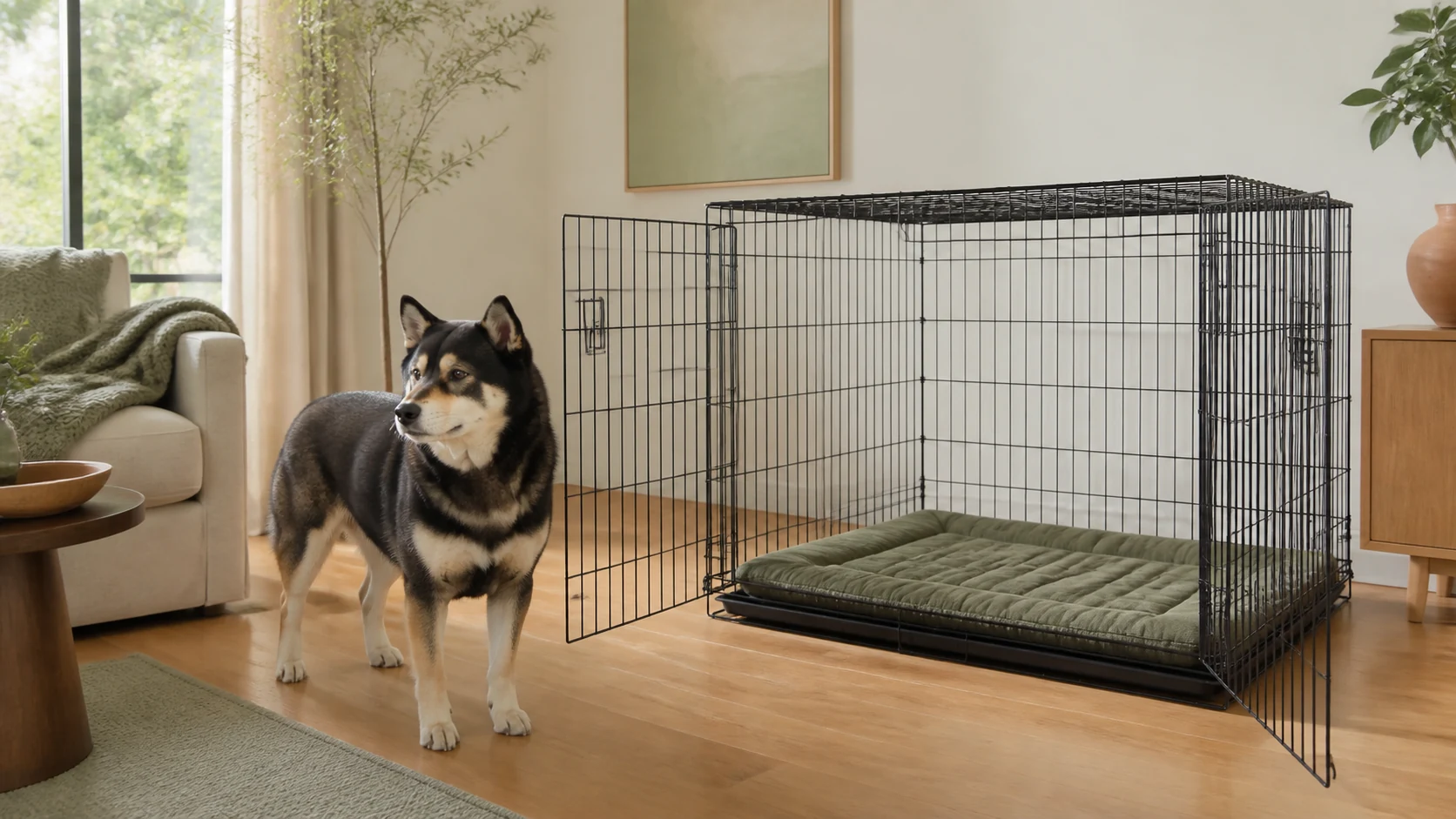
A large dog crate needs to fit more than the dog. It also needs enough floor space, door clearance, ventilation, cleaning access, and structural stability for a heavier body. Product labels such as large, XL, and XXL are inconsistent, so internal dimensions are more useful than the size name.
Start with the Dog Crates hub, measure with the Dog Crate Size Guide, and use the Dog Crate Size Calculator for a cautious starting range.
Quick read
Quick answer
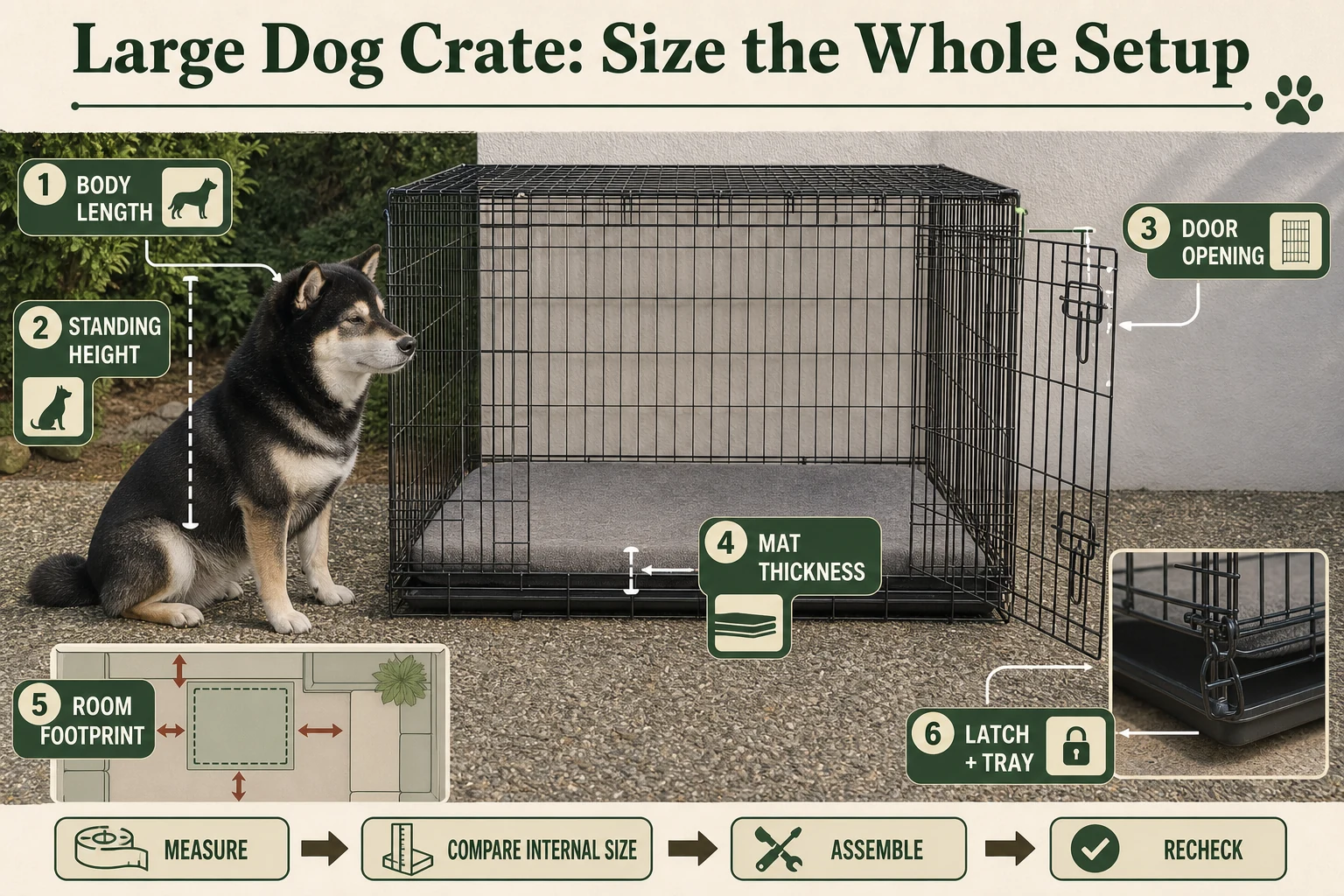
- Measure standing height and body length, then compare internal crate dimensions.
- Check the door opening, not only the crate interior; a large dog should not have to twist through a narrow entrance.
- Include the mat in the fit calculation because thick bedding reduces usable height.
- Plan the room before delivery: large crates need floor protection, door-swing clearance, and a stable route into the home.
- Match strength to behavior, not body weight alone. Panic and repeated escape attempts require professional support, not only heavier steel.
Share & embed
Measure the dog, then the room
Measure body length from the nose to the base of the tail while the dog stands naturally. Measure standing height from the floor to the top of the head or ears, whichever is higher in the dog's normal posture. Add a cautious movement allowance, then compare those values with the listing's internal dimensions.
The dog should be able to stand without crouching, turn around without folding tightly, and lie in a normal resting position. A crate does not need enough room for full-speed movement, but it should not force the dog into one curled position.
Then measure the room. Record the crate's outside footprint, door swing, nearby furniture, outlets, vents, and the path used to carry assembled panels inside. A crate that technically fits between two walls may still block drawers, walking routes, or emergency access.
Large, XL, and XXL labels
Do not assume those labels are standardized. One brand's 42-inch crate may differ from another in internal length, height, bar spacing, tray shape, and doorway size. Furniture-style crates often have thick walls that reduce usable interior space compared with the same outside footprint in a wire crate.
Calm large adult at home
Well-sized folding wire crate
- Look for
Internal dimensions, double-door access, stable tray, panel stiffness
- Avoid
Buying by breed label alone
Growing large-breed puppy
Wire crate with secure divider
- Look for
Adult-size shell, stable divider, easy-clean tray
- Avoid
Giving full oversized space without a routine plan
Visible living-room setup
Furniture-style crate after fit checks
- Look for
Ventilation, interior dimensions, door swing, cleaning access
- Avoid
Prioritizing appearance over usable space
Dog has defeated ordinary crates
Professional behavior review plus stronger enclosure
- Look for
Latch design, welds, bar spacing, floor and wheel locks
- Avoid
Treating heavy steel as a solution to panic
Vehicle travel
Purpose-built travel crate or restraint
- Look for
Vehicle fit, anchor instructions, current safety evidence
- Avoid
Assuming a home wire crate is crash protection
Door size and entry path
Large dogs need an opening that allows calm entry without scraping shoulders or ducking excessively. Compare door width and height when listings provide them. Double-door crates can make room placement easier because the dog can enter from the side or end.
Check how the door latches and whether it opens into a walkway. A large door creates a large sweep. Position the crate so the open door does not become a trip hazard or trap the dog between furniture.
Wire, furniture, plastic, or heavy duty
Wire crates provide airflow, visibility, divider compatibility, and broad size availability. They can rattle on hard floors, and large panels need careful assembly and inspection.
Furniture-style crates may fit a living room visually, but thick frames reduce internal space and seams can complicate cleaning. Use the Dog Crate Furniture Guide and Dog Crate Cover vs Furniture Crate before choosing appearance-first designs.
Plastic kennels create more visual enclosure and can be easier to wipe, but large sizes are bulky and may have narrower doors. Compare Wire vs Plastic Dog Crates for home and travel tradeoffs.
Heavy-duty metal crates are relevant only when ordinary construction is not enough and the dog's behavior can be managed safely. Panic, barrier frustration, self-injury, repeated escape attempts, and destructive confinement behavior need qualified veterinary or behavior support. Stronger walls do not resolve the cause.
Use Best Heavy-Duty Dog Crates for latch, interior-surface, ventilation, delivery, and panic-screening decisions before comparing reinforced models.
Bedding and usable height
A thick orthopedic mat can reduce several inches of standing height. Measure the crate with the intended mat inside and make sure the door still clears the mat edge. Bolsters and overfilled beds may bunch against the door or divider.
Use the Dog Crate Mats Guide and Dog Bed vs Crate Mat to compare thickness, support, washing, non-slip backing, and chewing risk. Inspect bedding after normal use and remove it if foam, fill, or fabric becomes accessible.
Floor load, noise, and cleaning
Large crates and dogs place more load on the floor. Lock wheels where supplied and make sure feet, casters, or floor protectors keep the crate level. A stable mat beneath a wire crate can reduce rattle, but it should not create a sliding surface or block airflow.
Choose a tray that can be removed without moving the entire crate. Check whether walls, furniture, or the opposite door block tray access. The Dog Crate Setup Checklist covers room placement, assembly, cleaning, bedding, and post-setup inspection.
Direct product CTAs
These direct Amazon options are comparison points, not universal winners. Verify the exact variant, internal dimensions, doorway, latch design, tray access, and return policy before buying.
What Dogs Like may earn from qualifying purchases. Affiliate links do not change the measurement, behavior, and room-fit checks in this guide.
Common mistakes
✓ Better buying habits
- Compare internal dimensions, not only length labels.
- Measure the doorway and room footprint.
- Include mat thickness in standing height.
- Check latches, panel stiffness, tray, and floor stability after assembly.
- Use a divider only when it is secure and part of a puppy routine.
- Seek professional help for panic or repeated escape behavior.
× Mistakes to avoid
- Assuming every 42-inch crate has the same interior.
- Buying by breed label or weight alone.
- Blocking a walkway with the open door.
- Adding a bed that bunches under the door.
- Leaving wheels unlocked or panels poorly seated.
- Using a heavier crate as the only response to distress.
Related guidance
Use the Dog Crates hub for the full category. Compare Best Dog Crates for Home, Dog Crate Mats Guide, and Dog Kennel vs Dog Crate when listing language is unclear. If the dog is still growing, use Best Dog Crates for Puppies and the Puppy Crate Training Schedule.
Frequently asked questions
What size crate does a large dog need?
Measure standing height and body length, then compare those values with internal dimensions. Large and XL labels are not standardized.
Is a 42-inch crate large enough?
It depends on the individual dog and the crate's actual interior. Check whether the dog can stand, turn, and lie normally with the intended mat inside.
Should a large dog crate have two doors?
Two doors can make room placement and access easier, but each door adds latches and hinges to inspect. One well-positioned door can also work.
Does a large dog need a heavy-duty crate?
Not automatically. Many calm large dogs use standard wire crates. Heavy-duty construction is a behavior and containment decision, not simply a body-size requirement.